Project FeederWatch

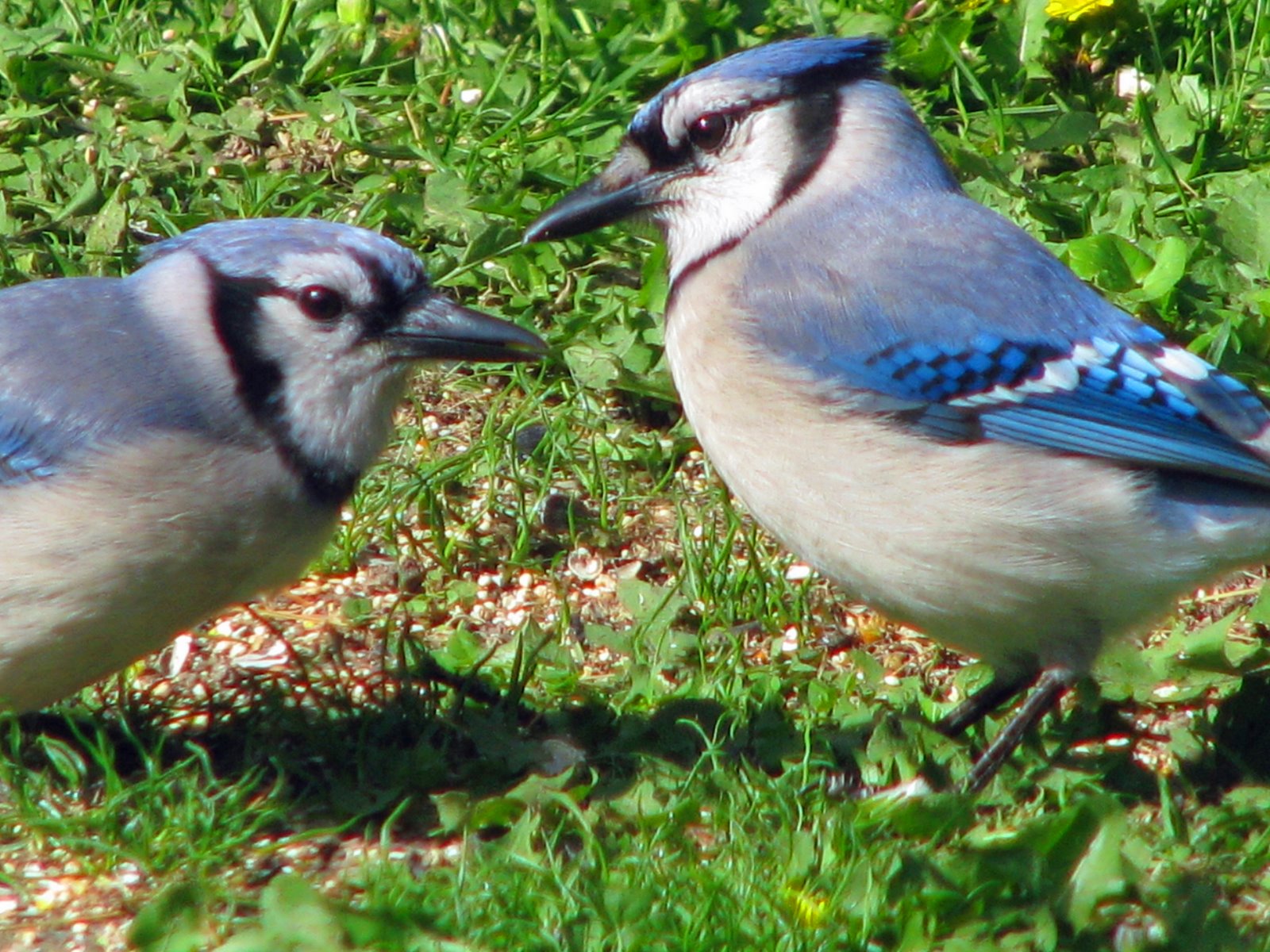
jaysThe 2016-2017 season of Project FeederWatch begins November 12, so there is still time to register for this wonderful program.

From the Project FeederWatch website:

Project FeederWatch is a winter-long survey of birds that visit feeders at backyards, nature centers, community areas, and other locales in North America. FeederWatchers periodically count the birds they see at their feeders from November through early April and send their counts to Project FeederWatch. FeederWatch data help scientists track broadscale movements of winter bird populations and long-term trends in bird distribution and abundance.

Anyone interested in birds can participate. FeederWatch is conducted by people of all skill levels and backgrounds, including children, families, individuals, classrooms, retired persons, youth groups, nature centers, and bird clubs. You can count birds as often as every week, or as infrequently as you like: the schedule is completely flexible. All you need is a bird feeder, bird bath, or plantings that attract birds.

If you plan to participate, set up your feeders now and commit to keeping them filled throughout the season. Use a variety of feeders and seed to attract a greater variety of visitors. For more information, check out this site.

Nine years ago

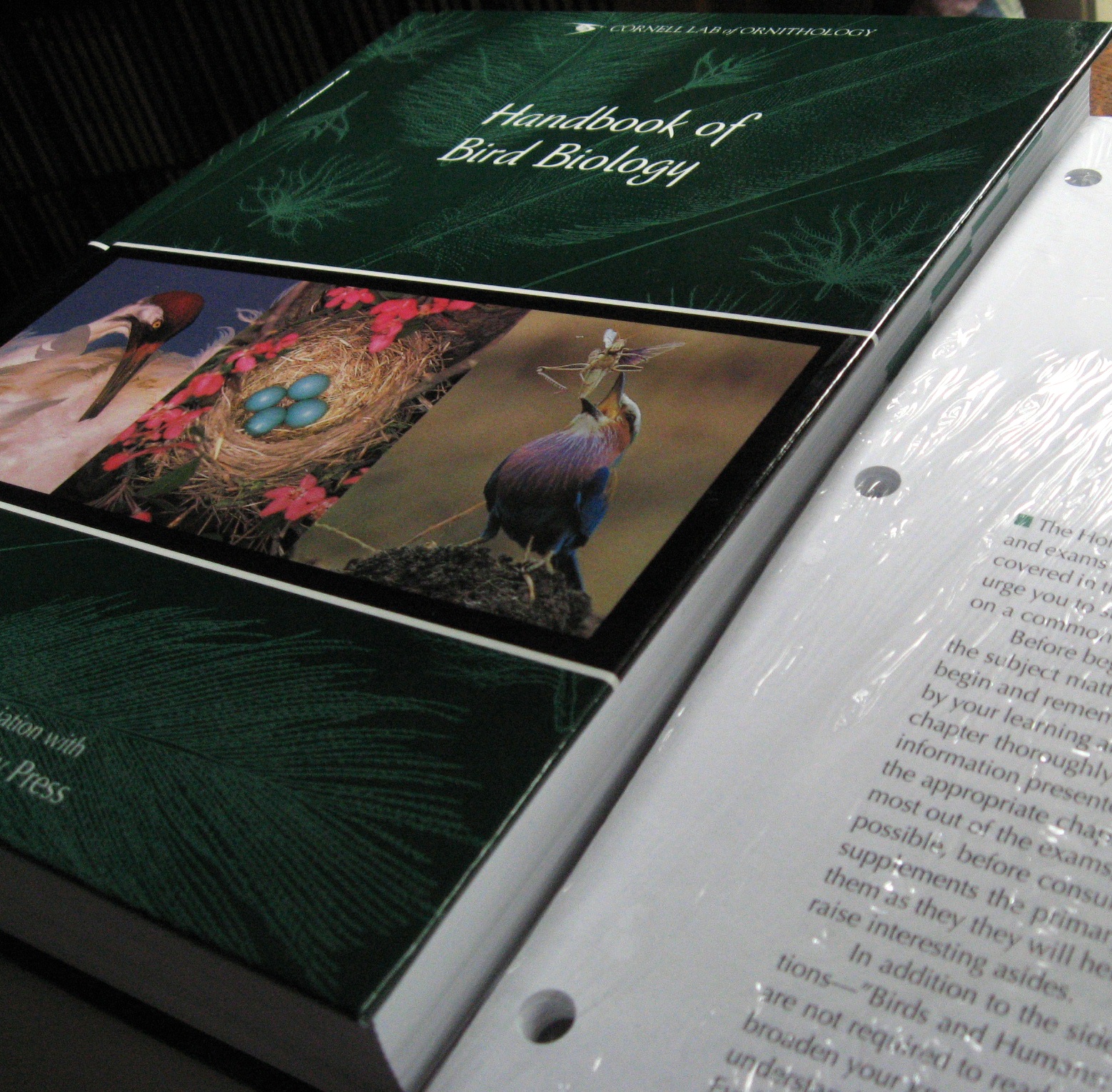
ornithology-abashedMore than nine years ago, on May 1, 2007, I posted the image above to my old site. Since then, I’ve started and stopped my work on the Home Study Course in Bird Biology at least a dozen times. For nearly a decade, something more pressing regularly presented itself, and I took comfort in the website note that while some folks finish the course rapidly, there is no completion deadline; in fact, one student took ten years to finish! (I should be so lucky.)

Even so, at the eight-year mark, last summer, I called the Cornell Lab to ensure that my course materials were still valid and was patched through to Kevin McGowan. (Insert my daughters and I mime-squealing with nerdish delight at my encounter with a birding world rock star.) He kindly assured me that my text and test materials were fine, although the new edition would be out in 2016. His warm encouragement nearly jumpstarted my efforts, but other cares, concerns, and pursuits soon supplanted my studies, and the Handbook was reshelved. Again.

And here we are, about seven months from the ten-year mark. The new Handbook has been released, and mine still looks brand new. Well, color me recommitted. I have been assigned approximately sixty-four hours during early voting, and I have vowed that the Home Study Course in Bird Biology will be my sole companion (apart from my fellow election judge, of course).

Maybe this time, eh?

Reading and watching

This month, I finished seventeen books —

seven novels:

Where They Found Her (Kimberly McCreight; 2015. Fiction.)
The Hidden Child (Camilla Läckberg; 2014. Fiction.)
Wonder (RJ Palacio; 2012. Fiction.)
The Easter Parade (Richard Yates; 1976. Fiction.)
The Elementals (Michael McDowell; 1981. Fiction.)
I’m Thinking of Ending Things (Iain Reid; 2016. Fiction.)

one play:

The Merchant of Venice (William Shakespeare; 1599. Drama.)

one collection of short stories:

Dubliners (James Joyce; 1914. Fiction.)

two non-fiction titles:

The Curse of the Good Girl (Rachel Simmons; 2009. Non-fiction.)
Lab Girl (Hope Jahren; 2016. Non-fiction.)

and six works of graphic fiction:

Huck, Volume 1 (Mark Millar; 2016. Graphic fiction.)
Kill Shakespeare, Volume 3: The Tide of Blood (Conor McCreery Millar; 2013. Graphic fiction.)
Fell, Volume 1, Feral City (Warren Ellis; 2007. Graphic fiction.)
Injection, Volume 1 (Warren Ellis; 2015. Graphic fiction.)
Trees, Volume 1 (Warren Ellis; 2015. Graphic fiction.)
Skim (Mariko Tomaki; 2008. Graphic fiction.)

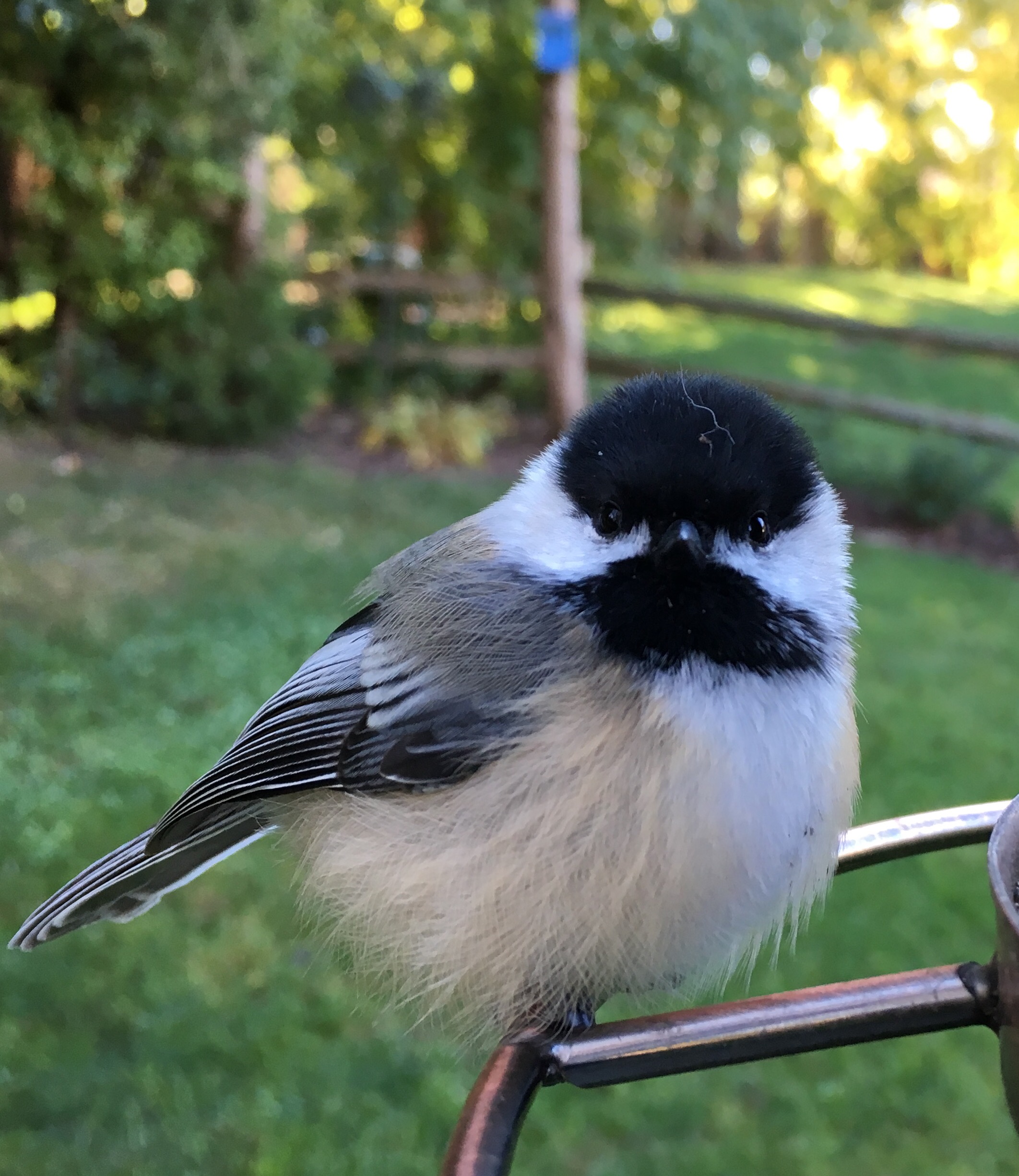
Right now, I’m in more of a watching mood than a reading mood, though. Does that ever happen to you? This afternoon, I’ve been watching the birds in our yards. We’ve had a lot of success with our latest food and feeder configuration: hummingbirds, orioles, and goldfinches, oh, my! Many of the regular visitors have been by, too — jays, cardinals, mourning doves, robins, cowbirds, house finches, black-capped chickadees, red-bellied and downy woodpeckers, and a few grackles, starlings, and house sparrows. And, of course, the Cooper’s hawks. So busy out there!

Now I am toying with watching Episode 4 of Mr. Robot. Gosh, is that a terrific show! Earlier this weekend, my daughters and I watched The Merchant of Venice with Al Pacino as Shylock. It was my second time, and it was just as excellent as the first. We will see the Shakespeare’s Globe production with Jonathan Pryce as Shylock at the Chicago Shakespeare Theater soon, and I so enjoy comparing various interpretations. The three of us are also watching The X Files. We’ve made it to Episode 9 of Season 9, and we think we will finish before they move to their university residence. That said, all of us agree that the show’s reputation outstrips its content, which how we also felt about Buffy the Vampire Slayer. Shrug. Not every program can be Slings & Arrows or LOST, though, right?

Speaking of watching things for a second time, I saw The Dead again this week. The closing paragraph of Joyce’s story is one of my favorites in all of literature, so it was with much scoffing that I first approached Huston’s film nearly thirty years ago. Of course the book will be better, I maintained. How could I have known that it would actually render the story a permanent part of my imagination? Both faithful to its source material and a work of its own many merits, the film draws much of its strength from flawless performances from the entire cast. It also benefits from meticulous attention to period detail and a score that is a character itself. Rewatching the film, I was reminded of its perfection, particularly the emotionally shattering redefinition of the Conroy marriage that occurs in the final scene.

Before I settle in with Mr. Robot I think I will assemble my proposed TBR stack for August. I already own a few of the books on the Man Booker Prize long list, and Lab Girl (which was good, really, but does anyone else wish that all of that imagination and talent had been mixed with less angst and whine?) made me pine for an upbeat if not stoic science memoir, and the Abbott book arrived last Tuesday… I’m off to assemble my pile.

The year of the ….

I first read about “Bird of the Year” a dozen years ago, in Lyanda Lynn Haupt’s paean to birding, Rare Encounters with Ordinary Birds. She writes:

There is a game birders play on New Year’s Day called “Bird of the Year.” The very first bird you see on the first day of the new year is your theme bird for the next 365 days. It might seem a curious custom, but people who watch birds regularly are always contriving ways to keep themselves interested. This is one of those ways. You are given the possibility of creating something extraordinary — a Year of the Osprey, Year of the Pileated Woodpecker, Year of the Trumpeter Swan. This game is an inspiration to place yourself in natural circumstances that will yield a heavenly bird, blessing your year, your perspective, your imagination, your spirit. New year, new bird.

After her breathless anticipation, Haupt is confronted with… a European Starling, or “sky-rat.”

The Year of the European Starling. Inauspicious, yes, but not without its charms, according to Haupt.

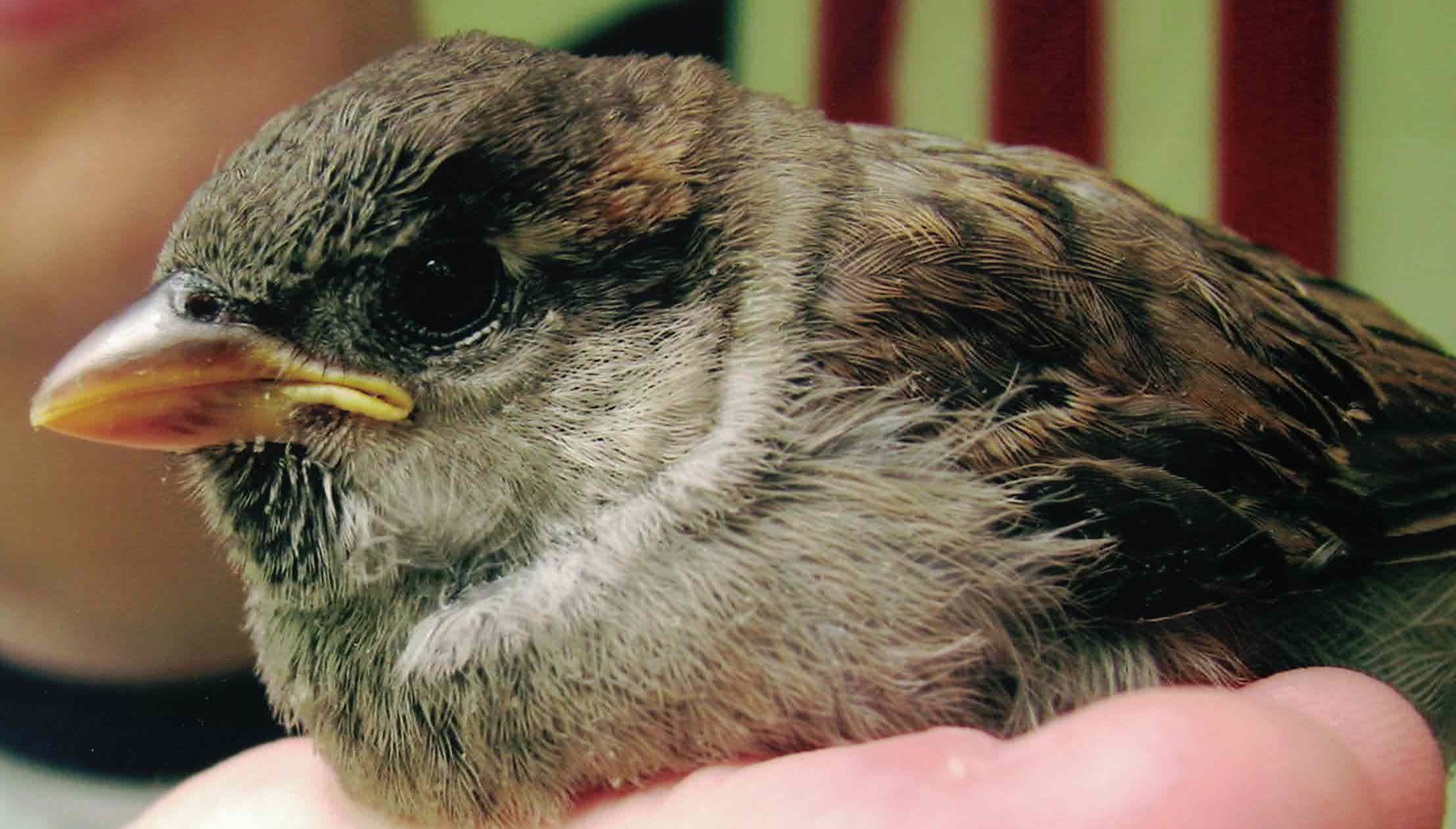
Before heading to bed on New Year’s Eve, I ensured that all of the feeders were topped off and that corn and nuts were scattered for the squirrels. (As any seasoned backyard birder knows, there are no squirrel-proof feeders. Cheap feed scattered away from the feeders will (mostly) keep those furry nuisances away from the birds and the more expensive seed, though.) Last year, the Year of the American Goldfinch, I hung a Post-It on the big window to remind everyone to note his or her first bird. This year, I forgot the note, but it didn’t matter. The weather has been so warm that the window in my bedroom — and thus, the pleated blind — is often open a bit each night. I saw the first bird of the year before I had even left my bed: a house sparrow hopping and chatting with his friends in the yew hedge.

Scan_20160108
I took the above photo in Spring 2007.

Project FeederWatch

jays
Helping birds is easy.

1. Put up a feeder.

2. Count the birds that visit.

3. Send the data to scientists.

The 2015-2016 season of Project FeederWatch begins November 14, so it’s not too late to register for this wonderful program.
From the Project FeederWatch website:

Project FeederWatch is a winter-long survey of birds that visit feeders at backyards, nature centers, community areas, and other locales in North America. FeederWatchers periodically count the birds they see at their feeders from November through early April and send their counts to Project FeederWatch. FeederWatch data help scientists track broadscale movements of winter bird populations and long-term trends in bird distribution and abundance.

Anyone interested in birds can participate. FeederWatch is conducted by people of all skill levels and backgrounds, including children, families, individuals, classrooms, retired persons, youth groups, nature centers, and bird clubs. Participants watch their feeders as much or as little as they want over two consecutive days as often as every week (less often is fine). They count birds that appear in their count site because of something that they provided (plantings, food, or water).

If you plan to participate, set up your feeders now and commit to keeping them filled throughout the season. Use a variety of feeders and seed to attract a greater variety of visitors. For more information, check out this site.