
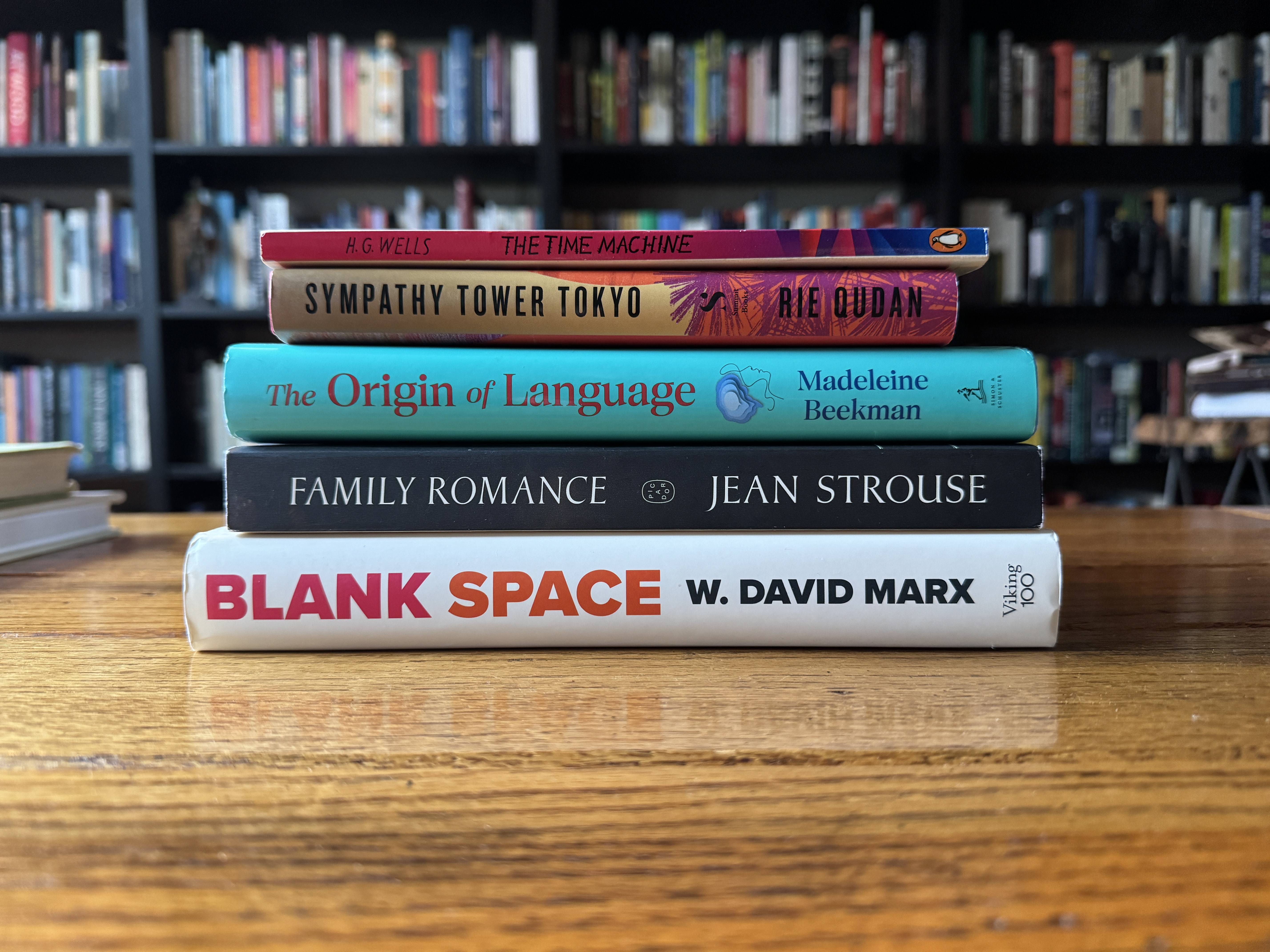
A little late posting this… The edition of The Time Machine features the cover design by a contestant on Work of Art, a program my daughters and I enjoyed when it aired more than fifteen years ago.
A little late posting this… The edition of The Time Machine features the cover design by a contestant on Work of Art, a program my daughters and I enjoyed when it aired more than fifteen years ago.
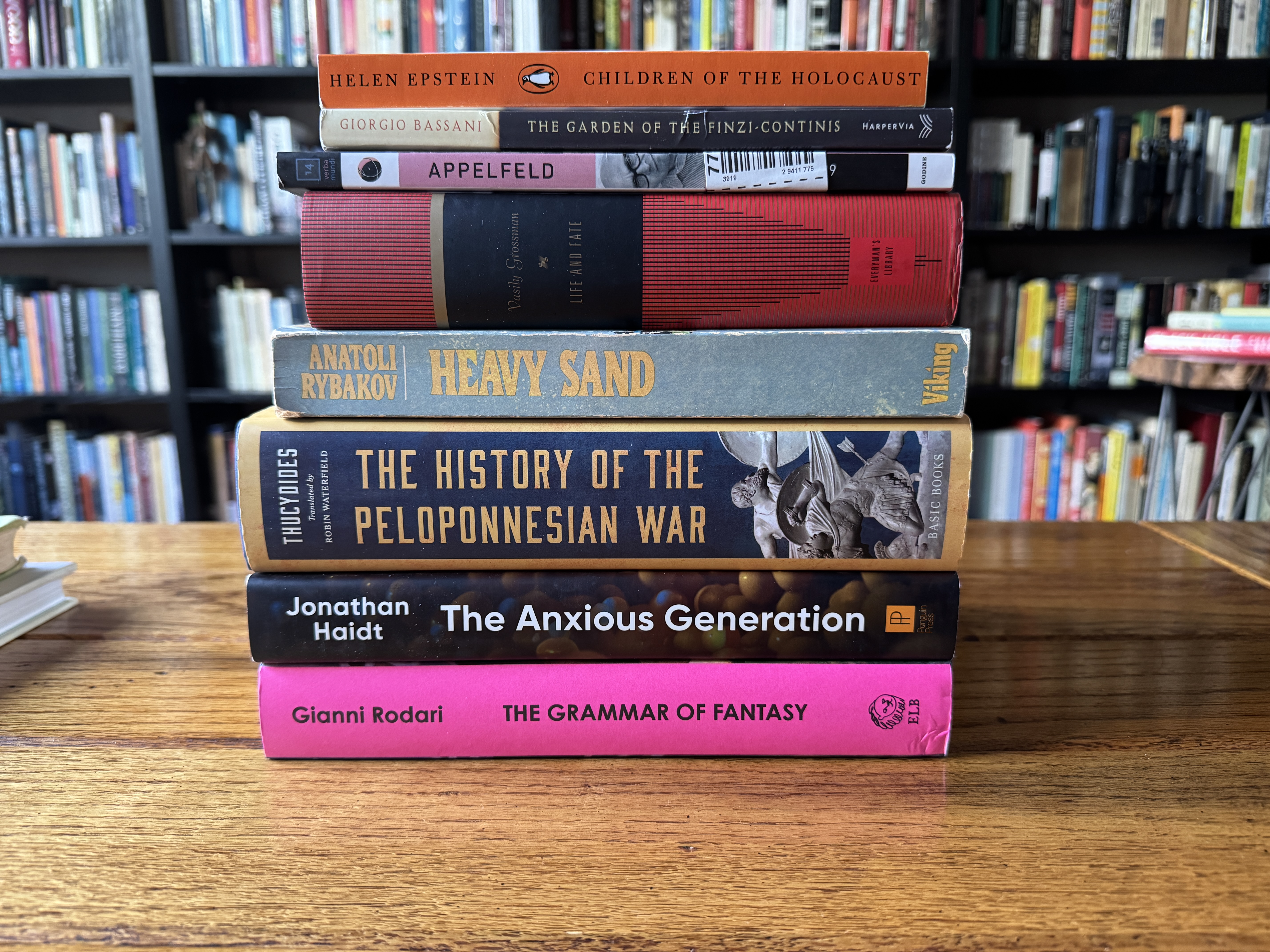
A recent Roundtable by The 92nd Street Y course resulted in several of the books above; general interest, the rest.

page 150
You can feel sorry for yourself and not whine about it. Future-you will thank now-you for not giving up when you feel like it. Suffer, but don’t add to your suffering with a whole performance. Write a timetable, stick to it. “Our routes,” I’d told the children when they were small. “Bath, books, bed.” Routine first, because routine is a way to get traction, if nothing else, when all else fails or has failed: handhold, toehold, step. “It’s a question of discipline… When you’ve finished washing and dressing each morning, you must tend your planet. I’d written that out for all my children, from The Little Prince.
That’s the great thing about parenting, one of them, all the stuff I wish I’d known; I could learn it and teach it at the same time.
page 211
Even ease takes discipline is the point; you have to participate in your own life, survive enthusiastically whatever happens, or you’ll never rise again. Discipline is borrowed backbone. I’d have been sunk, drunk, gone under without it.
Discipline is the only gift you can give your future self.
page 252
You see, in this way, a child dies — your child, mine — and you think, I thought, I’ll never care about anything else again. Not really. But unbidden, other things shoulder their way into your grief, saturated world; and coincidentally, you should shoulder your way out of it. Apples roll under seats, you drink, tea, and your bladder fills. You register injustice, you feel outrage, you find yourself at a border post looking for the bathroom. You’re ridiculous and human and insufficient, but you’re back in play. Relief filled my chest, blew it open like the steel bands on an oak casket that had been snapped.
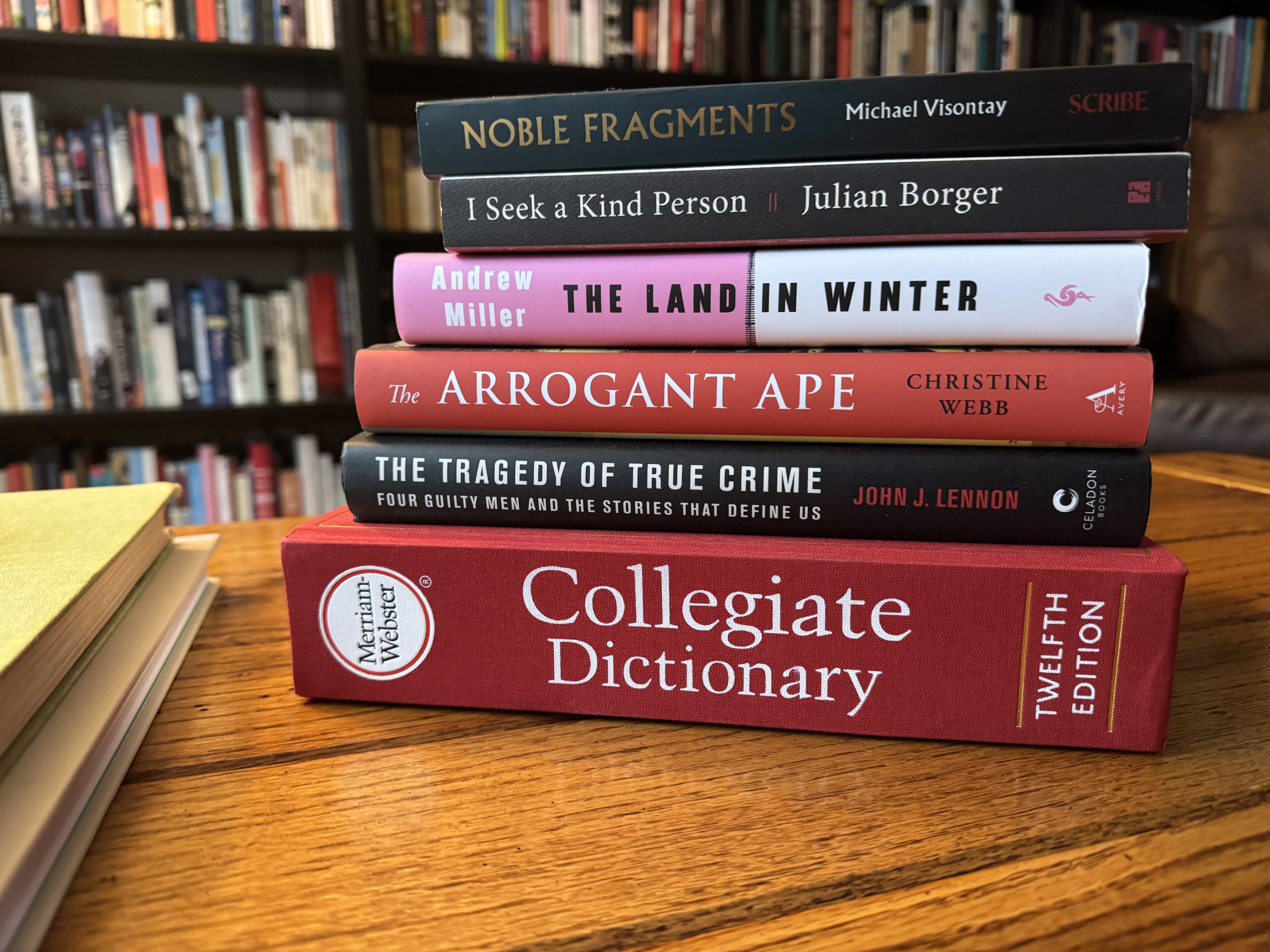
Recent acquisitions.
Over the holiday, I finished The Amazing Adventures of Kavalier and Clay (Michael Chabon; 2000) for one Roundtable by The 92nd Street Y course and have nearly finished The Oppermanns (Lion Feuchtwanger; 1933) for another.
My reread of Moby-Dick (Herman Melville; 1851) with Samantha Rose Hill continues. As I mentioned, my daughter and I are registered to read in the Moby-Dick Readathon at the New Bedford Whaling Museum. This year, the event begins on January 3, exactly 185 years after Melville sailed from New Bedford on the Acushnet. We will return to Boston from the Readathon in time for my daughter to head to work and for me to attend (virtually) the first meeting of the latest iteration of UChicago Graham School’s course on the book.
A friend and I will continue making our way through E.M. Forster’s novels with Howards End (1910), January’s selection. We will also meet to discuss some short stories in December, beginning with the first in Simon Van Booy’s 2009 collection, Love Begins in Winter.
Music lessons resume this coming week; the holiday concert is the following week. With winter holidays and related prep and travel, it’s difficult to say what sort of progress I will make on the two remaining projects in the sidebar.
The morning has run off without me, but I will catch up to it soon enough. In the meantime, I’ve just finished some desk work and tomorrow’s chapters of Bleak House (Charles Dickens; 1853), which I’m reading with APS Together. Other reading this week includes The Dispossessed (Ursula K. LeGuin; 1974) for a short course with NYR Seminars; The Amazing Adventures of Kavalier and Clay (Michael Chabon; 2000) and the Stanley Lombardo translation of The Iliad for courses with Roundtable by The 92nd Street Y; and Moby-Dick, this time with Samantha Rose Hill.
Between this week’s lesson and next, I will attend another performance class for adult music students, the focus of which will be music for a holiday concert, but the chief part of my daily practice comprises Marcel Moyse’s 24 Little Melodic Studies and On Sonority, Art, and Technique; Taffanel and Gaubert; and M.A. Reichert’s 7 Daily Exercises. I’m also working out the second movement of Bach’s Flute Sonata in E-flat major.
Before today’s practice, though, I must do a few here-comes-winter tasks in the yards and walk. We raked and walked in snow and temps in the low twenties earlier this week; it’s sunny and 49 as I type this; the daytime highs on Friday and Saturday will be in the sixties. What is that saying about Chicago(land) weather? If you don’t like it, then just wait fifteen minutes.
What have you been reading? Studying? Thinking about? Leave a comment; I would enjoy hearing from you. Looking ahead to 2026, I am wondering if a year of “reading at whim” might not be best — fewer classes and reading groups, more pulling down some of the volumes already on my shelves. I just reached into the shelves behind and drew from them, randomly: The Hummingbird (Sandro Veronesi; 2019/2020) and The Cold Millions (Jess Walters; 2020). Unread. I looked to the left and the first title I made out was The Big Sort: Why the Clustering of Like-Minded American is Tearing Us Apart (Bill Bishop; 2009). Unread. The bookcase in front of me? Bitch: On the Female of the Species (Lucy Cooke; 2022). Unread. More than half of the books here are. As I’ve said, this once embarrassed me. Now it alternately enlivens and frightens me.
From early in Nassim Nicholas Taleb’s The Black Swan: The Impact of the Highly Improbable:
The writer Umberto Eco belongs to that small class of scholars who are encyclopedic, insightful, and nondull. He is the owner of a large personal library (containing thirty thousand books), and separates visitors into two categories: those who react with “Wow! Signore professore dottore Eco, what a library you have! How many of these books have you read?” and the others — a very small minority — who get the point that a private library is not an ego-boosting appendage but a research tool. Read books are far less valuable than unread ones. The library should contain as much of what you do not know as your financial means, mortgage rates, and the currently tight real-estate market allows you to put there. You will accumulate more knowledge and more books as you grow older, and the growing number of unread books on the shelves will look at you menacingly. Indeed, the more you know, the larger the rows of unread books. Let us call this collection of unread books an antilibrary.
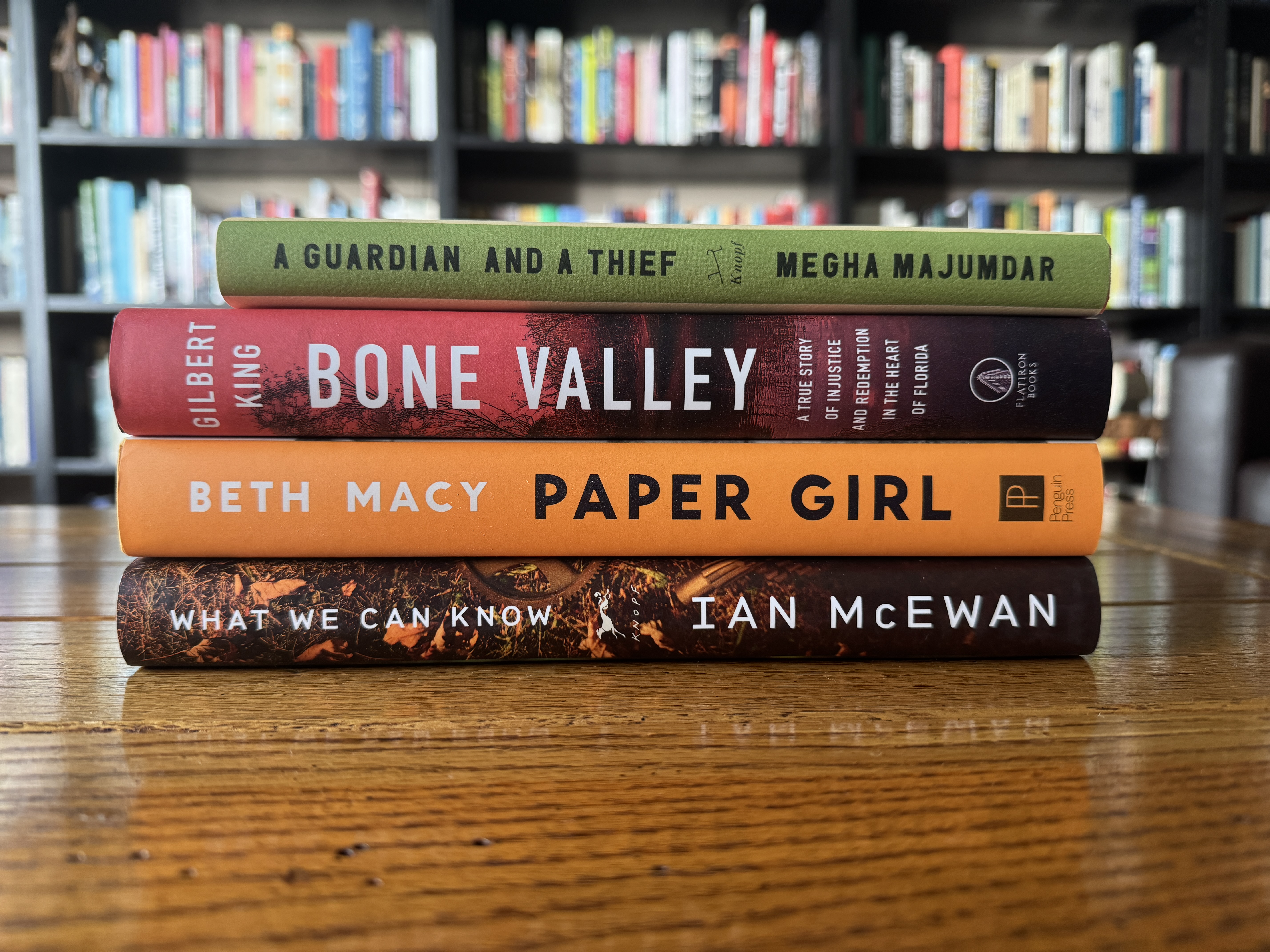
My stack is already precarious, so these have been shelved.
In between walking and leaf-raking, I have been reading and studying. Yesterday the Roundtable by 92nd Street Y course on the Iliad began, and the Library of America (LoA) course on Joan Didion ended. (With one exception, I have greatly appreciated the Roundtable courses and recommend them.) The NYR Seminar led by Daniel Mendelsohn concluded last week, and it was so terrific, I signed up for another (shorter) seminar with them. My two-person study group has moved on to our third Forster novel, A Room with a View (1908), and I’m participating in two other slow-read groups: Bleak House with APS Together (underway) and Moby-Dick with Samantha Rose Hill (beginning November 9). (Speaking of the White Whale, my daughter and I are once again slated to read at the marathon.)
I continue to work in Marcel Moyse’s 24 Little Melodic Studies and On Sonority, Art, and Technique; Taffanel and Gaubert; and M.A. Reichert’s 7 Daily Exercises. My lessons are now complemented by a performance class, at the first meeting of which, I presented Germaine Tailleferre’s “Pastorale for Flute and Piano” and at the second, the James Galway arrangement of “Ashokan Farewell.” My new solo is Bach’s Flute Sonata in E-flat major.

This summer’s drought and the continued warm temperatures have delayed autumn’s arrival: Most trees are reluctant to release their leaves; the weekend’s rain reinvigorated the grass. It remains just cool enough to walk with a jacket at sunrise.
Last night marked the halfway point of an NYR Seminar led by Daniel Mendelsohn on his translation on The Odyssey. Fabulous — the seminar and the translation. Last week, I finished Edith Hall’s Aristotle’s Way: How Ancient Wisdom Can Change Your Life in anticipation of a course I am taking through Roundtable by 92nd Street Y. Today I’m continuing to reacquaint myself with Joan Didion’s work for a course with the Library of America.
For my next lesson, I’m preparing the seventh of Marcel Moyse’s 24 Little Melodic Studies and its variations. Having worked through Exercise 4 of Taffanel and Gaubert, I am becoming acquainted with Michel Debost’s scale game. We’ve added the first of M.A. Reichert’s 7 Daily Exercises to my practice routine, and I continue to use Moyse’s On Sonority, Art, and Technique. My current solo piece is Germaine Tailleferre’s “Pastorale for Flute and Piano.”
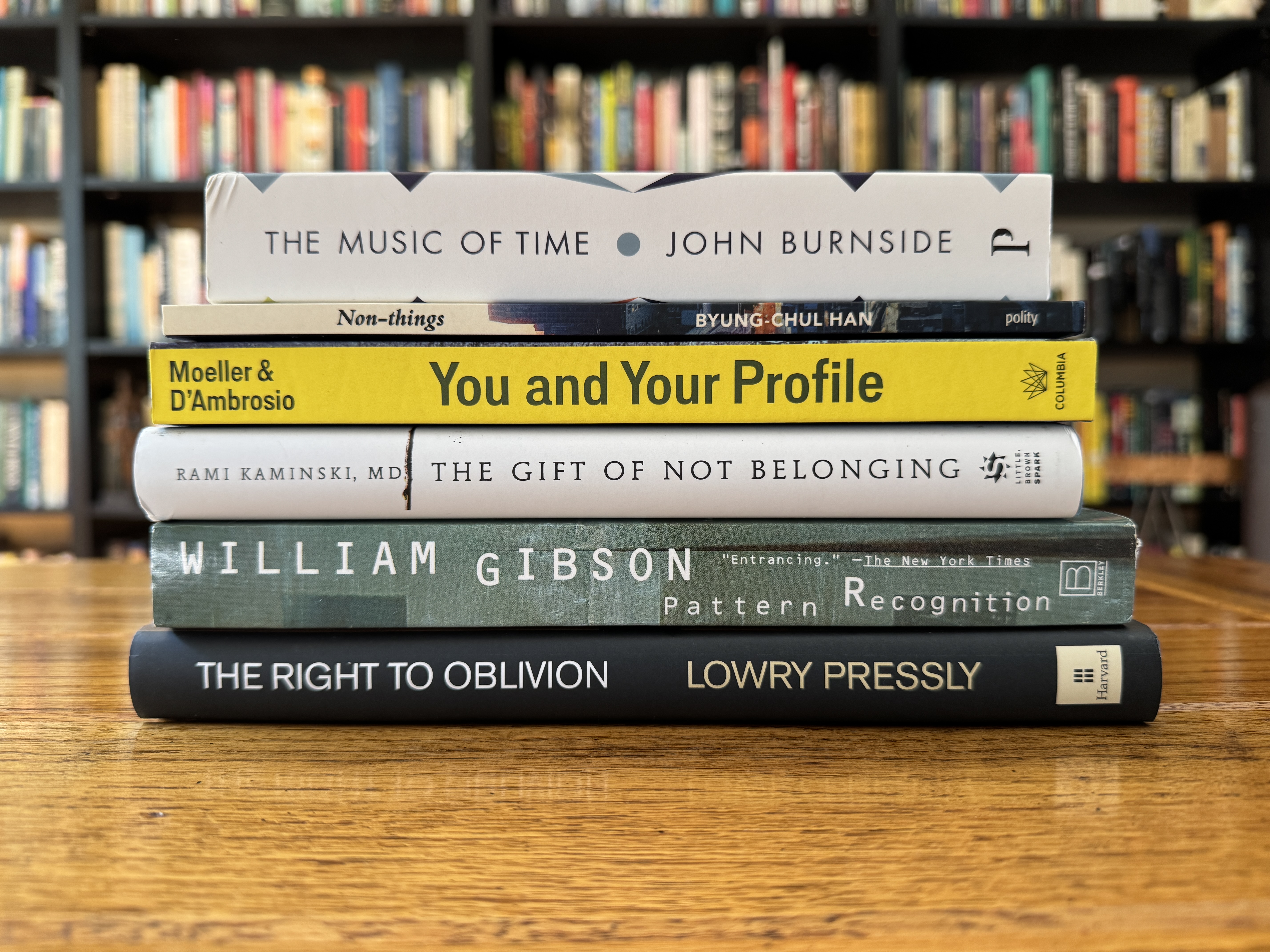
Recently acquired.
Four of the titles pictured above are selections for the 2026 Philosophical Book Club at Commonplace Philosophy. Speaking of philosophy, my two-person study group will discuss Book IX of Aristotle’s Nicomachean Ethics tomorrow, which means this excellent project draws to a close soon. Next up for us is a deep dive into the novels of E.M. Forster, beginning with Where Angels Fear to Tread (1905). We’ve been reading and studying together for a couple of years now, so it is no surprise that we often discover new books that appeal to us both. Most recently, a Guardian review ensured that Rami Kamiski’s The Gift of Not Belonging ended up on our doorsteps and then at the tops of our respective “actively reading” stacks. Ditto John Burnside’s The Music of Time: Poetry in the Twentieth Century (2021). Both of these are pictured above.
For courses at the University of Chicago Graham School, I’m reading Hannah Arendt’s The Origins of Totalitarianism (1951) and (re)reading Charles Dickens’ A Tale of Two Cities. Later this semester, I will read his Little Dorrit and Our Mutual Friend. It may prove aspirational, but I’ve pulled Claire Tomalin’s 2011 biography of Dickens from the shelves. For an upcoming seminar led by the translator, I’m reading Daniel Mendelsohn’s The Odyssey (2025), and as part of the enrichment experience for Big White Fog at the Court, I’ve pulled down Richard Wright’s Native Son (1940), selected by the Community Reads Book Club. (Admittedly, this, too, may be aspirational.) After attending the KINO! Film Salon discussion of the documentary Werner Herzog: Radical Dreamer, I began reading his 2022 memoir, Every Man for Himself and God Against All, which is pretty terrific.
As for what I’ve recently finished, that includes the texts associated with courses I took through Roundtable by 92nd Street Y: North and South (Elizabeth Gaskell; 1855), Storylife: On Epic, Narrative, and Living Things (Joel Christensen; 2025); and Possession: A Romance (A.S. Byatt; 1990). I reread Lionel Shriver’s 2016 novel, The Mandibles, the book my youngest packed for vacation. It holds up — presciently so. What didn’t work for me was Megan Abbott’s latest, El Dorado Drive. Her previous novels have been reliably fun “beach reads,” but this was clumsy and predictable. Barbara Pym’s Excellent Women (1952), on the other hand, which I read with APS Together, was elegant, endlessly surprising, gorgeously written.
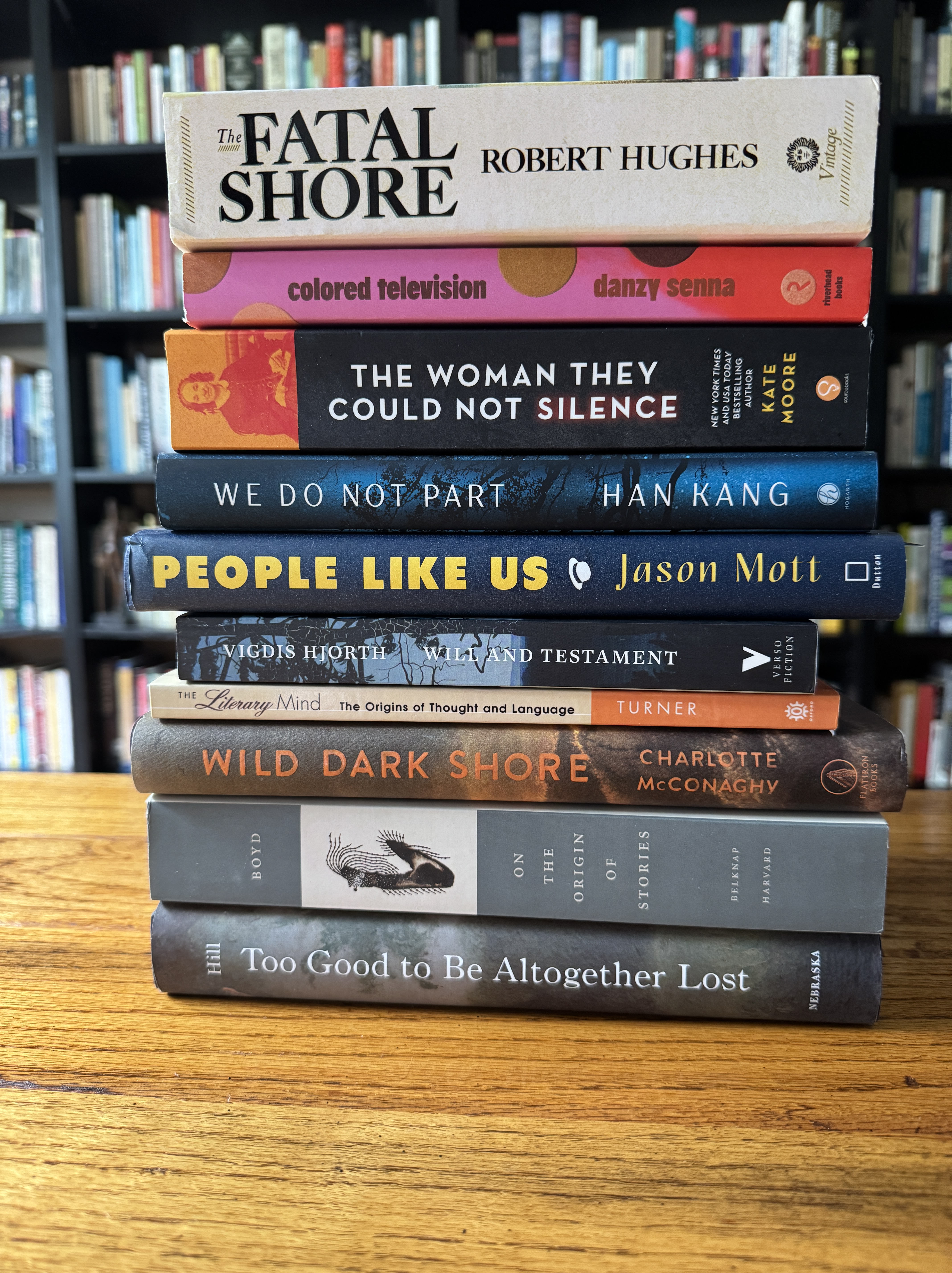
Picked up most of these at an independent bookstore in Ann Arbor this past weekend.
 Nerdishly