
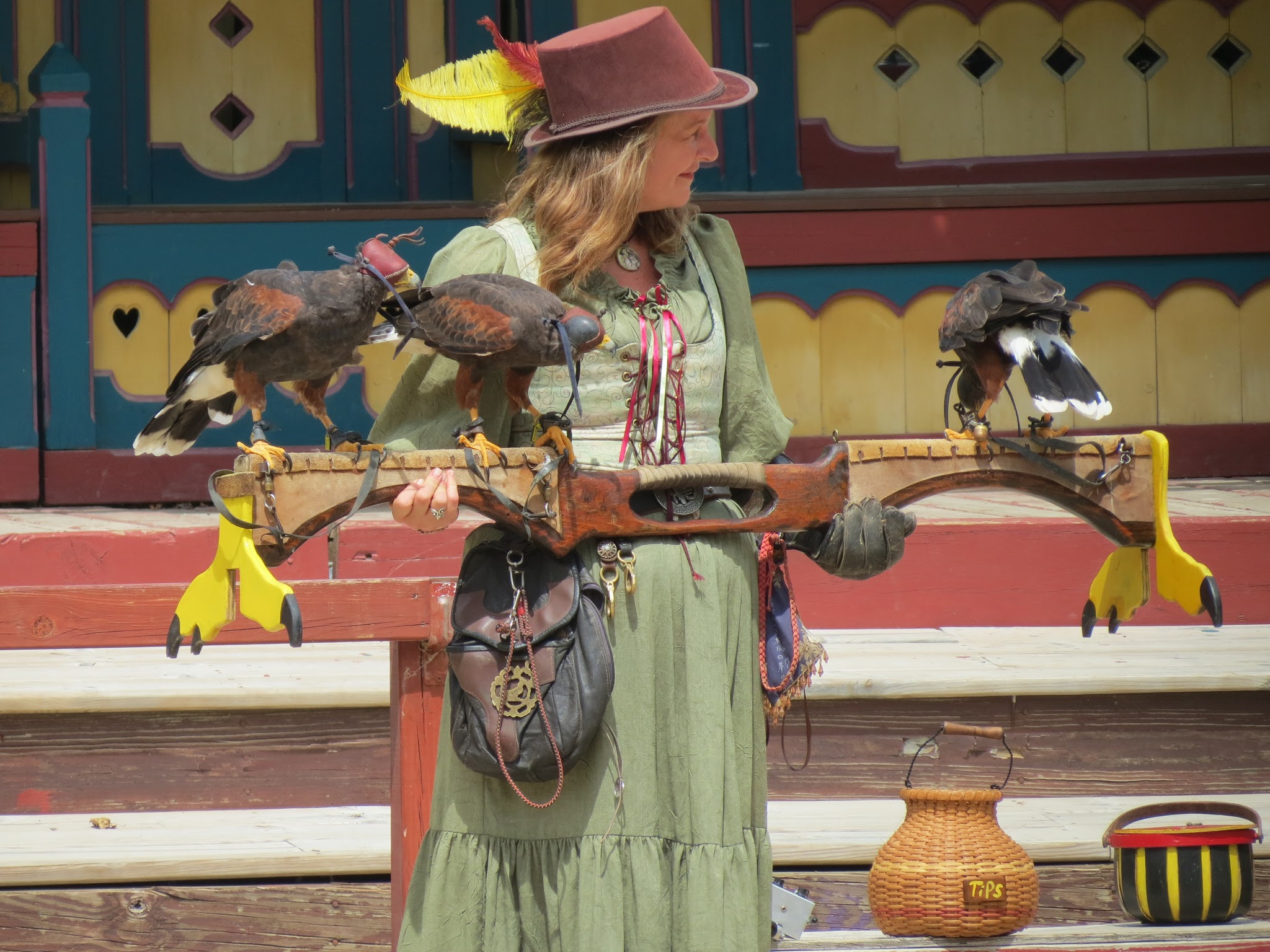
I was reminded of the image above (taken at the Bristol Renaissance Faire in September 2013) at the beginning of Chapter XXX: “[A]s he drew near he realized they were falconers. He came closer, and among them he saw a graceful lady […] dressed in green….”
Rereading Chapters XXII and XXIII
In Our Lord Don Quixote, Miguel de Unamuno invites us to reread “the narrative of the astonishing visions of Don Quixote; let him judge as he should judge, by the joy and the delight derived from the reading, and let him tell me later if these experiences are not more believable than others no less astonishing which God is said to have granted to certain of his servants, dreamers in the profound enchanted cave of ecstasy. And there is no choice but to believe Don Quixote, a man incapable of lying….”
Is Don Quixote “incapable” of lying? Again and again, I wonder about the role of “truth” and “true” in this narrative. Are dreams and visions “true”?
My marginalia for Chapter XXII includes a note about the continued abundance and kindness accorded to Don Quixote (i.e., the gifts and respect of the newlyweds); a mark around Sancho Panza’s observation, “What a devil of a knight errant you are, and what a lot of things you know!” (p. 598); and another mark around Don Quixote’s exclamation to Sancho Panza, “[T]here are some who exhaust themselves learning and investigating things that, once learned and investigated, do not matter in the slightest to the understanding or the memory” (p. 601). Oh, and regarding the length of rope: A hundred fathoms is six hundred feet or forty stories.
Last week, I described the events of Chapter XXIII as a “remarkably benign (Arthurian-inspired?) dive into the cave.” Following the required reread of these chapters, I researched my hunch about the nature of the Cave of Montesinos episode. Here are two articles that may interest others:
(1) “The Grail Quest: Imagery and Motif in the Episode at the Cave of Montesinos in ‘Don Quixote’” by Bruce Tracy. The Bulletin of the Rocky Mountain Modern Language Association, Mar., 1974, Vol. 28, No. 1 (Mar., 1974), pp. 3-9.
Tracy writes, “Cervantes has combined the Grail Quest motif with the dream vision, and ingeniously, but not adequately, integrated Dulcinea within it.”
(2) “The Subterranean Grail Paradise of Cervantes” by Philip Stephan Barto. PMLA , Jun., 1923, Vol. 38, No. 2 (Jun., 1923), pp. 401-411.
Barto notes, “That we are here dealing with the Arthurian grail-paradise is further attested by the mention of the necromancer Merlin, Queen Guinevere and Quintoniana, cupbearer to Launcelot. Even Launcelot would seem, by implication, to be here, since it is said of his cupbearer that she served him ‘when he came from Britain.’”
A few notes on Chapters XXIV through XXXIII
● I laughed aloud at Sancho’s lament, “O wedding of Camacho, O plenty in the house of Don Diego, I miss you so often!” (p. 617) One could reread this novel simply to observe the (wildly unreliable) ways in which characters mark time.
● Also from Sancho: “Is it possible that a man who knows how to say all the many good things that he’s said here can say he’s seen the impossible foolishness that he says he saw in the Cave of the Montesinos? Well, now, time will tell.” (p. 619) Time is not the only topic about which our characters display an extraordinary lack of consistency or reliability; they also vacillate on such subjects as truth, intelligence, and sanity, among others.
● How did I know Señor Master Pedro was Ginés de Pasamonte? Was there a textual clue I am now failing to recall – perhaps in the introduction? (That is certainly a pitfall of reading a long work over many weeks while reading other books: Despite note-taking, discussion, and marginalia, some details are inevitably lost; this novel requires rereading.) Well, although the mild-mannered puppeteer betrayed nothing of the fierce persona displayed in Part I, I saw through his disguise. Also, in this episode – an echo or mirror of the attack on the wine bags (giants) – I appreciated that Don Quixote had enough money to make amends.
● While the duke and duchess certainly ply the knight and his squire with food and compliments, this is not the same abundance about which I wrote last week; this is sport at the expense of someone else’s dignity, made worse when one learns that for Don Quixote “this was the first day he really knew and believed he was a true knight errant and not a fantastic one” (p. 658). Later I cringed when Don Quixote expounds, “If knights, and the great, the generous, and the highborn considered me a fool, I would take it as an irreparable affront” (p. 666); is that not how the duke and duchess feel about him?
● Earlier this week, I finished reading Michael F. Moore’s new translation of The Betrothed, the 1827 novel by Alessandro Manzoni. In addition to an unfortunate character who collected many works of “chivalric science,” the book includes this remarkable passage: “In this manner, they wandered wherever fate might lead (hence the glorious name of knights-errant) among the poor pedestrian riffraff of city and country folk whose only weapon to ward off death and soften the blow were the rags on their backs. Ah, the knighthood! Such a beautiful, wise, and useful profession.”
 Nerdishly
I do thoroughly enjoy these posts. I learn so much about deep reading from them. That is a skill I lack but am trying to develop.
LikeLiked by 1 person
1) “Cervantes has combined the Grail Quest motif with the dream vision, and ingeniously, but not adequately, integrated Dulcinea within it,” you quote, but it was not Cervantes who wrote this DQ story; he was just a stooge. Francis Bacon invented the DQ and has the role of Don Quixote, ( he had some co-authors: Ben Jonson = Sancho Pança, John Donne, who wrote the poems in the DQ and ‘the two friends’, Francis Beaumont & John Fletcher, they wrote the loose stories in the DQ.) Bacon had more helpers for the DQ: the librarian Robert Cotton (ps. is Don Álvaro Tarfe, try to find why..) and the printer William Stansby ( ps. is Bramidán de Tajayunque).
2) I’m really glad finally Bruce Tracy saw that the writer ( Francis Bacon was a copycat!) combined the Grail Quest, because that’s what the DQ is about: not only a) entertainment, not only b) study, but c) the esoteric level: the quest for the Holy Grail.
3) Why do you think he used the name Dulcinea?
Dulcinea: Dulce – Ci(g)ne – a : Dulce = Sweet. Cigne (in French, you do not pronounce here the -g-). In Spanish it is ‘cisne’ of the Latin loanword cygnus, from Greek κύκνος.
The brightest star in Swan is Deneb. The entire DQ revolves around the Swan and the star Deneb: Dulcinea = Dulce Cygne –a: reading backwards = α Cygni.
Dulcinea of Toboso: anagram for Boötes, from the Greek Βοθτης, Boōtēs ‘herdsman’ or ‘plowman’ or ‘oxdriver’; from βοῦς bous ‘cow’.
The -es- in Bo-ö-t-es you pronounce ‘as’ – in as you like it. Three times an -o- to indicate that one -o- is normal and the other ö does not appear in the English language. This vowel is a diaeresis, which is used instead of a hyphen, because it is a pulling apart of two sounds, a separation. There is a mark placed over a vowel to indicate that the vowel is pronounced in a separate syllable, diacritical. So it’s not an umlaut, but a two-tone divided into two sounds. Which means that Boötes is both an anagram, or an acrostic and a secret word, referring to the Big Bear, or Arcturus and at the same time to the village of Toboso: Bo -oo- t-..s
In the DQI p. 111: A stone would be laid on the grave of the young man in love and on it would later be carved:
Heere of a loving Swaine,
The Frozen Carkasse lies:
Who was a Heard likewise,
And died through disdaine.
Sterne rigour hath him slaine,
Of a coy, faire, ingrate,
By whom love doth dilate
Her tyrannie amaine.
The word Boötes appears also regularly in the Shakespeare plays, sometimes in mirror writing: SHTWOB. You have to change the Greek letters to Latin letters, three Latin letters, and three Greek letters: SETOOB and then read from back to front. ( Greek Bèta= Latin B, Greek ω = Latin O, Greek Sigma = Latin S. )
A lot of poems Donne had to write in the DQ have these 6 initials. Just see it!
4) Tracy writes, “Cervantes has combined the Grail Quest motif with the dream vision, and ingeniously, but not adequately, integrated Dulcinea within it.” You quote, but Tracy did not understand what the name really means. If you want to understand it, you have to read my book: the deciphering of the Don Quixote & the unmasking of Avellaneda, the translation of my 2015 book.
Barto you say: “Queen Guinevere and Quintoniana, cupbearer to Launcelot. Even Launcelot would seem, by implication, to be here, since it is said of his cupbearer that she served him ‘when he came from Britain.’” There are many indications that this book comes from Britain. I’ll give you one..
The Avellaneda ( the ‘spurious’ DQ) begins: ‘El sabio Alisolán, historiador no menos moderno que verdadero..’ The wise Alisolán, historian no less modern than true..
If there is an indication then it is in this name again: El sa… BIO ALISOLÁN is an anagram of O(H) ISLA ALBIÓN. Albion was the name England had in antiquity, but more or less in a humoristic way, ‘you insolent Albion!
LikeLike