
 I grew tired of waiting for my holds to come in at the library, so I ordered two books I wanted. After borrowing another, I decided I must own it. And the other two? Leapt into my cart. *wink*
Author Archives: Nerdishly
American Sign Language
 About a third of the students in the first aid and CPR course we completed over the summer were, as my older daughter and I are, employed by schools. The instructor remarked that, like the certification we earned that afternoon, basic ASL skills are also a terrific asset to educators, both in emergency situations and in the classroom. Naturally, then, when the local college posted a fall course schedule that included a four-semester sequence of ASL classes, it seemed like one of those serendipity / synthesis / synchronicity moments, and we enrolled.
The required text for the class is A Basic Course in American Sign Language; I picked up the optional workbook and DVDs from the series, too. Knowing that we appreciate having several delivery options when we study, my younger daughter, who began learning ASL from a college friend last year, recommended Sign School (which her friend played a large role in developing) and the American Sign Language Dictionary app.
While my daughters use their skills regularly, the older in her work and the younger to communicate with her friend, my husband (who also decided to take the class) and I don’t have an immediate need for ASL. Both of us have been teaching fingerspelling, however: he to his colleagues and I to my students. I have also taught my students several signs, including AWESOME, SURPRISED, and INTERESTING.
Perhaps it goes without saying, but the fact that, even now, we are still engaged in a version of the family-centered learning project is so motivating. Bonus: My study group lives with me or is only a FaceTime call away!
On my desk
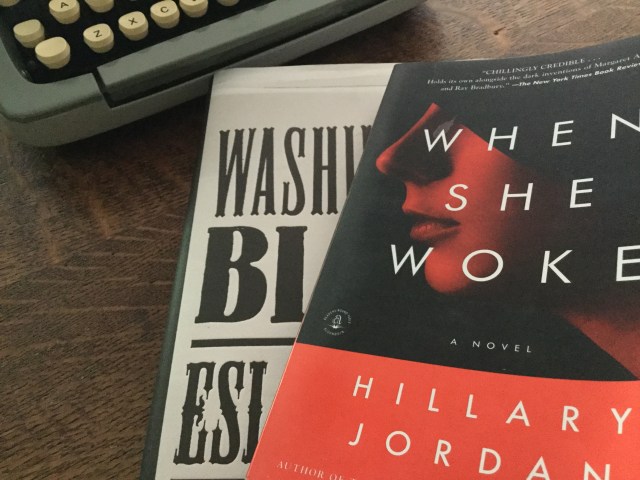 From Hillary Jordan’s When She Woke:
p. 253
She’d always believed that her parents had done right by her, but now, sitting mute at Stanton’s table, she found herself seething over their choices. Why had they kept her life so small? Why had they never asked her what she wanted? At every possible turn, she saw, they’d chosen the path that would keep her weak and dependent. And the fact that they couldn’t see it that way, that they sincerely believed they’d acted in her best interest, didn’t make it any less true, or them any less culpable.
I was certain I had read this novel when it was first published seven years ago, but I have no record of it, nor did it seem terribly familiar after the first chapter, so I picked up a remaindered paperback. While better than some entries to the “If you loved The Handmaid’s Tale, read this!” category of dystopian fiction, When She Woke proffers neither the intelligence nor the pervasive horror that undergird Atwood’s classic.
With some bookstore credits, I purchased Esi Edugyan’s novel, which has been shortlisted for the Man Booker Prize.
A few book notes
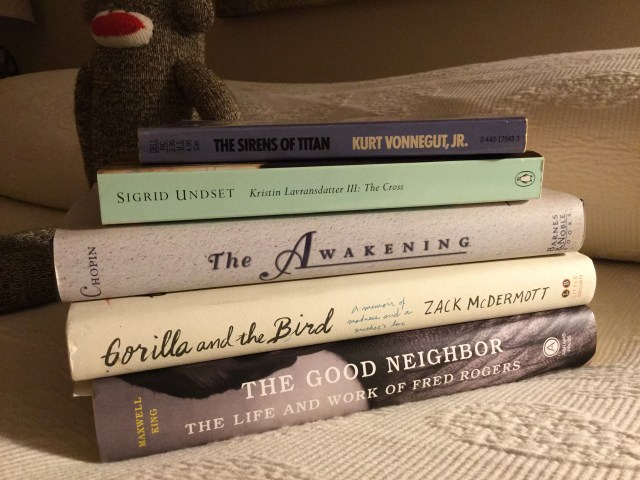
What I’m reading now.
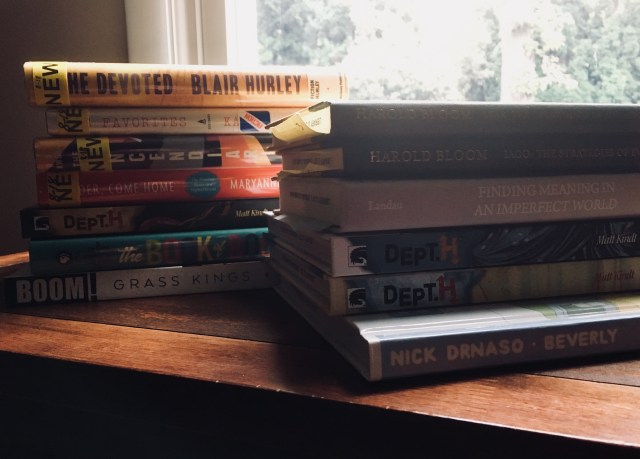
■ Since my last post, I have read a number of graphic fiction works, including:
● Grass Kings, Volume 1: New World Order (Matt Kindt; 2018. Graphic fiction.)
● Dept. H, Vol. 2: After the Flood (Matt Kindt; 2017. Graphic fiction.)
● Dept. H, Vol. 3: Decompressed (Matt Kindt; 2018. Graphic fiction.)
● Beverly (Nick Drnaso; 2016. Graphic fiction.)
While waiting for the library to acquire Nick Drnaso’s Sabrina (which appeared on the Mann Booker Prize longlist), I borrowed his 2016 work, Beverly, which was alternately damning and depressing. I am also waiting for the library to acquire the fourth volume of Matt Kindt’s Dept. H.
■ I am behind on my Banned Books Week selection, a reread of The Awakening (Kate Chopin), but I have finished The Third Hotel, Laura van den Berg’s meditation on death, grief, falling apart, and staggering on. For the commonplace book:
p. 80
Her husband believed that once the theater went dark and the film began, the viewer was alone — even if they had arrived in the company of others. This solitude was needed to dissolve the logic and laws of the world they had come from, replacing those principles with the logic and laws of the screen; that was how Yuriel Mata’s eels had slipped past. In this way you could descend into the theater with a person you knew intimately and then, once the lights returned, find yourself seated next to a stranger.
p. 88
Her own vast and incurious country often felt alien to her, with its unimaginative pledges and toxic patriotism, its aversion to discomfort and complex thought (the death of her brother-in-law alone had been enough to instill in her a hatred of truisms — what was so impossible about saying, Right now our lives are fucked up and we don’t know exactly when things will get better?), its desire to be recognized as a beacon of justice without ever actually acting like one. At the same time, America was the only country she had ever lived in, and she understood it could be disingenuous, perhaps even dangerous, to allow herself to feel superior to the thing she had always lived inside, the thing that had made her.
p. 93
You are dead, she thought. How could she have forgotten?
She had heard of the syndrome that drove people to believe loved ones had been replaced by fakes, but perhaps an inversion existed, one in which the fake was mistaken for the real, and she was afflicted.
p. 174
She did not know how to grieve her husband’s death or her father’s decline or the choice each day carried her closer to, the choice she was wholly unprepared to make — or would turn out to be more prepared than any person should be.
She did not know how to grieve in the context of her life.
Bullshit, Richard said. No one gets on a plane to see a movie.
Everyone dies at the end, she said, except the hero’s daughter.
p. 200
When a person did not know they were being watched, what they would do when they believed themselves to be in a state of true privacy — that was the lure of of found footage, that clarification of the human mystery, and that was why surveillance was so lethal: a true erosion of self.
■ With only three months remaining, it seems prudent to re-evaluate my reading resolutions for this year.
1. Read from the shelves.
I must make this annual resolution simply to torment myself. Of the 111 books I have read cover to cover this year, 39 were published in 2018. So much for reading from my own library, eh?
2. Complete a close reading of Moby Dick.
I’ve read it once and listened to the spectacular audiobook (William Hootkins; 2004) dozens of times, but I would still like to reread Moby Dick.
3. Reread at least one Vonnegut novel.
Sirens of Titan by Thanksgiving break.
4. Finish reading several books abandoned in 2017 (or *gulp* earlier).
No progress.
5. Read at least thirty non-fiction titles.
I’ve read twenty-three, so far.
Bookishness

A few recent acquisitions.
So far this month, I have finished nine books:
■ The Children (Lucy Kirkwood; 2016. Drama.)
■ Vox (Christina Dalcher; 2018. Fiction.)
■ The Water Cure (Sophie Mackintosh; 2018. Fiction.)
■ Dept. H, Vol. 1: Murder Six Miles Deep (Matt Kindt; 2017. Graphic fiction.)
■ The Walking Dead, Volume 30: New World Order (Robert Kirkman; 2018. Graphic fiction.)
■ His Favorites (Kate Walbert; 2018. Fiction.)
■ The Incendiaries (R.O. Kwon; 2018. Fiction.)
■ Kristin Lavransdatter: The Wreath (Sigrid Undset; 1920. (Trans. Tiina Nunnally; 1997.) Fiction.)
■ The Devoted (Blair Hurley; 2018. Fiction.)
This puts me at 103 for a year-to-date total.
My Banned Books Weeks selection is The Awakening (Kate Chopin), a novel I first read more than three decades ago. I wonder how it will hold up. I am thisclose to finishing The Third Hotel (Laura van den Berg), and Fear (Bob Woodward), among other titles, is on my nightstand.
The following passage from R.O. Kwon’s recent novel, The Incendiaries, is for my commonplace book:
p. 58
No loss occurs in isolation, and a side profit of the faith that I missed at times like this was how easily, while Christ shone in each face, I loved. If hatred cuts both ways, to forgive can be a balm, and I often missed, as I would a friend, the more tranquil person I now had no reason to be.
Borrowed
A fuzzy photo of my library bag contents.
New books
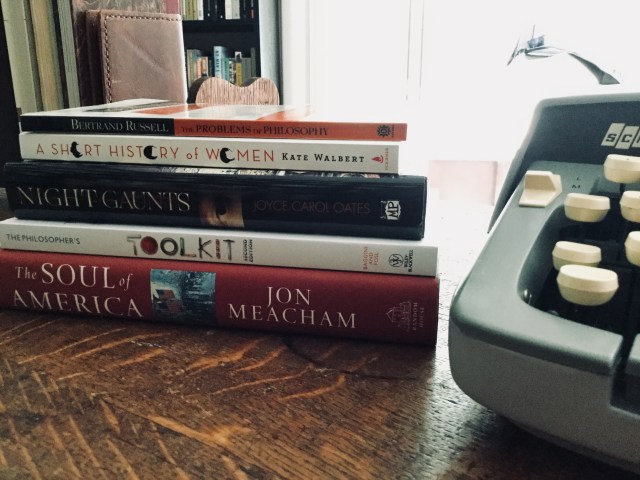 Flute practice and lessons. A music theory MOOC. An ASL course. The lawn. (It keeps on growing! That’s the rain and Milorganite.) A long weekend with my daughter. Reading. And work. That’s where I’ve been. But look! Another photo of new books. *wink*
“And, as they say, the incident is closed.”
Past one o’clock. You must have gone to bed.
The Milky Way streams silver through the night.
I’m in no hurry; with lightning telegrams
I have no cause to wake or trouble you.
And, as they say, the incident is closed.
Love’s boat has smashed against the daily grind.
Now you and I are quits. Why bother then
To balance mutual sorrows, pains, and hurts.
Behold what quiet settles on the world.
Night wraps the sky in tribute from the stars.
In hours like these, one rises to address
The ages, history, and all creation.
This poem was found among Vladimir Mayakovsky’s papers after his suicide on April 14, 1930. The middle section, with modest revisions, served as an epilogue to his suicide note. Yes, plagued by critics and disappointed in his personal relationships, the poet who had criticized poet Serge Yesenin for committing suicide took his own life: You and I, we are quits, and there is no point in listing mutual pains, sorrows, and hurts.
 Suicide is the tenth leading cause of death in the United States, maintains the American Foundation for Suicide Prevention (AFSP). But we don’t talk about it much, do we?
According to the AFSP:
Although there is no single cause of suicide, one of the risks for suicide is social isolation, and there’s scientific evidence for reducing suicide risk by making sure we connect with one another. We can all play a role through the power of connection by having real conversations about mental health with people in everyday moments – whether it’s with those closest to us, or the coffee barista, parking lot attendant, or the grocery store clerk.
It’s also about the connection we each have to the cause, whether you’re a teacher, a physician, a mother, a neighbor, a veteran, or a suicide loss survivor or attempt survivor. We don’t always know who is struggling, but we do know that one conversation could save a life.
Know the suicide warning signs and if you or someone you know is struggling, call the National Suicide Prevention Lifeline, (800) 273-TALK (8255).
Take care of yourselves.
Out walking
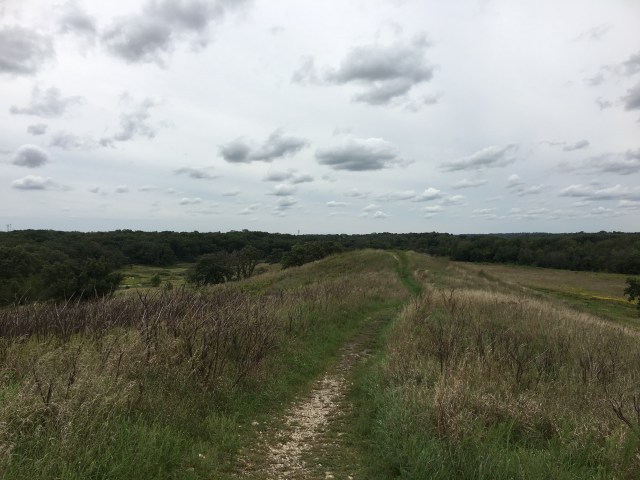
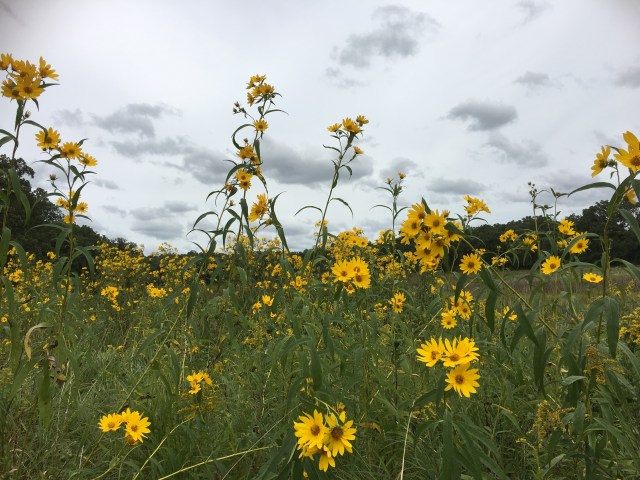
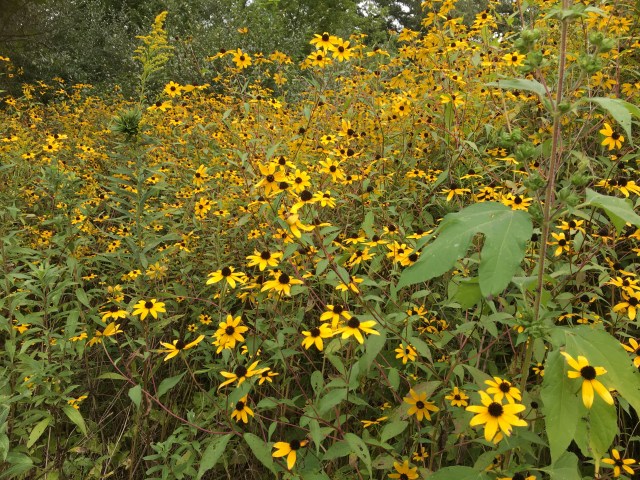
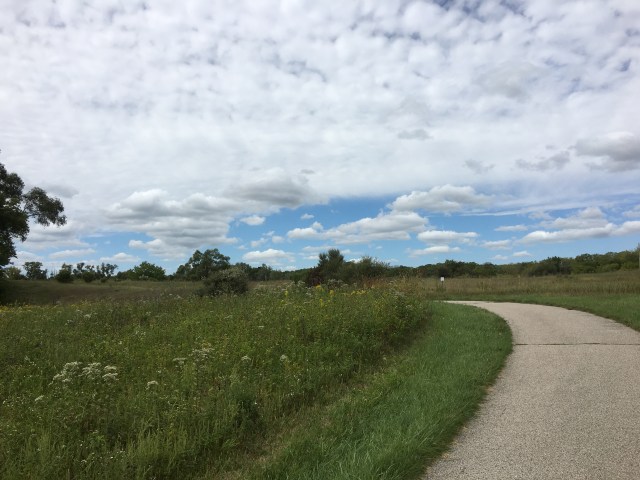 From Anna Botsford Comstock’s Handbook of Nature Study:
In my belief, there are two and only two occupations for Saturday [or Sunday] afternoon or forenoon for a teacher. One is to be out-of-doors and the other is to lie in bed, and the first is best. Out in this, God’s beautiful world, there is everything waiting to heal lacerated nerves, to strengthen tired muscles, to please and content the soul that is torn to shreds with duty and care.
“Karma is choice.”
 From Sy Montgomery’s The Soul of an Octopus:
p. 190
In casual Western conversation, karma is used interchangeably with destiny, kismet, luck, and fate. Bill had chosen the name while still in the grip of what felt to us all like a star-crossed tragedy of Shakespearean proportions. During the Elizabethan era, most Europeans believed each person’s fate was predetermined, hardwired by the positions of the planets and the stars. Some people still do. But the idea of karma has a deeper, more promising, meaning than that of fate. Karma can help us develop wisdom and compassion. In Hinduism, karma is a path to reaching the state of Brahman, the highest god, the Universal Self, the World Soul. Our karma is something over which, unlike fate, we do have control. “Volition is karma,” the Buddha is reported to have said. Karma is not fate, but, in fact, its opposite: Karma is choice.
I was hooked by page six, when Montgomery reminds readers of the octopus in Jules Verne’s 20,000 Leagues under the Sea. Synchronicity, serendipity, synthesis.
My last entry for August, The Soul of an Octopus was the ninety-fourth book I finished reading so far this year and the twenty-third title in my quest to read at least thirty non-fiction titles in 2018. Last month, I also (finally!) finished The Aeneid, and during the drive down to visit my youngest yesterday, I listened to the remaining lectures in Elizabeth Vandiver’s The Aeneid of Virgil.
Other reading highlights from the past month:
■ Nomadland: Surviving America in the Twenty-First Century (Jessica Bruder; 2017. Non-fiction.)
As I mentioned here, Janesville, Squeezed, and Nomadland (related entry here) formed a sobering trilogy.
■ Hope Never Dies: An Obama Biden Mystery (Andrew Shaffer; 2018. Fiction.)
What silly fun this was! My older daughter and I listened to this while walking and running errands.
■ Things We Lost in the Fire (Mariana Enriquez; 2017. Fiction.)
Wow. Just… wow. From the Amazon blurb: “Written in hypnotic prose that gives grace to the grotesque, Things We Lost in the Fire is a powerful exploration of what happens when our darkest desires are left to roam unchecked, and signals the arrival of an astonishing and necessary voice in contemporary fiction.”
■ When You Reach Me (Rebecca Stead; 2009. Fiction.)
This beautiful Newbery Award winner reminded why I love to read.
The Kristin Lavransdatter readalong began today, and I have nearly finished this week’s objective: Part 1 of The Wreath (seven chapters). It was easy to become absorbed in this old-fashioned but well-told story.
I will likely finish The Children, a play by Lucy Kirkwood, this holiday weekend and The Third Hotel, a new novel by Laura van den Berg, a little later this week. Another new release, Vox (Christina Dalcher), is also on my nightstand. Derivative, flawed, and strictly plot-driven, it may be done sooner than the atmospheric and disturbing Hotel, which I find I must set aside periodically — not unlike my experience with the brilliant Things We Lost in the Fire. Perhaps I need time to think about the images and ideas the writers have presented; or maybe, more accurately, I need to look away for a bit.
More soon.
 Nerdishly