Reading notes

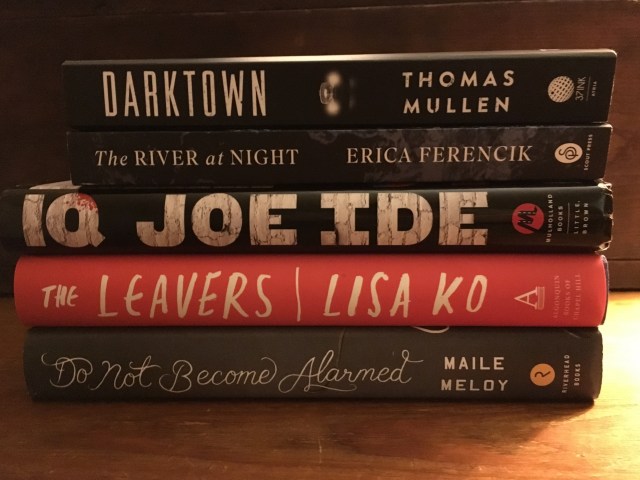
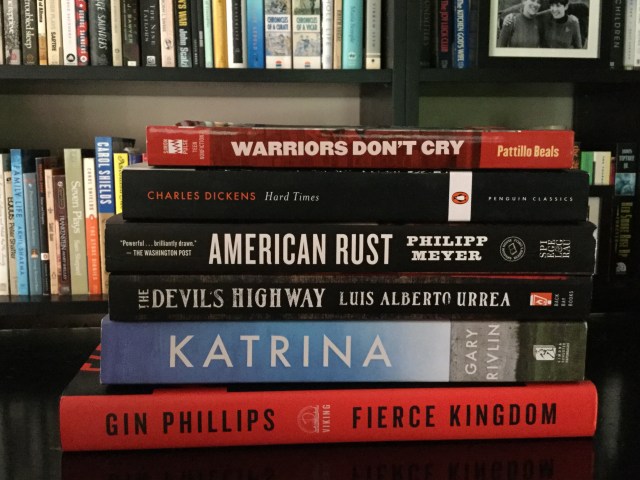
Since my last bookish post, I have, among other things, seen the Ivo van Hove-directed A View from the Bridge at the Goodman (get there, if you can), visited my daughters, taken three flute lessons, (nearly) finished four weeks at my new job, and completed six books:

Timon of Athens (William Shakespeare; 1605. Drama.)
Macbeth (William Shakespeare; 1606. Drama.)
Do Not Become Alarmed (Maile Meloy; 2017. Fiction.)
Why Be Happy When You Could Be Normal? (Jeanette Winterson; 2012. Non-fiction.)
Carrying the Elephant (Michael Rosen; 2002. Poetry.)
War and Peace (Leo Tolstoy; 1869. (Trans. L. and A. Maude; Everyman’s Library; 1992.) Fiction.)

The plays, both rereads, represent my Shakespeare in a Year progress. I plan to read Sonnets 112 through 120 and the related commentary between now and Sunday evening, which should catch me up.

From Macbeth, which is one of my favorite of the plays:

Act IV, Scene iii

Be comforted:
Let’s make us medicines of our great revenge,
To cure this deadly grief.

Seven years ago, I pressed my copy of Maile Meloy’s Both Ways Is the Only Way I Want It on someone, promising beautiful prose and original storytelling. I regretted it almost instantly, and I really regretted it a few years later when the same someone mentioned the book in conversation, “Have you read it?” she asked. “It’s pretty good.” Um, yes, I read it. The copy you just finished, in fact. And, “pretty good” seems pretty inadequate, but okay. “Mmmm…” I replied, and reminded myself, again, not to give my books away. Pass them to my daughters, sell them, donate them, yes. But give them away? Not anymore, I don’t. Anyway, while I readily concede that Do Not Become Alarmed does not cast the same spell as Both Ways, it is as impossible to put down as Fierce Kingdom (Gin Phillips), which I read last month, so, recommended.

As I mentioned last time, I reread Fun Home (Alison Bechdel) in anticipation of seeing the Victory Gardens production. I had a notion that Jeanette Winterson’s memoir would make a neat pairing, and I was a little right — and a little wrong. Here are my remaining commonplace book entries for Why Be Happy When You Could Be Normal?

p. 140
I did not realise that when money becomes the core value, then education drives towards utility or that the life of the mind will not be counted as a good unless it produces measurable results. That public services will no longer be important. That an alternative life to getting and spending will become very difficult as cheap housing disappears. That when communities are destroyed only misery and intolerance are left.

p. 144
There’s a lot of talk about the tame world versus the wild world. It is not only a wild nature that we need as human beings; it is the untamed open space of our imaginations.

Reading is where the wild things are.

p. 170
And extremes — whether of dullness or fury — successfully prevent feeling. I know our feelings can be so unbearable that we employ ingenious strategies — unconscious strategies — to keep those feelings away. We do a feelings-swap, where we avoid feeling sad or lonely or afraid or inadequate, and feel angry instead. It can work the other way, too — sometimes you do need to feel angry, not inadequate; sometimes you do need to feel love and acceptance, and not the tragic drama of your life.

It takes courage to feel the feeling — and not trade it on the feelings-exchange, or even transfer it altogether to another person.

Michal Rosen’s Sad Book, illustrated by Quentin Blake, is quite possibly the most accurate depiction of sorrow and grief I have ever read. I cannot tell you how many times I have thought to send Rosen a postcard that simply says, “Yes. Thank you.” This week, I read Carrying the Elephant, his collection of prose poems. Again, “Yes. Thank you.”

p. 48
… Yes, it is unfair and
cruel. It also makes me tired with a
tiredness that hangs on like a dog. It’s nice of
you to say you’ll always remember him. You won’t.

p. 50
… You see me and you cry, you’re
overwhelmed. You ask me how it’s
possible for me to carry on. I wonder
if I look like someone who looks like
it’s possible to carry on.

And, as I shared yesterday, I have finished reading War and Peace. Here are the remaining commonplace book entries:

Book Three, Chapter 25
As often happens with passionate people, he was mastered by anger but was still seeking an object on which to vent it.

Book Four, Chapter 13
This was his acknowledgment of the impossibility of changing a man’s convictions by words, and his recognition of the possibility of everyone thinking, feeling, and seeing things each from his own point of view. This legitimate peculiarity of each individual, which used to excite and irritate Pierre, now became a basis of the sympathy he felt for, and the interest he took in other people. The difference, and sometimes complete contradiction, between men’s opinions and their lives, between one man and another, pleased him and evoked from him an amused and gentle smile.

Next up? It’s hard to say. Last night, I grabbed a thriller. After the “heavy” reading and work and the yard chores (yeah, I decided to mow and rake when I got home), You (Caroline Kepnes) seemed right. The thing is, I have a feeling that this is going to become graphic in a way that my post-fifty self no longer tolerates well, so I may be in search of something else before day’s end.

On a related (sort of) note: My husband and I have only two episodes of Jon Ronson’s The Butterfly Effect remaining. We were already Ronson fans (The Psychopath Test, So You’ve Been Publicly Shamed), so this podcast (free to Prime and Audible customers) interested us. Although Ronson navigates an X-rated world, the podcast is never more than R-rated. Here’s Ronson’s description:

It’s sad, funny, moving and totally unlike some other nonfiction stories about porn – because it isn’t judgmental or salacious. It’s human and sweet and strange and lovely. It’s a mystery story, an adventure. It’s also, I think, a new way of telling a story. This season follows a single butterfly effect. The flap of the butterfly’s wings is a boy in Brussels having an idea. His idea is how to get rich from giving the world free online porn. Over seven episodes I trace the consequences of this idea, from consequence through to consequence. If you keep going in this way, where might you end up? It turns out you end up in the most surprising and unexpected places.

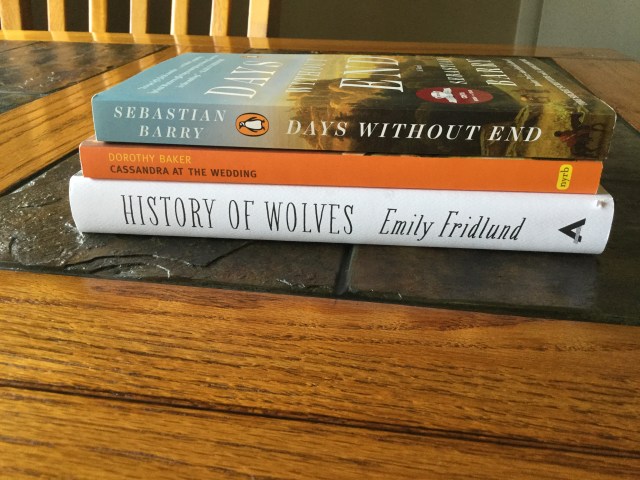
Mission accomplished

IMG_3539

I have read War and Peace.

As I’ve mentioned, War and Peace has always been one of those books I hope to get to… Some day! Back in June, I adopted Robin’s plan, one that all but ensured that “some day” would occur by late October. I chose the three-volume Everyman’s Library edition (Maude translation) and persuaded my husband to join me in the challenge. And here we are! Mission accomplished about a month ahead of schedule! Commonplace book entries for this and other books in my next bookish entry.

Reading notes

IMG_3133Since my last bookish post, I’ve moved my daughters back to university; received two offers so delightful that I rethought my ideas about “retirement” and accepted one; survived a particularly nasty bout of food poisoning; and finished the following books:

The Followers (Rebecca Wait; 2015. Fiction.)
Hamlet (William Shakespeare; 1602. Drama.)
The Grip of It (Jac Jemc; 2017. Fiction.)
Measure for Measure (William Shakespeare; 1604. Drama.)
The Marriage Pact (Michelle Richmond; 2017. Fiction.)
Fierce Kingdom (Gin Phillips; 2017. Fiction.)
Fun Home (Alison Bechdel; 2006. Graphic memoir.)
Othello (William Shakespeare; 1603. Drama.)

If you liked last summer’s The Girls (Emma Cline), and I did, you may appreciate The Followers, a difficult story told well. The Grip of It offers a literary twist on the haunted house genre. The Marriage Pact passed an amiable summer afternoon despite its pedestrian prose and improbable plotting. Fierce Kingdom, however, managed something special. This beautifully written and almost recklessly fast-paced thriller is destined for big-screen treatment. For the commonplace book:

p. 17
In a year he will be in kindergarten and these days of superheroes will fade and be replaced by something she can’t guess, and then at some point the zoo itself will be replaced and life will have gone on and this boy holding her hand will have turned into someone else entirely.

p. 160
She does not know when she started imagining the end of things. It’s possible that turning forty triggered it or that Lincoln triggered it from the moment he began changing from a baby into a boy and she realized how he was going to vanish, over and over again, until finally he was grown and gone, and it’s possible she has such dark thoughts precisely because there is nothing she wants more than for life to stay exactly as it is, never changing, and maybe she loves it all the more because she knows it can’t last.

p. 165
You are supposed to be more forgiving of your parents, aren’t you, after you have children yourself? After you understand what parenting really means?

The Bechdel memoir (an exquisite, smart book I devoured and pressed on all who would listen when it was first published more than a decade ago) was a reread: We will see the Victory Gardens production later this month.

The plays, all rereads, represent some of my Shakespeare in a Year progress. (Yes, I had planned to substitute a Hamlet-inspired novel, but my daughters and I ended up revisiting the play before they finished moving back to university. Still, The Dead Fathers Club (Matthew Haig), a book that has been on my shelves since 2006 may (finally!) end up on this year’s list.) I have also reached Sonnet 111 and pushed Sir Thomas More down the list a bit.

Yesterday marked the beginning of Week 11 in my quest to read War and Peace in seventeen weeks, but the book remains so compelling that I have already finished the reading for Weeks 12 and 13.

From Book Three, Part Two, Chapter 10:

He had managed people for a long time, and knew that the chief way to make them obey is to show no suspicion that they can possibly disobey.

And now I’m reading Jeanette Winterson’s Why Be Happy When You Could Be Normal?

p. 8
When we tell a story we exercise control, but in such a way as to leave a gap, an opening. It is a version, but never the final one. And perhaps we hope that the silences will be heard by someone else, and the story can continue, can be retold.

When we write we offer the silence as much as the story. Words are the part of story that can be spoken.

From the archives

The following was originally written more than a decade ago in response to a post on a homeschooling board; it was then reshaped and published to my old site. The original poster asked about managing her child’s attitude toward schoolwork. She was having difficulty finishing lessons each week and felt they were falling behind. This repost (with minor edits) is provided at A.K.’s request.

It all begins with me.
Most of the time when things “break bad” here (and they do; not often, but they do), it’s more about me than about anyone else. When the work is taking forever to complete, when the quality is less than expected, when enthusiasm has waned, etc., I don’t need to look much further than the example I’ve been setting. Have I been on-task? Have I been doing my job(s) with attention to detail? Have I conveyed my love of the subject and of the family-centered learning project? Or have I been dealing with our accountant in a series of longwinded telephone calls? Spending twenty extra minutes on the treadmill? Checking email or blogging? Planning activities for next week, month, or year when we haven’t completed the activities for this week, month, or year? (Actually, I gave up that last bit during year one of this adventure. One of the first hard lessons I learned about home education is that my time is best spent not on elaborate lesson plans (no matter how ingenious, inventive, or inspiring to other hs-ing mothers), thumbing through catalogues, drafting curriculum wishlists, or bouncing from one resource to another but on the simple task of focusing on the moment we’re in. It has saved me years of angst and wasted time, talent, and treasure, that lesson has.)

Don’t misunderstand. I think that it’s important that we parent-educators tend to our needs, but I also think it’s critical that we do it on our own time. (For me, that’s in the wee, small hours of the morn’ or the late evening hours after they head to bed or, sometimes, during the day on “free” days (one benefit of year-round studies).) When I forget this self-mandate (e.g., when I take a call during lesson time or blog while the kids are laboring over math sheets), I send the following mixed message: Leading the family-centered learning project is my first and most important job — except when I want to do something else. Make that mistake too many times, and it’s really no wonder when the youngest dallies over a sheet she previously needed only thirty minutes to complete for three, four times longer than that; no wonder that they’re feeling recalcitrant, unmotivated; no wonder our interactions are laced with discontent.

Lest you or someone else click away in anger, note that this is not a criticism of any sort. I don’t know how you approach your work. You asked how to reach your child’s heart, though; I can only tell you how I reach my own children’s hearts and minds:

With as much consistency as possible, I model the behavior and standards I want the kids to maintain.

And I’ve been doing that since we began this adventure.

By necessity, this means I haven’t adopted then abandoned multiple approaches to parenting or learning. It means that I decided on a fairly certain course early on, a course chosen to match my personality and goals well.

And I’ve stuck with it.

There is an unmistakable rhythm to our days, a dance of daily routines and rituals that guide this family’s life, and everyone sways to the silent music

…because it has been playing since they they arrived.

Sure, there’s spontaneity. And fun. Lots of it. Surprise. Humor. Laughter. But that’s the harmony. The melody is one of clearly stated goals and plenty of examples of how to achieve them.

We parent-educators love to point out that the benefit of homeschooling is that we can tailor the curriculum and our approach to our students’ needs. I suspect, however, that there is a point at which this becomes too much of a good thing. Clearly, when an elementary school student fails to understand that his or her job is to play and learn and study and grow (and to do so without a big fuss), he or she needs less “heart talk” and more “stern talk” — mixed with a healthy dose of the teacher modeling the same level of commitment to task.

What is “stern talk”? It might look something like this: Quite simply, education is the law here; as in, parents must provide their children with an education. If my child isn’t learning (barring some sort of organic issue), we are not complying with the law. If I am doing my part (check), that leaves you, the child. You must do your part. In this house, that means that the following activities must be completed on a daily (weekly, monthly, annual) basis. Until we’re in compliance, we will skip the following activities: [insert favorite programs, extracurriculars here].

I’m going to circle back to my original premise: It all begins with the parent-educator. Anger and sadness are one response to a recalcitrant student. Humor is another approach. But, in the end, unwavering purposefulness may be the best choice, and that’s hard to achieve if we haven’t done the hard work of laying out our own courses. As I said, this is not a criticism but an observation based on my teaching and parenting experiences: Things work best when I work best.