The year in books

As it has been for the past few years, my general reading plan in 2024 was to select more volumes from my shelves (i.e., books acquired in 2023 or earlier). The reach goal — sometimes stated, lately not — is one hundred books read from the shelves, including at least twenty-four non-fiction titles and at least one book from each of several special collections in my home library. This year I met the special collections goal handily:

Shakespeare (about or retold; the plays do not count for this goal): Dunbar (Edward St. Aubyn; 2017)
Poetry: Beowulf: A New Translation (Maria Dahvana Headley; 2021), Metamorphoses (Ovid (trans. Stephanie McCarter; 2022)), and Inferno (Dante; 1321 (trans. Robin Kirkpatrick; 2006))
NYRB: The Hearing Trumpet (Leonora Carrington; 1974)
Kurt Vonnegut (by or about): Breakfast of Champions (1973)
Joyce Carol Oates (by or about): Evil Eye (2013)
Philosophy: The Limits of My Language: Meditations on Depression (Eva Meijer; 2019/2021) and How to Tell A Story (Aristotle’s Poetics (trans. Philip Freeman; 2022))
Art: Georgia O’Keeffe: A Life (Roxana Robinson; 1989)
Children’s/YA: The Magician’s Elephant (Kate DiCamillo; 2009)
Birding: Field Notes from an Unintentional Birder (Julia Zarankin; 2020)

Although I only read twenty-two non-fiction titles from my shelves, I met the spirit of the goal, to read more non-fiction, with thirty-one titles this year. Speaking of more — DRUMROLL! — one hundred of the books I read this year were from my shelves. (The complete list of books read in 2024 is here.)

And what great books! With Night School Bar, I read Mikhail Bulgakov’s The Master and Margarita and with the Newberry Library, Adventures of Huckleberry Finn (Mark Twain; 1885) and James (Percival Everett; 2024). With A Public Space’s APS Together, I read Graham Greene’s Monsignor Quixote (1982) and with The Deep Read, Trust (Hernan Diaz; 2022). Although I didn’t participate in the online forums, I read As I Lay Dying (1930) with Faulkner in August and with the SciFri Book Club, An Immense World: How Animal Senses Reveal the Hidden Realms Around Us (Ed Yong; 2022), The Invention of Nature: Alexander Von Humboldt’s New World (Andrea Wulf; 2015), Forest Walking: Discovering the Trees and Woodlands of North America (Jane Billinghurst and Peter Wohlleben; 2022), and A Sand County Almanac (Aldo Leopold; 1949). With the Academy of American Poets, I finally read Ovid’s Metamophoses (trans. Stephanie McCarter; 2022), as well as The Shield of Achilles (W.H. Auden; 1952/2024) and selections of Emily Dickinson’s work. I also decided to rejoin the 100 Days of Dante group and have already reread Inferno.

The reading friend I mentioned last year and I continued meeting this year, finishing Thomas Mann’s The Magic Mountain and our deep dive into the work of E.B. White in February, then moving on with Elena Ferrante’s four Neapolitan novels, The Sea (John Banville; 2005), Middlemarch (George Eliot; 1871), and The Bell (Iris Murdoch; 1958). She also hosted three discussions for larger groups: The Lifted Veil (George Eliot; 1869), Washington Square (Henry James; 1880), and one meeting on a selection of W.H. Auden’s poetry. 

Although I fell behind on my third “Shakespeare in a Year” project, I have no doubt I will finish the remaining plays and Marjorie Garber’s Shakespeare After All (2004) in the first few months of 2025. As I mentioned throughout the year, my other project was to read Willa Cather’s twelve novels in chronological order. What a fabulous and worthwhile experience! These were some of my favorite books of the year, especially The Professor’s House (1925). Other standout books this year included:

■ The Master and Margarita (Mikhail Bulgakov; 1967. Fiction.)
■ The Michigan Murders (Edward Keyes; 1976. Non-fiction.)
The Guest Cat (Takashi Hiraide; 2001/2014. Fiction.)
James (Percival Everett; 2024. Fiction.) 
■ Sociopath: A Memoir (Patric Gagne; 2024. Non-fiction.) 
■ NeuroTribes: The Legacy of Autism and the Future of Neurodiversity (Steve Silverman; 2015. Non-fiction.) 
■ Oranges Are Not the Only Fruit (Jeanette Winterson; 1985. Fiction.) 
■ The Hearing Trumpet (Leonora Carrington; 1974. Fiction.) 
Orbital (Samantha Harvey; 2023. Fiction.) 
The Invention of Nature: Alexander Von Humboldt’s New World (Andrea Wulf; 2015. Non-fiction.)
Dunbar (Edward St. Aubyn; 2017. Fiction.) 
Breakfast of Champions (Kurt Vonnegut; 1973. Fiction.)
Great Expectations (Vinson Cunningham; 2024. Fiction.)
Exhalation (Ted Chiang; 2019. Fiction.)
Daytripper (Fábio Moon and Gabriel Bá; 2011. Graphic fiction.)

Falling

According to the forecast, daytime temperatures will reach the low eighties tomorrow and Wednesday. That’s all right; I’ll rise early to walk, and throughout the day, I’ll remind myself that the cooler weather will return on Thursday.

In my last post, I somehow neglected to mention Monk, which opened my recent “small screen as succor” season. My older daughter suggested that I try a few episodes of the television series, one that my son adored. I came for sentimental reasons and remained for Tony Shalhoub’s performance.

Of course, I have been reading, too. Since my last annotated list I finished Henry IV, Part II, Henry V, The Merry Wives of Windsor, Much Ado about Nothing, and Pericles, Prince of Tyre for my “Shakespeare in a Year” project (Pericles out of order in anticipation of seeing this); and for my Willa Cather project, Death Comes for the Archbishop (1927) and Shadows on the Rock (1931). For a seminar led by translator Stephanie McCarter, I tackled her 2022 translation of Ovid’s Metamorphoses and for a seminar led by W.H. Auden scholar Edward Mendelson, The Shield of Achilles. I read John Leland’s Happiness Is a Choice You Make: Lessons from a Year Among the Oldest Old for a talk he was giving at the University of Chicago but missed the event. Similarly, I read SciFri Book Club’s September selection, Forest Walking: Discovering the Trees and Woodlands of North America (Jane Billinghurst and Peter Wohlleben; 2022) but did not participate in the online discussion.

Revisiting some books I shared with my children has been a source of comfort and delight: Freddy Goes to Florida (Walter Brooks; 1927), Harry Potter and the Sorcerer’s Stone and Harry Potter and the Chamber of Secrets (J.K. Rowling; 1997 and 1998).

Other fiction read during this period included Bury This (Andrea Portes; 2014), The Gate to Women’s Country (Sheri S. Tepper; 1988), The Devil and Webster (Jean Hanff Korelitz; 2017), Sipsworth (Simon Van Booy; 2024), The Sea (John Banville; 2005), and A Haunting on the Hill (Elizabeth Hand; 2023). Other non-fiction works included Notes on a Silencing: A Memoir (Lacey Crawford; 2020), The Limits of My Language: Meditations on Depression (Eva Meijer; 2019/2021), and A Wolf Called Romeo (Nick Jans; 2014).

With a small discussion group, I’m rereading George Eliot’s Middlemarch and with 100 Days of Dante, The Divine Comedy. Beside my favorite chair is George Orwell’s 1984, which I picked up to celebrate the seventy-fifth anniversary of its publication and to mark Banned Books Week. (Yes, I’m a wee bit behind but catching up.)

Fall-ish

It has been cooler this month than I’ve come to expect from August, and apart from a spike tomorrow, the forecast shows daytime highs in the upper seventies — bliss. This morning, we walked in a steady shower; while this is not a problem for us, it was certainly kind of one of our neighbors to leap from his porch to offer us an umbrella. I have been thinking of his thoughtfulness all day.

It occurs to me that I haven’t recapped my reading in more than a month. Since my last annotated list, I’ve read King John, The Merchant of Venice, Richard II, Henry IV, Part I, and the related essays in Garber’s Shakespeare After All for my third iteration of Shakespeare in a Year. For my Willa Cather project, I read The Professor’s House (1925; July’s selection) and My Mortal Enemy (1926; August’s) — both remarkable, much better than reviews would have anyone believe. I also appreciated Benjamin Taylor’s brief biography, Chasing Bright Medusas: A Life of Willa Cather (2024).

After reading My Hijacking: A Personal History of Forgetting and Remembering (Martha Hodes; 2023), I reread The Little Prince (Antoine de Saint-Exupéry; 1943), which Hodes references throughout her memoir about trauma and memory. 

If a lack of age / experience explains why I had previously avoided Henry James, then color me grateful to have “grown up”: I read Washington Square (1880) with a discussion group late last month and now look forward to more James. The group host mentioned that James’ work is discussed in Reading Lolita in Tehran (Azar Nafisi; 2003), so I plucked that memoir from the shelves (where it had patiently waited for twenty years) and finished in a few sittings.

In anticipation of this, I read Inherit the Wind (Jerome Lawrence and Robert E.Lee; 1955) and for a discussion with a reading friend, The Story of the Lost Child (Elena Ferrante; 2014).

Want (Lynn Steger Strong; 2020), Long Bright River (Liz Moore; 2020), and Orbital (Samantha Harvey; 2023) are more recently published works I finished since my last recap. If I were to choose only one to recommend, it would be Harvey’s exquisite prose-poem of a novel.

The #faulknerinaugust group chose As I Lay Dying (1930) this year, and while I did not participate in the online discussion, I did appreciate the “reminder” to read more Faulkner. Apart from short fiction, this novel, and last year’s selection (Absalom! Absalom! 1936) represent my experience with this author, who may well be another that required whatever my older self brings to the reading table. As I wrote to another reading friend, Dying was painfully beautiful and bleak.

Right now, I’m reading The Invention of Nature: Alexander Von Humboldt’s New World (Andrea Wulf; 2015) with the SciFri Book Club and this year’s Briefly Very Beautiful (Roz Dineen) because I’m a sucker for well-reviewed dystopian fiction.

As I finish typing this, the outdoor thermometer reads sixty-nine. It is gently raining, and it’s so overcast that we’ve turned on lights throughout the house. Fall-ish. For me, the “new year” generally follows an academic calendar, beginning unofficially when the slant and color of the light change in early August, and officially when fall lessons / activities / schedules / etc. resume. This year, that was this past Tuesday, when I returned to my weekly music lessons. Band rehearsals resume next week; our Halloween and late fall concerts are already on the calendar. Heck, the HVAC tech will perform the annual clean-and-check on the furnace next week. Happy new year.

June and part of July in books

Atomic Habits (James Clear; 2018) 
The instructor of a body mapping class I took through the Chicago Flute Club recommended this. If the topic of habits — how they are developed, how they are reformed or changed — interests you, Charles Duhigg’s The Power of Habit: Why We Do What We Do in Life and Business (2012) is a much better choice.

Strangers to Ourselves: Unsettled Minds and the Stories That Make Us (Rachel Aviv; 2022) 
I am not sure what prompted me to pull this down; it has been on the shelves since it was first published. What a compelling read, though. Review here.

Those Who Leave and Those Who Stay (Elena Ferrante; 2013) 
As I’ve mentioned, a reading friend and I are making our way through the Neapolitan novels. So. Much. Drama.

A Lost Lady (Willa Cather; 1923)  
This was a reread and so far the weakest entry in my Cather project. That is not to say it wasn’t worthwhile — just not as good as, say, My Ántonia. Next up is The Professor’s House.

A Midsummer Night’s Dream (1595) 
With half the year behind me and only about a month of summer remaining (most of my activities follow an academic year calendar), I must work out a new plan for completing my Shakespeare in a Year project. Until then… I paired my reread of Dream with the Bridge Theatre production streaming on National Theatre at Home. Good stuff.

Georgia O’Keeffe: A Life (Roxana Robinson; 1989) 
This is a dense but readable biography. I am looking forward to seeing Georgia O’Keeffe: “My New Yorks” next month.

■ Oranges Are Not the Only Fruit (Jeanette Winterson; 1985)
Read with my daughter, who now shares my affection for Winterson’s wordsmithery.

■ The Magician’s Elephant (Kate DiCamillo; 2009) 
Recommended by a friend.

Endgame (Samuel Beckett; 1957) 
In June, we scored tickets to see Michael Shannon in Turret. (Reviews here and here.) Of course, he delivered a riveting performance, as did Lawrence Grimm and Travis Knight. But the play, written and directed by A Red Orchid ensemble member Levi Holloway, attempted to say and do so much, too much, and resolved nothing. Even the absurd should make a sort of sense, right? Turret really did not. Realizing that Beckett’s play was the inspiration, I picked up the script and followed my reading with the production featuring Michael Gambon and David Thewlis (streaming on YouTube). I would have loved to see Shannon, Grimm, and Knight in a production of Endgame.

The Hearing Trumpet (Leonora Carrington; 1974)
Last September I fell in love with the work of Remedios Varo. In October while at MoMa, I was struck by similarities in work by Carrington. A friend sent me this book, which strikes me as the novel version of her art — surreal, complex, mythic but also oddly familiar. Recommended.

■ A Deadly Wandering (Matt Richtel; 2014) 
The dangers of texting while driving are no longer news, of course, but this excellent book provides a compelling exploration of attention, justice, and trauma.

■ Liliana’s Invincible Summer: A Sister’s Search for Justice (Cristina Rivera Garza; 2023)
At first the lyrical writing of this account of a thirty-year-old murder jarred me. Eventually, though, the contrast of style and content knocked me out.

May in books

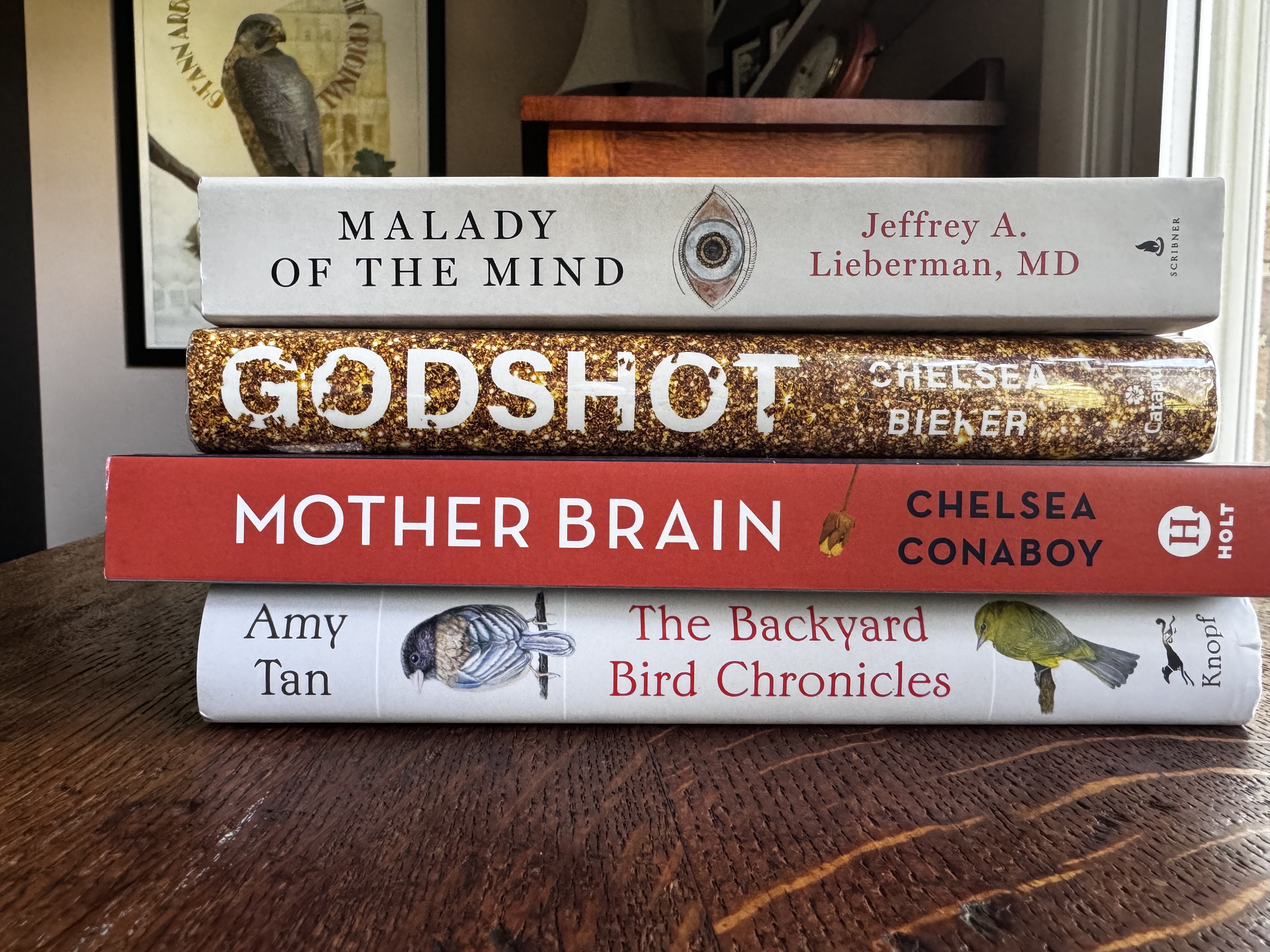
Recent acquisitions.

On some level, I always knew May, June, and July were going to be busy, probably stressful. It’s no surprise, then, that I remain behind on my Shakespeare in a Year project and have strayed far afield of my Latin goal. Still, I generally make time to read.

Girl A (Abigail Dean; 2021)
Day One (Abigail Dean; 2024)
Borrowed from the library. Reviews here and here.

NeuroTribes: The Legacy of Autism and the Future of Neurodiversity (Steve Silverman; 2015)
Read with my daughter. Related link here.

Trust (Hernan Diaz; 2022. Fiction.) RFS
Read with UCSC’s The Deep Read. Visit their site for faculty lectures, reading notes, and more.

The Story of a New Name (Elena Ferrante; 2012)
“So much drama!” my reading friend and I texted to one another as we read the second of the Neapolitan Novels. But what if the author has disguised her commentary on the volatile nature of female relationships and the life of the mind in a melodramatic mix of misogyny, abuse, poverty, and small meannesses? She engages readers in the book equivalent of a soap opera, then levels them with sly observations.

The Ministry of Time (Kaliane Bradley; 2024)
Part Kate and Leopold and part (somewhat messy) dissection of the nature of power, this novel didn’t impress me as it has others.

An American Dreamer: Life in a Divided Country (David Finkel; 2024)
Review here.

One of Ours (Willa Cather; 1923)
Read from the shelves. As I’ve mentioned, I’m (re)reading Cather’s novels, one each month in chronological order. The (inevitable) conclusion of this one, which earned the Pulitzer Prize, gutted me.

I’m So Glad We Had This Time Together (Maurice Vellekoop; 2024)
Vellekoop’s art is terrific and the story, compelling, but this memoir was too long by about 225 pages.

April in books

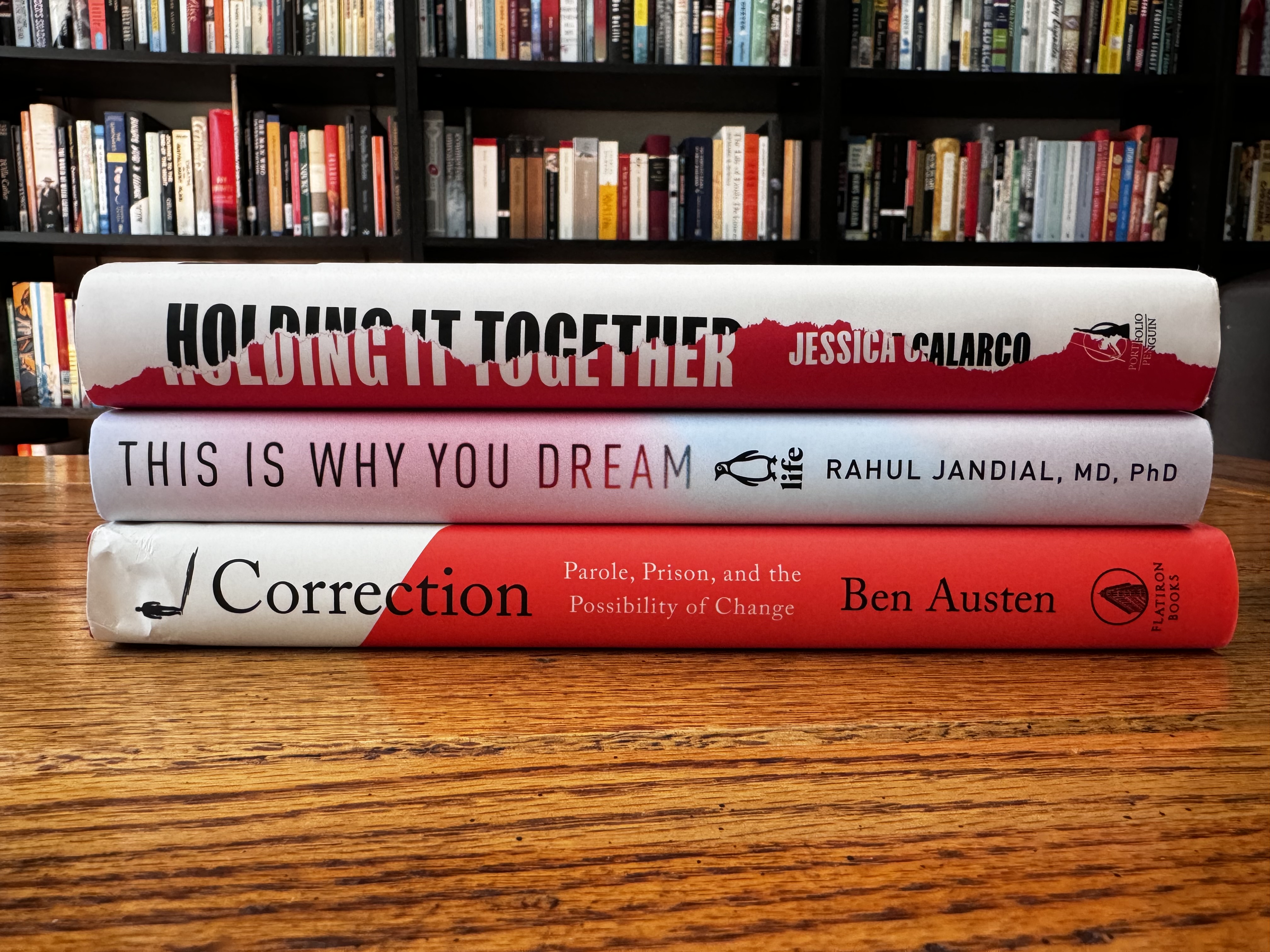
The books pictured above were part of last weekend’s haul from two favorite independent bookstores: Literati and the Dawn Treader, but it will be a while before I get to them. This morning I will finish Hernan Diaz’s Trust for UCSC’s The Deep Read and likely turn to Elena Ferrante’s The Story of a New Name for an ongoing reading project with a friend.

Here are the books I read in April:

■ Adventures of Huckleberry Finn (Mark Twain; 1885)
■ James (Percival Everett; 2024)
In March, John Warner of Biblioracle wrote, “I almost cannot imagine a future where teachers assign ‘The Adventures of Huckleberry Finn’ without also assigning ‘James’ alongside it. Doing such a thing would be an amazing opportunity for discussion and learning for students of any age.” Agreed. Last month, I reread Adventures of Huckleberry Finn for a Newberry Library course. At the first meeting, participants agreed to add James to the syllabus, and at our final meeting, with only one exception, we agreed that the discussion and experience were richer for having read both novels.

■ Love’s Labor’s Lost 
■ Romeo and Juliet 
April and now May have been much busier and more random than I prefer, so while I have not abandoned my third Shakespeare in a Year project, I have definitely fallen behind. 

■ My Ántonia (Willa Cather; 1918)
I have not, however, fallen behind on my Cather project (i.e., read her twelve novels in publication order, one per month). It has been about thirty-five years since I first encountered My Ántonia, so when I sat down with it last month, I remembered little more than how much I admired Cather’s style. Well. My younger self had good reading taste if poor retention: This book is perfect.

■ Rosencrantz and Guildenstern Are Dead (Tom Stoppard; 1966)
Reread in anticipation of the well-reviewed Court production. (Review here.)

■ The Lifted Veil (George Eliot)
A friend hosted a small group to discuss this slim work — an atmospheric novella with a wildly unreliable narrator that shares more characteristics with Robert Louis Stevenson’s Strange Case of Dr. Jekyll and Mr. Hyde than with any of Eliot’s own novels.

■ Sociopath: A Memoir (Patric Gagne)
■ This American Ex-Wife: How I Ended My Marriage and Started My Life (Lyz Lenz)
Both of these non-fiction titles were published this year, and both interested me enough to read now rather than later. Reviews here and here.

March in books

■ Henry VI, Part 2  
■ Henry VI, Part 3 
■ Julius Caesar 
■ The Comedy of Errors 
Keeping up with my “Shakespeare a in Year” plans.

■ Poverty, By America (Matthew Desmond; 2023. Non-fiction.)
Evicted: Poverty and Profit in the American City (2016) was more penetrating, but this is an excellent primer. 

■ Such a Fun Age (2019) 
■ Come and Get It (2024)
Both of these novels by Kiley Reid are compulsively readable. 

■ The Guest Cat (Takashi Hiraide; 2001/2014. Fiction) 
What a quiet and poignant exploration of loss, grief, and marriage.

■ Girl in the Blue Coat (Monica Hesse; 2016. Fiction.)
Last month, a friend observed, “You have not said a word about the book, which perhaps is saying plenty.” It is.

■ The Song of the Lark (Willa Cather; 1915) 
Fred? Why? This among other head-scratchers, including the the depiction of Thea’s professional development through the eyes of the men in her life rather than her experience. Still, my Cather project is delighting me.

■ My Brilliant Friend (Elena Ferrante; 2012) 
Speaking of delight, I am reading the Neapolitan novels with a friend. These are the sort of books that define why I love to read — to learn, to discover, yes, but sometimes simply to become absorbed, even a bit lost in another place, other lives. 

■ A Streetcar Named Desire (Tennessee Williams; 1951) 
Read in anticipation of seeing this excellent production.

■ Beowulf: A New Translation (Maria Dahvana Headley; 2021)
I’m with this reviewer: Read it now.

February in books

The Two Gentlemen of Verona (1589)
The Taming of the Shrew (1590)
Titus Andronicus (1593)
Henry VI, Part 1 (1591)
As I mentioned last month, Marjorie Garber’s Shakespeare After All is my guide to the 2024 edition of “Shakespeare in a Year.”

■ Women We Buried, Women We Burned (Rachel Louise Snyder; 2023. Non-fiction.)
Review here.

■ The Casebook of Sherlock Holmes (Sir Arthur Conan Doyle; 1927. Fiction.)
These are regularly referred to as the weakest of the stories, but I was well entertained by them.

■ O Pioneers! (Willa Cather; 1913. Fiction.)
This was the second in my quest to read (in some cases, reread) one of Cather’s twelve novels each month in chronological order.

■ Essays of E.B. White (E.B. White; 1977. Non-fiction.)
Earlier this month, I resurfaced from a multi-month deep dive into White’s work. We concluded with the essays in the last third of this collection, which, apart from “Once More to the Lake” and “Will Strunk,” were much less compelling (dare I say, “weaker”?) than the other selections.

■ The Elements of Style (William Strunk Jr. and E.B. White; 2000. Non-fiction.)
Of course, I reread this classic after finishing White’s essays.

Wrong Place, Wrong Time (Gillian McAllister; 2022. Fiction.) RFS
Predictable but entertaining.

■ The Puppets of Spelhorst (Kate DiCamillo; 2023. Fiction.)
Although I am not as big a fan of DiCamillo as the dear friend who gave me this book, I appreciated it, especially the lovely illustrations.

■ The Magic Mountain (Thomas Mann; 1924. Fiction.)
■ Thomas Mann’s The Magic Mountain: A Reader’s Guide (Rodney Symington; 2011. Non-fiction.)
The final meeting on this is next week. Among other things, my heavily annotated copy bears witness to my attempts to converse with this difficult novel of ideas.

Often I am able to chat with one or both of my daughters while I am out walking. They always inquire how I’m doing, and when the temps soar above seventy or, conversely, when the sidewalks have iced over, I routinely reply, “Today I like having walked much better than walking.” About The Magic Mountain, I will share that I like having read it much better than reading it.

January in books

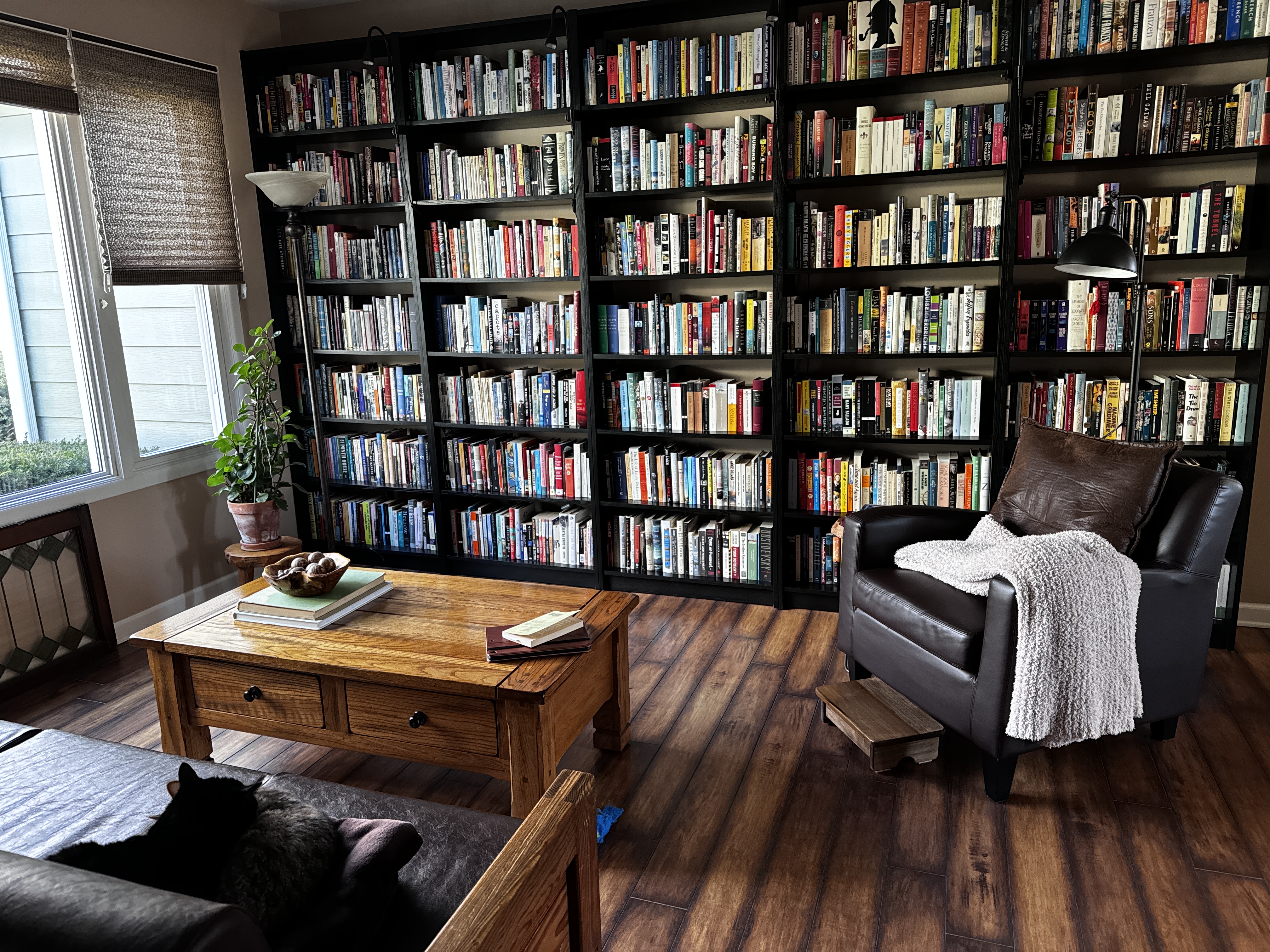
For the first and only time, the forever home apparently qualifies as a “trend.”

All the Sinners Bleed (S.A. Crosby; 2023. Fiction.)
Read from the shelves. This was one of the few on President Obama’s 2023 list that I hadn’t already acquired or considered when the list was published. The reviews were so favorable that I was surprised by how thin I found it.

The Pallbearers Club (Paul Tremblay; 2022. Fiction.)
Read from the shelves. Perhaps it is time to acknowledge that the success and originality of 2015’s A Head Full of Ghosts was singular.

The Master and Margarita (Mikhail Bulgakov; 1967. Fiction.)
Read from shelves with Night School Bar. The Burgin and Tiernan translation is unmatched.

The Michigan Murders (Edward Keyes; 1976. Non-fiction.)
Read from the shelves. This is a true-crime classic.

God Is an Octopus: Love, Loss, and a Calling to Nature (Ben Goldsmith; 2023. Non-fiction.)
Read from the shelves. Again, I experienced a disconnect between the favorable reviews and my… indifference. Following the death of his teenaged daughter, Goldsmith explored numerous spiritual belief systems as he grieved and recommitted to environmental issues (e.g., rewilding). In every way, this is a book that seems written for me, but finishing it felt like an obligation.

An Immense World: How Animal Senses Reveal the Hidden Realms Around Us (Ed Yong; 2022. Non-fiction.)
Read from the shelves with the Sci Fri Book Club.

Neon Paradise (G. —; 2024 (unpublished). Drama.)
A dear friend asked me to be an early reader. The material is original and compelling, and I am excited to see where this project goes.

Alexander’s Bridge (Willa Cather; 1912/1922. Fiction.)
(Re)read from the shelves. Cather penned twelve novels. I’ve decided to read (in some cases, reread) one each month in chronological order.

The Latinist (Mark Prins; 2022. Fiction.)
Read from the shelves. Who knew how riveting a book about a classics scholar finishing her doctoral studies could be?

The Penelopiad (Margaret Atwood; 2005. Fiction.)
(Re)read from the shelves in anticipation of seeing this.

Burn It Down: Power, Complicity, and a Call for Change in Hollywood Bridge (Maureen Ryan; 2023. Fiction.)
Read from the shelves. What a terrific book! Related link.

Richard III (William Shakespeare; 1594. Drama.)
(Re)read from shelves. For the 2024 edition of “Shakespeare in a Year,” Marjorie Garber’s Shakespeare After All is my guide, but I began with Richard III in anticipation of this.