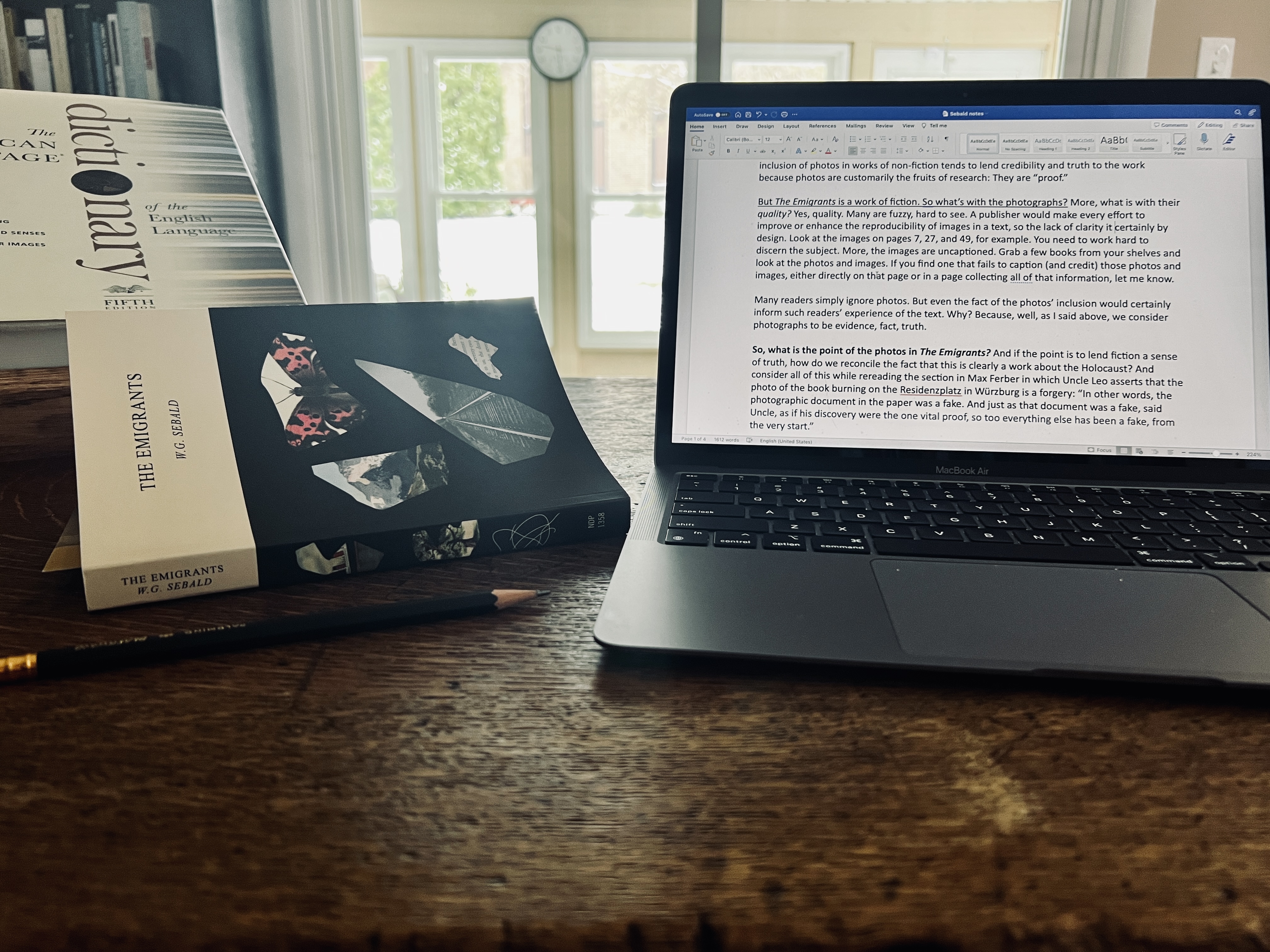
A reading group guide for The Emigrants


An introduction of sorts
If you’ve been visiting this site for a while, you know I am drawn to Anselm Kiefer’s extraordinary painting Midgard. Last year, when I read The Emigrants for the first time, I connected the ways in which W.G. Sebald’s prose moved me to the ways in which Midgard acts on my imagination; both works are now housed in the same room in my imagination.

Not one to be content with simply sensing the artistic pairing, though, I poked around a bit. Plenty on this topic can be found in academic article databases, but here’s something succinct from The Nation (August 2016):

“The link between artistic creation and failure is intimate in the best of cases, but nowhere is this sense of inadequacy more acute than in literature or art about the Holocaust, which erects, by its own lights, a series of failed monuments to an event that is fundamentally illegible. To memorialize a tragedy, one must inscribe unmistakable significance into reticent materials, attempting to curb the natural processes of forgetting and obsolescence. In this way, acts of aestheticization are exercises in misrepresentation, requiring us to arrange neutral resources into artificially beautiful or meaningful configurations. But can we misrepresent without also misleading, mangling? These questions rightfully obsess a generation of postwar German-language writers and artists, most notably the author W.G. Sebald, who was born in 1944 in Bavaria and died in the UK in 2001, and the visual artist Anselm Kiefer, born one year later in the neighboring state of Baden-Württemberg, and since 1992 a resident of France.” [Emphasis added]

Naturally, I then spent more time with Kiefer’s work. If you’re interested in how artistic expressions can intersect, give Anselm Kiefer a google. Does his work evoke in you the same unease Sebald’s prose does?

Speaking of unease, in many of the reading groups in which I have participated in the last few years, we have been exhorted to focus exclusively on the text we share. I hear that, but as a former teacher and as an engaged reader, I can also see numerous shortcomings in such a reading, not the least of which would be the disadvantages of a lack of context. If I were in the middle of a deserted island and The Emigrants fell from the sky and thwocked me in the head, presuming I knew enough of the world, I could glean a great deal from the text alone. But wouldn’t a bit of a frame enrich the reading? For example, doesn’t the information from The Nation article quoted above provide helpful context? 

____________________

It has been suggested that what writers and artists say about their own work — in interviews, for example, or autobiographies – is largely unreliable, primarily because much of their “interpretation” is simply storytelling (or, in the case of, say, Ernest Hemingway, mythologizing) or reinterpreting past work to dovetail current efforts. In her biography of Sebald (Speak, Silence: In Search of W.G. Sebald, 2022), Carol Angier dismantles many of the lies Sebald perpetrated stories Sebald told not only about his own life but about the sources of his work — and the latter in particular is kind of a big deal. Authors are invariably asked some version of, “Where do you get your ideas?” Sebald was (beyond) slippery in his answers, and simply skimming a few articles (here, here, and here) provides some clues as to why. Were these stories his to tell?

Context has its merits.

What follows next are a few questions that may prove helpful in a discussion of The Emigrants. Feel free to add your own in the comments.

What do we make of the epigraphs? They’re unattributed and enigmatic.

DR HENRY SELWYN: “And the last remnants memory destroys” (Doesn’t memory preserve?)

PAUL BEREYTER: “There is a mist that no eye can dispel” (Blindness, memory, trauma?)

AMBROS ADELWARTH: “My field of corn is but a crop of tears” (Trauma?)

MAX FERBER: “They come when night falls to search for life” (Ghosts? Memories? Dreams?)

What is the purpose of the photographs? Typically, we consider photographs “evidence” or “fact.” (Apparently, a line of philosophical inquiry disputes this, which is cool, but I am talking about our general experience of physical photographs. After all, when someone shares a school photo of her granddaughter, we don’t ordinarily enter into a discussion about the truth-value of representational photography.) The inclusion of photos in works of non-fiction tends to lend credibility and truth to the work because photos are customarily the fruits of research: They are “proof.” 

But The Emigrants is a work of fiction. So what’s with the photographs? More, what is with their quality? Yes, quality. Many are fuzzy, hard to see. A publisher would make every effort to improve or enhance the reproducibility of images in a text, so the lack of clarity is certainly by design. Look at the images on pp. 7, 27, and 49, or on pp. 158, 159, and 168, for example. You need to work hard to discern the subject. More, the images are uncaptioned. Grab a few books from your shelves and look at the photos and images. If you find one that fails to caption (and credit) those photos and images, either directly on that page or in a section collecting that information, let me know.

Many readers simply ignore photos, but the photos’ inclusion alone would still inform such readers’ experience of the text. Why? As I said above, we consider photographs to be evidence, fact, truth.

So, what is the point of the photos in The Emigrants? And if the point is to lend a fictional narrative a sense of truth, how do we reconcile the fact that this is clearly a work about the Holocaust? And consider all of this while rereading the section in Max Ferber in which Uncle Leo asserts that the photo of the book burning on the Residenzplatz in Würzburg is a forgery (p. 1830: “In other words, the photographic document in the paper was a fake. And just as that document was a fake, said Uncle, as if his discovery were the one vital proof, so too everything else has been a fake, from the very start.” If we use photos to signal truth, don’t faked or forged photos deny truth?

Finally, note that The Emigrants concludes with an extended meditation on pictures from an exhibition the narrator of the Ferber section saw in Frankfurt (pp. 235-237): “color photographs, tinted with a greenish-blue or reddish-brown.” 

Who is the narrator of The Emigrants? Is it the same person in all four sections? Is the narrator a stand-in for Sebald, or is something more complicated occurring? In the margin of p. 75, I wrote, “Oral histories,” which made me think of singers in the Iliad and the Odyssey and the way in which stories are passed in an oral tradition. Passages to consider:

From Bereyter, p. 29: “And so, belatedly, I tried to get closer to him, to imagine what his life was life….” Why? The writer’s instinct? This whole page is sort of depressing, right? It’s as if the narrator is colluding in Paul’s destruction. He (the narrator) is moved to empathy and connection “belatedly” and with the object of parlaying it into a story, his story. His medium is others’ pain, trauma.

Also on that page: “It is in order to avoid this sort of wrongful trespass that I have written down what I know of Paul Bereyter.” And with that we are introduced to a narrator who thinks there is a “rightful” trespass of someone else’s story.

And on p. 224, this: “[A]nd now as I write these lines, it feels as if I had lost her, and as if I could not get over the loss.” So. Let’s revisit the question from the piece I linked above: Can one misrepresent without also misleading, mangling? 

What is this work saying about nature? From Selwyn, p. 7: “Nature itself was groaning and collapsing beneath the burden we placed upon it.” It seems as if this is one of Sebald’s chief themes – nature brutalized by man (e.g., Manchester and industrialization in Max Ferber); nature reasserting itself amid the ruins of man’s architecture (the hospital in Ambros Adelwarth); nature as largely inscrutable. Passages to consider:

From Bereyter, p. 45: “… [O]n this occasion, Paul, in a conjecture she felt to be most daring, had linked the bourgeois concept of Utopia and order, as expressed in the designs and buildings of Nicolas Ledoux, with the progressive destruction of natural life.”

From Adelwarth, p. 110: “… I have spent my life out of doors here, in the boathouse or the apiary, depending on the weather, and I no longer concern myself with what goes on in the so-called real world. No doubt I am now, in some sense, mad; but, as you may know, these things are merely a question of perspective.” Dr Abramsky lives on the decaying site of the hospital; nature is reclaiming the horror man built. (Side note: Why might the narrator know that these things are merely a question of perspective?)

p. 137: “Decay, nothing but decay, marasmus, and emptiness. Not a sign of any business of industry.”

p. 140: “Cosmo says repeatedly that he is horrified by the city.”

From Max Ferber, p. 150: “… a city spread across a thousand square kilometres, built of countless bricks and inhabited by millions of souls, dead and alive.”

p. 151: “One might have supposed that the city had long since been deserted, and was left now as a necropolis or mausoleum.”

p. 156: “On those wanderings, when winter light flooded the deserted streets and squares for the few hours of real daylight, I never ceased to be amazed by the completeness with which anthracite-coloured Manchester, the city from which industrialization had spread across the entire world, displayed the clearly chronic process of its impoverishment and degradation to anyone who cared to see.” Perhaps this will interest no one but me, but does the “its” in that perfect if bleak sentence refer to the city or industrialization? How well it works as either!

Similarly, what is this work saying about trauma and despair? Passages to consider:

From Selwyn, p. 21 (Selwyn is speaking): “But I have never been able to bring myself to sell anything, except perhaps, at one point, my soul.” __ and __ “The years of the second war, and the decades after, were a blinding bad time for me, about which I could not say a thing even if I wanted to.”

From Selwyn, p. 23 (the narrator is speaking): “But certain things, as I am increasingly becoming aware, have a way of returning unexpectedly, often after a lengthy absence.” __ and __ “And so they are ever returning to us, the dead. At times they come back from the ice more than seven decades later and are found on the edge of the moraine, a few polished bones and a pair of hobnailed boots.”

From Bereyter, p. 42: Describing Paul as “… desolation itself.”

p. 44: “… Paul, who was almost consumed by the loneliness within him….”

p. 55: “… and doubtless saw more than any heart or eye can bear.”

p. 58: “Paul copied out hundreds of pages, mostly in Gabelsberg shorthand because otherwise he would not have been able to write fast enough, and time and again one comes across stories of suicide. It seemed to me, said Mme Landau, handing me the black oilcloth books, as if Paul had been gathering evidence, the mounting weight of which, as his investigations proceeded, finally convinced him that he belonged to the exiles and not to the people of S.”

p. 61: “It is hard, said Mme Landau, when I told her about those railway lessons, in the end it is hard to know what it is that someone dies of.”

From Adelwarth, p. 99: “At that time he had no interest in talking about the past at all.” (This section opens with depiction upon depiction of sorrow and loss in his extended family.)

p. 102: “At any rate, the more Uncle Adelwarth told his stories, the more desolate he became.”

p. 111: Dr Abramsky describes Adelwarth: “Nonetheless, even when he was simply standing at the window looking out he always gave the impression of being filled with some appalling grief. I do not think, said Dr Abramsky, that I have ever met a more melancholy person than your great-uncle; every casual utterance, every gesture, his entire deportment (he held himself erect until the end), was tantamount to a constant pleading for leave of absence.”

p. 113: Dr. Abramsky on Adelwarth: “… [T]hat docility, as I was already beginning to suspect, was in fact due simply to your great-uncle’s longing for an extinction as total and irreversible as possible of his capacity to think and remember.”

From Max Ferber, p. 161: “There was nothing he found so unbearable as a well-dusted house, and he never felt more at home than in places where things remained undisturbed, muted under the grey, velvety sinter left when matter dissolved, little by little, into nothingness.”

p. 170: Max Ferber is speaking: “… I gradually understood that, beyond a certain point, pain blots out the one thing that is essential to its being experienced – consciousness – and so perhaps extinguishes itself; we know very little about this. What is certain, though, is that mental suffering is effectively without end. One may think one has reached the very limit, but there are always more torments to come. One plunges from one abyss into the next.”

p. 191: “Naturally, I took steps, consciously or unconsciously, to keep at bay thoughts of my parents’ sufferings and of my own misfortune, and no doubt I succeeded sometimes in maintaining a certain equability by my self-imposed seclusion; but the fact is that that tragedy in my youth struck such deep roots within me that it later shot up again, put forth evil flowers, and spread the poisonous canopy over me which has kept me so much in the shade and dark in recent years.”

What is Sebald saying about memory (which is, of course, inextricably linked to any discussion of trauma and despair)? Passages to consider:

From Selwyn, p. 17: “Kaspar, to the delight of his mentor, was distinguishing for the first time between dream and reality, beginning his account with the words: I was in a dream, and in my dream I saw the Caucasus.”

From Bereyter, p. 50: “Do you know, she said on one of my visits to Yverdon, the systematic thoroughness with which these people kept silent in the years after the war, kept their secrets, and even, I sometimes think, really did forget, is nothing more than the other side of the perfidious way in which Schöferle, who ran a coffee house in S, informed Paul’s mother Thekla, who had been on stage for some time in Nuremberg, that the presence of a lady who was married to a half Jew might be embarrassing to his respectable clientele….”

p. 51: “He said that he could see things with the greatest clarity, as one sees them in dreams, things he had not thought he still had within in him.”

p. 63: “The disquiet I experienced because of that momentary failure to see what was meant – I now sometimes feel that at that moment I beheld an image of death – lasted only a very short time, and passed over me like the shadow of a bird in flight.”


From Adelwarth, p. 100: “… Uncle Adelwarth had an infallible memory, but that, at the same time, he scarcely allowed himself access to it. For that reason, telling stories was as much a torment to him as an attempt at self-liberation. He was at once saving himself, in some way, and mercilessly destroying himself.”

p. 145: “Memory, he added in a postscript, often strikes me as a kind of dumbness. It makes one’s head heavy and giddy, as if one were not looking back down the receding perspectives of time but rather down on the earth from a great height, from one of those towers whose tops are lost to view in the crowds.” (Consider this powerful observation in light of the work Uncle Kasimir did (p. 85). “Have you got a head for heights?”)

From Max Ferber, p. 181: “Ferber commented that, purely in terms of time, I was now as far removed from Germany as he had been in 1966; but time, he went on, is an unreliable way of gauging these things, indeed it is nothing but a disquiet of the soul. There is neither a past nor a future. At least, not for me. The fragmentary scenes that haunt my memories are obsessive in character. When I think of Germany, it feels as if there were some kind of insanity lodged in my head. Probably the reason why I have never been to Germany again is that I am afraid to find that this insanity really exists.”

p. 207: In Luisa’s memoir: “Only when you hold your own breath do they return from death to life, only then does time begin to pass again. Time. What time was all that? How slowly the days passed then! And who was that strange child, walking home, tired, with a tiny blue and white jay’s feather in her hand?”

p. 225: “…I felt increasingly that the mental impoverishment and lack of memory that marked the Germans, and the efficiency with which they had cleaned everything up, were beginning to affect my head and my nerves.”

What did you make of the work’s editorial style and the appearance of the pages? Did you notice the length of the paragraphs? Their arbitrary divisions or lack thereof (e.g., the bottom of p. 176)? The unusual punctuation breaks (e.g., the em dashes on pp. 38 and 220, which could have simply been paragraph breaks)? I wonder if the appearance or form of the pages – the lengthy paragraphs, the enigmatic punctuation “pauses,” the uncaptioned, blurry images – is meant to convey the shape of memory and/or dream, which would not be as, for lack of better words, rigid or strictly shaped as a lived event. Did you also notice that nothing is quoted? Long passages of people telling the narrator stories occur sans quotation marks. Why? What effect does that produce?

Did you notice the nods to Nabakov? See. pp. 16, 43, 104. It is possible that most of the references to men and butterflies regard Nabakov (e.g., pp. 115, 174, 214).

Other notes and questions

  • Apart from all of the other trauma they have experienced, the notable loves of both Selwyn and Adelwarth were men – men they then lost. 
  • What do you make of the narrator’s elaborate dream in the Ambros Adelwarth section, beginning on p. 121?
  • Sebald relied on lists (e.g., p. 130 (“Acacias, cork oaks, sycamores, eucalypts, junipers, laurels…”). Take a look at the list of religious institutions beginning on p. 137 and continuing through p. 140 or of occupations and surnames on p. 191 and 192. Is it an affectation, or is he making a point? If the latter, what is it? 
  • Max Feber’s work in charcoal (pp. 161 to 162) resembles the narrator’s writing process (p. 230).
  • References to a mental asylum, pigeons, and an anarchic school teacher in the Ferber section (p. 189) neatly anchor the narrative to the Abelwarth, Selwyn, and Bereyter stories, respectively.
  • Why are Elaine (Selwyn) and Kathinka (Ferber) such diminished, broken characters?
  • Dr Abramsky gestures with a goose wing (Abelwarth, p. 115), Kathinka wears a bonnet featuring a seagull wing (Ferber, p. 196), and Luisa carries a jay feather (Ferber, p. 207). I don’t like to Mrs.-Grimm-the-English-teacher every symbol, but this seems significant, particularly when one considers the passage from the Bereyter section (p. 63), quoted above and repeated here: “The disquiet I experienced because of that momentary failure to see what was meant – I now sometimes feel that at that moment I beheld an image of death – lasted only a very short time, and passed over me like the shadow of a bird in flight.”
Acquisitions

After a week of sun and temperatures in the seventies and eighties, we were reminded afresh of the fickle nature of spring on the prairie when we awoke to an inch of snow and sidewalks slippery enough to end our morning walk before it began. That’s all right. Tomorrow night I will lead a book discussion on W.G. Sebald’s The Emigrants, so I spent the time editing my notes and then shaping them into an entry I could post here.

Pages remaining: 75

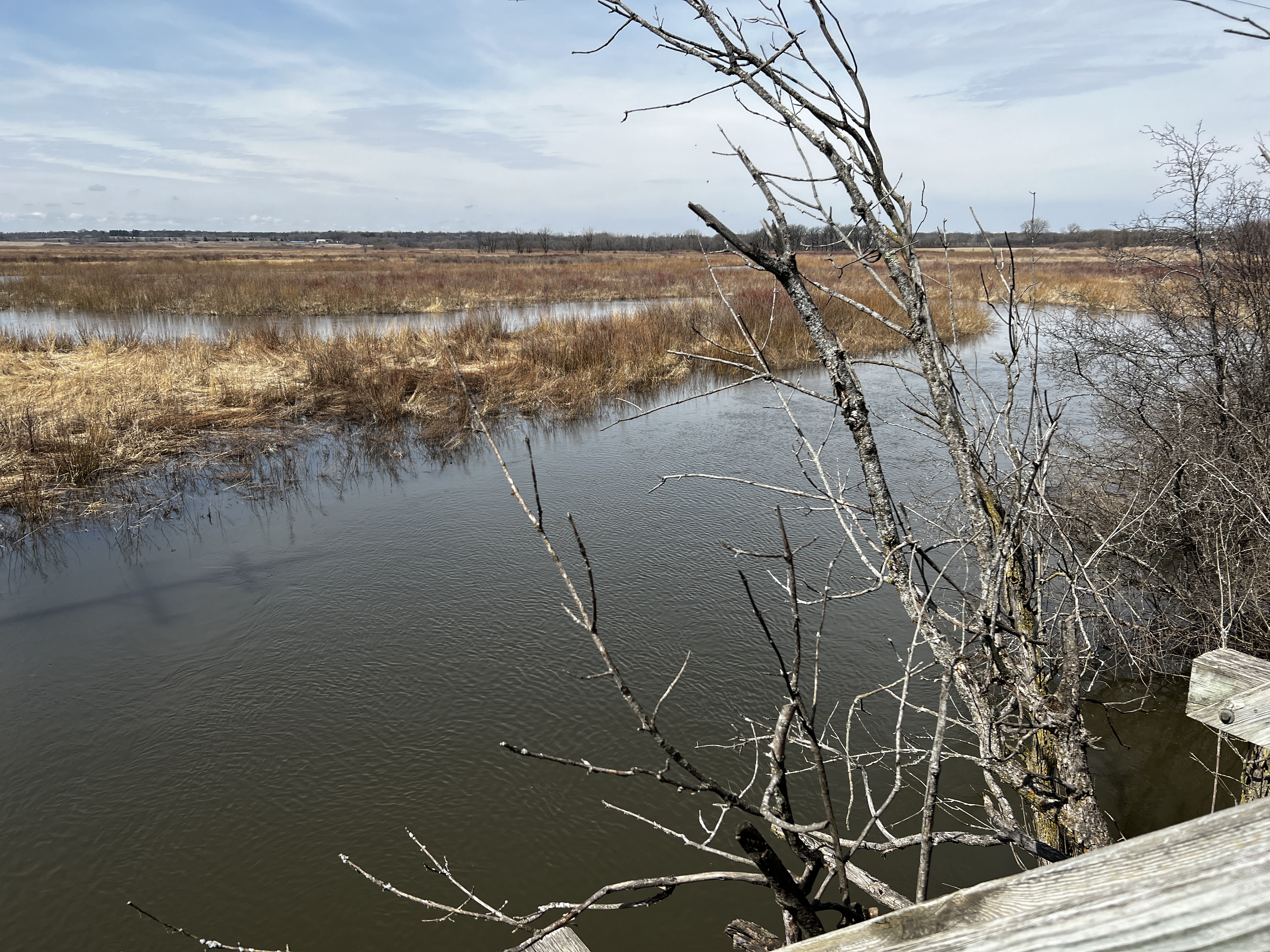
Image captured on this morning’s walk.

Offered by Open Yale Courses, Cervantes’ Don Quixote includes twenty-four lectures delivered by Professor Roberto González Echevarría, who was, at the time the course was recorded (2009), the Sterling Professor Emeritus of Hispanic and Comparative Literature at Yale. I have only had time to listen to the introductory lecture and the beginning of the second, but wow! What erudition, insight, and humor! The professor’s Cervantes’ Don Quixote: A Casebook was already on my shelves, but I have also picked up the book that collects the text of the lectures.  

One takeaway from early in Lecture 2: The professor defines a romance as “a story with a linear plot and unchanging characters,” whereas novels “are works in which there is a clash between the protagonists and the settings in which they move […] and in which the characters evolve as a result of the actions in which they are involved.” Have Don Quixote and Sancho Panza evolved? If so, how?

Marginalia

On page 772: “… [H]e was foolish, unpolished, and plump….” My older daughter has recently discovered the charms of Parks and Recreation. As were her sister and I, she is rather outraged by the way otherwise dear characters treat Jerry. Advising that spoilers may prohibit her from reading the entire piece right now, I sent her a 2015 article from The Atlantic, “And the Meek Shall Inherit Pawnee.” From the conclusion: “We are all, basically, Jerry. We are all flawed and farty and meek. Our faces will all, at some point, be symbols of failure. They will all, at some point, be covered in pie.” As we near the conclusion of Don Quixote, I wonder if we are not all, basically, Sancho – flawed, farty, meek, and now keenly aware that a good meal (or pie) and a loyal pet beat a governorship any day.

On page 774: “[D]eceptions become the truth, and deceivers find themselves deceived.” Those of you who speak Spanish already knew this, but according to the Encyclopedia Britannica, the name Barataria is derived from the Spanish word meaning “to deceive.” Since this is not an academic paper, I will share that a quick peek at Wikipedia indicated that it is derived from barato, which actually means “cheap.” Deception, cheating – either is apt, right? (And, yes, perhaps a footnote already addressed this, but I finally identified the pun this week.) 

On page 785: The Duchess signs her letter to Teresa, “Your friend who loves you.” I wrote in the margin, “Is this true, kind?” It does seem as if she treats Teresa with less cavalier cruelty than she has treated Sancho.

On page 814: May time be on my side this week because I would really like to give the structure of Part II the same analysis I applied to Part I. When Sancho is reacquainted with the Moor Ricote, I wondered if Cervantes was mirroring characters we met in Part I.

On page 818: Trapped beneath the ground, Sancho laments that his master, while in the enchanted Montesinos, “saw beautiful and peaceable visions….” What does Sancho now believe about Don Quixote’s experience?

On page 836: Don Quixote describes two kinds of beauty and acknowledges that he may not be handsome but that “it is enough for a virtuous man not to be a monster….” Don Quixote is growing old before our readerly eyes, isn’t he?

General observation: Roque Guinart merits his own spin-off.

“The solitude of the hero is a sad thing!”

Along the prairie trail this past weekend.

This week’s reading delivers what must be one of the novel’s most poignant moments: “It is recounted that as soon as Sancho left, Don Quixote felt lonely for him, and if it had been possible for him to revoke the squire’s mandate and take the governorship away from him, his master would have done so” (p. 739). Theirs may be, in contemporary terms, a somewhat toxic co-dependency, but the sparring knight and squire are one another’s person – or, perhaps more accurately, the squire is the knight’s person. After all, what is Don Quixote sans Sancho Panza? What happens when a knight confronts a lion and survives, but his squire is not present to witness (and potentially retell) the adventure? 

From the edges of painful absence, the Knight of the Lions begs leave of the Duchess – “he withdrew to his chamber alone, not permitting anyone to come in to serve him…” (p. 741) – and promptly ruins his stocking. Readers have been aware of Don Quixote’s material poverty for nearly eight hundred pages, but this bitter blend of need and loneliness hurts, doesn’t it? In Our Lord Don Quixote, Miguel de Unamuno asks, “How indeed could he have avoided feeling his solitude, since Sancho was the whole of humanity for him, and it was in Sancho that he loved all men? How could he not feel lonely, when Sancho had been his confidant […]? Was not the mysterious secret of his life something between the two of them alone? Without Sancho, Don Quixote is not Don Quixote, and the master has greater need of the squire than the squire of the master. The solitude of the hero is a sad thing!” (pp. 223-224) Yes, it is, and if Cervantes has somehow failed to appeal to our better natures prior to Sancho’s departure, he handily succeeds in Chapter XLIV. 

This week, I have been reading Of Human Kindness: What Shakespeare Teaches Us About Empathy (Paula Marantz Cohen; 2021). Cohen builds on Harold Bloom’s assertion that Shakespeare “‘invented the human’ – a reference to the rich interior lives of his characters” by arguing, “[T]his human dimension also involves an intimate connection to us, who study him. Shakespeare invented complex individuals who elicit empathy,whom we, audience or readers, feel for even when they fall outside the realm of our experience” (p. 3). Perhaps because the Grossman translation of Don Quixote includes Bloom’s introduction, or perhaps because I have read the plays so often, I have been a bit obsessed with the idea that Shakespeare and Cervantes were, at the same moment in history, (re)writing the characters whose names alone now serve as shorthand for aspects of human experience (e.g., Macbeth, Hamlet, Lear, Romeo, Falstaff, Brutus, Don Quixote). The passage “Don Quixote felt lonely for him” elicited in me the same throat-lump empathy as “I know thee not, old man” (Prince Hal – now King Henry V – to former companion Falstaff in Henry IV, Act V, Scene 4); “O, reason not the need!” (Lear to Regan in King Lear, Act II, Scene 4); and “[T]he rest is silence” (Hamlet to Horatio in Hamlet, Act V, Scene 2).

Speaking of Hamlet, Don Quixote’s advice to Sancho Panza (Chapters XLII and XLIII) reads like a nuanced version of Polonius’ speech to Laertes in Hamlet, Act I, Scene 3, beginning, “And these few precepts in thy memory – Look thou character. Give thy thoughts no tongue, any unproportion’d thought his act. Be thou familiar, but by no means vulgar.” And still speaking of Shakespeare, the manner in which the Duke and Duchess toy with the knight and squire initially reminded me of the laughter and sport Theseus and Hippolyta and the two couples enjoy at the expense of the “rude mechanicals” in A Midsummer Night’s Dream, but when I reread Act V, Scene 1, I realized that, in fact, Theseus leans more toward Don Diego than the manipulative Duke and Duchess; he demonstrates tolerance and patience in accepting their performance. So, what motivates the Duke and Duchess, anyway? Does the idea of Sancho beating himself entertain them? Do their machinations represent a bid for immortality – that is, are their antics an attempt to insert themselves into the sequel of a popular novel? 

Two other notes:

(1) Is it sloppy reading on my part, or did Sancho Panza dispense with the assorted petitioners pretty handily?

(2) Near the conclusion of Chapter XLII, Don Quixote says of the squire’s tall tale about the ride on Clavileño,“…[E]ither Sancho is lying, or Sancho is dreaming.” Coupled with the chapter’s conclusion about what the knight wants Sancho to believe about his adventures in the cave, this statement admits doubt about the nature of truth in this narrative. If they build consensus around a single narrative, is it true? Even if it only occurred in their dreams or their imaginations? 

Notes on Chapters XXII through XXXIII

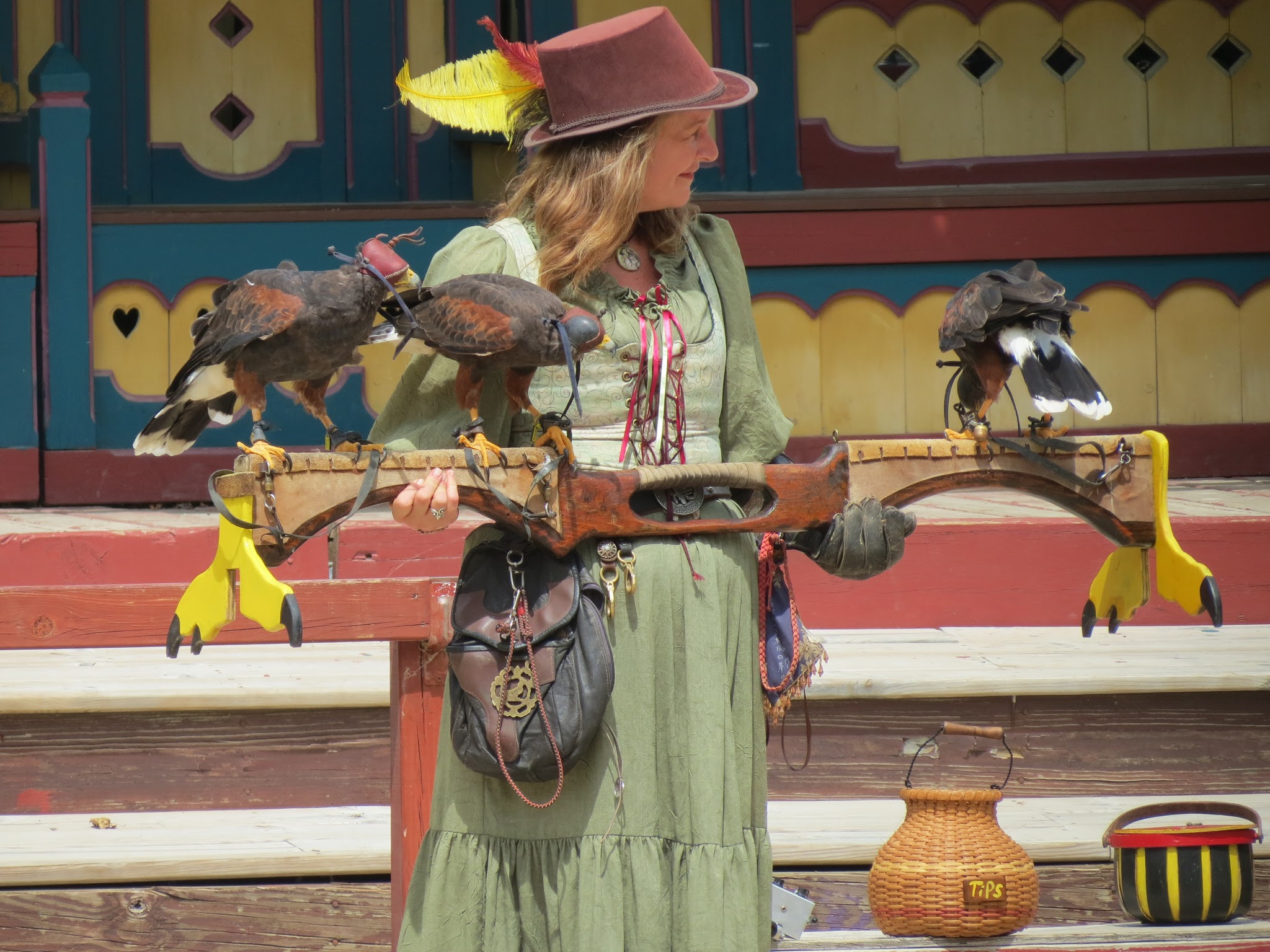
I was reminded of the image above (taken at the Bristol Renaissance Faire in September 2013) at the beginning of Chapter XXX: “[A]s he drew near he realized they were falconers. He came closer, and among them he saw a graceful lady […] dressed in green….”

Rereading Chapters XXII and XXIII

In Our Lord Don Quixote, Miguel de Unamuno invites us to reread “the narrative of the astonishing visions of Don Quixote; let him judge as he should judge, by the joy and the delight derived from the reading, and let him tell me later if these experiences are not more believable than others no less astonishing which God is said to have granted to certain of his servants, dreamers in the profound enchanted cave of ecstasy. And there is no choice but to believe Don Quixote, a man incapable of lying….”

Is Don Quixote “incapable” of lying? Again and again, I wonder about the role of “truth” and “true” in this narrative. Are dreams and visions “true”?

My marginalia for Chapter XXII includes a note about the continued abundance and kindness accorded to Don Quixote (i.e., the gifts and respect of the newlyweds); a mark around Sancho Panza’s observation, “What a devil of a knight errant you are, and what a lot of things you know!” (p. 598); and another mark around Don Quixote’s exclamation to Sancho Panza, “[T]here are some who exhaust themselves learning and investigating things that, once learned and investigated, do not matter in the slightest to the understanding or the memory” (p. 601). Oh, and regarding the length of rope: A hundred fathoms is six hundred feet or forty stories.

Last week, I described the events of Chapter XXIII as a “remarkably benign (Arthurian-inspired?) dive into the cave.” Following the required reread of these chapters, I researched my hunch about the nature of the Cave of Montesinos episode. Here are two articles that may interest others:

(1) “The Grail Quest: Imagery and Motif in the Episode at the Cave of Montesinos in ‘Don Quixote’” by Bruce Tracy. The Bulletin of the Rocky Mountain Modern Language Association, Mar., 1974, Vol. 28, No. 1 (Mar., 1974), pp. 3-9.

Tracy writes, “Cervantes has combined the Grail Quest motif with the dream vision, and ingeniously, but not adequately, integrated Dulcinea within it.”

(2) “The Subterranean Grail Paradise of Cervantes” by Philip Stephan Barto. PMLA , Jun., 1923, Vol. 38, No. 2 (Jun., 1923), pp. 401-411.

Barto notes, “That we are here dealing with the Arthurian grail-paradise is further attested by the mention of the necromancer Merlin, Queen Guinevere and Quintoniana, cupbearer to Launcelot. Even Launcelot would seem, by implication, to be here, since it is said of his cupbearer that she served him ‘when he came from Britain.’”

A few notes on Chapters XXIV through XXXIII

● I laughed aloud at Sancho’s lament, “O wedding of Camacho, O plenty in the house of Don Diego, I miss you so often!” (p. 617) One could reread this novel simply to observe the (wildly unreliable) ways in which characters mark time. 

● Also from Sancho: “Is it possible that a man who knows how to say all the many good things that he’s said here can say he’s seen the impossible foolishness that he says he saw in the Cave of the Montesinos? Well, now, time will tell.” (p. 619) Time is not the only topic about which our characters display an extraordinary lack of consistency or reliability; they also vacillate on such subjects as truth, intelligence, and sanity, among others.

● How did I know Señor Master Pedro was Ginés de Pasamonte? Was there a textual clue I am now failing to recall – perhaps in the introduction? (That is certainly a pitfall of reading a long work over many weeks while reading other books: Despite note-taking, discussion, and marginalia, some details are inevitably lost; this novel requires rereading.) Well, although the mild-mannered puppeteer betrayed nothing of the fierce persona displayed in Part I, I saw through his disguise. Also, in this episode – an echo or mirror of the attack on the wine bags (giants) – I appreciated that Don Quixote had enough money to make amends.

● While the duke and duchess certainly ply the knight and his squire with food and compliments, this is not the same abundance about which I wrote last week; this is sport at the expense of someone else’s dignity, made worse when one learns that for Don Quixote “this was the first day he really knew and believed he was a true knight errant and not a fantastic one” (p. 658). Later I cringed when Don Quixote expounds, “If knights, and the great, the generous, and the highborn considered me a fool, I would take it as an irreparable affront” (p. 666); is that not how the duke and duchess feel about him?

● Earlier this week, I finished reading Michael F. Moore’s new translation of The Betrothed, the 1827 novel by Alessandro Manzoni. In addition to an unfortunate character who collected many works of “chivalric science,” the book includes this remarkable passage: “In this manner, they wandered wherever fate might lead (hence the glorious name of knights-errant) among the poor pedestrian riffraff of city and country folk whose only weapon to ward off death and soften the blow were the rags on their backs. Ah, the knighthood! Such a beautiful, wise, and useful profession.”

Abundance

By Chapter XXIV in Part I, Don Quixote and Sancho Panza have endured – among other ignominies – ridicule, blanket-bouncing, grievous injuries, and “the tempest of stones” (p. 172) with which the galley slaves repay their freedom. Despite the measured (or, as some have suggested, darker) opening of Part II, however, this week’s reading shows the hapless heroes of our tale the faces of success, abundance, and even a degree of respect. Once he has handily dispatched Bachelor Sansón Carrasco*, Don Quixote encounters the Knight of the Green Coat (also known as Don Diego de Miranda), who, following the adventure of the lions, invites the newly renamed Knight of the Lions to his home. In this “castle,” Don Quixote and Sancho Panza enjoy such food, conversation, company, and bounty as to render this encounter a perfect inverse of their experiences at the inn in Part I.

To his son, Don Diego confides, “I can only say that I have seen him do things worthy of the greatest madman in the world, and heard him say things so intelligent that they wipe out and undo his mad acts” (p. 569), an observation that rightly describes the waffling this reader experiences when contemplating Cervantes’ intent. Following his lengthy discussion with the Knight of the Lions, Don Lorenzo is as puzzled as his father. “Once again the father and son were astonished by the mixed speech of Don Quixote, sometimes intelligent and sometimes utterly foolish, and by the persistence and perseverance of his complete devotion to the search for his misadventurous adventures, which were the object and goal of all his desires” (p. 575).

Not long after their departure from Don Diego’s home, Don Quixote and Sancho Panzo meet the licentiate and Cochuelo and learn about yet another besotted shepherd. (Pastoral alert!) The fair (of course!) Quiteria, object of Basilio’s affections, is about to marry the much wealthier Camacho, and thus our knight and squire find themselves guests in the second generous and abundant setting of Part II. With nary an interpolated novel, miscreant (here’s looking at you, Don Fernando), or mistreated woman in sight, a ruse works, Don Quixote brandishes his lance, love prevails, and, contrary to Sancho’s gloomy grousing, the abundance continues in a third location.

What book is this? Following the remarkably benign (Arthurian-inspired?) dive into the cave, that was my chief question. What am I reading? And why does the relative success of these several “misadventurous adventures” worry me – in fact, fill me with foreboding? “All things are possible,” Don Quixote tells us on page 559, but we already know – spoiler alert – the hero dies. Will his successes, such as they are, continue, or will Carrasco end them?

Other notes and marginalia

“Señor, sorrows were not made for animals but for men; but if men feel them too much, they turn into animals; your grace should restrain yourself….” (p. 521)

“[T]here is more rashness than courage in a single man attacking an army that has Death in it, and emperors fighting in person, and the help of good and bad angels….” (p. 525)

“Every day, Sancho,” said Don Quixote, “you are becoming less simple and more intelligent.” (p. 527)

“I tell you, Sancho, with your natural wit and intelligence, you could mount a pulpit and go around preaching some very nice things.” (p. 590)

The sagacity of “good Sancho, wise Sancho, Christian Sancho, sincere Sancho” (p. 526) continues to grow – perhaps because the knight’s “conversation has been the manure that has fallen on the barren soil of [Sancho’s] dry wits” (p. 528). Or perhaps because the inversions at work here are not only in the knight’s fortune?

“[S]ince I am a devil, all things are within my grasp.” (p. 523)

The scenes featuring the cart of actors put me in mind of the Player and the Tragedians in Tom Stoppard’s Rosencrantz and Guildenstern Are Dead.

“I love him with all my heart and couldn’t leave him no matter how many crazy things he does.” (p. 536)

Watson and Wilson could intone the same of Holmes and House, no? I was reminded of these dynamic pairings again on page 570, when Don Quixote described the “science” of knight errantry, a science that shares some characteristics with the art of detection.

“Certainly, Señor Sansón Carrasco, we’ve gotten what we deserved: it’s easy enough to think up and begin an enterprise, but most of the time it’s hard to end it. Don Quixote’s crazy, we’re sane, and he walks away healthy and laughing, while your grace is bruised and sad.” (p. 549)

Indeed!

“…I shall recount to you some of what I have seen down there, which will make you believe what have recounted here, whose truth admits neither argument nor dispute.” (p. 614)

And, yes, I remain fascinated by the uses and definitions of “true” and “truth” in this work.

_______________________

* Are you a Parks and Recreation fan? For some reason, from the moment of Carrasco’s introduction in Part II, I was reminded of Justin Anderson, about whom Ron wisely observes, “He’s a tourist. He vacations in people’s lives, takes pictures, puts them in his scrapbook, and moves on. All he’s interested in are stories. Basically, Leslie, he’s selfish, and you’re not, and that’s why you don’t like him.”

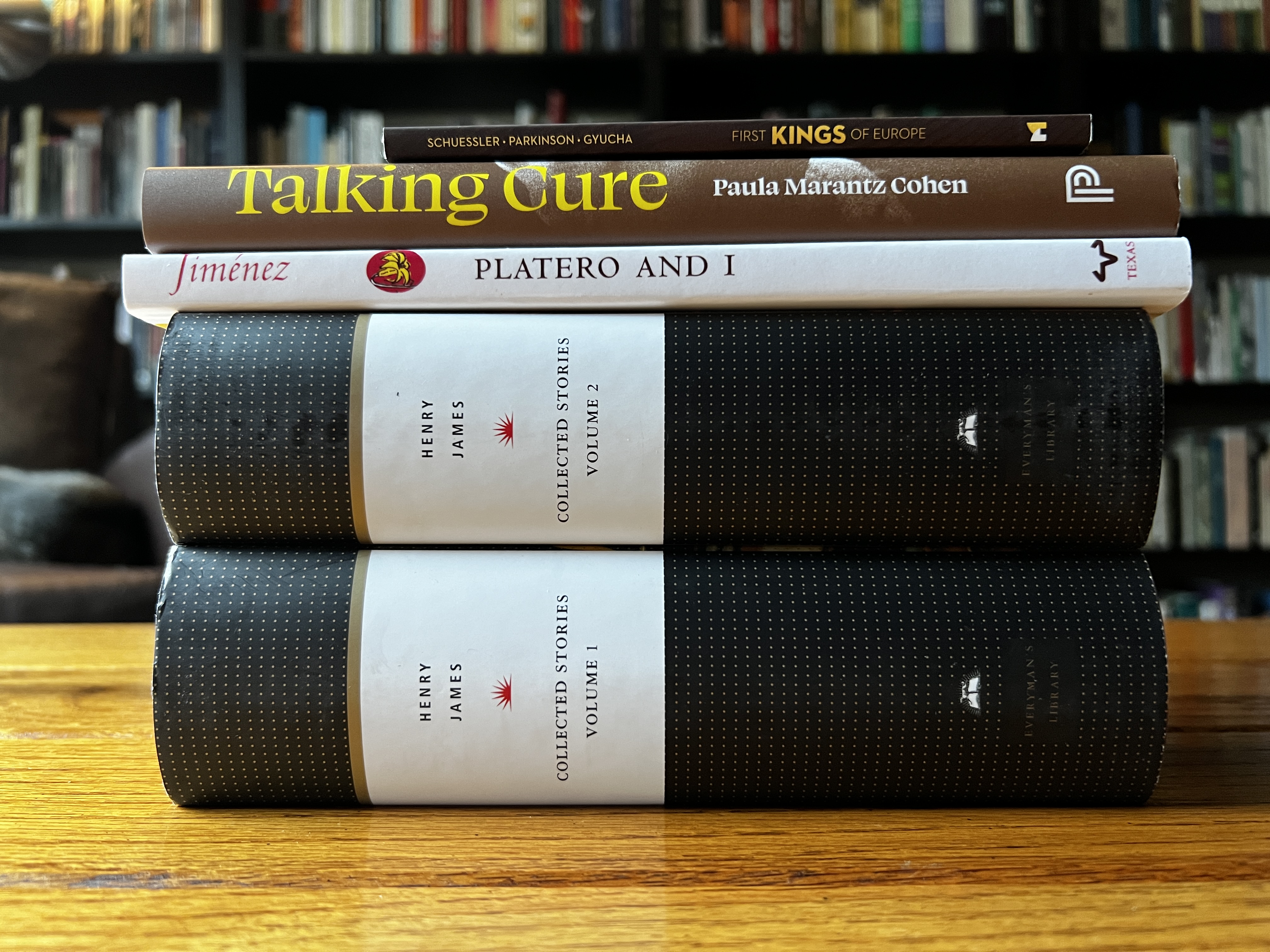
New books, a play, and some music

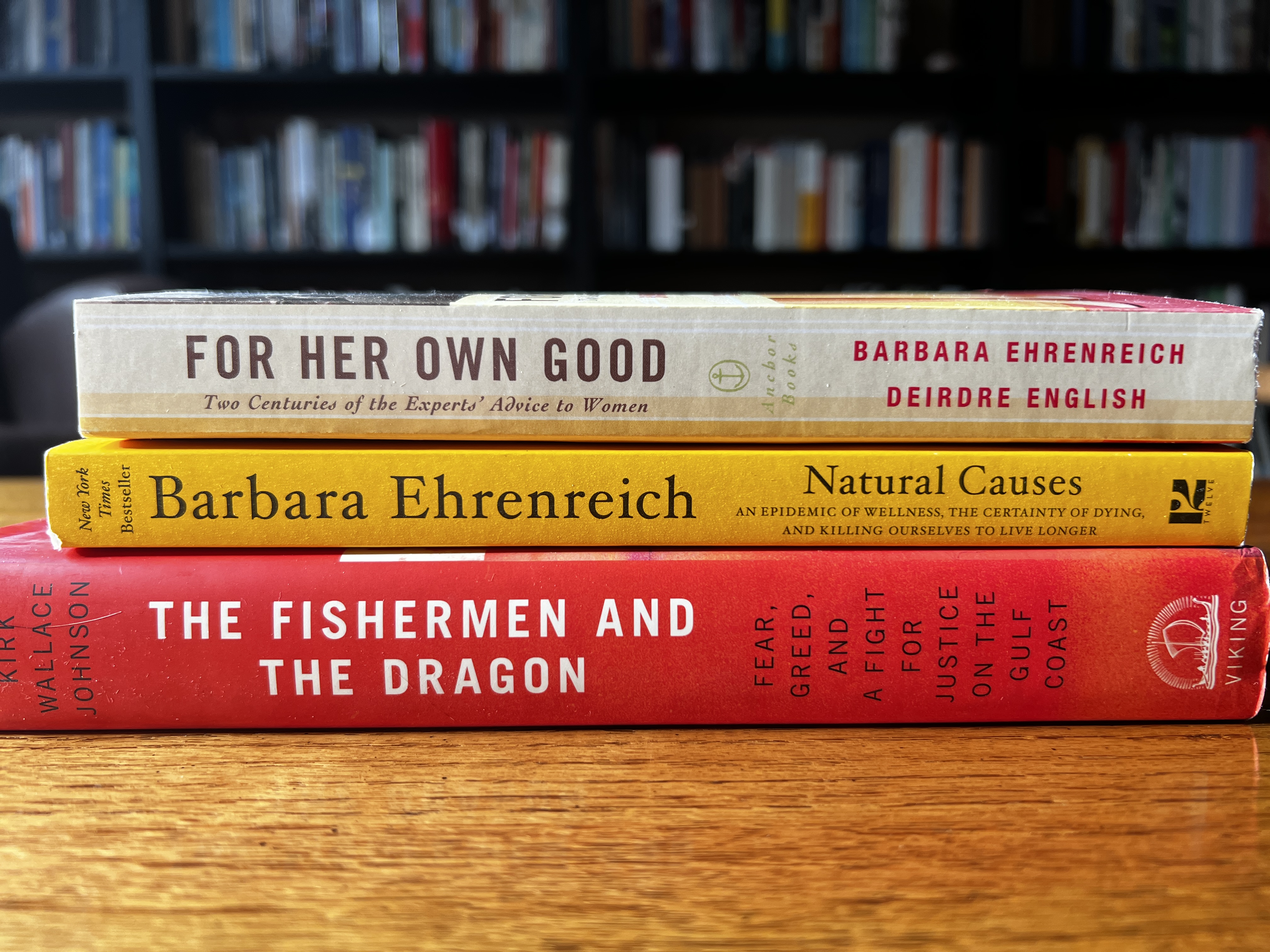
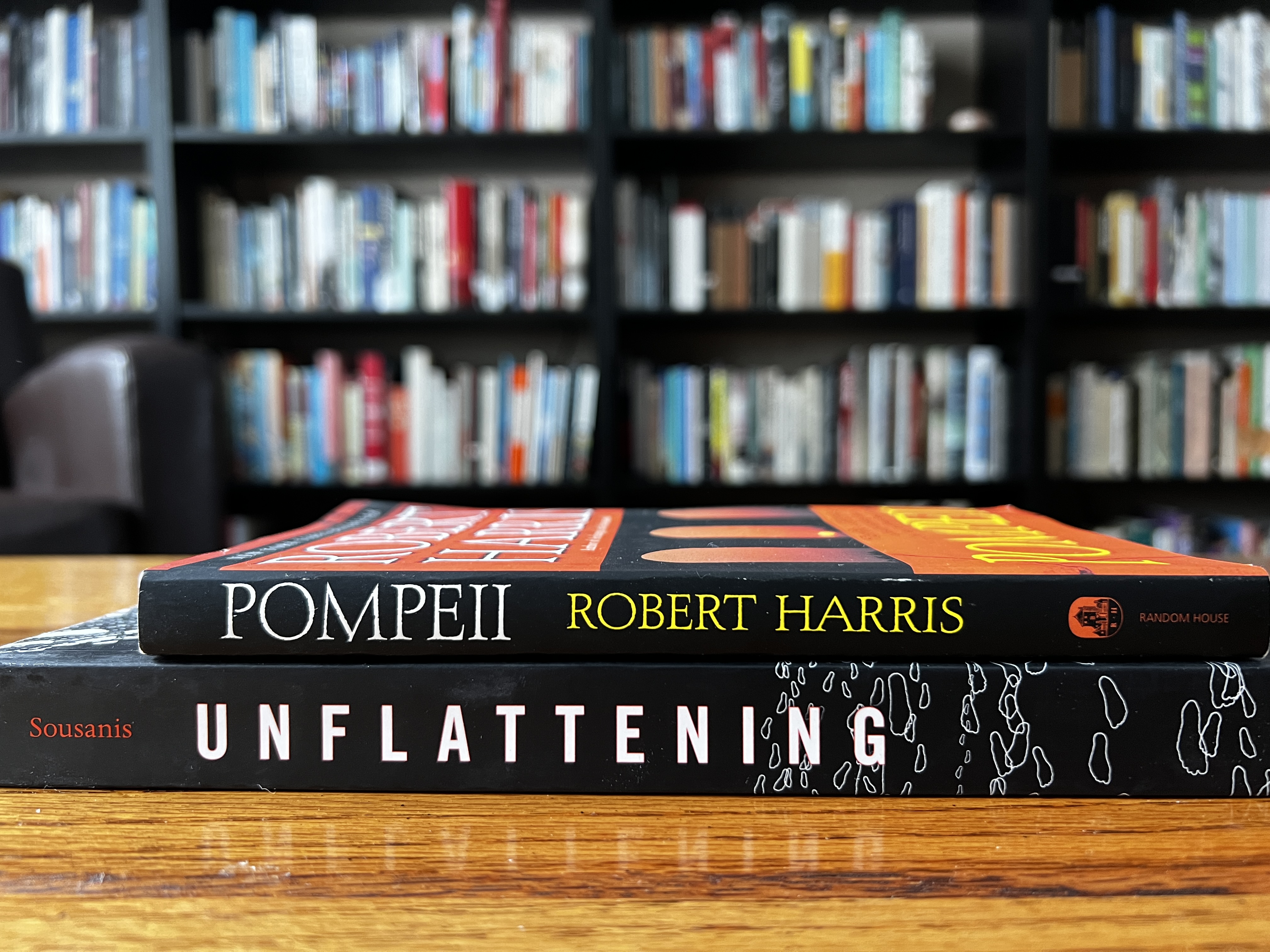
A couple of new books.

Over the weekend, we saw The Comedy of Errors, the last production Barbara Gaines will direct as artistic director of the Chicago Shakespeare Theater. (Reviews here and here.) For the record, we didn’t mind the framing device, at all. Errors is a fairly ridiculous play; the frame gave it the support most contemporary audiences require. We also heard a short concert given by a small ensemble of Elgin Symphony Orchestra members — really delightful.

Pages remaining in journey: 364


“As for your grace’s valor, courtesy, deeds, and undertakings,” Sancho continued, “there are different opinions. Some say, ‘Crazy, but amusing’; others, ‘Brave, but unfortunate’; and others, ‘Courteous, but insolent’; and they go on and on so much in this vein that they don’t leave an untouched bone in your grace’s body or mine” (p. 472).

It sounds as if Sancho has overheard a few book discussions, doesn’t it?

Earlier this week, one of my reading groups finished Crime and Punishment. Despite ten weeks of engaged reading and discussion, we failed to build consensus around any single idea about the philosophy and/or psychology of Raskolnikov. Might he be a psychopath or, at the very least, disturbed? Did the extremities of hunger and poverty inform his disordered thinking? Do his thought patterns simply underscore the limits of nihilism? Some combination of all of this? None of this? In our eighth meeting, I posited that the compulsion to pin a character to a specimen tray and label each of his acts (or, as Sancho might say, bones) might represent a contemporary tendency, one fueled by popular psychology, legal dramas, and the assumption that everything we do can be ascribed a concrete motive and, by extension, a value judgment: He did [insert act] because [insert motive], and that is [insert moral value]. After all, I suggested, sometimes thoughts and acts follow no discernible logic. Shakespeare gives us a fabulous example of this in The Winter’s Tale. Leontes’ jealous rage occurs in one short speech after his departing friend acquiesces to the queen’s entreaties that he, the friend, remain — for her husband’s sake! Leontes’ inexplicable madness results in the deaths of his son and a courtier, as well as the apparent deaths of his newborn and his wife. In a move that can confound readers, audiences, actors, and directors, Shakespeare provides no explanation for Leontes’ unbridled jealousy. Nothing in the text points to a motive. Rather, the writer seems to say, Some people are like this; here is a story about one. And it works! Why? Because more often than anyone would like to admit, what we say, do, and believe defies both logic and diagnosis.

I reread The Winter’s Tale following that meeting and was struck again by how inessential Leontes’ motive is to the plot. In Shakespeare’s blend of tragedy (the first three acts, the fall of the king), comedy (the fourth act, the pastoral involving the shepherdess and the prince), and history (the fifth act, the kingdom in need of an heir), the why of Leontes’ behavior proves far less critical to the play than the fallout of that behavior. Similarly, the why of Raskolnikov’s behavior – in this reader’s opinion, anyway – proves far less critical to Crime and Punishment than the fallout of that behavior. Like Shakespeare, Dostoevsky refrains from defining a motive for the main character’s action. Yes, he draws readers into Raskolnikov’s head; in fact, many early paragraphs read like soliloquies; but the novel seems rooted in the effects of Raskolnikov’s act, on him and on the characters with whom he interacts. It is not, then, a story about why Raskolnikov kills, any more than The Winter’s Tale is a story about why Leontes spirals out of control. Crime and Punishment concerns what occurs in the aftermath of a brutal act.

Of course, because I am also reading Don Quixote, I have found myself wondering about the Knight of the Sorrowful Face. “[T]he common people think your grace is a madman, and that I’m just as great a simpleton” (p. 471), Sancho informs Don Quixote. The gentry suggest he has overstepped his bounds, and other knights want nothing to do with him. Crazy, amusing; brave, unfortunate; courteous, insolent. Maybe the compulsion to pin a character to a specimen tray and label each of his bones is not as contemporary as I thought, eh? Increasingly, however, I find myself drawn to the idea that we need to keep this character far, far away from tray and pins.

A participant in the tutorial has noted that some of us have been “cheating” on Don Quixote and wondered how that has affected our experience of other novels. I loved the use of “cheating” because I often refer to myself as a recklessly and unapologetically promiscuous reader, one who will leave books partially read to pursue others, only to return to books begun well before any of those, all with the cologne of new books clinging to my sweater. Seriously, though, it is not so much that I have been cheating on Don Quixote but rather that I have added Cervantes to a conversation occurring in one of the rooms of my imagination. While participating in the tutorial, I have also completed two courses on one of my favorite works of fiction, Moby-Dick, a short course on The Odyssey, and the reading group for Crime and Punishment. That puts Melville, Homer, Cervantes, Dostoevsky, and Shakespeare in the same mental living room; imagine my delight! Although I am still working out Dostoevsky’s relationship to the other writers, it is clear that Melville is indebted to both Cervantes and Shakespeare, and that these three have a running tab with the oral tradition that yielded the Homeric epics. In anticipation of another course, I began rereading Kurt Vonnegut’s Cat’s Cradle, which begins, “Call me Jonah.” With that nod to Melville, Vonnegut entered the living room. (Speaking of Melville and specimen trays, has anyone yet satisfactorily explained Ahab? Of course not, although CLR James makes some insightful, if dated, points about who Ahab may have become to the collective American imagination.) These authors have a lot to talk about, and I am listening.

The other books I am reading have not been enveloped by Don Quixote; nor the reverse. Rather, each of the books amplifies the others.

Marginalia
“…I give you a Don Quixote who is, at the end, dead and buried, so that no one will dare tell more tales about him, for the ones told in the past are enough…” (p. 458).
Spoiler alert, right? Since January 2022, I have participated in one discussion group and two courses on Moby- Dick, and in each, participants were upset when the conclusion was referenced. And our Crime and Punishment group agreed to avoid spoilers, although privately I argued that the title is as much a spoiler as this quote from Don Quixote.

“…I only devote myself to making the world understand its error in not restoring that happiest of times when the order of knight errantry was in flower” (p. 464).
Don Quixote has a vision board.

“It seems to me,” said Don Quixote, “there is no human history in the world that does not have its ups and downs, especially those that deal with chivalry; they cannot be filled with nothing but successful exploits” (p. 476).
Given my reflection above, you will understand how the idea of Don Quixote saying this to Leontes or Ahab simply cracked me up.

“To say witty things and to write cleverly requires great intelligence: the most perceptive character in a play is the fool, because the man who wishes to seem simple cannot possibly be a simpleton. History is like a sacred thing; it must be truthful, and wherever truth is, there God is; but despite this, there are some who write and toss off books as if they were fritters” (p. 478).
Elsewhere, while discussing Moby-Dick, I observed the parallels between Pip and Lear’s fool, which, naturally, ensured I added King Lear to my to-be-(re)read stack, but arriving at this passage, I wondered, Does Don Quixote have a fool? If so, is it Sancho? Or is the Knight of the Sorrowful Face the author’s fool? (And, yes, there is truth, my readerly kryptonite.)