
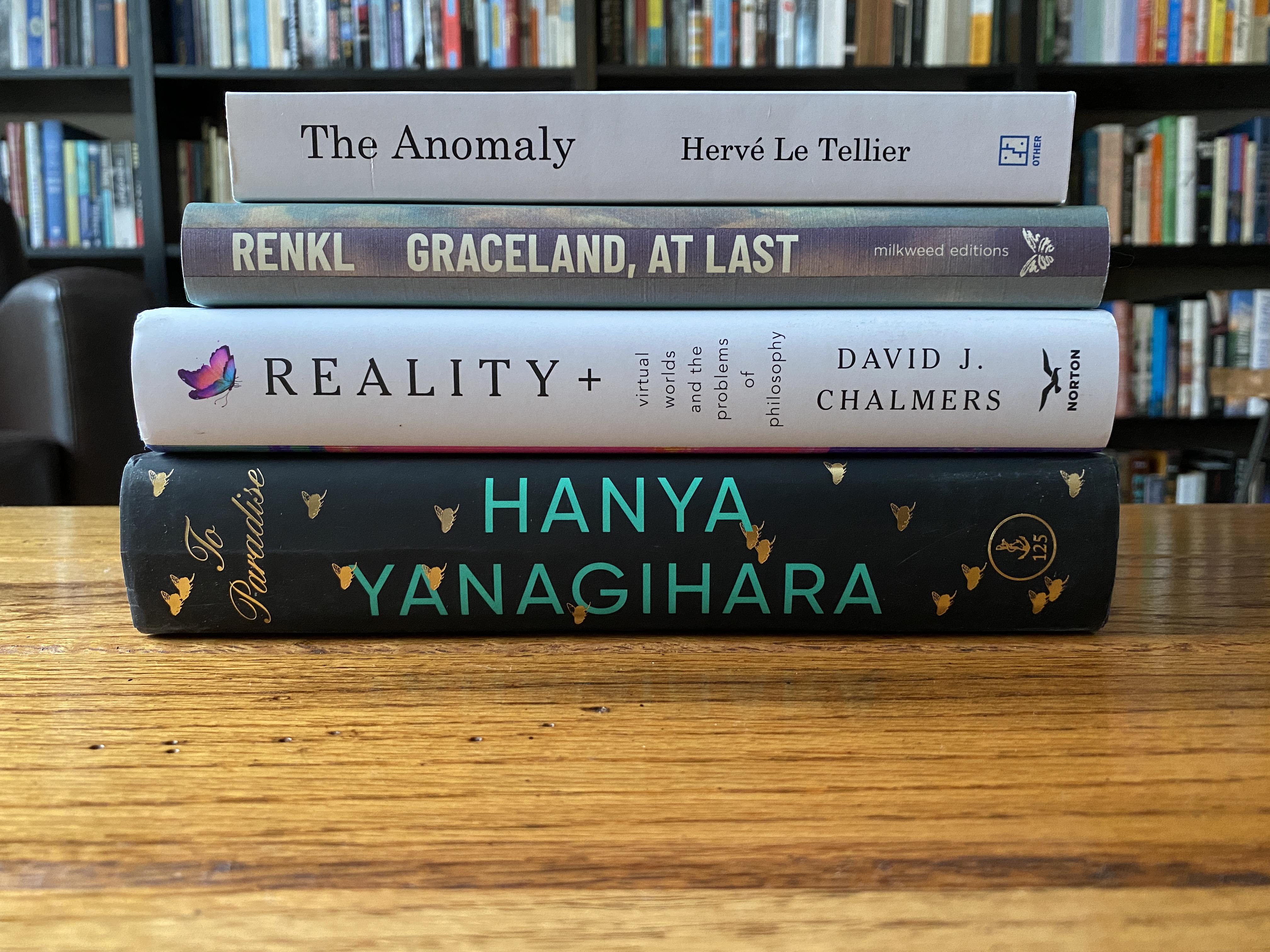
In which my acquisitions continue to surpass my reading pace.
In which my acquisitions continue to surpass my reading pace.

Image captured last week at the Conservatory at the Matthaei Botanical Gardens.
Since my last post, I’ve read:
■ Macbeth (William Shakespeare; 1606. Drama.)
In advance of watching Joel Coen’s film. Related story/review here.
■ Six Characters in Search of an Author (Luigi Pirandello (Trans. Edward Storer; 1921. Drama.)
Cannot recall the precise path that led me to Scallydandling about the books, but I can say that I enjoy poking about in her video lists. Six Characters was her January drama selection.
■ Late Migrations: A Memoir of Love and Loss (Margaret Renkl; 2019. Non-fiction.)
For the commonplace book:
p. 7
But the shadow side of love is always loss, and grief is only love’s twin.
p.17
Holding a useless camera, I suddenly realize that something extraordinary is happening right before me, a great serpent slowly on the move and all the songbirds aware of its presence and calling to each other and telling each other to beware. The miracle isn’t happening in the sky at all. It’s happening in the damp weeds of an ordinary backyard, among last year’s moldering leaves and the fragrant soil turned up by moles.
p. 73
[…B]ut the flip side of ignorance is astonishment, and I am good at astonishment.
p. 155
When I didn’t die, however, and then didn’t die some more, I came one day to understand: I wasn’t dying; I was grieving. I wasn’t dying. Not yet.
p. 186
Human beings are creatures made for joy. Against all evidence, we tell ourselves that grief and loneliness and despair are tragedies, unwelcome variations from the pleasure and calm and safety that in the right way of the world would form the firm ground of our being. In the fairy tale we tell ourselves, darkness holds nothing resembling a gift.
What we feel always contains its own truth, but it is not the only truth, and darkness almost always harbors some bit of goodness tucked out of sight, waiting for an unexpected light to shine, to reveal it in its deepest hiding place.
With the month closing and only nine books on my list, I’d say this year has begun at a far more leisurely pace than last year (twenty-five books). That said, I’m reading quite a bit. With 100 Days of Dante, I’ve nearly climbed Mount Purgatory. With book groups, I’m reading Anna Karenina, Moby-Dick, and Debt (see sidebar). I’ve just begun A Clockwork Orange, the February Cardiff BookTalk selection. And my husband and I have embarked on a read-the-bible-in-a-year schedule. (It pains me to confess that I haven’t read the complete bible. Do you have a recommendation for a “bible as literature” resource? We’ll take it.)
I began listening to State of Terror (Louise Penny and Hillary Rodham Clinton) on the drive to and from Michigan last week — not Chief Inspector Gamache but certainly entertaining. While away, I also tried to finish Noah Hawley’s latest novel, Anthem (review here), but no luck. Unlike S. Kirk Walsh, I’m finding it a bit… tedious.
Before heading out on my mini-vacation, I gave a Zoom* performance for an audience of one, playing the Rondeau, Polonaise, and Badinerie from Suite No. 2 in B Minor, BWV 1067. Was it flawless? Nope. But while I was away, my teacher wrote, in part, “Really, really excellent work on the Bach! So pleased and proud that you put your all into it and did such a great job.” Yes, I’m still grinning. My new solo piece is Howard Ferguson’s Three Sketches for Flute and Piano. I’m also working on the ninth of 18 Studies for Flute by Joachim Anderson, Op. 41, in Robert Cavally’s Melodious and Progressive Studies from Andersen, Gariboldi, Koehler, and Terschak for Flute, Book 1, and “From Duetto No. IV” (W.F. Bach) in Selected Duets for Flute, Volume II (Advanced). My practice schedule remains much as it was in the fall.
Our walking schedule, however, does not: The snow and ice (to say nothing of the extreme cold of days like yesterday) make early morning walks in the neighborhood untenable, so we’ve been using workouts on DVDs, after which, I hop on the exercise bike while my husband gets ready for work. We have the equipment needed to walk the conservation district paths, though, so we head there on the weekends during which the weather cooperates.
* Given the continuing uncertainty surrounding the virus, I requested that we return to the virtual format until at least February.
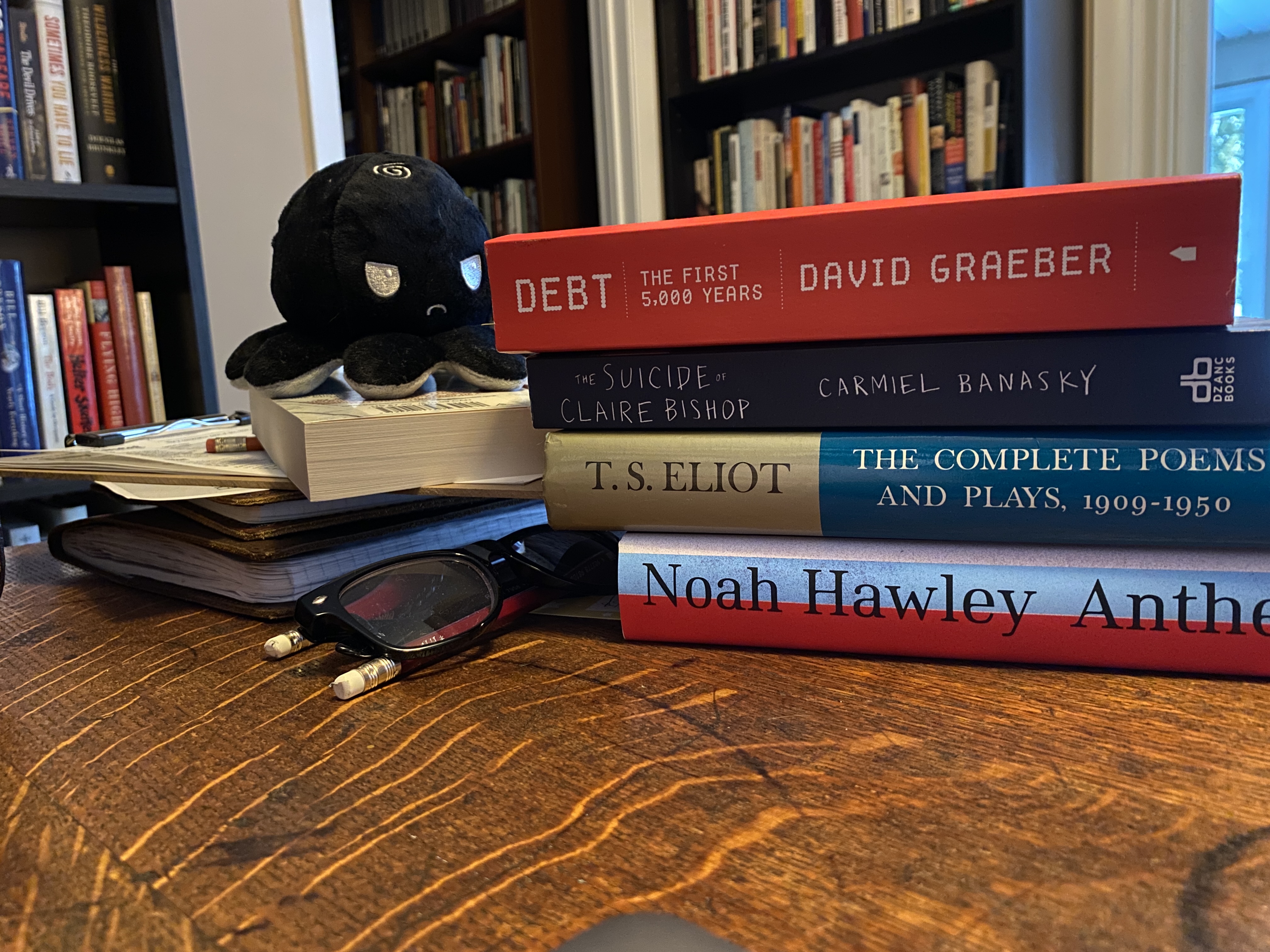
In September, I made a note to read Murder in the Cathedral (T.S. Eliot; 1935) following this from Louise Penny’s A Beautiful Mystery:
“Will no one rid me of this troublesome priest,” Gamache repeated. “It’s what Henry the Second said about Thomas à Becket.”
“Is that supposed to mean something to me?”
Gamache grinned. “Hang in there, young man. This story ends in murder.”
“Better.”
“This was almost nine hundred years ago,” the Chief continued. “In England.”
“I’m already asleep.”
“King Henry promoted his good friend Thomas to be archbishop, thinking that would give him control of the Church. But it backfired.”
Despite himself, Beauvoir leaned forward.
(By the way, if pressed, I’d say Bury Your Dead and A Beautiful Mystery are my favorite books in the Chief Inspector Gamache series.) I finally read Eliot’s play last week, at which point, I also toggled two novels, The Suicide of Claire Bishop (Carmiel Banasky; 2015) and Anthem (Noah Hawley), which was just released. A couple of unexpected intersections emerged, including two Claires (titular and Simon Oliver’s sister in Anthem) and discussions / plot points concerning mental health (including suicide), political activism, and religion.
Here’s another intersection:
In Part I of Murder in the Cathedral, the Fourth Tempter asks Thomas, “What can compare with the glory of the Saints,” coaxing him to “Seek the way of martyrdom,” to which Thomas responds, “Others offered real goods, worthless / But real. You only offer / Dreams to damnation.” Although the archbishop knows that to aspire to sainthood is sinful, unsaintly, he cannot help himself; he has thought about it.
Then, this from pages 149-150 of Anthem:
“Martyrs believe their suffering makes them holy. That sacrifices made in this life will gain them reward in the afterlife. They get romantic when they talk about dying for a cause. His name was Duncan. Her name was Ashli. His name was Tim McVeigh. This is the difference between the martyr and the saint. Sainthood requires selflessness. One cannot aspire to sainthood, because the very desire to be a saint is in and of itself unsaintly….”
Tonight I plan to finish Banasky’s novel before settling in to watch the Season 2 premiere of All Creatures Great and Small, and tomorrow I hope to finish The Prince (Machiavelli; 1532). (I began reading this to prepare for a “First Friday Lecture.”) The year began with Summerwater (Sarah Moss; 2020) and Lost Everything (Brian Francis Slattery; 2012), both of which are bleak but worthwhile.

My current stack.
My 2022 plan: Read no fewer than 100 books from my personal library (i.e., books acquired before the end of 2021), including 25 or more non-fiction titles; at least two books from each of the following categories: Shakespeare (about and/or retold; the plays will not satisfy this category), poetry, NYRB, Kurt Vonnegut (by or about), Joyce Carol Oates, philosophy, art, and children’s / YA; and at least one book about my bird of the year (American Crow).
This morning, I joined our local library’s winter reading program, which awards virtual badges for minutes of reading. (I usually satisfy their requirements for a prize (a free book) within a week.) I will join Yiyun Li, who led both iterations of Tolstoy Together (I participated in 2021), when she begins Moby Dick this year, and I will continue my journey with Dante in 100 Days. Otherwise, I have not yet locked in any other reading projects, although I do hope to continue my studies with The Catherine Project.
I read 233 books in my first year of retirement and 208 in my second. As I eye the list of tomes on my list for this year (e.g., Tom Stoppard: A Life (Hermione Lee; 2020; 896 pages), Van Gogh: The Life (Steven Naifeh and Gregory White Smith; 2011; 976 pages; and Ruth Bader Ginsberg: A Life (Jane De Hart; 2018; 752 pages)), I wonder if it’s wise to put a number out there. Granted, last year I managed The Count of Monte Cristo (Alexander Dumas; 1844), The Brothers Karamazov (Fyodor Dostoevsky; 1880), Middlemarch (George Eliot; 1871), The Free World: Art and Thought in the Cold War (Louis Menand; 2021), and War and Peace (Leo Tolstoy; 1869). Still, I think I will let the year unfold a bit before making a projection.
What reading plans are you making?
 Tomorrow is New Year’s Eve, and I have no intention of rushing through any of the several books I’m currently enjoying, so I am calling it at 208 books read this year. (As always, I have included only cover-to-covers.) Here is my complete list, here are all of the posts annotating that list, and here are a few numbers:
♦ 208 books read this year
♦ 84 fiction titles (not including graphic works)
♦ 48 non-fiction titles (not including graphic works)
♦ 7 poetry selections
♦ 49 plays
♦ 20 graphic works (6 of which were non-fiction selections)
♦ 55 rereads (i.e., books that I had first read sometime in the past, not this year)
As I’ve shared, my goals for this year were to read 100 books from my shelves (i.e., books in my collection before the end of 2020), including at least 24 non-fiction titles and at least one book from each of the following categories: Shakespeare (by, about, retold, etc.) poetry, NYRB, Kurt Vonnegut (by or about), Joyce Carol Oates, philosophy, art, and children’s / YA. I read 123 books from the shelves, 27 of which were non-fiction titles, and, I met each of the category challenges.

In which my “Christmas book flood” resumes. At least for today.

Image captured today at the Milwaukee County Zoo.
“Looks like Ruth,” said my husband, who recently finished the fifth in Louise Penny’s Chief Inspector Gamache series. I could only laugh in agreement. If the fictional poet, my favorite character in the series, were a siamang, she’d look like the one above. Speaking of Three Pines, since my last annotated list, I finished All the Devils Are Here (2020) and am partly through the most recent book, The Madness of Crowds (2021). I accept the repetition, the improbabilities, the continuity errors, the repetition, etc. because I appreciate the world Penny built, in spite of its (many) flaws.
I also finished two books I mentioned earlier this month: In a Dark Wood: What Dante Taught Me About Grief, Healing, and the Mysteries of Love (Joseph Luzzi; 2015) and Thinking, Fast and Slow (Daniel Kahneman; 2011), which means that I have exceeded one of my challenges: at least 24 non-fiction titles read from shelves. The twenty-sixth was Give Me Everything You Have: On Being Stalked (James Lasdun; 2013). I began reading it eight years ago and was engaged but set it aside for some reason. A slim volume, it was easy to reread the first forty pages and continue. A fan of those neat moments of synthesis / synchronicity / serendipity, I appreciated Lasdun’s discussion of Sir Gawain and the Green Knight, which I also mentioned reading earlier this month, and Jorge Luis Borges’ “The Library of Babel,” which I read to prepare for last week’s The Readers Karamazov podcast. From Lasdun, for the commonplace book:
A person crosses your path; briefly their story intersects with yours and diverges again, leaving something of itself with you and maybe taking something of yours in return, and they’re gone. These days I have to remind myself that encounters with other people can be both interesting and inconsequential.
For a Chicago Humanities Festival “Between the Lines” event earlier this month, I read On Freedom: Four Songs of Care and Constraint (Maggie Nelson; 2021). Reviews here and here.
When I closed Our Country Friends (Gary Shteyngart; 2021), I turned to what appears to have been one of its inspirations, Uncle Vanya (Anton Chekhov; 1898. (Trans. Peter Carson; 2002)), which I much preferred. (Later in the winter break, I’m planning to watch the production filmed in August 2020 from the Harold Pinter Theatre in London.)
Tonight I plan to read Canto 12 of Dante’s Purgatorio for 100 Days of Dante and to finish Brown Girl Dreaming (Jacqueline Woodson; 2014) for a program in February.

Image captured at the conservation area this weekend.
In May, I noted that we were averaging about three miles daily on our morning walks. By mid-October, we had nudged that average to 3.5 miles with a four-plus-mile walk or two on the weekend. Just a month later, we had settled into a 4.1-mile daily average, and that seems to be about the right commitment for the time and light available to us before my husband begins work. The benefits are many, including a clear head, quality sleep, and an improved mood, even as the light continues to wane. Our neighborhood is wonderfully walkable, but at least once a week (usually on the weekend), we head to one of the conservation areas or state parks, something for which our feet and knees thank us. From Anna Botsford Comstock’s Handbook of Nature Study:
In my belief, there are two and only two occupations for Saturday [or Sunday] afternoon or forenoon […]. One is to be out-of-doors and the other is to lie in bed, and the first is best. Out in this, God’s beautiful world, there is everything waiting to heal lacerated nerves, to strengthen tired muscles, to please and content the soul that is torn to shreds with duty and care.
Arguably, I walk (and ride the exercise bike, do some weight work, and stretch) to ensure I can curl up and read (sans guilt and remorse) for long spells. Since my last annotated list, I finished, among other things, Linda Lear’s excellent biography of Beatrix Potter, which satisfied one of my reading challenges. As I wrote in August, my 2021 reading plan is to read no fewer than 100 books from my personal library (i.e., books acquired before the end of 2020), including 24 or more non-fiction titles and at least one book from each of the following categories: Shakespeare (by, about, retold, etc.), poetry, NYRB, Kurt Vonnegut (by or about), Joyce Carol Oates, philosophy, art, and children’s / YA. At this writing, I’ve read 196 books, 118 of which were read from my shelves (RFS). Twenty-three of those RFS were non-fiction titles, so I must read at least one more non-fiction work from my shelves, a challenge that will likely be met with either Daniel Kahneman’s Thinking, Fast and Slow, which I began reading in advance of attending The Guardian Live event last month, or Joseph Luzzi’s In a Dark Wood: What Dante Taught Me About Grief, Healing, and the Mysteries of Love, which complements my participation in 100 Days of Dante. (By the way, we are only six cantos into Purgatorio, so it’s not too late to join the project.)
Here is how I met the other RFS category challenges:
Shakespeare (by, about, retold, etc.):
With The Winter’s Tale, The Tempest, and King Lear, I finished rereading all the plays last month. Earlier this year, I also read Maggie O’Farrell’s Hamnet and Matthew Haig’s The Dead Fathers Club, but, as I mentioned in last year’s summary, this year’s challenge is only satisfied if I have read at least one of the many non-fiction works I’ve collected. I’ve read three:
■ Tyrant: Shakespeare on Politics (Stephen Greenblatt; 2018.)
■ How to Think Like Shakespeare: Lessons from a Renaissance Education (Scott Newstok; 2020.)
■ Falstaff: Give Me Life (Harold Bloom; 1992.)
Poetry:
■ War Music: An Account of Homer’s Iliad (Christopher Logue; 2015.)
■ Stag’s Leap (Sharon Olds; 2012.)
■ Chicago Poems (Carl Sandburg; 1916. Poetry.)
■ The Inferno of Dante (Dante Alighieri; 1320. (Trans. Robert Pinsky; 1995.))
■ Sir Gawain and the Green Knight (Unknown; 14th century. (Trans. J.R.R. Tolkien; 1975.) Poetry.)
NYRB:
■ The Goshawk (T.H. White; 1951. Non-fiction.)
Kurt Vonnegut (by or about):
■ God Bless You, Mr. Rosewater (Kurt Vonnegut; 1965. Fiction.)
Joyce Carol Oates:
■ Pursuit (Joyce Carol Oates; 2019. Fiction.)
■ The Collector of Hearts (Joyce Carol Oates; 1998. Fiction.)
Philosophy:
■ Lost in Thought: The Hidden Pleasures of an Intellectual Life (Zina Hitz; 2020. Non-fiction.)
■ Meditations (Marcus Aurelius; 180 A.D. (Trans. Gregory Hays.) Non-fiction.)
■ The Gospel According to Jesus: A New Translation and Guide to His Essential Teachings for Believers and Unbelievers (Stephen Mitchell; 1993. Non-fiction.)
Art:
■ Beatrix Potter: A Life in Nature (Linda Lear; 2007. Non-fiction.)
■ The Complete Tales (Beatrix Potter; 2002 edition. Fiction.)
Children’s / YA:
■ The Absolutely True Diary of a Part-Time Indian (Sherman Alexie; 2007. Fiction.)
■ The Mouse and His Child (Russell Hoban; 1967. Fiction.)
■ Harry Potter and the Sorcerer’s Stone (J.K. Rowling; 2001. Fiction.)
■ Harry Potter and the Prisoner of Azkaban (J.K. Rowling; 1999. Fiction.)
■ Harry Potter and the Goblet of Fire (J.K. Rowling; 2000. Fiction.)
■ Harry Potter and the Order of the Phoenix (J.K. Rowling; 2003. Fiction.)
■ Harry Potter and the Half-Blood Prince (J.K. Rowling; 2005. Fiction.)
■ Harry Potter and the Deathly Hallows (J.K. Rowling; 2007. Fiction.)
In more recent reading news… Tolstoy Together 2021 concludes tomorrow, but, for a number of reasons, I decided to read the two epilogues of War and Peace and finish Yiyun Li’s companion volume late last week. As I noted in my October 7 tweet, the short readings coupled with the reflections in Tolstoy Together: 85 Days of War and Peace became a sort of secular daily devotional for me. What will I do on December 9? Well, 100 Days of Dante continues, and tomorrow is another Cardiff BookTalk, for which I read J.R.R. Tolkien’s translation Sir Gawain and the Green Knight.
Yesterday I read the fifteenth book in Louise Penny’s Chief Inspector Gamache series, and late last month I finished reading Akwaeke Emezi’s 2020 novel, The Death of Vivek Oji, which was heart-breaking. (Reviews here and here.)

Apparently, my book flood will continue a wee bit longer.
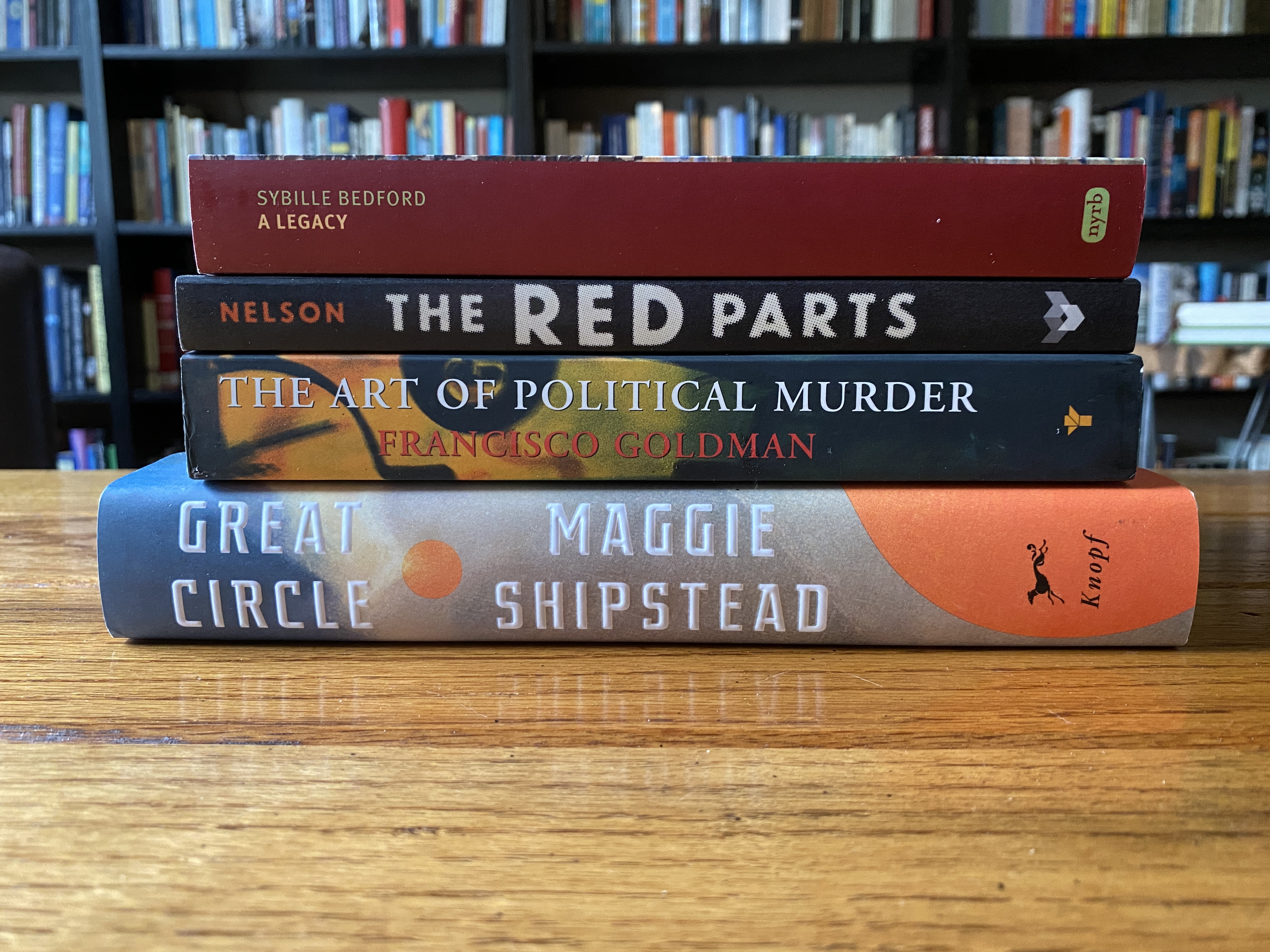
The book flood becomes a trickle.

