In 2017, I participated in a book group that tackled War and Peace in seventeen weeks. This time, I’m reading with the Tolstoy Together 2021 participants.

In 2017, I participated in a book group that tackled War and Peace in seventeen weeks. This time, I’m reading with the Tolstoy Together 2021 participants.

We arrived at the trail for our four-mile walk just after sunrise, and since returning home, we’ve knocked out the few outdoor chores on our list. The calendar may read September, but the weather indicates mid-July: Highs today and tomorrow may hit ninety or more. That sounds like my cue to lower the blinds and the thermostat and settle in with a stack of books after my music practice.
This weekend, I’m reading Marisel Vera’s The Taste of Sugar (2020) for an upcoming Chicago Humanities Festival event, and Laura Lippman’s most recent bestseller, Dream Girl, which is my “Farewell, summer!” selection.

Image captured at the conservation district on Labor Day.
From Book II, Chapter 15, of Middlemarch:
I at least have so much to do in unraveling certain human lots, and seeing how they were woven and interwoven, that all the light I can command must be concentrated on this particular web, and not dispersed over that tempting range of relevancies called the universe.
Although I missed the August meetings of book group, I did finish (re)reading Middlemarch and have returned in time for our three remaining meetings this month.
Book Five, Chapter 44
He distrusted her affection; and what loneliness is more lonely than distrust?
Book Five, Chapter 46
Our sense of duty must often wait for some work which shall take the place of dilettanteism and make us feel that the quality of our action is not a matter of indifference.
Book Five, Chapter 50
“… [T]here are always people who can’t forgive a man for differing from them.”
I also finished reading Rebecca Mead’s My Life in Middlemarch.
p. 41
Coming to languages too late for effortless fluency, she set about achieving what she could through resolution and determination. She found an outlet for her hungry ambition by reshaping herself into an intellectual. She turned her yearning into learning.
p. 145
Books — or texts, as they were called by those versed in theory — weren’t supposed merely to be read, but to be interrogated, as if they had committed some criminal malfeasance.
p. 172
Such an approach to fiction — where do I see myself in here? — is not how a scholar reads, and it can be limiting and its solipsism. It’s hardly an enlarging experience to read a novel as if it were a mirror of oneself. One of the useful functions of literary criticism and scholarship is to suggest alternative lenses through which a book might be read.
A book group member recommended The Readers Karamazov podcast, which began its second season with a four-episode discussion of Middlemarch. (And, yes, I must go back and listen to their The Brothers Karamazov episodes.) What a terrific resource! I enjoyed their insights so much that I plan to read along for the rest of this season. Candide (Voltaire; 1759. (Trans. John Butt; 1947.), their next selection, was a reread for me.
In my quest to reread all of Shakespeare’s plays, I have finished Twelfth Night and Troilus and Cressida since my last annotated list.
Under the heading “beach reads” (although I spent no time at the beach this summer), file the following:
■ The House in the Cerulean Sea (TJ Klune; 2020. Fiction.)
p. 188
It struck him, then, just who this house belonged to, and how much of an honor this would be. For an adult sprite, their dwelling was their most important possession. It was their home where all their secrets were kept. Sprites were notorious for their privacy, and he had no doubt that Phee would one day be the same, though he hoped she would remember the time spent at Marsyas in her youth. She wouldn’t have to be so alone.
■ The Turnout (Megan Abbott; 2021. Fiction.)
Review here.
■ The Plot (Jean Hanff Korelitz; 2021. Fiction.)
Review here.
■ A Trick of the Light (Louise Penny; 2011. Fiction.)
The Inspector Gamache series is actually a number of steps up from “beach read.” As always, many thanks to Robin for recommending these books.
My recent graphic work selections include:
■ Odessa (Jonathan Hill; 2020. Graphic fiction.)
■ The Hard Tomorrow (Eleanor Davis; 2019. Graphic fiction.)
■ Sweet Tooth: The Return (Jeff Lemire; 2021. Graphic non-fiction.)
■ It’s Not What You Thought It Would Be (Lizzy Stewart; 2021. Graphic non-fiction.)
■ Seek You: A Journey through American Loneliness (Kristen Radtke; 2021. Graphic non-fiction.)
Radtke’s Seek You is a gorgeous read. Highly recommended.
■ Gilead (Marilynne Robinson; 2004. Fiction.)
Speaking of gorgeous reads, how did this languish on my shelves for seventeen years? Beautiful, beautiful.
p. 7
Well, see and see but do not perceive, hear and hear but do not understand, as the Lord says. I can’t claim to understand that saying, as many times as I’ve heard it, and even preached on it. It simply states a deeply mysterious fact. You can know a thing to death and be for all purposes completely ignorant of it. A man can know his father, or his son, and there might still be nothing between them but loyalty and love and mutual incomprehension.
p. 39
But I’ve developed a great reputation for wisdom by ordering more books than I ever had time to read, and reading more books, by far, than I learned anything useful from, except, of course that some very tedious gentleman have written books. This is not a new insight, but the truth of it is something you have to experience to fully grasp.
p. 197
We take fortuitous resemblances among us to be actual likeness, because those around us have also fallen heir to the same customs, trade in the same coin, acknowledge, more or less, the same notions of decency and sanity. But all that really just allows us to coexist with the inviolable, untraversable, and utterly vast spaces between us.
p. 233
I was thinking about the things that had happened here just in my lifetime — the droughts and the influenza and the Depression and three terrible wars. It seems to me now we never looked up from the trouble we had just getting by to put the obvious question, that is, to ask what it was the Lord was trying to make us understand.
p. 246
I love the prairie! So often I have seen the dawn come and the light flood over the land and everything turned radiant at once, that word “good” so profoundly affirmed my soul that I am amazed I should be allowed to witness such a thing.
Recent non-fiction selections included:
■ Fulfillment: Winning and Losing in One-Click America (Alec MacGillis; 2021)
Review here.
■ Witch-Hunt: Mysteries of the Salem Witch Trials (Marc Aronson; 2003)
■ The 57 Bus: A True Story of Two Teenagers and the Crime That Changed Their Lives (Dashka Slater; 2017)
Original article here.
Other books:
■ Green Shadows, White Whale (Ray Bradbury; 1992. Fiction.)
I read Bradbury’s fictionalized account of his travels to Ireland to write the script of Moby Dick for an upcoming Newberry Library program.
■ Medea (Euripides (trans. D. Raynor); 431 B.C. Drama.)
Read before seeing the excellent 2014 production streaming on National Theatre at Home. I also enjoyed the related Reading Greek Tragedy Online episode, which can be found here.
Color me grateful this readerly refuge survived the pandemic.

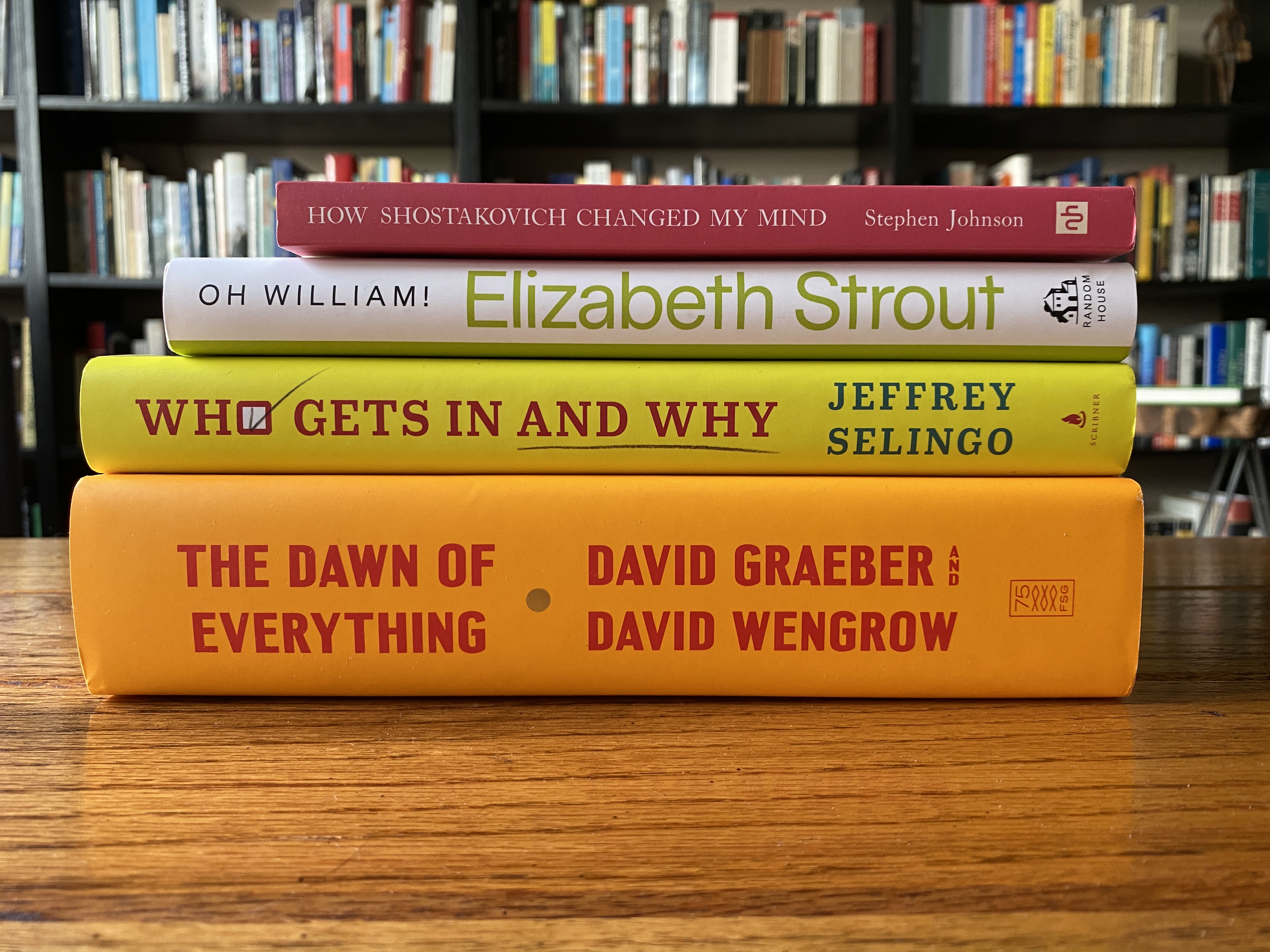
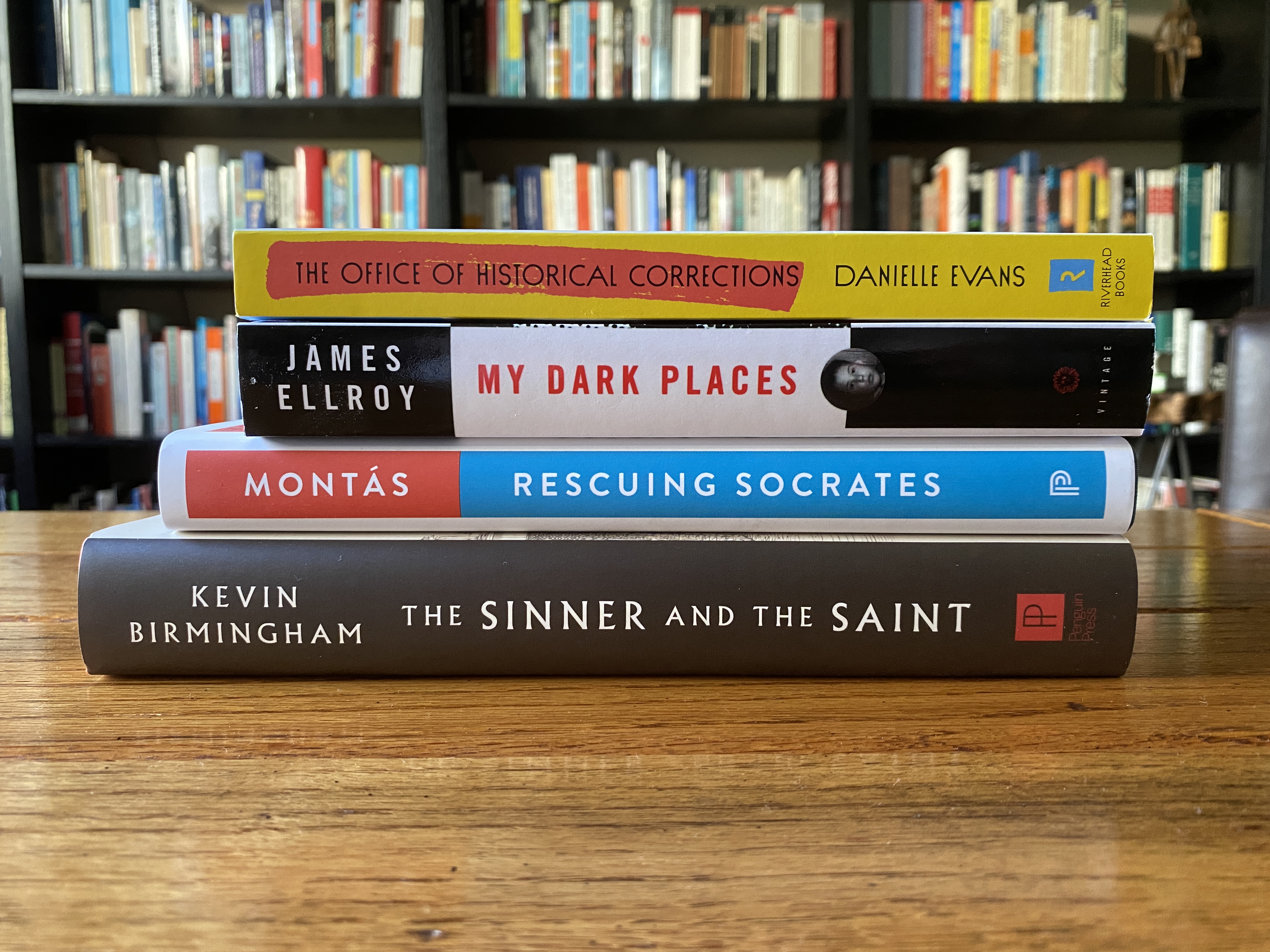
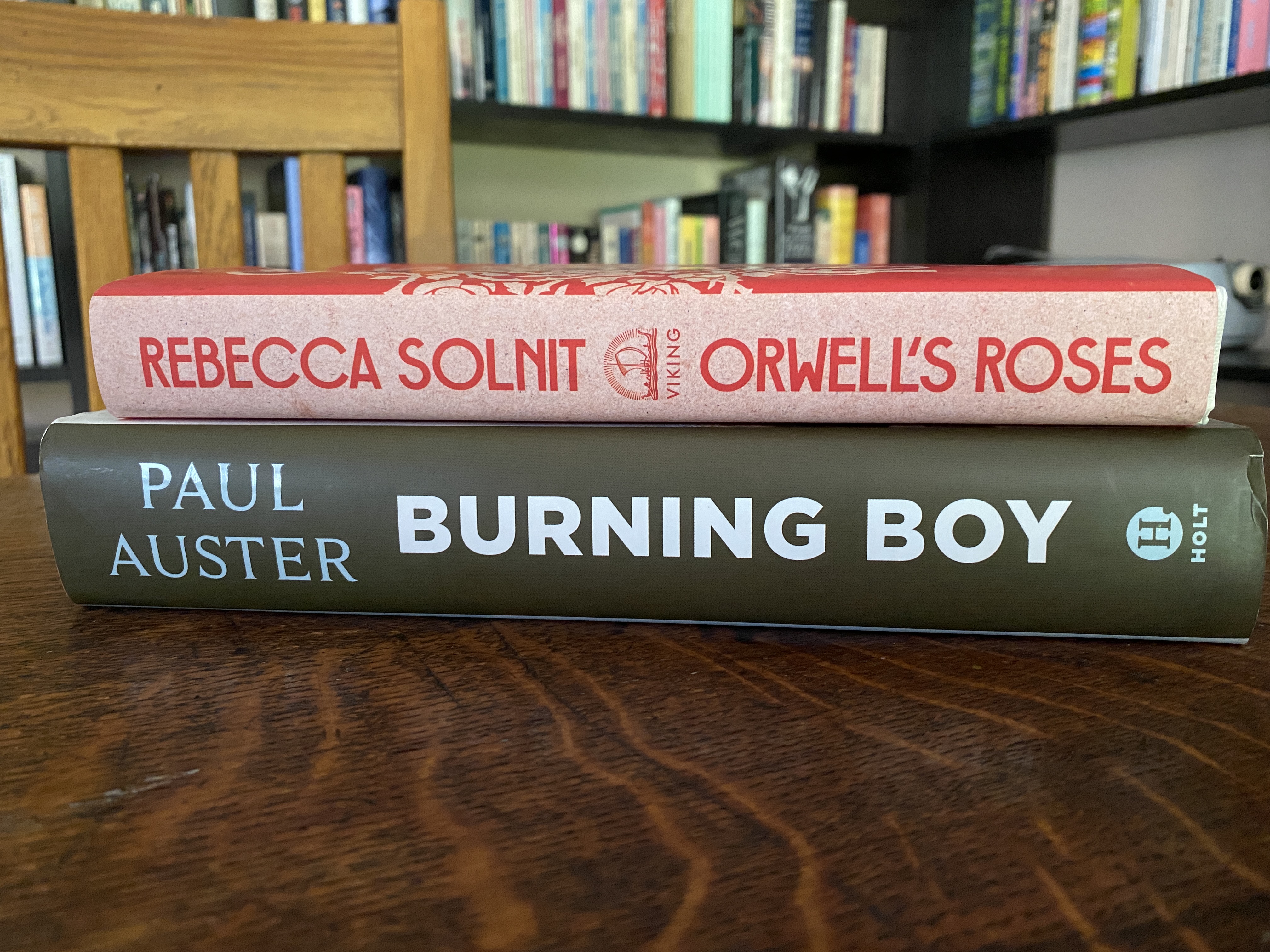
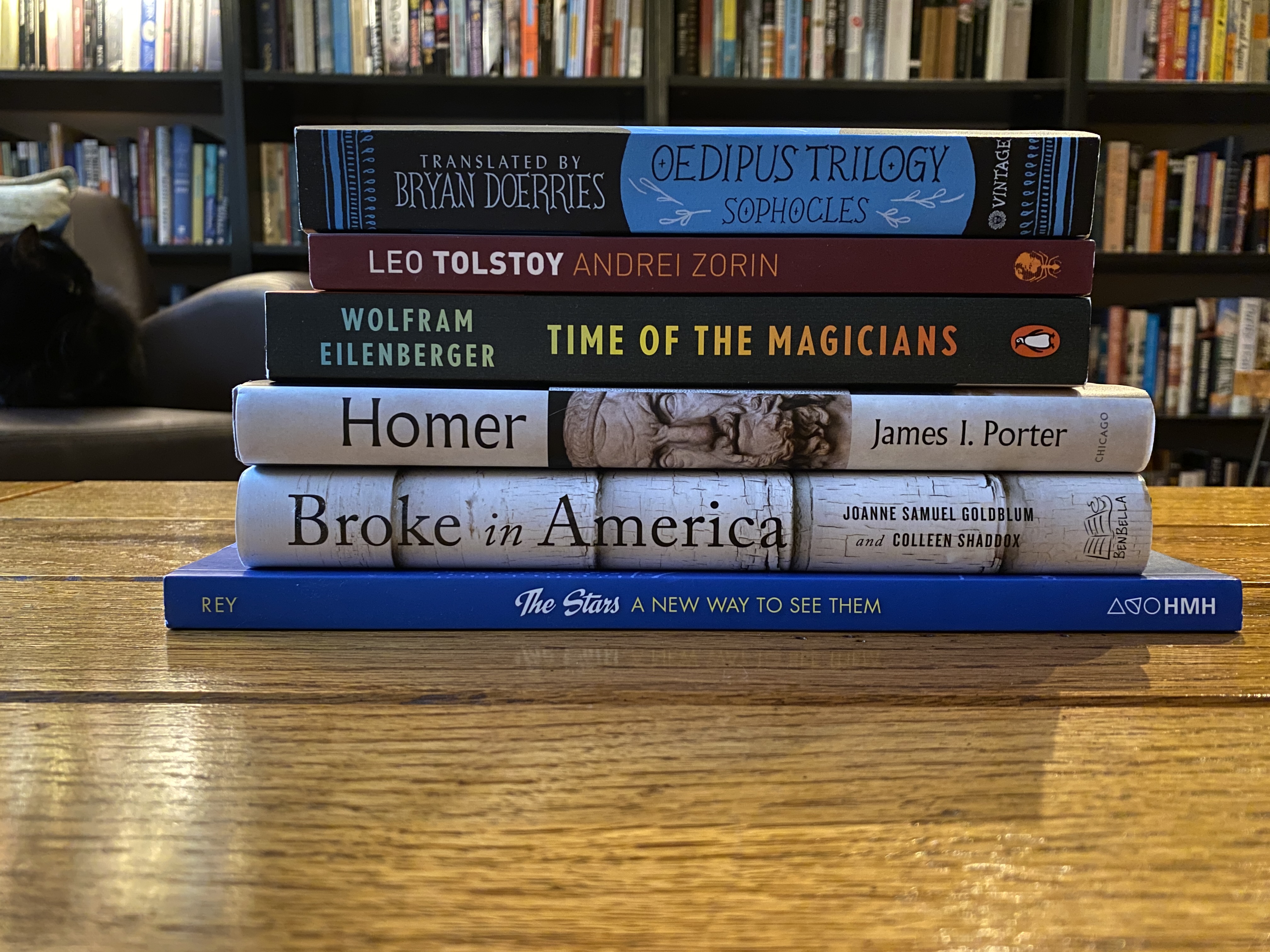
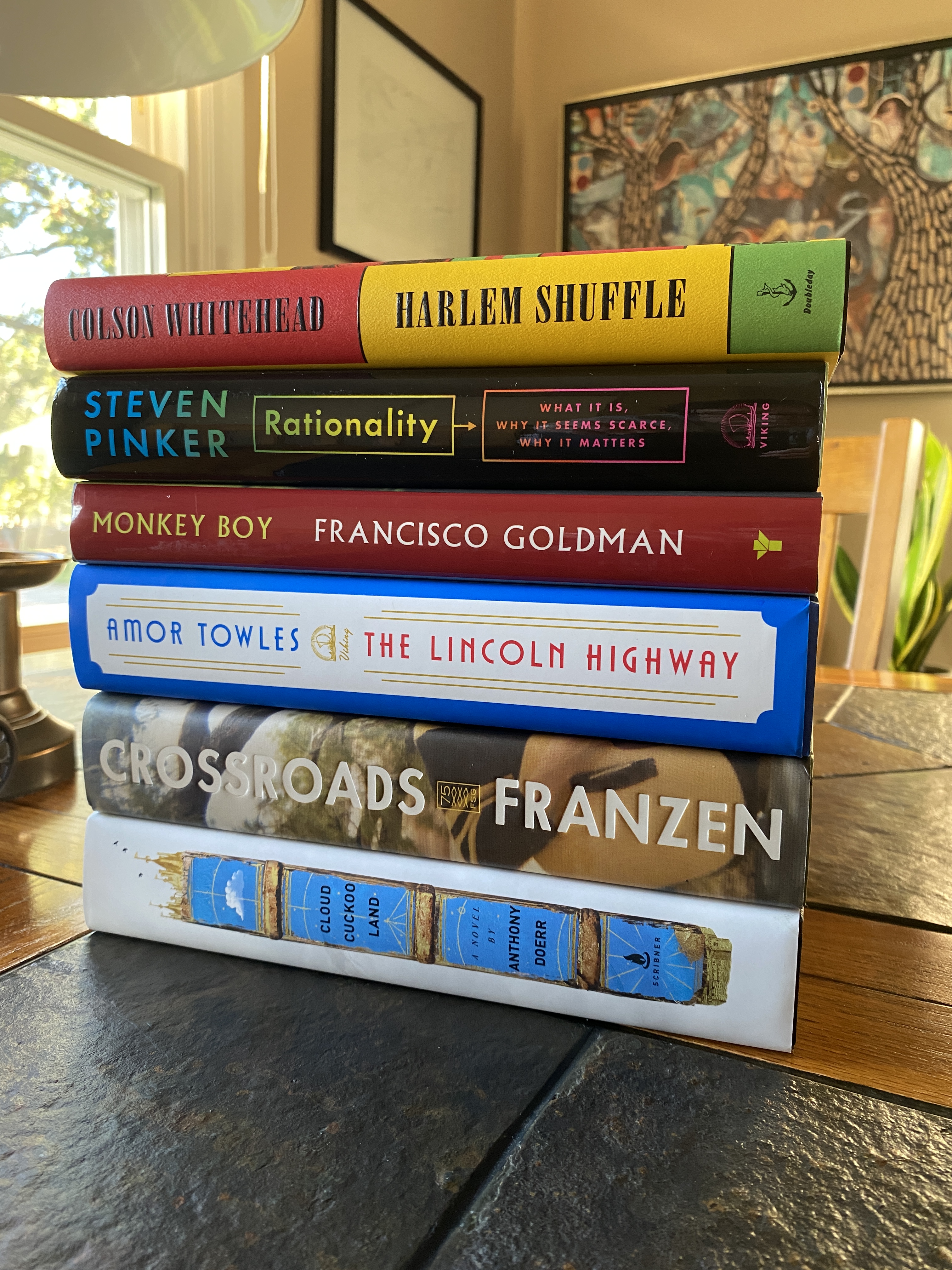
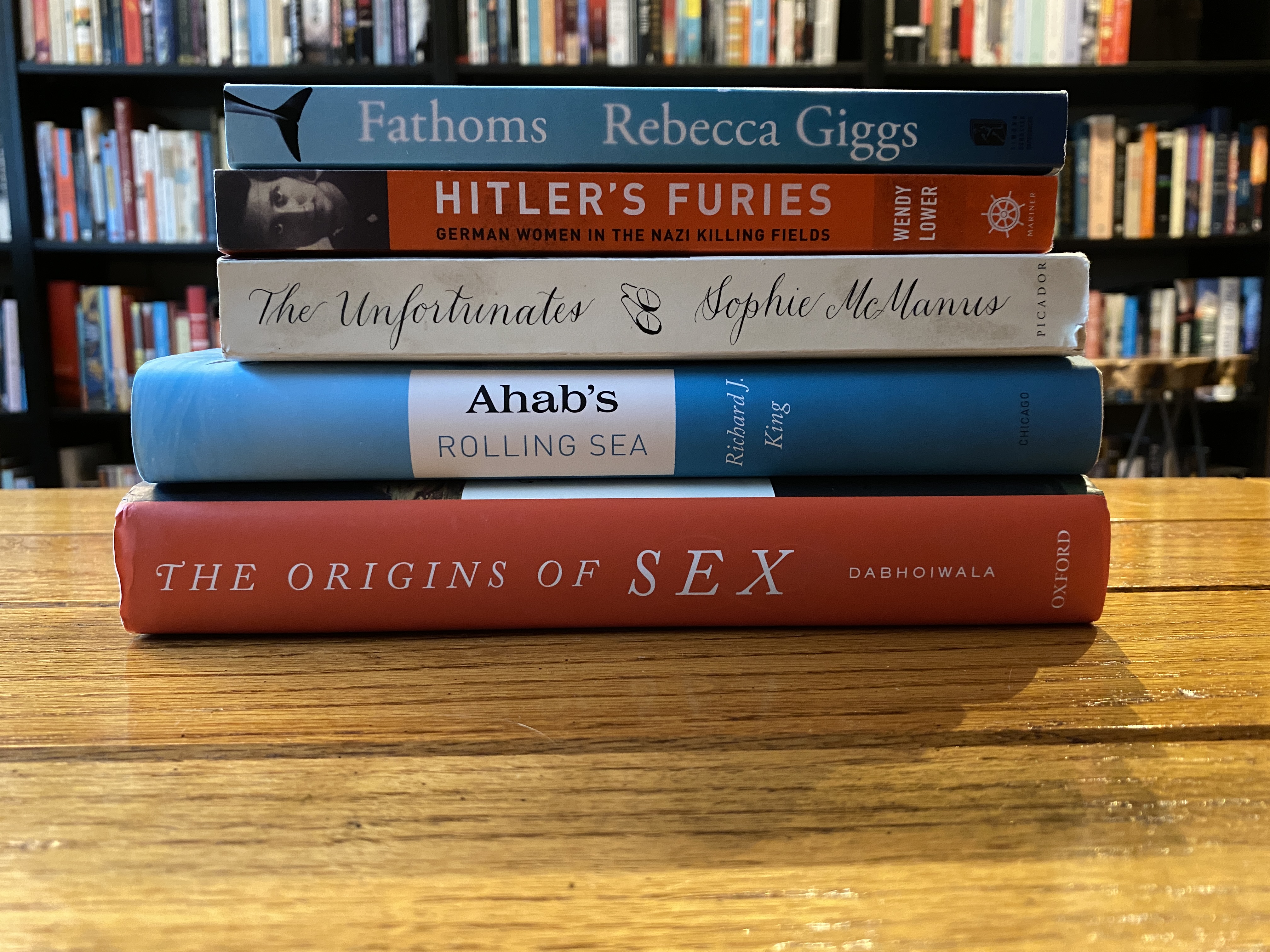
A few recent acquisitions.
My 2021 reading plan is fairly simple: Read no fewer than 100 books from my personal library (i.e., books acquired before the end of 2020), including 24 or more non-fiction titles and at least one book from each of the following categories: Shakespeare (by, about, retold, etc.), poetry, NYRB, Kurt Vonnegut (by or about), Joyce Carol Oates, philosophy, art, and children’s / YA. At this writing, I’ve read 129 books, 91 of which were read from my shelves (RFS). Twenty-one of those RFS were non-fiction titles, so I must read read nine more books from my shelves, and at least three of those should be non-fiction works. With five months remaining in the year, that seems doable.
How am I doing with those RFS categories, then?
Shakespeare (by, about, retold, etc.):
In my quest to reread all of the plays this year, I’ve finished 26, so far. I’ve also read Maggie O’Farrell’s Hamnet and Matthew Haig’s The Dead Fathers Club. As I mentioned in last year’s summary, though, this category is not met in 2021 unless I have read at least one of the many non-fiction works I’ve collected. So far, I’ve read three:
■ Tyrant: Shakespeare on Politics (Stephen Greenblatt; 2018. Non-fiction.)
■ How to Think Like Shakespeare: Lessons from a Renaissance Education (Scott Newstok; 2020. Non-fiction.)
■ Falstaff: Give Me Life (Harold Bloom; 1992. Non-fiction.)
Poetry:
■ War Music: An Account of Homer’s Iliad (Christopher Logue; 2015. Poetry.)
■ Stag’s Leap (Sharon Olds; 2012. Poetry.)
■ Chicago Poems (Carl Sandburg; 1916. Poetry.)
NYRB:
■ The Goshawk (T.H. White; 1951. Non-fiction.)
Kurt Vonnegut (by or about):
I have not met this goal, nor have I selected title(s) to meet it.
Joyce Carol Oates:
■ Pursuit (Joyce Carol Oates; 2019. Fiction.)
■ The Collector of Hearts (Joyce Carol Oates; 1998. Fiction.)
Philosophy:
■ Lost in Thought: The Hidden Pleasures of an Intellectual Life (Zina Hitz; 2020. Non-fiction.)
■ Meditations (Marcus Aurelius; 180 A.D. (Trans. Gregory Hays.) Non-fiction.)
■ The Gospel According to Jesus: A New Translation and Guide to His Essential Teachings for Believers and Unbelievers (Stephen Mitchell; 1993. Non-fiction.)
Art:
Linda Lear’s biography of Beatrix Potter is on my nightstand. This and a volume of Potter’s complete tales are how I hope to meet this goal.
Children’s / YA:
■ The Absolutely True Diary of a Part-Time Indian (Sherman Alexie; 2007. Fiction.)
■ The Mouse and His Child (Russell Hoban; 1967. Fiction.)
■ Harry Potter and the Sorcerer’s Stone (J.K. Rowling; 2001. Fiction.)
■ Harry Potter and the Prisoner of Azkaban (J.K. Rowling; 1999. Fiction.)
■ Harry Potter and the Goblet of Fire (J.K. Rowling; 2000. Fiction.)
■ Harry Potter and the Order of the Phoenix (J.K. Rowling; 2003. Fiction.)
■ Harry Potter and the Half-Blood Prince (J.K. Rowling; 2005. Fiction.)
■ Harry Potter and the Deathly Hallows (J.K. Rowling; 2007. Fiction.)
I also planned to read Simone de Beauvoir’s The Second Sex (1949) and Tom Reis’ The Black Count: Glory, Revolution, Betrayal, and the Real Count of Monte Cristo (2012) this year, as well as biographies of Tom Stoppard, Ruth Bader Ginsberg, and Fred Rogers. At this writing, I remain optimistic about meeting these “mini-challenges.”
This weekend, though, I’m focused on Book Five of Middlemarch for book group, Gilead (Marilyn Robinson; 2003), and a graphic novel I espied on my way out of the “prize room” from which my husband and I collected our books for completing the library’s summer reading program.

Some recent acquisitions.
Since 1989, I’ve been promising myself I’d return to Middlemarch (George Eliot; 1871). Thirty-two years later, nearly to the month, I’ve (finally) kept my word: Members of the reading group that attempted to penetrate the mysteries of The Brothers Karamazov (Fyodor Dostoevsky; 1880) earlier this year are now working their way through Eliot’s wise novel. Although one of our core principles is to avoid secondary sources, I must confess to (quietly) enjoying the companionship of Rebecca Mead’s My Life in Middlemarch (2014), as well as the most recent episodes of The Readers Karamazov podcast.
Book One, Chapter 1
Women were expected to have weak opinions; but the safeguard of society and of domestic life was, that opinions were not acted on. Sane people did what their neighbors did, so that if any lunatics were at large, one might know and avoid them.
Book One, Chapter 6
We mortals, men and women, devour many a disappointment between breakfast and dinner-time; keep back the tears and look a little pale about the lips, and in answer to inquiries say, “Oh, nothing!” Pride helps us; and pride is not a bad thing when it only urges us to hide our own hurts — not hurt others.
Book Two, Chapter 16
This was one of the difficulties of moving in good Middlemarch society: it was dangerous to insist on knowledge as a qualification for any salaried office.
Book Four, Chapter 42
Here was a man who now for the first time found himself looking into the eyes of death — who was passing through one of those rare moments of experience when we feel the truth of a commonplace, which is as different from what we called knowing it, as the vision of waters upon the earth is different from the delirious vision of the water which cannot be had to cool the burning tongue. When the commonplace “We must all die“ transforms itself suddenly into the acute consciousness “I must die — and soon,” then death grapples us, and his fingers are cruel; afterwards, he may come to fold us in his arms as our mother did, and our last moment of dim earthly discerning may be like the first. […] In such an hour the mind does not change its lifelong bias, but carries it onward in imagination to the other side of death, gazing backward — perhaps with the divine calm of beneficence, perhaps with the petty anxieties of self assertion.
Other books I’m reading are listed in the sidebar.
As we head into August, I realize that I’ve read 128 books so far this year (eighteen since my last annotated list), but I still need to sort through the list to see which of my annual goals / reading challenges remain unmet. Note that in this annotated list, I’ve moved away from presenting the books in the order in which I read them, opting instead to cluster related titles.
■ As You Like It (William Shakespeare; 1599. Drama.)
■ Hamlet (William Shakespeare; 1601. Drama.)
By my count, thirteen works remain in my quest to reread all of Shakespeare’s plays this year.
Act I, Scene V
HORATIO
O day and night but this is wondrous strange!
HAMLET
And therefore as a stranger give it welcome.
There are more things in heaven and earth, Horatio,
Than are dreamt of in your philosophy….
■ Hamnet (Maggie O’Farrell; 2020. Fiction.)
■ The Dead Fathers Club (Matt Haig; 2006. Fiction.)
I appreciated both of these books, the former less than most readers, though, and the latter (commonplace book passage follows), more.
p. 113
Its like how in War soldiers are told to kill other men and then they are Heroes but if they killed the same men when they were not in War they are Murderers. But they are still killing the same men who have the same dreams and who chew the same food and hum the same songs when they are happy but if it is called War it is all right because that is the rules of War.
■ How to Think Like Shakespeare: Lessons from a Renaissance Education (Scott Newstok; 2020. Non-fiction.)
What a delight to read John Warner’s recommendation of this and Zena Hitz’s Lost in Thought: The Hidden Pleasures of an Intellectual Life (which I read earlier this year).
p. 3
[W]e claim to know thinking when we see it, despite the difficulty of definition. And if we believe cultivating it is a good thing, then we are often perverse. We’ve imposed educational programs that kill the capacity to think independently, or even the desire to do so. While we point to thinkers — Leonardo, Galileo, Newton, Darwin, Curie — who modeled the disciplined, independent, questing intellect we claim to revere, we reinforce systems ensuring that our own young people could never emulate them.
■ Hawking (Ottaviani and Myrick; 2019. Graphic non-fiction.)
■ The Trojan Women (Euripides): A Comic (Anne Carson; 2021. Graphic fiction.)
■ Family Tree, Vol. 3: Forest (Jeff Lemire; 2021. Graphic fiction.)
Feynman (Ottaviani and Myrick; 2011) was a stronger work, but Hawking certainly engaged me, as did the offbeat graphic interpretation of The Trojan Women. The conclusion to Family Tree, however, was a disappointing jumble.
■ Trojan Women (Euripides (trans. E. P. Coleridge); 415 B.C. Drama.)
After reading Carson’s graphic adaptation, I turned to the play itself. Once again, Harvard’s Reading Greek Tragedy Online was a fabulous companion. (Related episode here.)
■ Home Fire (Kamila Shamsie; 2017. Fiction.)
Review here.
p. 10
She felt, as she did most mornings, the deep pleasure of daily life distilled to the essentials: books, walks, spaces in which to think and work.
■ Antigone (Sophocles (trans. Don Taylor); 441 B.C. Drama.)
Partway through Shamsie’s gorgeous retelling of Antigone, I decided to reread Sophocles’ play and watch the 2012 production on National Theatre at Home, the latter of which is first-rate.
■ Harry Potter and the Sorcerer’s Stone (J.K. Rowling; 2001. Fiction.)
Yes. Again.
■ Fox 8 (George Saunders; 2015. Fiction.)
If George Saunders wrote it, I want to read it.
■ Bury Your Dead (Louise Penny; 2010. Fiction.)
Penny’s sixth Gamache novel kept me company on the most recent long drive to see my daughters. (Ralph Cosham is the perfect narrator for these mysteries.) I finally had an opportunity to finish reading it mid-month.
■ The Hummingbirds’ Gift: Wonder, Beauty, and Renewal on Wings (Sy Montgomery; 2021. Non-fiction.)
This seemed rather slight, which made sense when I realized it is a repackage of a chapter from Montgomery’s longer book, Birdology (2010).
■ Postcard Poems (Jeanne Griggs; 2021. Poetry.)
See this entry.
■ Dreamland: The True Tale of America’s Opiate Epidemic (Sam Quinones; 2015. Non-fiction.)
In 2019, I read Beth Macy’s Dopesick (2018), which put Dreamland on my readerly radar. Both will inform my upcoming appointment with the tome that is Empire of Pain: The Secret History of the Sackler Dynasty (Patrick Radden Keefe; 2021).
■ Breaking and Entering: The Extraordinary Story of a Hacker Called “Alien” (Jeremy N. Smith; 2019. Non-fiction.)
What a quick and engaging, if imperfect, read. More information here.
And it will be a little while longer before I return, but look: book photos. By the way, if you haven’t ordered Jeanne Griggs’ delightful Postcard Poems, let me encourage you to do so now. I agree with the reviewer who described these poignant pieces as “a quiet cadence of absence.” Beautifully done.