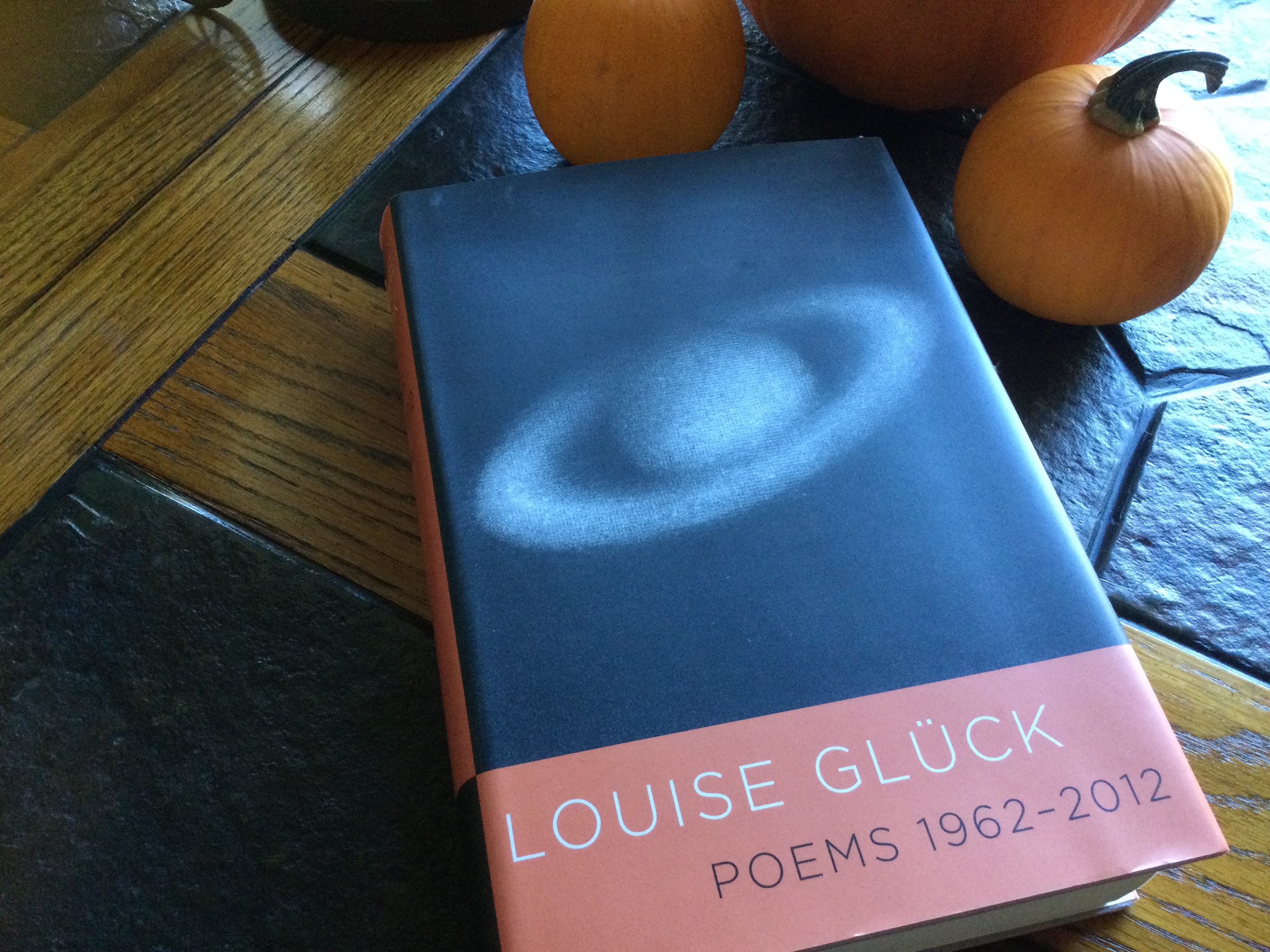
My November 2013 image of the sperm whale sculpture by Preston Jackson.
Guess who was selected to be a virtual reader in the New Bedford Whaling Museum’s annual Moby-Dick Marathon?
My November 2013 image of the sperm whale sculpture by Preston Jackson.
Guess who was selected to be a virtual reader in the New Bedford Whaling Museum’s annual Moby-Dick Marathon?

Today, a day on which it feels as if we have an “extra” hour, seemed like a good day to negotiate the timed entries, curbside pickup lines, and security checkins required to complete several errands, so we sallied forth after walking four miles, finishing chores, and assuring the cats that, yes, we would return. At the highway entrance on one of the main routes into the large town in which our activities were centered, the light turned green, but traffic halted abruptly in the wake of sirens and lights. A funeral? we wondered, as a long line of cars streamed off the highway. We then noticed the political flags and recognized that it was not a police vehicle barring our way but a member of the group in a vehicle outfitted with sirens and lights. Little surprises me (well, any of us, right?) these days, but that display of aggression, intimidation, and entitlement shook me.

Since my last annotated list, I’ve read twelve books, for a total of 202. With more than two months remaining in the year, it is possible that I will blow through my goal (revised thrice: from 104 to 120 to 156 to 208).
■ Leopoldstadt (Tom Stoppard; 2020. Drama.)
Read to prepare for Deep Dive: Tom Stoppard’s Leopoldstadt, presented by the Court Theatre and the University of Chicago.
■ The Bacchae of Euripides: A Communion Rite (Wole Soyinka; 1973. Drama.)
Read to prepare for the second “Theatre & Thought” series, Euripides’ The Bacchae and Contemporary Adaptations.
■ Strangers on a Train (Patricia Highsmith; 1950. Fiction.)
It is hard to believe this brooding, accomplished thriller was her first novel. Related article here.
■ Solitary (Albert Woodfox; 2019. Non-fiction.)
Review here.
■ They Thought They Were Free: The Germans, 1933-45 (Milton Mayer; 1959 (2017 edition). Non-fiction.)
Excerpt here. I cannot recommend this book enough.
■ Death of a Salesman (Arthur Miller; 1949. Drama.)
Reread after watching the stream of the Tony Award-winning Broadway production directed by Goodman Theatre’s Robert Falls.
■ The Bear (Andrew Krivak; 2020. Fiction.)
As I said to my husband, it is well written and engaging but not as special as the many recommendations had led me to believe.
■ Who Do You Love (Jennifer Weiner; 2015. Fiction.)
Once in a while, I just need some mental M&Ms.
■ Survival: Another Story, Vol. 1 (Takao Saito; 2017. Graphic fiction.)
■ Family Tree, Vol. 2: Seeds (Jeff Lemire; 2020. Graphic fiction.)
I no longer remember who pressed Survival on me, but it was worth the time; and I’m not certain where Family Tree is heading, which is a compliment of sorts.
■ Don’t Call Us Dead (Danez Smith; 2017. Poetry.)
Reviews here and here.
■ It Can’t Happen Here (Sinclair Lewis; 1936. Fiction.)
Read in anticipation of this. Review of the production here.
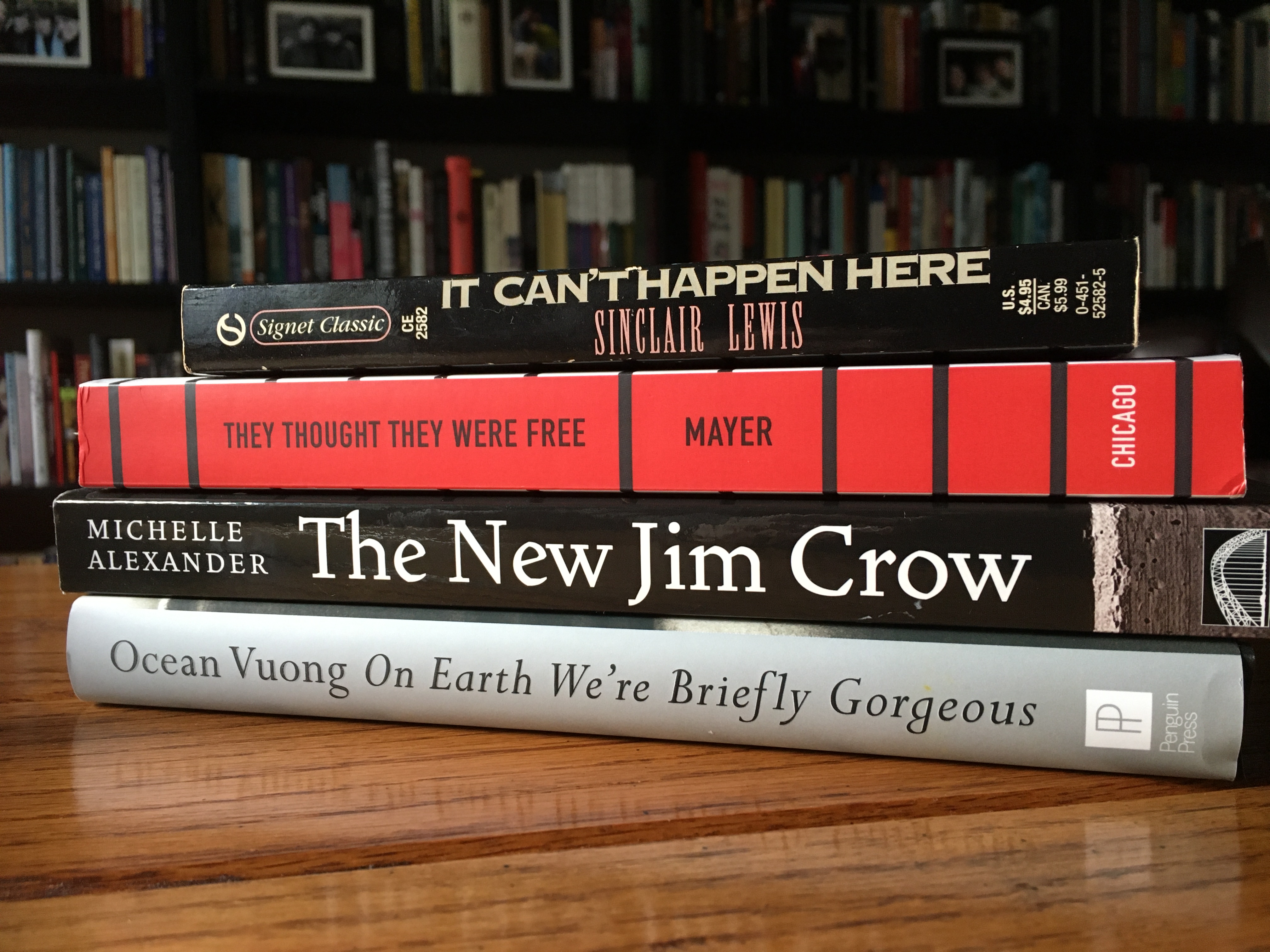
My “currently reading” stack changes often, but I added the Lewis in anticipation of this and the Alexander in the wake of finishing Albert Woodfox’s memoir.
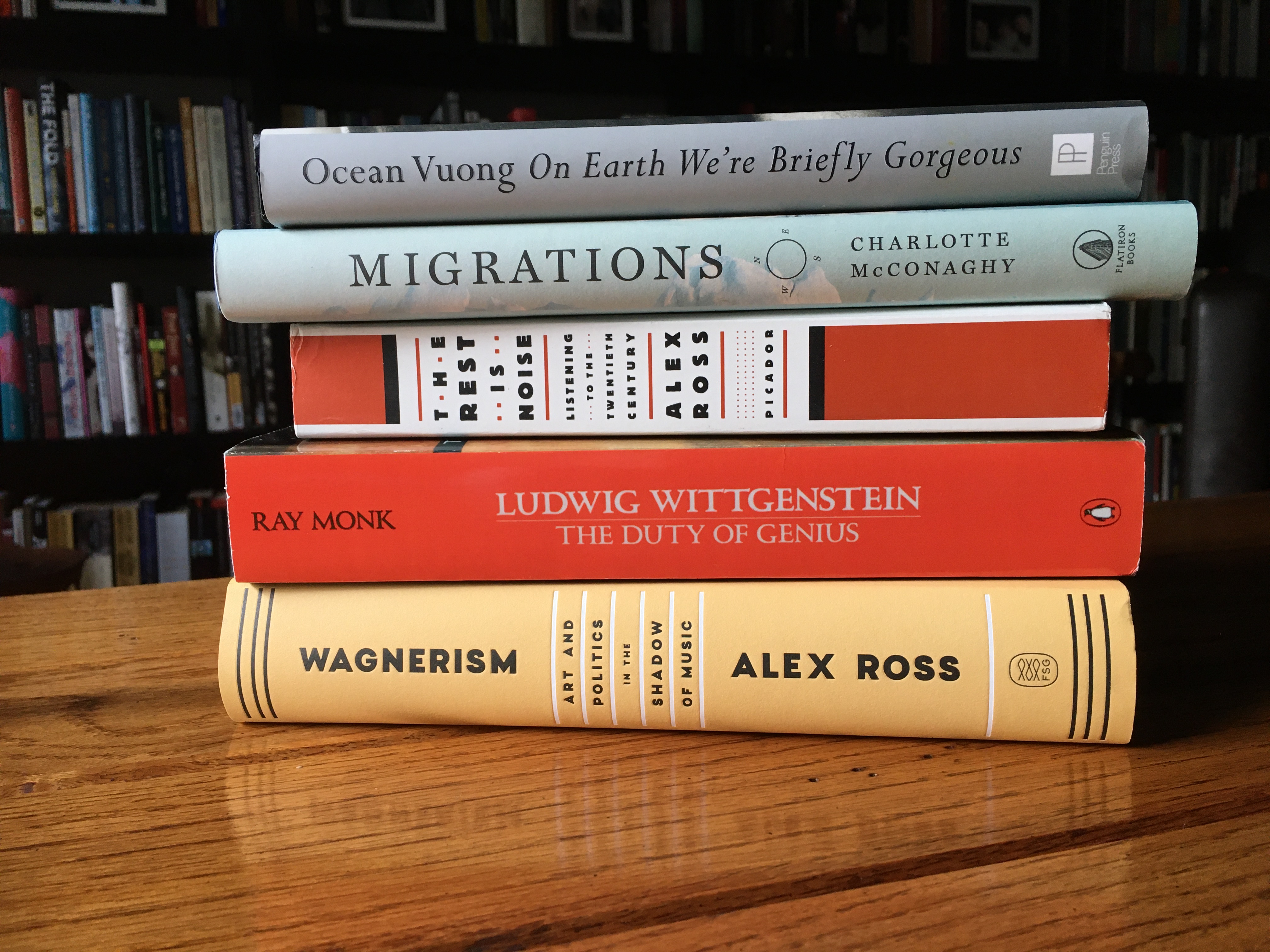
Purchased with three deals: points, a coupon, and a buy two/get one free.

So, yeah, I’m probably not going to be able to finish all of these this week. Heh, heh, heh.
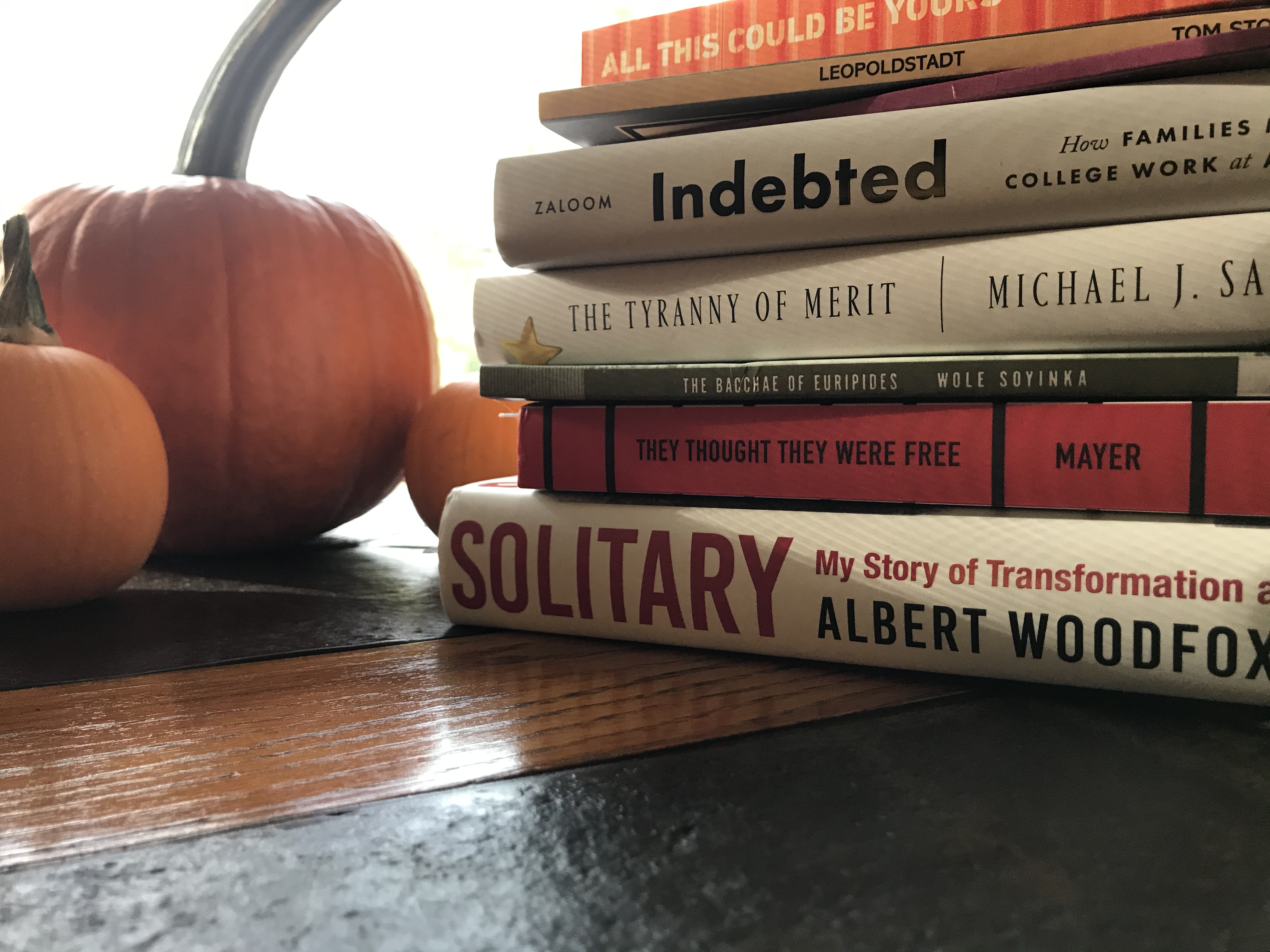
My weekend stack, which includes recent acquisitions.
I’ve finished twelve books since my last post, for a total of 190; my goal of 208 for the year is within reach.
■ Seven Guitars (August Wilson; 1995. Drama.) ATY
■ King Hedley II (August Wilson; 1999. Drama.) ATY
■ Jitney (August Wilson; 1982. Drama.)
■ Gem of the Ocean (August Wilson; 2003. Drama.)
■ Joe Turner’s Come and Gone (August Wilson; 1984. Drama.)
■ The Dramatic Vision of August Wilson (Sandra G. Shannon; 1995. Non-fiction.)
As I mentioned in my last post, Court Theatre’s 2020/21 season includes “Theatre & Thought,” four series of lectures by University of Chicago faculty and other scholars. The first four-week series, “The World of August Wilson and the Black Creative Voice,” concluded this week.
■ The Bacchae (Euripides; 405 B.C. Trans. Nicholas Rudall; 1996. Drama.)
The second four-week series, “Euripides’ The Bacchae and Contemporary Adaptation,” begins next week.
■ The Walking Dead: The Alien (Brian K. Vaughan; 2020. Graphic fiction.)
He had a brother?
■ Caste: The Origins of Our Discontents (Isabel Wilkerson; 2020. Non-fiction.)
Review here.
p. 223
This was the thievery of caste, stealing the time and psychic resources of the marginalized, draining energy in an already uphill competition. They were not, like me, frozen and disoriented, trying to make sense of a public violation that seemed all the more menacing now that I could see it in full. The quiet mundanity of that terror has never left me, the scars out living the cut.
We are told over and over again in our society not to judge a book by its cover, not to assume what is inside before we have had a chance to read it. Yet humans size up and make assumptions about other humans based on what they look like many times a day. We prejudge complicated breathing beings in ways that we are told never to judge inanimate objects.
■ Monogamy (Sue Miller; 2020. Fiction.)
Review here. A satisfying way to pass a Sunday afternoon.
■ Level 7 (Mordecai Roshwald; 1959. Fiction.)
What an odd time to rediscover this fictional diary of a nameless, button-pushing soldier.
■ Dear Edward (Ann Napolitano; 2020. Fiction.)
Earlier this summer, a friend asked if I had read this. We don’t necessarily read in the same ways or for the same reasons, but when I reached for a simple book earlier this week, I didn’t put it down. Sad without being (too) sentimental, true without being (too) didactic, it’s also filled with quiet humor. The main character may be a bit precocious, but then again, he was homeschooled.
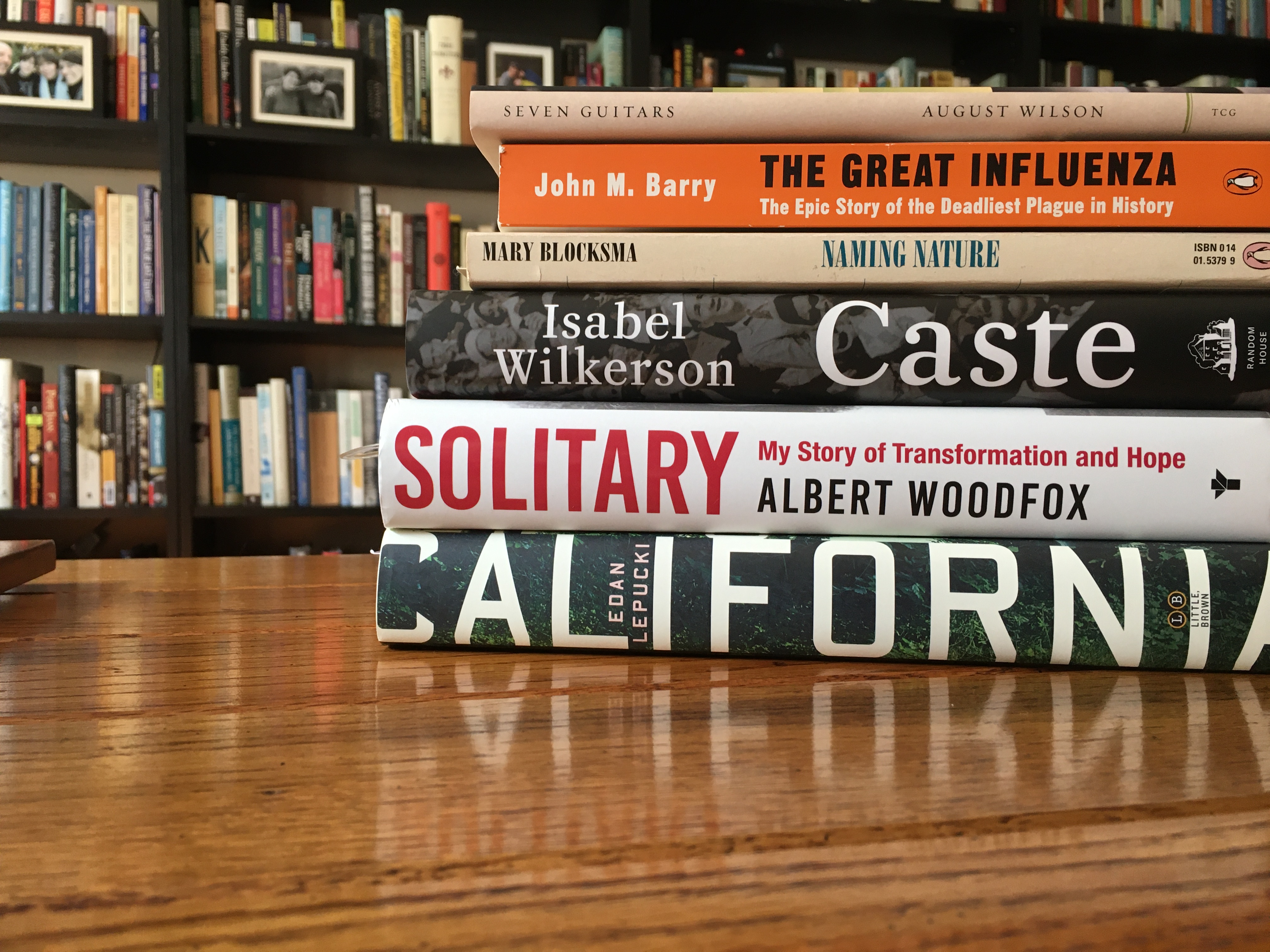
Current stack.
■ The New Wilderness (Diane Cook; 2020. Fiction.)
This caught my eye when it was long-listed for the Booker Prize. (It made the short list.) Review here. I wasn’t “dazzled,” but I was riveted.
■ The River at Night (Erica Ferencik; 2017. Fiction.)
■ The Truth about Harry Quebert Affair (Joël Dicker; 2014. Fiction.)
Every once in a while, I peruse the shelves, stop on a book, and think, “Hmmm. How did this get here?” So it was with these two. River, was mildly entertaining; Affair, however, was dreadful.
■ Sentient (Jeff Lemire; 2019. Graphic fiction.)
■ We Stand on Guard (Brian K. Vaughan; 2016. Graphic fiction.)
Both are solid stand-alone volumes.
■ The Piano Lesson (August Wilson; 1987. Drama.)
■ Fences (August Wilson; 1985. Drama.)
■ Two Trains Running (August Wilson; 1993. Drama.)
■ Ma Rainey’s Black Bottom (August Wilson; 1982. Drama.)
■ Radio Golf (August Wilson; 2005. Drama.)
Court Theatre’s 2020/21 season includes “Theatre & Thought,” four series of lectures by University of Chicago faculty and other scholars. For the first four-week series, “The World of August Wilson and the Black Creative Voice,” I’m making my way through the entire American Century Cycle.
From Radio Golf, Wilson’s last play:
If it don’t take all the quarters you fix it. Anybody with common sense will agree to that. What they don’t agree on is how to fix it. Some people say you got to tear it down to fix it. Some people say you got to build it up to fix it. Some people say they don’t know how to fix it. Some people say they don’t want to be bothered with fixing it. You mix them all in a pot and stir it up and you got America. That’s what makes this country great.
■ Voices from Chernobyl: The Oral History of a Nuclear Disaster (Svetlana Alexievich; 2005 (1997). Non-fiction.)
Read as a companion to Adam Higginbotham’s Midnight in Chernobyl: The Untold Story of the World’s Greatest Nuclear Disaster (2019). Haunting.
p. 107
I’ve felt something like this when someone close to me died. The sun is out, and the birds are flying, and the swallows, it starts raining — but he’s dead. Do you understand? I want to explain this whole other dimension in a few words, explain how it was for me then.

A summertime photo: Last August, my daughters and I spent an evening at the beach not far from where my husband and I grew up. The sound of the waves washing in and out… one of my favorites.
As back-to-school season drew near, I craved the sort of books that slide down like a glass of Hi-C and some Oreos, a snack Debbie D.’s mother often served when we climbed out of the pool following a long afternoon of lazily spinning on floats and gossiping. What can I say? We were young and unworried. Anyway, that yen for the bound version of refined sugar explains these two selections:
■ The Gifted School (Bruce Holsinger; 2019. Fiction.)
■ A Good Marriage (Kimberly McCreight; 2020. Fiction.)
Good luck and a great conversation with my older daughter explain the four graphic works I finished since my last post:
■ Family Tree, Vol. 1: The Sapling (Jeff Lemire; 2020. Graphic fiction.)
■ Something Is Killing the Children, Vol. 1 (James Tynion IV; 2020. Graphic fiction.)
■ Undiscovered Country, Vol. 1 (Scott Snyder; 2020. Graphic fiction.)
■ The Loneliness of the Long-Distance Cartoonist (Adrian Tomine; 2020. Graphic non-fiction.)
After revisiting our admiration of Jeff Lemire’s work, I poked around to see what he’s been working on lately. Say what you will about algorithms, I am grateful for the two recommendations that followed my discovery of Lemire’s Family Tree; I have enjoyed other titles by Tynion and Snyder and found these pretty solid. Tomine’s wry memoir arrived in my stack via a Goodreads recommendation.
This month, I concluded my Harry Potter reread:
■ Harry Potter and the Deathly Hallows (J.K. Rowling; 2007. Fiction.)
The only book I’d go out of my way to recommend, though:
■ Lost Children Archive (Valeria Luiselli; 2019. Fiction.)
Gorgeously written, thinky, harrowing. I really loved it. Reviews here and here.
p. 29
Conversations, in a family, become linguistic archaeology. They build the world we share, layer it in a palimpsest, give meaning to our present and future. The question is, when, in the future, we dig into our intimate archive, replay our family tape, will it amount to a story? A soundscape? Or will it be all sound rubble, noise, and debris?