Acquisitions


I’ve read 23 books since my last list, which puts me at 75 for the year, so far.
■ Parnassus on Wheels (Christopher Morley; 1917. Fiction.) RFS
I meant to read this ten or fifteen years ago, but I’m glad I didn’t because its innocence, humor, and bookish fun were something I needed now much more than then.
p. 43
“Judging by the way you talk,” I said, “you ought to be quite a writer yourself.”
“Talkers never write. They go on talking.”
■ How to Die: An Ancient Guide to the End of Life (Seneca; ed. James Romm; 2018. Non-fiction.) RFS
■ How to Keep Your Cool: An Ancient Guide to Anger Management (Seneca; ed. James Romm; 2019. Non-fiction.) RFS
■ How to Grow Old: Ancient Wisdom for the Second Half of Life (Marcus Tullius Cicero; ed. Philip Freeman; 2016. Non-fiction.) RFS
■ How to Be Free: An Ancient Guide to the Stoic Life (Epictetus; ed. A.A. Long; 2018. Non-fiction.) RFS
These four books are part of Princeton University Press’ “Ancient Wisdom for Modern Readers” series. I was particularly delighted by Cicero’s anecdote about Sophocles defending himself against his sons’ claims that he was experiencing age-related feeble-mindedness.
p. 49
[T]he old man then read to the court his Oedipus at Colonus, which he had just written and was even then revising, asking when he finished if it sounded like the work of a weak-minded person. After his recitation, the jury acquitted him.
It’s no secret that I am an abiding fan of synthesis / serendipity / synchronicity: We had tickets to Court Theatre’s now-rescheduled production of The Gospel at Colonus. Of course, then, Oedipus at Colonus was in my reading plan for April. How neat to have this tie-in.
■ The Bookshop (Penelope Fitzgerald; 1978. Fiction.) RFS
When I added Parnassus on Wheels to my Goodreads, this came up as a suggestion — another book I had meant to read a long time ago. The ending broke my heart, but I loved The Bookshop. Lively, whose Moon Tiger (1987) I greatly admire, is a wordsmith.
■ The Haunted Bookshop (Christopher Morley; 1919. Fiction.) LIB
This was nowhere near as beguiling as Parnassus on Wheels.
■ Chemistry (Weike Wang; 2017. Fiction.) RFS
I’m not certain I am actually the audience for this book about a young woman who experiences personal crisis after her partner proposes, but I thought it was terrific — smart and bittersweet. Check out this interview with the author.
■ The Sense of an Ending (Julian Barnes; 2011. Fiction.) RFS
Most folks read this years ago, when Barnes nabbed the Man Booker Prize. Again, this was just the book I needed now. It’s exquisite… perfect.
p. 65
Later on in life, you expect a bit of rest, don’t you? You think you deserve it. I did, anyway. But then you begin to understand that the reward of merit is not life’s business.
p. 104
How often do we tell our own life story? How often do we adjust, embellish, make sly cuts? And the longer life goes on, the fewer are those around to challenge our account, to remind us that our life is not our life, merely the story we have told about our life. Told to others, but — mainly — told to ourselves.
p. 115
Sometimes I think the purpose of life is to reconcile us to its eventual loss by wearing us down, by proving, however long it takes, that life isn’t all it’s cracked up to be.
■ The Storytelling Animal: How Stories Make Us Human (Jonathan Gottschall; 2012. Non-fiction.) RFS
Naturally, this fan of synthesis / serendipity / synchronicity appreciated hearing an echo of Barnes’ narrator in Gottschall’s exploration of narrative and psychology.
p. 161
We spend our lives crafting stories that make us noble — if flawed — protagonists of first-person dramas. A life story is a “personal myth” about who we are deep down — where we come from, how we got this way, and what it all means. Our life stories are who we are. They are our identity. A life story is not, however, an objective account. A life story is a carefully shaped narrative that is replete with strategic forgetting and skillfully spun meanings.
■ Oedipus at Colonus (Sophocles; 406 B.C. Trans. Robert Fitzgerald; 1969. Drama.) RFS
See above.
Scene IV
OEDIPUS:
I am perfectly content, so long as you
Can neither wheedle me nor fool these others.
CREON:
Unhappy man! Shall it be plain that time
Brings you no wisdom? that you shame your age?
OEDIPUS:
An agile wit! I know no honest man
Able to speak so well under all conditions!
■ Truth and Beauty (Ann Patchett; 2004. Non-fiction.) RFS
This complemented Lucy Grealy’s Autobiography of a Face (1994), which I read last month.
■ The Lost Books of the Odyssey (Zachary Mason; 2007/2010. Fiction.) RFS
April may prove to be the month of perfect books. Boy, was this fabulous. Reviews here and here.
p. 83
Finally, I saw myself, how my wit exceeded that of other men but gave me no leverage against fate, and how in the time to come it would avail me nothing but possibly an understanding of the full scope of my helplessness.
■ Harry Potter and the Sorcerer’s Stone (J.K. Rowling; 1998. Fiction.) RFS
■ Harry Potter and the Chamber of Secrets (J.K. Rowling; 1998. Fiction.) RFS
I had expected that returning to these would prove too bitter… but it was sweet comfort.
■ Lost Girls: An Unsolved American Mystery (Richard Kolker; 2013. Non-fiction.) RFS
After watching a trailer for a new movie of the same title, I headed to the shelves where this terrifically written entry in the unsolved mystery / true crime genre has awaited me (for *shhh* seven years). Review here.
■ The Tempest (William Shakespeare; 1610. Drama.) RFS
Years ago, when I first read The Tempest, I noted that Miranda was homeschooled. As I wrote elsewhere those many years ago, Prospero the schoolmaster serves his own needs at the expense of his student’s; and his dubious classroom management skills coupled with his troubling use of “wench” as term of endearment irritated in both that first reading and this most recent. Yet, when nearly every kid in the United States is “suddenly homeschooled,” rediscovering Shakespeare’s take on homeschooling provided another dose of synthesis / serendipity / synchronicity.
Act I, Scene 2
PROSPERO:
Now I arise:
[Resumes his mantle]
Sit still, and hear the last of our sea-sorrow.
Here in this island we arrived; and here
Have I, thy schoolmaster, made thee more profit
Than other princesses can that have more time
For vainer hours and tutors not so careful.
■ Man’s Search for Meaning: An Introduction to Logotherapy (Viktor E. Frankl; 1946. Non-fiction.) RFS
This was the fourth or fifth time I’ve read this book.
p. 56
Sensitive people who were used to a rich intellectual life may have suffered much pain (they were often of delicate constitution), but the damage to their inner selves was less. They were able to retreat from their terrible surroundings to a life of inner riches and spiritual freedom.
p. 68
Humor was another of the soul’s weapons in the fight for self-preservation. It is well known that humor, more than anything else in the human make-up, can afford an aloofness and an ability to rise above any situation, even if only for a few seconds.
p. 122
We needed to stop asking about the meaning of life, and instead to think of ourselves as those who were being questioned by life — daily and hourly. Our answer must consist, not in talk and meditation, but in right action and in right conduct. Life ultimately means taking the responsibility to find the right answer to its problems and to fulfill the tasks which it constantly sets for each individual.
■ Give Me Your Heart (Joyce Carol Oates; 2010. Fiction.) RFS
It was a bit of a chore to work through this one.
■ Viktor Frankl: A Life Worth Living (Anna S. Redsand; 2006. Non-fiction.) RFS
A suitable introduction to Frankl for middle-school students.
■ American Predator (Maureen Callahan; 2019. Non-fiction.) RFS
Related link here. This was one that made me check the window and door locks. Again. And again.
■ Flatland (Edwin A. Abbott; 1884. Fiction.) RFS
Trippy blend of satire, math, and physics. Related link here.
■ Measure for Measure (William Shakespeare; 1603. Drama.) RFS
The Shakespeare Project of Chicago hopes to move its production of Measure for Measure to next season.
Act I, Scene 4
LUCIO:
Our doubts are traitors
And make us lose the good we oft might win
By fearing to attempt.
Act II, Scene 2
ISABELLA:
So you must be the first that gives this sentence,
And he, that suffers. O, it is excellent
To have a giant’s strength; but it is tyrannous
To use it like a giant.
—————————————
ATY Acquired this year
LIB Borrowed from library (including Hoopla and Overdrive)
OTH Other
RFS Read from shelves


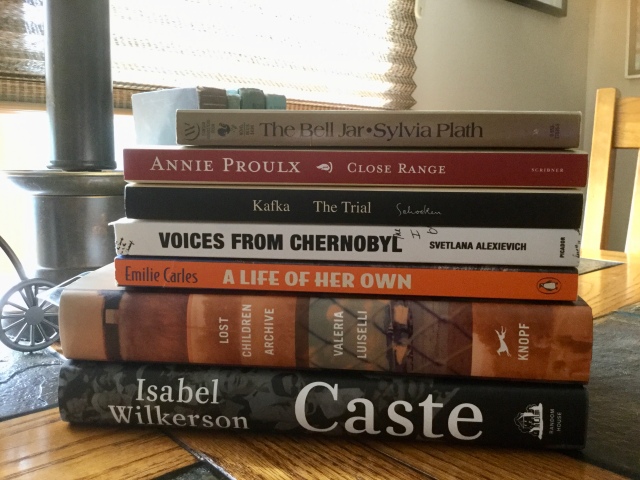
The stack beside my favorite reading chair.
Last year, I issued myself a bold challenge: Read one hundred books from my shelves (i.e., books in my collection before the end of 2018), including at least 24 non-fiction titles and at least one book from each of the following “special collections”: Shakespeare, poetry, NYRB, Vonnegut, Joyce Carol Oates, philosophy, art, and children’s / YA. I met the special collections goal, but of the 42 non-fiction titles I read last year, only 18 were RFS (read from shelves). And of the 120 books I read last year, only 53 were RFS. (Here is last year’s summary.)
Without fanfare, I renewed the challenge for 2020, and I’m enjoying significantly more success. At this writing, I’ve read 69 books, 51 of which were in my collection before the end of 2019; and I’ve read 27 non-fiction works, 23 of which were RFS. As for the mini-challenges:
Shakespeare RFS: Richard III, The Taming of the Shrew, As You Like It and The Tempest
Poetry RFS: Aimless Love (Billy Collins)
NYRB RFS:
Vonnegut RFS:
Joyce Carol Oates RFS:
Philosophy RFS: How to Die: An Ancient Guide to the End of Life (Seneca); How to Keep Your Cool: An Ancient Guide to the Anger Management (Seneca); How to Grow Old: Ancient Wisdom for the Second Half of Life (Marcus Tullius Cicero); and How to Be Free: An Ancient Guide to the Stoic Life (Epictetus)
Art RFS:
Children’s / YA RFS:
I’m three stories into Joyce Carol Oates’ 2010 collection, Give Me Your Heart; and I recently pulled Mother Night from my Vonnegut shelves. The narrator is a Nazi propagandist, so the choice may prove an interesting complement to The Plot Against America (Philip Roth, 2004), which I read last month. I haven’t made decisions about the other categories.
My unfinished business from last year is Chris Chester’s Providence of a Sparrow, which is a gorgeous memoir. I simply need to finish it.
So with eight months remaining in the year, I’m experiencing a sense of (cautious) optimism about meeting all of my 2020 reading goals. In fact, I have been toying with increasing my Goodreads challenge, which is currently 104 books. We’ll see.
And, yes, book talk in the midst of a pandemic may seem like the equivalent of putting my hands over my ears and saying, “La, la, la! I can’t hear anything.” I do hear. Books are what keep me sane afterward.
Since my last list, I have read fifteen books, which means that I have completed Robin’s “Read 52 Books in 52 Weeks” challenge. But let’s keep going, eh?
■ Autobiography of a Face (Lucy Grealy; 1994. Non-fiction.) RFS
p. 7
The cruelty of children is immense, almost startling its precision. The kids at the parties were fairly young and, surrounded by adults, they rarely make cruel remarks outright. But their open, uncensored stares were more painful than the deliberate taunts of my peers at school, where insecurities drove everything and everyone like some looming, evil presence in a haunted machine. But in those backyards, where the grass was mown so short and sharp it would have hurt to walk on it, there was only the fact of me, my face, my ugliness.
■ The Plot Against America (Philip Roth; 2004. Fiction.) RFS
I had thought this would be a reread but then realized I had confused it with American Pastoral. The book is practically perfect, so although the first episode of the new HBO series was solid, it’s unlikely that I will continue watching.
p. 114
Turned wrong way round, the relentless unforeseen was what we schoolchildren studied as “history,” harmless history, where everything unexpected in its own time is chronicled on the page as inevitable. The terror of the unforeseen is what the science of history hides, turning a disaster into an epic.
p. 300
Whether outright government-sanctioned persecution was inevitable, nobody could say for sure, but the fear of persecution was such that not even a practical man grounded in his everyday tasks, a person who tried his best to contain the uncertainty and the anxiety and the anger and operate according to the dictates of reason, could hope to preserve his equilibrium any longer.
p. 316
To have enslaved America with this hocus-pocus! To have captured the mind of the world’s greatest nation without uttering a single word of truth! Oh, the pleasure we must be affording the most malevolent man on earth!
■ Aimless Love (Billy Collins; 2013. Poetry.) RFS
Billy Collins is a treasure.
■ My Dark Vanessa (Kate Elizabeth Russell; 2020. Fiction.) ATY
Read in two sittings. Timely and disturbing. Related links here and here.
■ Severance (Ming La; 2018. Fiction.) RFS
Prescient and gorgeously written. I cannot recommend it enough. Mr. Nerdishly agrees, wryly adding, “It’s also scary as hell.” Review here.
■ Trees, Vol. 3 (Warren Ellis; 2020. Graphic fiction.) LIB
Strong addition to the series.
■ Oblivion Song, Vol. 4 (Robert Kirkman; 2020. Graphic fiction.) LIB
Less so.
■ Say Nothing: A True Story of Murder and Memory in Northern Ireland (Patrick Radden Keene; 2019. Non-fiction.) RFS
Related links here and here.
■ Catch and Kill (Ronan Farrow; 2019. Non-fiction.) RFS
This reminded me of my experience reading Bad Blood: I could not put it down; hours disappeared. A review and an article about the related podcast.
■ The Old Man and the Sea (Ernest Hemingway; 1952. Fiction.) ATY
This is another of those books that I have reread as an adult and realized, “Wow, that was clearly wasted on my teenaged self.”
No one should be alone in their old age, he thought. But it is unavoidable.
■ Postal: Deliverance, Vol. 1 (Brian Edward Hill; 2019. Graphic fiction.) LIB
The owner of the comic book store we patronize has fruitfully recommended several series to me, so it’s odd that he didn’t mention that Postal, a series on my shortlist, had continued. Well, it was a treat to discover the first volume on Hoopla.
■ The Nose (Nikolai Gogol; 1835. Fiction.) RFS
We saw some of William Kentridge’s The Nose Series at the Milwaukee Art Museum, but a search of the museum’s website yields only a tax document mentioning that the prints were there. Weird. Well, in any event, I now plan to watch the Kentridge production of the Shostakovich opera via Met On Demand.
But nothing lasts long in this world, and so even joy is weaker one minute than the last, and by the third it has become something fainter still, until finally it fades imperceptibly back into the more usual state of one’s mind, just as a ripple on water, born from the drop of a pebble, will gradually merge back into the smooth surface of the lake.
■ The Book of M (Peng Shepherd; 2018. Fiction.) RFS
Too long by one hundred pages, and, boy, is the chapter for each narrator device one of the most overused in contemporary fiction, or what? Add to that the fact that I grew impatient with the fantastical elements by the final third, and you have the recipe for a Meh rating.
■ The Lion in Winter (James Goldman; 1966. Drama.) RFS
Reread one of my favorites because this is a season that requires such indulgences.
Act II, Scene 1
Eleanor: I adored you.
Henry: Never.
Eleanor: I still do.
Henry: Of all the lies, that one is the most terrible.
Eleanor: I know: that’s why I saved it up for now. (They throw themselves into each other’s arms.) Oh, Henry, we have mangled everything we’ve touched.
■ The Dream-Quest of Vellitt Boe (Kij Johnson; 2016. Fiction.) RFS
My ticket stub from Chicago Shakespeare Theater’s 2016 production of Tug of War: Friendly Fire marked page 41. My best guess, then, is that I began this unusual book four years ago and set it aside. Written as a feminist counterpoint to H.P. Lovecraft’s The Dream-Quest of Unknown Kadath, this short novel is certainly not my usual fare, but I returned to the beginning and gave it another shot. Still not my cuppa, but, hey, I finished it this time. Related article here.
—————————————
ATY Acquired this year
LIB Borrowed from library (including Hoopla and Overdrive)
OTH Other
RFS Read from shelves
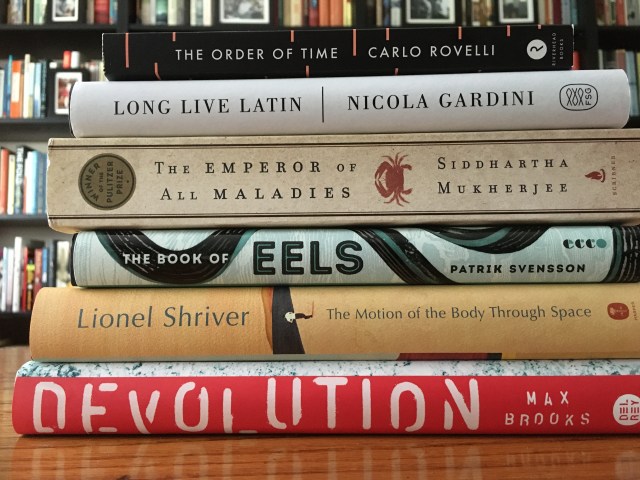
I ordered several of these from the Seminary Co-op Bookstore, which needs support now more than ever. Consider making your April book purchases there.
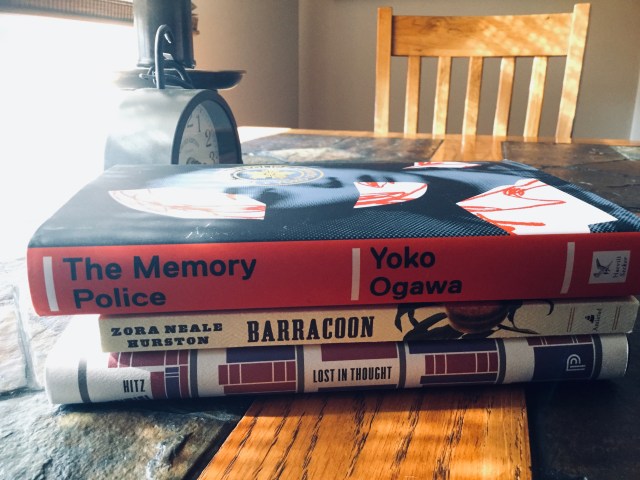
I may switch it up before week’s end, but this is what I’m working with right now.

It’s as if I had been preparing for this moment my entire life.

Talk about serendipity, synthesis, and synchronicity…
Not long after I finished reading Mary Beard’s slim volume, Women & Power, I visited the MFA, where the Head of Medusa (Arnold Böcklin, 1894) held my gaze.
■ The Truants (Kate Weinberg; 2019. Fiction.) LIB
A quick, entertaining read. I particularly relished the idea of Agatha Christie as a subject of academic inquiry.
■ Women and Power (Mary Beard; 2017. Non-fiction.) RFS
Mary Beard is a genius. Related link here.
■ Men Explain Things to Me (Rebecca Solnit; 2017. Non-fiction.) RFS
Related link: “Before there was mansplaining, there was Rebecca Solnit’s 2008 critique of male arrogance. Reprinted here with a new introduction.”
p. 10
Dude, if you’re reading this, you’re a carbuncle on the face of humanity and an obstacle to civilization. Feel the shame.
p. 62
Gay men and lesbians have already opened up the question of what qualities and roles are male and female in ways that can be liberating for straight people. When they marry, the meaning of marriage is likewise opened up. No hierarchical tradition underlies their union. Some people have greeted this with joy.
■ The Prime of Miss Jean Brodie (Muriel Spark; 1961. Fiction.) RFS
Muriel Spark was a genius, too.
■ The Lady from the Sea (Henrik Ibsen; 1888. Drama.) RFS
Read in anticipation of seeing the Court Theatre production.
■ Five Days at Memorial (Sheri Fink; 2013. Non-fiction.) RFS
Related link here.
■ The Taming of the Shrew (William Shakespeare; 1592. Drama.) RFS
Reread in anticipation of seeing the Royal Shakespeare Company at Chicago Shakespeare.
■ Zeitoun (Dave Eggers; 2009. Non-fiction.) RFS
This was the perfect companion to Fink’s Five Days at Memorial and Patricia Smith’s Blood Dazzler earlier this year.
■ As You Like It (William Shakespeare; 1599. Drama.) RFS
Read in anticipation of seeing the Chicago Shakespeare production.
Act III, Scene V
But, mistress, know yourself: down on your knees,
And thank heaven, fasting, for a good man’s love:
For I must tell you friendly in your ear,
Sell when you can: you are not for all markets:
Cry the man mercy; love him; take his offer:
Foul is most foul, being foul to be a scoffer.
■ American Dirt (Jeanine Cummins; 2020. Fiction.) ATY
From the NYT review by Parul Sehgal:
But does the book’s shallowness paradoxically explain the excitement surrounding it? The tortured sentences aside, “American Dirt” is enviably easy to read. It is determinedly apolitical. The deep roots of these forced migrations are never interrogated; the American reader can read without fear of uncomfortable self-reproach. It asks only for us to accept that “these people are people,” while giving us the saintly to root for and the barbarous to deplore — and then congratulating us for caring.
It certainly was “enviably easy to read.”
p. 50
What a waste of time it had all been. Lydia feels annoyed that her niece won’t get to see the music box she purchased for her special day. How expensive it was! She realizes, even as this thought occurs to her, how bizarre and awful it is, but she can’t stop it from crashing in. She doesn’t rebuke herself for thinking it; she does herself the small kindness of forgiving her malfunctioning logic.
p. 276
He’s a philosopher, she thinks. He’s rough, but he means what he says, and his openness is a provocation. Despite everything, he likes being alive. Lydia doesn’t know whether that’s true for herself. For mothers, the question is immaterial anyway. Her survival is a matter of instinct rather than desire.
■ Homer’s The Iliad and The Odyssey (Alberto Manguel; 2007. Non-fiction.) RFS
We’ve had our tickets to the Court’s sold-out, site-specific remount of An Iliad since September. It was more than worth the wait and the price.
p. 2
We don’t know anything about Homer. It is otherwise with Homer’s books. In a very real sense, the Iliad and the Odyssey are familiar to us prior to opening the first page. Even before we begin to follow the changing moods of Achilles or admire the wit and courage of Ulysses, we have learned to expect that somewhere in these stories of war in time and travel in space we will be told the experience of every human struggle and every human displacement. Two of our oldest metaphors tell us that all life is a battle and that all life is a journey; whether the Iliad and the Odyssey drew on this knowledge or whether this knowledge was drawn from the Iliad and the Odyssey is, in the final count, unimportant, since a book and its readers are both mirrors that reflect one another endlessly.
p. 88
A book’s influence is never straightforward. Common readers, unrestricted by the rigours of academe, allow their books to dialogue with one another, to exchange meanings and metaphors, to enrich and annotate each other. In the reader’s mind, books become intertwined and intermingled, so that we no longer know whether a certain adventure belongs to Arsilaous or to Aquiles, or where Homer ends Ulysses’ adventures and the author of Sinbad takes them up again.
p. 226
The scene of war, says Homer, is never only that of war: it is never only that of men acting out in the present the events of the day. It is always the scene of the past as well, a display of what men secretly once were, revealed now in their ultimate moments. Confronted with the imminence of violent death, war also confronts them with the memory of days of peace, of the happiness that life can, and should, grant us. War is both things: the experience of an awful presence and the ghost of a beloved past.
■ The Iliad (Gareth Hinds; 2019. Graphic fiction.) RFS
I did not appreciate this volume as much as Hinds’ graphic retelling of The Odyssey, which I read last year.
■ Why We Can’t Sleep (Ada Calhoun; 2020. Non-fiction.) LIB
p. 221
Could we even see our newfound midlife invisibility as a source of power? In Harry Potter’s world, one of the most prized magical tools is an invisibility cloak. There are great advantages to being underestimated. Two of the best reporters I know are women in their fifties. They look so friendly and non-threatening, if you notice them at all. They can lurk in any room without usually wary people remembering to keep their guard up. Then they write devastating whistleblowing articles. The world ignores middle-aged women at its peril.
■ Vinegar Girl (Anne Tyler; 2016. Fiction.) RFS
Read as a companion to my Shrew reread. This was also “enviably easy to read,” and that’s not a criticism.
—————————————
ATY Acquired this year
LIB Borrowed from library
OTH Other
RFS Read from shelves
On this gray, cold morning, all I really want to do is sip coffee, watch the birds in my yard (right now, three beautiful crows, my bird of the year), and read. Alas, I am covering the vacation of the gal who took over my tutoring gig, so I must rouse myself, don something more appropriate than these comfortable flannel pants and my favorite old sweater, and prepare the sort of nutritious lunch that will keep me going until 6 p.m. Sigh.