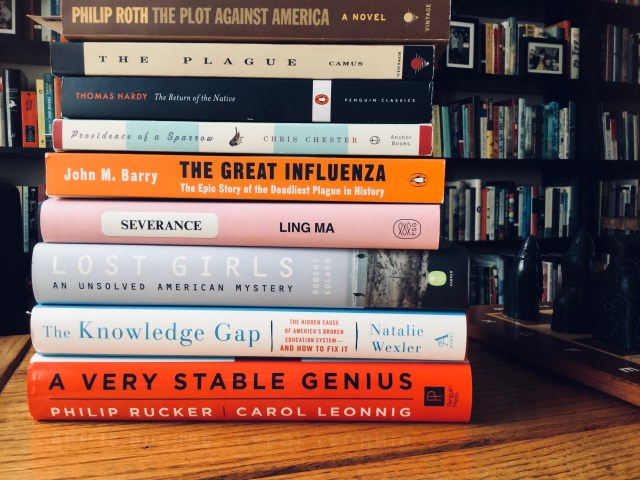
 In this, as in the other annotated lists, the order is roughly that in which I finished reading the books, although I do sometimes cluster related titles to remark on them as a set. The object is to gather the mental slips of paper I’ve tucked into each book — passages I hope to remember, articles and / or images I sought while reading, my reasons for choosing this volume or that, etc.
■ After I’m Gone (Laura Lippman; 2014. Fiction.) RFS
■ I’d Know You Anywhere (Laura Lippman; 2010. Fiction.) RFS
In 2008, I read Lippman’s What the Dead Know (2007). Although I do not remember much about it, the fact that I read it is all that explains the two additional Lippman titles on my shelves. In a different time, After I’m Gone would have been an adequate poolside companion.
■ The Journalist and the Murderer (Janet Malcolm; 1990. Non-fiction.) RFS
Most know this book’s first sentence, which is also its argument: “Every journalist who is not too stupid or too full of himself to notice what is going on knows that what he does is morally indefensible.” Related links here and here.
■ Tales from the Loop (Simon Stålenhag; 2014. Graphic fiction.) LIB
I had thought the stories would be too slight, but, in fact, they amplify the weird beauty of his paintings. Related article here.
p. 77
The one thing he was admired for was his accurate penalty shots when we played soccer during recess, so his stories may have been designed to get some attention during the winter months, when the soccer field play frozen and empty. What follows is what he told us.
■ Mother Night (Kurt Vonnegut; 1961. Fiction.) RFS *
Revisiting my Vonnegut collection requires reassurance, “Ah, it holds up,” as if I were crossing a footbridge that readily supported my younger, lighter self but might buckle under the weight of my older, solid self. This book argues strongly for the bridge’s inherent reliability.
■ Harry Potter and the Prisoner of Azkaban (J.K. Rowling; 1999. Fiction.) RFS *
A comforting reread.
■ The Nickel Boys (Colson Whitehead; 2019. Fiction.) RFS
What can I add to the chorus (e.g., here, here, and here) that has praised this and his earlier The Underground Railroad?
■ Bartleby, the Scrivener (Herman Melville; 1856. Fiction.) RFS *
From “Herman Melville’s Bartleby and the steely strength of mild rebellion” (The Guardian; January 9, 2017):
There are very few stories that, on re-reading after re-reading, seem to become impossibly more perfect, but Herman Melville’s eerie, aching story Bartleby, the Scrivener is one such. Like a parable without an obvious moral, it is defiance raised to the metaphysical.
■ Chaos: Charles Manson, the CIA, and the Secret History of the Sixties (Tom O’Neill; 2019. Non-fiction.) RFS
Related link here.
p. 84
I was writing a story about Charles Manson that had, so far, very little Manson in it. It was more about the way that events, in all their messy reality, boiled down to canonical fact; the way that a narrative becomes the narrative.
■ The Metamorphosis (Franz Kafka (1915); Bantam ed. 1972. 201 pages. Fiction.) RFS *
Have seven years passed since I read this with my daughters? Below are images they created in the wake of our discussions.
■ Kafka (Robert Crumb; 1993 / 2013. Graphic non-fiction.) RFS
■ James Joyce: Portrait of a Dubliner (Alfonso Zapico; 2011. Graphic non-fiction.) RFS
Excellent, both.
■ The Underground Railroad (Colson Whitehead; 2016. Fiction.) RFS
Related link here.
■ The Book of Delights (Ross Gay; 2019. Non-fiction.) ATY
Following Melissa’s recommendation, I finished this collection of essays in 1.5 sittings. Related link here.
p. 32
[T]he process of thinking that writing is, made disappearable by the delete button, makes a whole part of the experience of writing, which is the production of a good deal of florid detritus, flotsam and jetsam, all those words that mean what you have written and cannot disappear (the scratch-out its own archive), which is the weird path toward what you have come to know, which is called thinking, which is what writing is.
p. 49
“What if we joined our wildernesses together?” Sit with that for a minute. That the body, the life, might carry a wilderness, an unexplored territory, and that yours and mine might somewhere, somehow, meet. Might, even, join.
p. 195
I’m from the Northeast, I hear myself say. Or, I’m a Northeasterner. Meaning, linguistically, that the appropriate plural of “you” in certain contexts is “yous.” Meaning the beach is called the shore, and you go down to it. To swim in the wooder.
Aside: If I had a dollar for every quizzical look I have endured when asking for a glass of water, I could buy a large house on the shore.
■ The Amazing Maurice and His Educated Rodents (Terry Pratchett; 2001. Fiction.) RFS
Part of an informal summer book club with my older daughter.
■ A Very Easy Death (Simone de Beauvoir; 1964. Non-fiction.) RFS
A friend recently shared that she thought her mother might be making surreptitious cigarette runs to the corner store. It wasn’t that the woman, who is in her late seventies, had resumed the habit that so upset my friend; it was that she was venturing out during the pandemic and not letting the people in her circle know.
I listened, because in such conversations, that is all that is generally required. When her anger had abated a bit, I ventured, “You have officially entered the ‘parenting your parent’ stage, eh?” Later, in one of those odd moments of serendipity / synthesis / synchronicity, I realized that Beauvoir’s memoir of her mother’s illness, hospitalization, and death was the book I planned to read next.
p. 92
Well-intentioned readers urged, ‘Disappearing is not of the least importance: your works will remain.’ And inwardly I told them all that they were wrong. Religion could do no more for my mother than the hope of posthumous success could do for me. Whether you think of it as heavenly or as earthly, if you love life immortality is no consolation for death.
p. 98
Everyone knows the power of things: life is solidified in them, more immediately present than in any one of its instants.
■ Providence of a Sparrow (Chris Chester; 2002. Non-fiction.) RFS
Unfinished business from last year. Related link here.
p. 7
Baseline for me has always been slightly below sea level. Too modest a depth in which to drown but deep enough to suggest what life must be like for those truly debilitated by anxiety and sadness that doesn’t go away. I suspect my mother and I have this in common and that her rather non-specific complaints of “not feeling well” I recall from childhood were tendrils snaking out from that buried route. She died of cancer when I was twenty-three, long before I developed enough compassion and insight to know her better. A pity, it’s likely we’d have found lots to discuss.
p. 182
The realization that we volunteer for many of our sorrows has helped me a good deal. We acquire them in seed form with each new attachment and shouldn’t be surprised when they sprout one day. Speaking as a person whose biochemistry manufactures gloom as a matter of course, it’s taken me years to understand that fate has never singled me out. The universe has better things to do than plague me with loss or go out of its way to make my life miserable. A perverse egotism is one of the problems with free-floating depression. It sits on your psyche calling attention to itself until you have to believe you’re important enough and special enough for the gods to persecute.
■ The Blue Castle (L.M. Montgomery; 1926. Fiction.) RFS
This had been in my shelves for a decade. Thanks to Jeanne’s review, I finally read (and loved) it.
■ Alexander’s Bridge (Willa Cather; 1912. Fiction.) RFS
It is difficult to believe that this was her first novel.
■ Breakfast at Tiffany’s (Truman Capote; 1958. Fiction.) RFS *
I first read this book more than thirty years ago, but I actually read it last week. Capote was a genius.
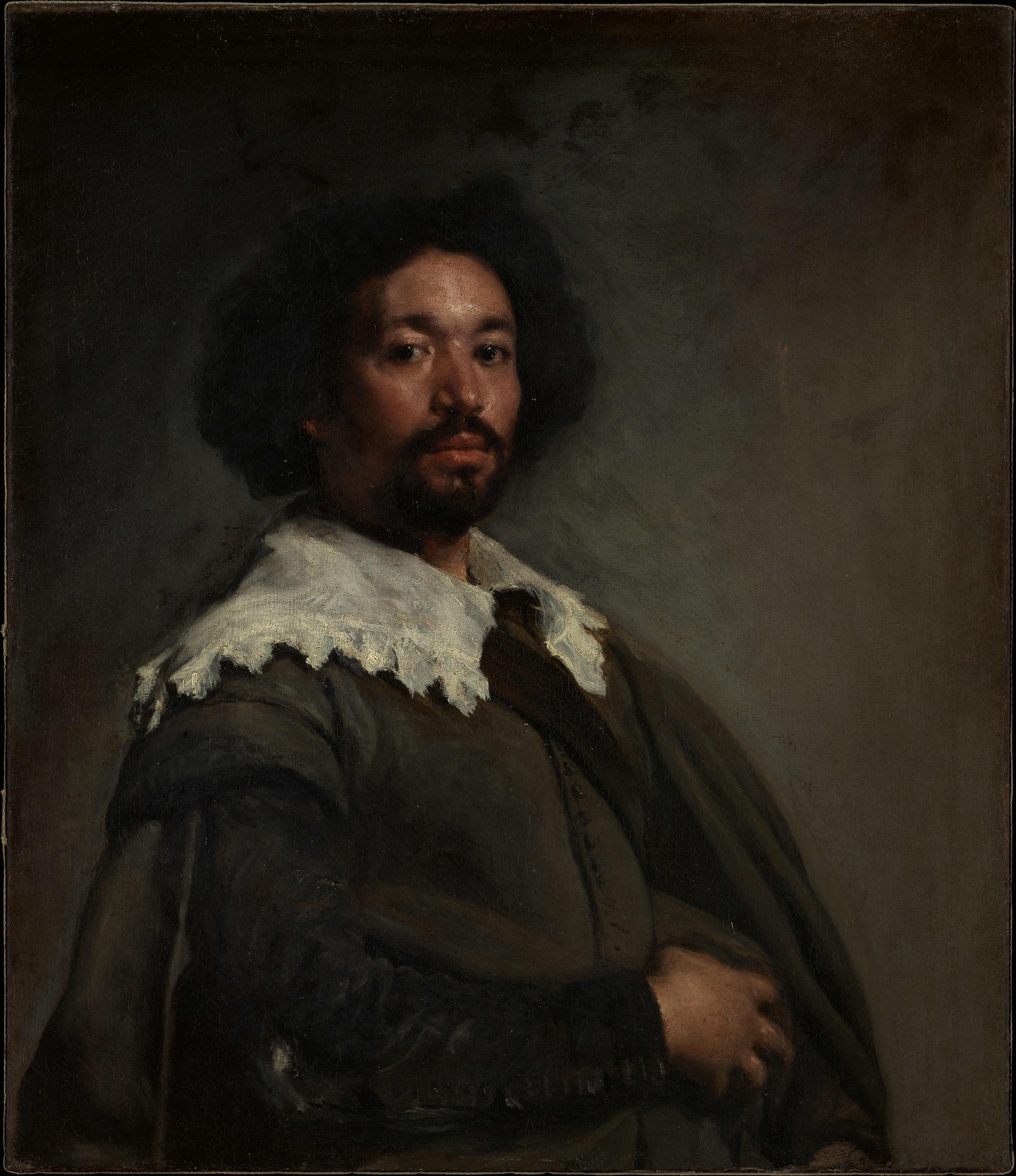
■ I, Juan de Pareja (Elizabeth Barton de Treviño; 1965. Fiction.) RFS
This satisfied my Children’s / YA RFS sub-challenge. From the Metropolitan Museum of Art:
Velázquez most likely executed this portrait of his enslaved assistant in Rome during the early months of 1650. According to one of the artist’s biographers, when this landmark of western portraiture was first put on display it “received such universal acclaim that in the opinion of all the painters of different nations everything else seemed like painting but this alone like truth.” Months after depicting his sitter in such a proud and confident way, Velázquez signed a contract of manumission that would liberate him from bondage in 1654.
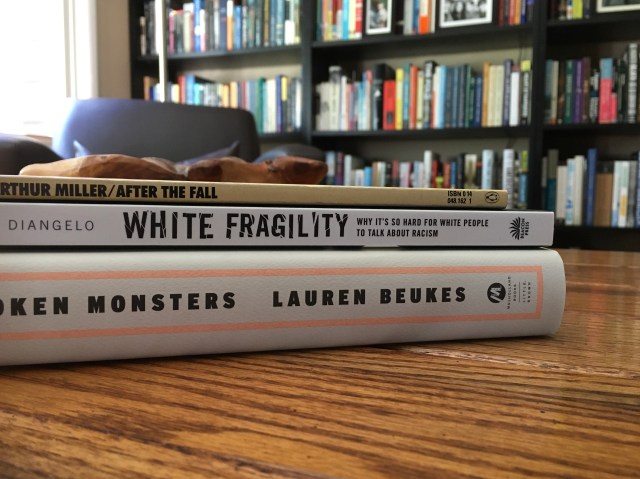
■ Incident at Vichy (Arthur Miller; 1965. Drama.) RFS *
This fit in so well with recent (re)reading: The Plot Against America (Philip Roth; 2004), Man’s Search for Meaning: An Introduction to Logotherapy (Viktor E. Frankl; 1946), and Mother Night (Kurt Vonnegut; 1961).
■ Gilgamesh: A New English Version (Stephen Mitchell; 2004. Poetry.) RFS *
“Gilgamesh is the story of a hero’s journey,” writes Stephen Mitchell in the introduction; “one might say that it is the mother of all heroes’ journeys, with its huge uninhibited mythic presences moving through a landscape of a dream.” He explains:
The archetypal hero’s journey proceeds in stages: being called to action, meeting a wise man or guide, crossing the threshold into the numinous world of the adventure, passing various tests, attaining the goal, defeating the forces of evil, and going back home. It leads to a spiritual transformation at the end, a sense of gratitude, humility, and deepened trust in the intelligence of the universe. After he finds the treasure or slays the dragon or wins the princess or joins with the mind of the sage, the hero can return to ordinary life in a state of grace, as a blessing to himself and to his whole community. He has suffered, he has triumphed, he is at peace.
So Gilgamesh is a quest story, maintains Mitchell, but on close inspection, it’s a “bizarre, quirky, and postmodern” one.
Revisiting Mitchell’s remarkable version of “the oldest story in the world, a thousand years older than the Iliad or the Bible,” I was again undone by Book VIII. Enkindu, Gilgamesh’s best friend, has died. “Hear me, elders, hear me, young men,” laments Gilgamesh,
[M]y beloved friend is dead, he is dead,
my beloved brother is dead, I will mourn
as long as I breathe, I will sob for him
like a woman who has lost her only child.
O, Enkindu, you were the axe at my side
in which my arm trusted, the knife in my sheath,
the shield I carried, my glorious robe,
the wide belt around my loins, and now
a harsh fate has torn you from me, forever.
As they did sixteen years ago, the cadences of his profound grief recalled to me W.H. Auden:
He was my North, my South, my East and West,
My working week and my Sunday rest,
My noon, my midnight, my talk, my song;
I thought that love would last for ever: I was wrong.
The stars are not wanted now: put out every one;
Pack up the moon and dismantle the sun;
Pour away the ocean and sweep up the wood.
For nothing now can ever come to any good.
■ Einstein’s Dreams (Alan Lightman; 1993. Fiction.) RFS
Patterns often emerge in my reading, and I find that this oddly complements Flatland, which I read last month.
Aside: When I pulled the book from the shelves, I noticed a bookmark. I figured it was from the bookstore, but it was a commemorative item from a wedding, which meant I purchased this book used — perhaps at a library sale or a Half Price Books location? Of course, I Googled the couple and found that they had purchased a house in Illinois a few years after marrying. A yen to mail them their bookmark with a note about how awesome it was that they distributed bookmarks — bookmarks! — as a reminder of their special day seized me and would not let me go — until I realized that while the discovery may have delighted me, the reminder might not necessarily delight them. I wonder how many moments of joy are aborted by “On second thought…”?
■ The Odd Woman and the City (Vivian Gornick; 2015. Non-fiction.) RFS
I began this several years ago but apparently never finished it (although much to my chagrin, it appears in my 2016 books read list). I removed the bookmark and began again, finishing in one sitting. This reading experience reminded me of the deep delight (that word again!) I experienced when I first read Diana Athill’s Stet: An Editor’s Life nearly twenty years ago: More! I want to hear more of this voice! Related article here.
p. 20
One’s own best self. For centuries, this was the key concept behind any essential definition of friendship: that one’s friend is a virtuous being who speaks to the virtue in oneself. How foreign is such a concept to the children of the therapeutic culture! Today we do not look to see, much less affirm, our best selves in one another. To the contrary, it is the openness with which we admit to our emotional incapacities — the fear, the anger, the humiliation — that excites contemporary bonds of friendship. Nothing draws us closer to one another than the degree to which we face our deepest shame openly in one another’s company. Coleridge and Wordsworth dreaded such self-exposure; we adore it. What we want is to feel known, warts and all: the more warts the better. It is the great illusion of our culture that what we confess to is who we are.
p. 100
Good conversation is not a matter of mutuality of interests or class concerns or commonly held ideals, it’s a matter of temperament: the thing that makes someone respond instinctively with an appreciative “I know just what you mean,” rather than the argumentative “Whaddaya mean by that?” In the presence of shared temperament, the conversation almost never loses its free, unguarded flow; in its absence, one is always walking on eggshells.
■ We Have Always Lived in a Castle (Shirley Jackson; 1962. Fiction.) RFS
Although it received mix reviews, I may watch the film later this week. From NPR:
But calling Castle [the novel] “horror” would be a misrepresentation of the work, which is really a Gothic psychodrama that eats itself from the inside. The story centers around the peculiarities of the Blackwood sisters, the ones in the giant gabled manor up on a hill. They were orphaned years ago after their parents succumbed to a dinnertime poisoning. Who poisoned them?
■ The Ocean at the End of the Lane (Neil Gaiman; 2013. Fiction.) RFS
From A.S. Byatt, writing in The Guardian (July 3, 2013):
Gaiman is a master of fear, and he understands the nature of fairytales, the relation between the writer, the reader and the character in the tale.
■ Vincent and Theo: The Van Gogh Brothers (Deborah Heiligman; 2017. Non-fiction.) RFS
By the author of the lovely biography Charles and Emma: The Darwins’ Leap of Faith, this satisfied my Art RFS sub-challenge.
p. 50
They promise to always be close, to keep the bond between them strong and intimate. They will always walk together. They will be more than brothers, more than friends. They will be companions in the search for meaning in life and meaning in art. Together they will achieve lives filled with a purpose. And they will, when needed, carry each other’s parcels.
■ Cassandra at the Wedding (Dorothy Baker; 1962. Fiction.) RFS
This satisfied my NYRB RFS sub-challenge and completed my Goodreads goal of 104 books, and now Cassandra and Merricat, the unreliable narrator of Jackson’s We Have Always Lived in the Castle, are paired in my readerly imagination. From Nicholas Lazard’s review (The Guardian, October 30, 2012):
Thanks to the tireless raising of the point by Howard Jacobson and others, it seems just possible that the notion is sinking in that not to like a novel because one does not find the central character likeable is not, actually, a sophisticated way of reading. I need hardly add that I wholly endorse this view – but this doesn’t mean that I think there’s something immature or unworthy in taking pleasure in the characters a writer creates, whether you’re the reader or the writer.
p. 81
I love our bedroom, but it was designed for us as we once were, not as we are now.
—————————————
ATY Acquired this year
LIB Borrowed from library (including Hoopla and Overdrive)
OTH Other
RFS Read from shelves
* Denotes a reread

 Jeanne’s reviews at


 I’ve read 23 books since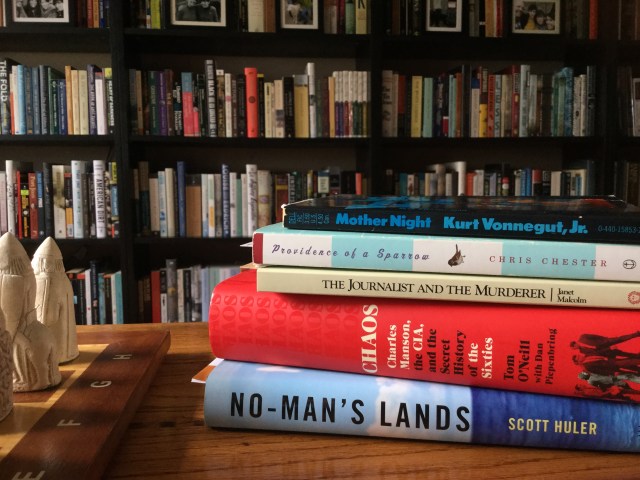

 Since
Since 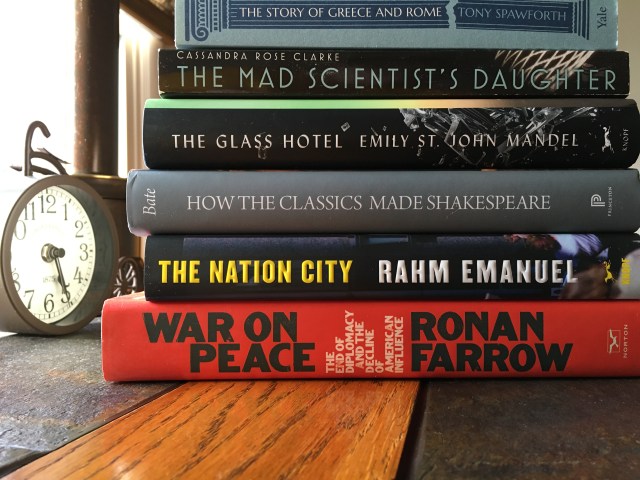 I ordered several of these from the
 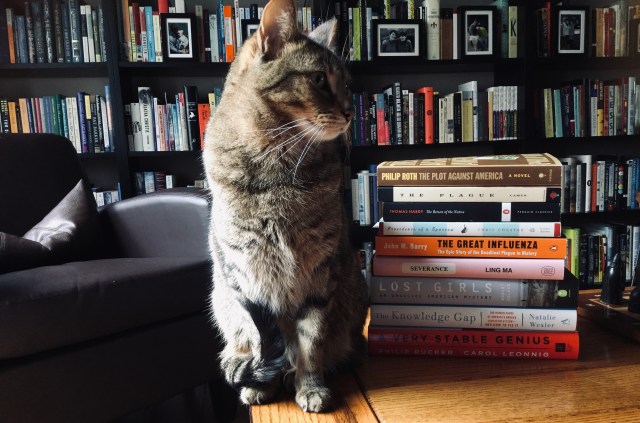 I may switch it up before week’s end, but this is what I’m working with right now.