

Shelved
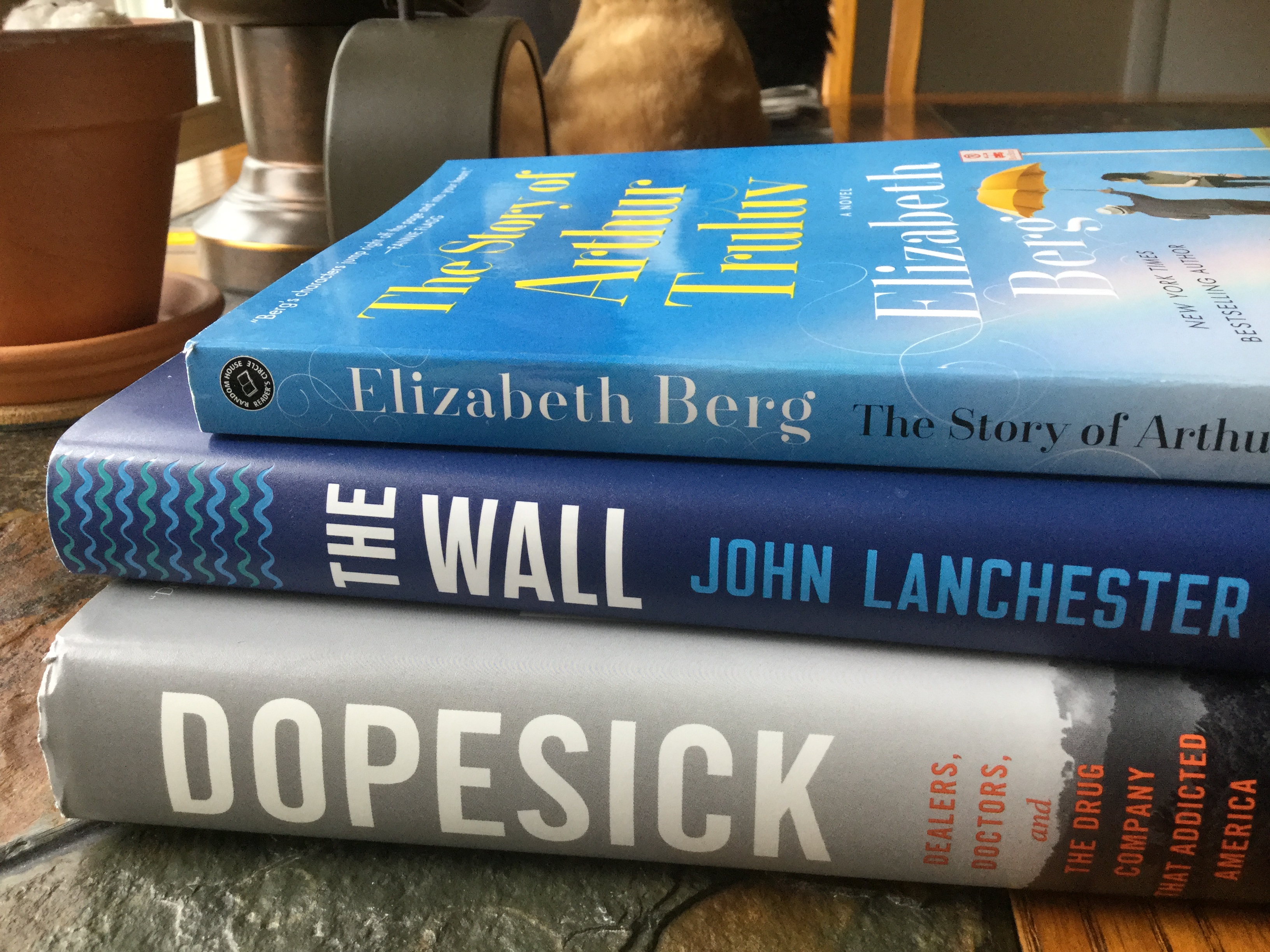 From The Story of Arthur Truluv (Elizabeth Berg; 2017):
p. 14
Mr. Lyons’s first name is Royal. Maddy thinks that’s hysterical. She wishes she could ask him what’s up with that. Royal. He’s got white hair and he’s a little fat. Maddy likes people who are a little fat; it seems to her that they are approachable. He’s a little fat and he’s got awfully pale skin and the links of his wristwatch are twisted like bad teeth. He doesn’t care about such things. He cares about words. He taught her one of her favorite words: hiraeth, a Welsh word that means homesickness for a home you cannot return to, or that maybe never was; it means nostalgia and yearning and grief for lost places. He used the word in a story that he read aloud to the class, and when he looked up, his eyes were full of tears. Nobody made fun of him after class, which was a miracle. Nobody said anything to her, anyway. Not that they would. She’s the girl who sits alone in the lunchroom, acting like her sandwich is fascinating. Or did. She skips lunch now.
She doesn’t know exactly why kids don’t like her. She’s good-looking enough. She has a sense of humor. She’s not dumb. She guesses it’s because they can sense how much she needs them. They are like kids in a circle holding sticks, picking on the weak thing. It is in people to be entertained by cruelty.
p. 18
Arthur thinks that, above all, aging means the abandonment of criticism and the taking on of compassionate acceptance. He sees that as a good trade. And anyway, Lucille makes those snickerdoodles, and she always packs some up for him to take home, and he eats them in bed, which is another thing he can do now, oh, sorrowful gifts.
From The Wall (John Lanchester; 2019):
p. 139
I suddenly got it. Hifa’s mother was one of those people who like life to be all about them. With the Change, that is a harder belief to sustain; it takes much more effort to think that life is about you when the whole of human life has turned upside down, when everything has been irrevocably changed for everyone. You can do it, of course you can, because people can do anything with their minds and their sense of themselves, but it takes work and only certain kinds of unusually self-centered people can do it. They want to be the focus of all the drama and pity and all the stories. I could tell that she didn’t like it that younger people are universally agreed to have had a worse deal than her generation.
From Dopesick (Beth Macy; 2018):
p. 125
Those of us living highly curated and time-strapped lives in cities across America — predominantly mixing virtually and physically with people whose views echoed our own — had no idea how politically and economically splintered our nation had become. And also how much poorer and sicker and work-starved the already struggling parts of the nation truly were — because we didn’t follow that story.
We may feel more connected by our cellphones and computers, but in reality we are more divided that ever before.
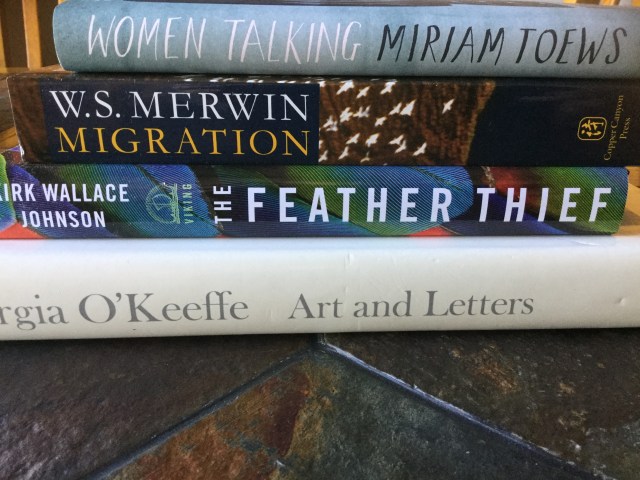
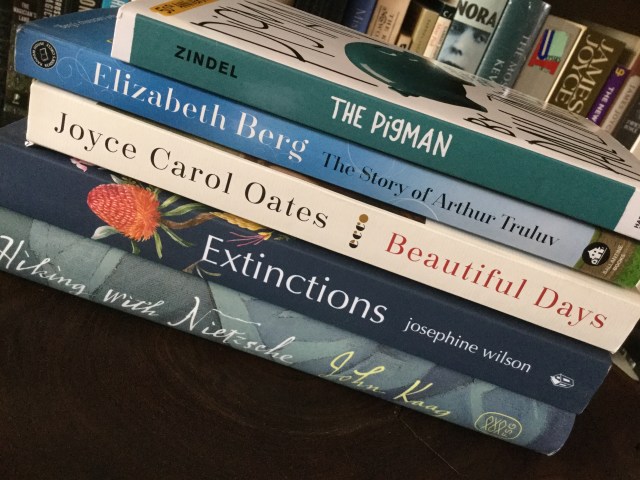
 I have reduced my active reading stack to one rustic box and one bedside shelf, so more than anything, these posts serve as a virtual TBR. Acquisitions are logged, then shelved, which satisfies both the reader and the neatnik in me.
Elsewhere, folks are discussing an article by Simon Fraser University professor Hannah Macgregor, “Liking Books Is Not a Personality.” The piece is thought-provoking, and the conversation it inspired was terrific, too. My acquisition process has become more stringent with each passing year, and my weeding is rigorous, too. The shelf space is finite, so the volumes in the permanent collection either “spark joy” or serve the antilibrary definition ascribed to Umberto Eco early in Nassim Nicholas Taleb’s The Black Swan: The Impact of the Highly Improbable:
The writer Umberto Eco belongs to that small class of scholars who are encyclopedic, insightful, and nondull. He is the owner of a large personal library (containing thirty thousand books), and separates visitors into two categories: those who react with “Wow! Signore professore dottore Eco, what a library you have! How many of these books have you read?” and the others — a very small minority — who get the point that a private library is not an ego-boosting appendage but a research tool. Read books are far less valuable than unread ones. The library should contain as much of what you do not know as your financial means, mortgage rates, and the currently tight real-estate market allows you to put there. You will accumulate more knowledge and more books as you grow older, and the growing number of unread books on the shelves will look at you menacingly. Indeed, the more you know, the larger the rows of unread books. Let us call this collection of unread books an antilibrary.
Have you seen this clip of Eco walking through his vast collection?
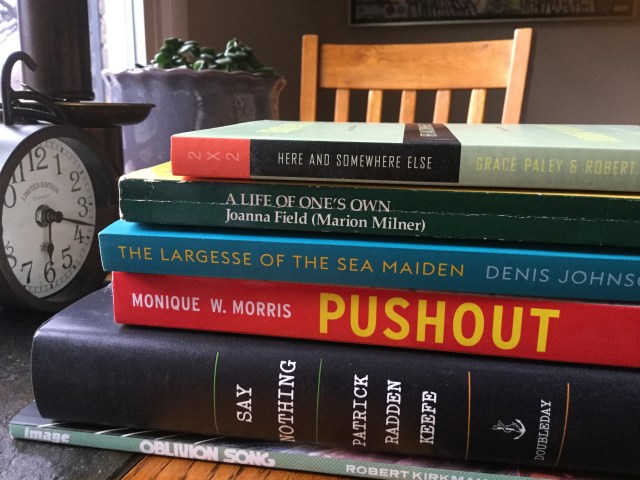 It had been a long time since the coin jar had been emptied, so earlier this week I poured the contents into a large baggie and added a trip to the bank to my modest list of spring break errands. But each time I remembered the awkward sack of coins in the backseat, the bank was closed. Eventually, I settled on the coin-changer at the local grocery store. Egads! What a ridiculous fee for cash! No fee for an Amazon gift card, though, and coupled with another card received earlier this month, it yielded enough to replace several bird feeders and choose a number of books from my wishlist. Pictured above are a few of the latter plus a book I bought used.
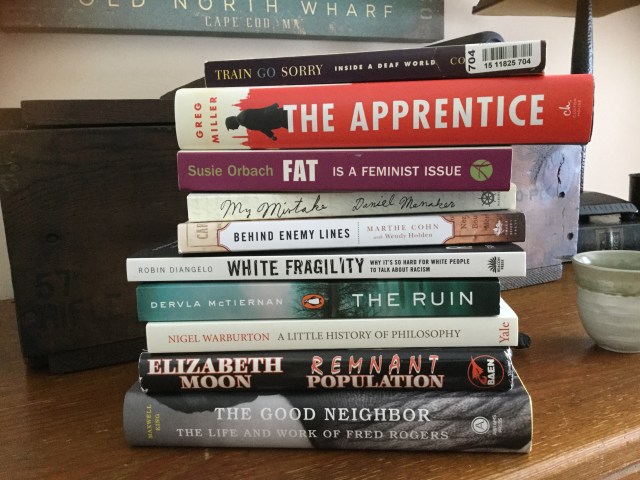 Last Sunday, I weeded about six bags of books from the collection and shifted accordingly while dusting the shelves. The project took about four hours. One of my goals was to reduce my TBR stack to one shelf, so I photographed this group of hopefuls before putting them in the main collection. Think of it as a virtual TBR stack.
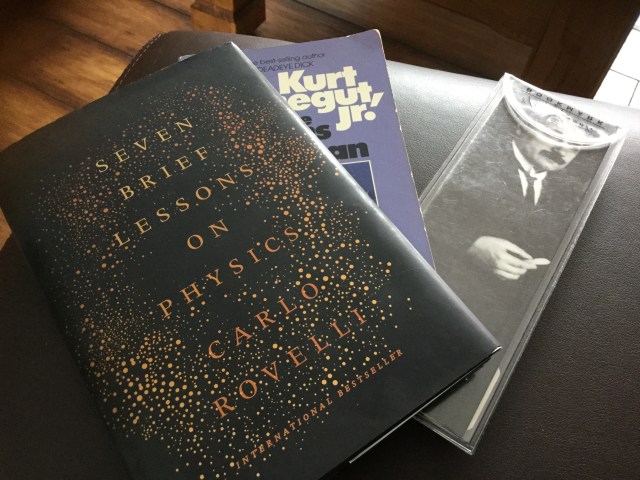 p. 33
p. 33
This is the world is described by quantum mechanics and particle theory. We have arrived very far from the mechanical world of Newton, where minute, cold stones eternally wandered on long, precise trajectories in geometrically immutable space. Quantum mechanics and experiments with particles have taught us that the world is a continuous, restless swarming of things, a continuous coming to light and disappearance of ephemeral entities. A set of vibrations, as in the switched-on hippie world of the 1960s. A world of happenings, not of things.
p. 37
Physics is not only a history of successes.
p. 63
Time sits at the center of the tangle of problems raised by the intersection of gravity, quantum mechanics, and thermodynamics. A tangle of problems where we are still in the dark. If there is something that we are perhaps beginning to understand about quantum gravity that combines two of the three pieces of the puzzle, we do not yet have a theory capable of trying to gather all three pieces of our fundamental knowledge of the world.
My school was closed Monday for snow. They were also closed early on Tuesday and all day Wednesday and Thursday for extreme cold. When I learned about the mid-week closures, I promised myself I would treat the days off as the gifts they were. No “getting ahead” on weekly chores. The house is immaculate. No reshelving projects. No reorganizing closets. No comparison shopping for a new lawn mower. The library looks wonderful. So do the closets. And I have at least six weeks on the lawn mower purchase.
Relax, I told myself. Approach the days with some child-like delight.
So, yes, I finished our federal and state tax returns, but I also finished Season 6 of Parks and Recreation and three books. Yeah, I caught up on correspondence with out-of-state family, practiced my music, and exercised. But I also slept in a bit and woke up without an alarm clock. And we made fun food: one-pot pasta and crunchy garlic bread; bacon sandwiches; brownies.
For two days: No makeup. No hair products. No work clothes.
I look forward to working with my students tomorrow; I do, after all, like my job. But what a week; Friday is already here!
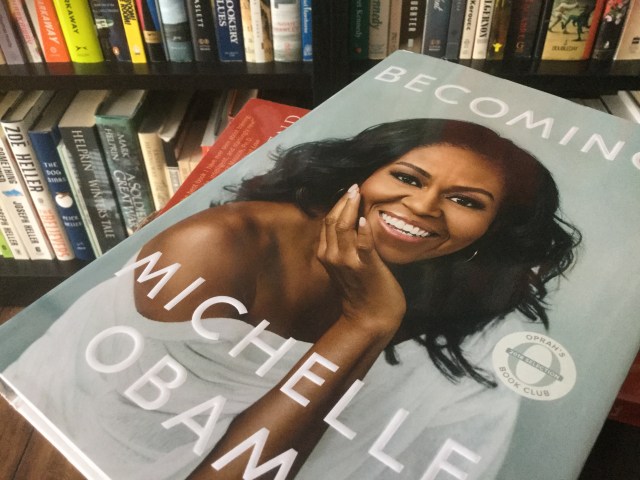 p. 144
It hurts to live after someone has died. It just does. It can hurt to walk down a hallway or open the fridge. It hurts to put on a pair of socks, to brush your teeth. Food tastes like nothing. Colors go flat. Music hurts, and so do memories. You look at something you’d otherwise find beautiful — a purple sky at sunset or a playground full of kids — and it only somehow deepens the loss. Grief is so lonely this way.
p. 411
In the end, Hillary Clinton won nearly three million more votes than her opponent, but Trump captured the Electoral College thanks to fewer than eighty thousand votes spread across Pennsylvania, Wisconsin, and Michigan. I am not a political person, so I’m not going to attempt to offer an analysis of the results. I won’t try to speculate about who was responsible or what was unfair. I just wish more people had turned out to vote. And I will always wonder about what led so many women, in particular, to reject an exceptionally qualified female candidate and instead choose a misogynist as their president. But the result was now ours to live with.

