Since my last “real” post (i.e., a post with more than an image of books), I have seen several plays, including The Belle of Amherst featuring Kate Fry (runs through December 6: get there, if you can); finished all of the Forty Little Pieces in Progressive Order and moved on to the Album of Sonatinas (‘hard to believe that I have been studying flute for three years now); and completed (nearly) twelve weeks at my no-longer-new job. By necessity more than design, my bookish notes from the last six weeks mostly comprise dog-earred pages, screenshots, photos of books, and random lists. With this post, I will try to impose a bit of order.
At this point I have finished reading 140 books:
— 45 plays (33 by Shakespeare)
— 38 fiction titles (not including graphic works)
— 21 non-fiction titles (not including graphic works)
— 5 poetry titles
— 31 graphic works (six of which were non-fiction works)
Coriolanus (“Hear you this Triton of the minnows?”) and King Lear (“O, let me not be mad, not mad, sweet heaven / Keep me in temper: I would not be mad!”) were the highlights of my recent Shakespeare in a Year progress. Finishing the Sonnets represents a milestone, I suppose, but what a slog! At least I can say I have met my goal to read more poetry this year. Heh, heh, heh. And the otherwise tedious task was certainly leavened by Don Paterson’s erudite and irreverent commentary. Over the next week or so, I will quickly reread The Winter’s Tale, The Tempest, and Henry VIII (all of which I have, within the last two years or so (re)read) and then turn to The Two Noble Kinsmen, which I have, to the best of my recollection, never read.
The most recent of the novels I’ve read this year is A Whole Life (Robert Seethaler; translated from the German by Charlotte Collins). In 2015, I noted that Maria Beig’s novel Hermine: An Animal Life (translated from the German by Jaimy Gordon) is perfect, so comparing my experience of A Whole Life to Hermine is the highest praise I can offer this beautiful and deceptively simple novel. See also this review from The Irish Times, which draws parallels to Stoner (John Williams) and So Long, See You Tomorrow (William Maxwell), two books that would, like Hermine, easily earn a spot in my “Essential Bookcase.”
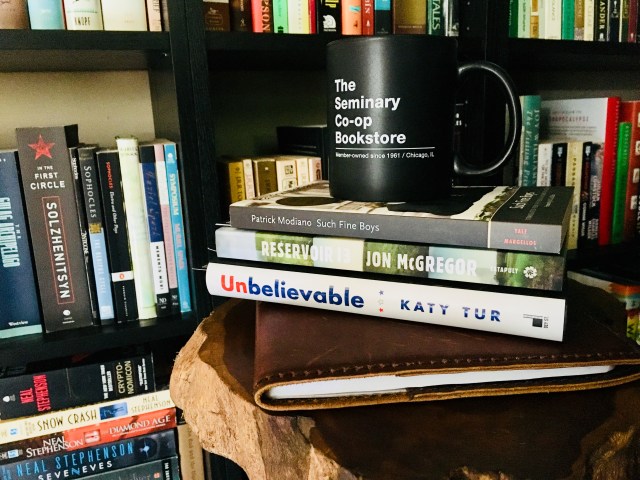
Another of my goals this year was to read at least twenty-six non-fiction works. Monica Hesse’s American Fire and Katy Tur’s Unbelievable represent the twenty-sixth and twenty-seventh titles toward that goal. Both books recount fascinating stories that probably would have been better related in long-form articles.
From American Fire: Love, Arson, and Life in a Vanishing Land:
p. 23
[W]hile some of his volunteers thought he was a hard-ass, his military training had taught him that there were right ways to do things and wrong ways, and getting small things correct was the only way to make sure the big things worked when it mattered most.
p. 205
It’s amazing how boring trials can be. How even the most salacious of crimes committed under the most colorful of circumstances can result in testimony that is tedious and snoozy.
From Unbelievable:
p. 201
I think we dislike and ultimately distrust the media because journalism, honestly pursued, is difficult and uncomfortable. It tells us things about the world that we’d rather not know; it reveals aspects of people that aren’t always flattering. But rather than deal with journalism, we despise journalism.
p. 235
We really have to start teaching journalism in elementary school. People don’t even understand the basics of what we do anymore.
Regarding the photo:
— Before seeing The Taming of the Shrew at the Chicago Shakespeare Theater (review here), we attended a “Preamble” program during which the lecturer mentioned Scheil’s She Hath Been Reading. Naturally, I had to have a copy.
— I am reading Hard Times in anticipation of seeing the play over autumn break. (Reviews here and here.)
— Withnail and I arrived on my stack via its (loose) ties to Hamlet.
— And the rest: Family Life leapt off the shelf at me yesterday. It seems like The Road to Jonestown has been on my stack too long. The Hate U Give is one of the few times I’ve given in to “But everybody’s reading it!” We’ll see how that works out.

 I have recently acquired the top three books on the stack, finished the bottom four plus Conversion (Katherine Howe), and been reading the rest.