Reading notes

img_1546Books about books appeal to me, and in 2012, Will Schwalbe’s The End of Your Life Book Club proved to be an amiable enough contribution to the genre, as did his recent Books for Living. One of the delights of the books about books genre is adding to one’s TBR pile, so what a pleasure it was to find that the recommendations that most interested me were already on my shelves.

To read: The Importance of Living (Lin Yutang); A Little Life (Hanya Yanagihara); A Fine Balance (Rohinton Mistry); Valley of the Dolls (Jacqueline Susann)
To reread: Stuart Little (E.B. White); David Copperfield (Charles Dickens); Reading Lolita in Tehran (Azar Nafisi); The Prime of Miss Jean Brodie (Muriel Spark)

The only purchase I made while reading Books for Living was The Confession, a John Grisham novel about the death penalty, which, because I read Just Mercy earlier this month, touched a chord of serendipity / synthesis / synchronicity.

For the commonplace book:

p. 188
The world is filled now with huggers. Maybe that’s because we live in such a technological age that people crave human touch. Men and women whom you barely know hug you hello and goodbye. Kids in school hug each other. Even in business meetings, people will give you a hug if they’ve sat with you in meetings a few times before (though not if they work at the same company). I really don’t like being hugged by anyone other than my husband. People regard this as a character flaw. One friend even devoted an hour of time with his analyst to discussing why I didn’t like to hug. I gather he takes it personally.

p. 255
Reading is a respite from the relentlessness of technology, but it’s not only that. It’s how I reset and recharge. It’s how I escape, but it’s also how I engage. And reading should spur further engagement.

(This entry from late last year discusses an excerpt of Books for Living: On reading.)

Speaking of the commonplace book, much of Eugene Ionesco’s Rhinoceros might be pressed into mine, but I will content myself with the following bits from Act III, when Dudard and Berenger discuss the way things are:

p. 75
BERENGER: I understand what you mean, at least I’m trying to. But you know — if someone accused me of being a bad sport, or hopelessly middle class, or completely out of touch with life, I’d still want to stay as I am.

p. 78
BERENGER: If only it had happened somewhere else, in some other country, and we’d just read about it in the papers, one could discuss it quietly, examine the question from all points of view and come to an objective conclusion. We could organize debates with professors and writers and lawyers, and blue-stockings and artists and people. And the ordinary man on the street, as well — it would be very interesting and instructive. But when you’re involved yourself, when you suddenly find yourself up against the brutal facts you can’t help feeling directly concerned — the shock is too violent for you to stay cool and detached. I’m frankly surprised, I’m very very surprised. I can’t get over it.

The Remy-Bumppo Theatre Company hosted a staged reading of this oft-read but rarely seen play last night, and as I did when watching the Shakespeare Project of Chicago’s King John last month, I thought, This is a play for our time, to be sure. From the conclusion:

People who try to hang on to their individuality always come to a bad end. [He shakes himself out of it.] Oh well, too bad! I’ll take on the whole lot of them! I’ll put up a fight against the lot of them, the whole lot of them! I’m the last man left, and I’m staying that way until the end.

I’m not capitulating!

I first read Rhinoceros in high school and thought myself so clever for “getting” it and Sartre’s No Exit and Beckett’s Waiting for Godot. As so many of us discover when we return to the books we swallowed whole as younger readers, though, I “got” little more than the tattered texts I purloined from the shelves of the English department — well, that and the tacit promise that I would return to the treasures at some point, (which, happily, I have).

On the topic of returning to books, as I mentioned here, The Last Policeman (Ben H. Winters) so pleased me that I was reluctant to begin Countdown City, fearing the second in the trilogy would disappoint. It did not. I plan to read the third book later this week.

Much of the “Shakespeare in Year” project also represents a return of sorts, although I find that I am less chagrined by these past readings than, say, by that of Rhinoceros. This is probably because I have been (re)reading Shakespeare for the last fifteen years; as an adult and an autodidact (as opposed to a cocky, know-it-all, “I ‘get’ it” teen), I have approached the plays and now the sonnets and long poems knowing that so much remains for me to learn.

Other commitments require that I continue to read ahead in order to keep up with the schedule, so at this writing, I have read through Sonnet 27 and Line 576 of Venus and Adonis and completed the following plays:

The Taming of the Shrew
The Two Gentlemen of Verona
Henry VI, Part 1
Henry VI, Part 2
Henry VI, Part 3
Richard III
Titus Andronicus
The Comedy of Errors
Love’s Labour’s Lost

A few notes: I appreciated Titus Andronicus much more than I had thought I would, but that doesn’t mean it was an easy read. Even if one accepts the idea that the plot is willfully over-the-top, it’s still horrifying. Given the graphic sound effects in the Arkangel recording, I had unhappily anticipated close-ups of violence and bloodletting. The film featuring Anthony Hopkins in the title role was, however, rather restrained, for which I was most grateful. Not all of the production choices appealed to me (frankly, I just didn’t understand a few), but overall, it earned a thumbs-up for both acting and restraint.

Maybe it was my mood, but The Comedy of Errors fared much better in this, my third or fourth, reading. Would that I could say the same about my second reading of Love’s Labour’s Lost. I’m actually a little concerned because we will see the Chicago Shakespeare Theater production next month; can they make this seem less… ridiculous? Again, maybe it was my mood.

The Sonnets. Sigh. Don Paterson’s commentary, though, makes the journey bearable. And perhaps I am too old to encounter Venus and Adonis for the first time because I have, several times, wondered, Kissing is a polite euphemism, right? What this work has made me realize is that I must read Ovid’s Metamorphoses. (I read some early in our home education days and some more before seeing the Lookingglass Theatre presentation of Mary Zimmerman’s play.) This year’s reading plan is already wildly ambitious, but Ovid is moving up.

Well before I get to Ovid, though, I will reread Edward III for “Shakespeare in Year” and finish The Changeling (Thomas Middleton and William Rowley), which the Shakespeare Project of Chicago will present later this month.

I will also read a few more books about geocaching. To explain: As an election judge, I have met some interesting folks with whom “What are you reading?” has been the perfect way to step around both banalities and (most) politics. Last week, a fellow election judge mentioned a popular fiction novel I had tossed across a hotel room in disgust three years ago, but rather than going there, we moved onto EMPs and emergency preparedness, which is not my usual fare, but in confirming via Amazon that, yes, he was talking about the tossed book, I saw Ted Koppel’s Lights Out, a book I knew was already on my shelves. It was clear-sighted, but I was glad to finish. Since early November, I have felt, well, not unlike Berenger: If only it had happened somewhere else, in some other country, and we’d just read about it in the papers….

The same judge also talked about his family’s interest in geocaching. When I first heard about this pursuit years ago, it seemed like a perfect fit for our family, but our days were already so full. The rhythm of our lives has changed a great deal since then, though, and the judge’s enthusiasm was contagious, so as we parted, he extracted a promise that I would tell him about our adventures when we work together again this week. On the way home from the polling place, I borrowed The Joy of Geocaching (Paul and Dana Gillin) from the library. That evening, I created an account at geocaching.com and downloaded the app to my phone, and this weekend my husband and I found our first cache. Actually, the truth? I found the cache on Friday afternoon, but I didn’t understand what I was looking at. When I brought my husband to the same spot on Saturday afternoon, he indicated that I had read the map and the app’s compass properly (I defer to him in such matters; he is an Eagle Scout), so it should be here…. “I’ve got it!” I hooted softly. “I’ve got it!” Aware that I needed to be discreet, I showed him the contents and the ingenious hiding spot, and we logged the cache in hard copy and in the app. We are late to this but, oh, how it dovetails current pursuits: biking (we took the first ride of the year on Saturday, by the way: thirteen easy miles; it was beautiful), walking / hiking in the county and state parks and conservation areas, and archery.

In addition to Rhinoceros, Books for Living, and The Joy of Geocaching, Calculating God and Diary of a Provincial Lady are pictured above. The latter is a reread. In recommending it recently, I suggested that if one thought Downton’s Dowager Countess was the primary reason to sit through any episode of Downton Abbey after the middle of Season Two, if one fancied the idea of British Bombeck, and if one craved a book that would take him or her completely and utterly out of this place and time, then one might be advised to reach for Diary of Provincial Lady.

Calculating God arrives on my stack via one of those “blind date with a book” gimmicks that popped up around Valentine’s Day. I answered a flurry of questions and landed on this. I read and enjoyed Sawyer’s WWW : Wake in 2010, so I am actually looking forward to my date.

Shakespeare in a Year

Four shelves of Shakespeare.

Four shelves of Shakespeare.

Now knee-deep in this project, I feel confident discussing my progress. So. Using this plan, a number of readers are attempting to read all of Shakespeare’s works in 2017. At this writing, I have completed the Sonnets through 18, Venus and Adonis through line 432, and the following plays:

The Taming of the Shrew
The Two Gentlemen of Verona
Henry VI, Part 1
Henry VI, Part 2
Henry VI, Part 3
Richard III

Because the Shakespeare Project of Chicago presented King John (a play for our time, to be sure) in January, I have also read that. Why am I off schedule? Early voting for the consolidated primary begins next week. This, coupled with my other pursuits, requires that I work ahead to keep up.

To complement my reading, I chose Tony Tanner’s Prefaces to Shakespeare. Garber, Bloom, and Van Doren were well exercised during our home education years, so it was time to turn to another resource. That said, I may supplement with a rerun of the Saccio lectures. For the sonnets, I am using Don Paterson’s Reading Shakespeare’s Sonnets and the app that features the filmed performances coupled with Paterson’s comments. (By the way, I purchased the Tanner seven years ago. It has given all of the stockpiled companions around the house hope: “Maybe she will read me next!” Heh, heh, heh.)

The plays
Going forward, I will try to be more methodical about my notes. As I recall, my remarks about Taming centered on how I would direct the final act as if Kate were complicit in the wager. I’ve written about my experience of Gentlemen a few times, including here; my reread was swift. The Henry VI plays were not tedious for me (some find them so) because I read them last year to prepare for the Chicago Shakespeare Theater’s Tug of War. (Foreign Fire and Civil Strife covered three plays each: Edward III, Henry V, and Henry VI, Part 1; and Henry VI, Parts 2 and 3, and Richard III. Yes, three plays, one meal, two snacks per event. It. Was. Awesome.) The “read a synopsis or retelling / watch a(t least one) production / listen to an unabridged recording with text in hand / dig into additional resources” approach works well for me, and this go-around, I watched The Hollow Crown, Cycle 2, and read the plays while listening to the Arkangel productions. Margaret interests me greatly; what a role that would be!

Richard III more naturally follows the Henry VI plays than Titus Andronicus (the next play on the plan), so I reread Richard III first. In addition to the CST production in the fall, we saw the Gift Theatre production of Richard III at the Steppenwolf last year. Wow. What a mesmerizing performance. Yes, he rose from his wheelchair and encircled Anne with his walker. Brilliant. (Review here.) Over the weekend, I also watched Benedict Cumberbatch as Richard in The Hollow Crown, Cycle 2. Maybe it was Richard III overload (or Benedict Cumberbatch overload, for that matter), but his Richard lacked the dark wit that usually makes the character such a delicious role.

Speaking of delicious, ahem… ‘gainst my wont, I have begun reading Titus Andronicus, one of the few plays I have not already read and studied, before seeing a production. Amazon Video had nothing, nor was there anything on our shelves, so I await word on my library holds. Spoiler alert: As many folks know, Titus Andronicus is a horror show of a play. Even if you choose to reconcile the violence as purposeful camp, it’s still rough going, especially if, like me, you use the Arkangel recording to complement your reading. You’ve been warned.

The sonnets
It is a reflection of my limitations, obviously, and not the poet’s, but the sonnets, with one exception, hold little appeal for me. The exception is Sonnet 74, which was sent to me with the note:

Below is Shakespeare’s Sonnet 74, where the poet addresses his beloved, advising that his spirit will live on after his death in what he leaves behind (his poem) and his spirit in his beloved’s heart. Bold emphasis is mine.

But be contented: when that fell arrest
Without all bail shall carry me away,
My life hath in this line some interest,
Which for memorial still with thee shall stay.
When thou reviewest this, thou dost review
The very part was consecrate to thee:
The earth can have but earth, which is his due;
My spirit is thine, the better part of me:
So then thou hast but lost the dregs of life,
The prey of worms, my body being dead,
The coward conquest of a wretch’s knife,
Too base of thee to be remembered.
The worth of that is that which it contains,
And that is this, and this with thee remains.

This reminds me to make the following commonplace book entry from King John:

CARDINAL PANDULPH
You hold too heinous a respect of grief.

CONSTANCE
He talks to me that never had a son.

KING PHILIP
You are as fond of grief as of your child.

CONSTANCE
Grief fills the room up of my absent child,
Lies in his bed, walks up and down with me,
Puts on his pretty looks, repeats his words,
Remembers me of all his gracious parts,
Stuffs out his vacant garments with his form;
Then, have I reason to be fond of grief?
Fare you well: had you such a loss as I,
I could give better comfort than you do.

Yes, I have mentally SCREAMED this:

[S]He talks to me that never had a son.

And this:

Fare you well: had you such a loss as I,
I could give better comfort than you do.

Once I finish Titus Andronicus, I will use the rest of this week’s Shakespeare time to read through Sonnet 27.

The long poems
Which leaves Venus and Adonis. While tame by today’s standards, this is certainly naughty Shakespeare. Chuckle. According to my husband, this poem merits my eyebrow face — when my eyebrows rise so high, they all but disappear. My reading / listening, though, has been a powerful reminder that so much of human narrative — perhaps especially Shakespeare — is meant to be heard. I blame the Q Brothers for this, but my imagination’s ear *totally* heard an ad-rap-tation of the poem! My goal, in addition to Sonnets 19 through 27, is to read through Line 576 this week.

More book notes

img_9809
■ Wednesday is comics day. This week, my pull list comprised Saga #42 and Revival #46.

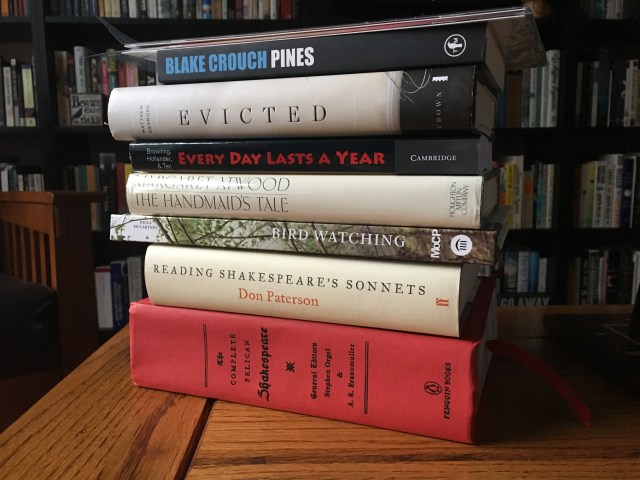
■ Crouch’s Dark Matter entertained three of us late last year, so I chose Pines for an easy, escapist read.

■ Move Evicted to the top of your TBR pile. Now. Really. I’ll wait. From my commonplace book:

p. 256
The Hinkstons expected more of their landlord for the money they were paying her. Rent was their biggest expense by far, and they wanted a decent and functional home in return. They wanted things to be fixed when they broke. But if Sherrena wasn’t going to repair her own property, neither were they. The house failed the tenants, and the tenants failed the house.

p. 257
Substandard housing was a blow to your psychological health: not only because things like dampness, mold, and overcrowding could bring about depression but also because of what living in awful conditions told you about yourself.

p. 285
Poverty could pile on; living it often meant steering through gnarled thickets of interconnected misfortunes and trying not to go crazy. There were moments of calm, but life on balance was facing one crisis after another.

p. 291
The home is the wellspring of personhood.

■ We will see the world premiere of The Book of Joseph at the Chicago Shakespeare Theater next month. The play adapts the correspondence collected in Every Day Lasts a Year.

■ Our family book club chose The Handmaid’s Tale for our winter selection. We listened to the audiobook for a bit during each of our drives in and out of Chicago and on the way back to campus. (Claire Danes does exceptional work with the narration.) My husband completed the audiobook, my daughters are reading the rest in between classes and research, and I finished by rereading my thirty-one-year-old hardback. Since I first read Tale, it has been a looming part of the landscape of my imagination, yet I was unprepared for how much more horrifying it seems now — now that I am the mother of adult daughters, now that the world appears to have gone a bit mad.

p. 181
No mother is ever, completely, a child’s idea of what a mother should be, and I suppose it works the other way around as well. But despite everything, we didn’t do too badly by one another, we did as well as most.

I wish she were here, so I could tell her I finally know this.

■ I picked up Bird Watching from a bargain table at the university bookstore. I want to adore McCartney’s playfulness, but I do not.

■ Maybe I should have declined the invitation because I knew I would not be able to give the “Shakespeare in a Year” project my complete attention until this weekend, but I am confident I will be completely caught up by Groundhog’s Day.

Reading notes

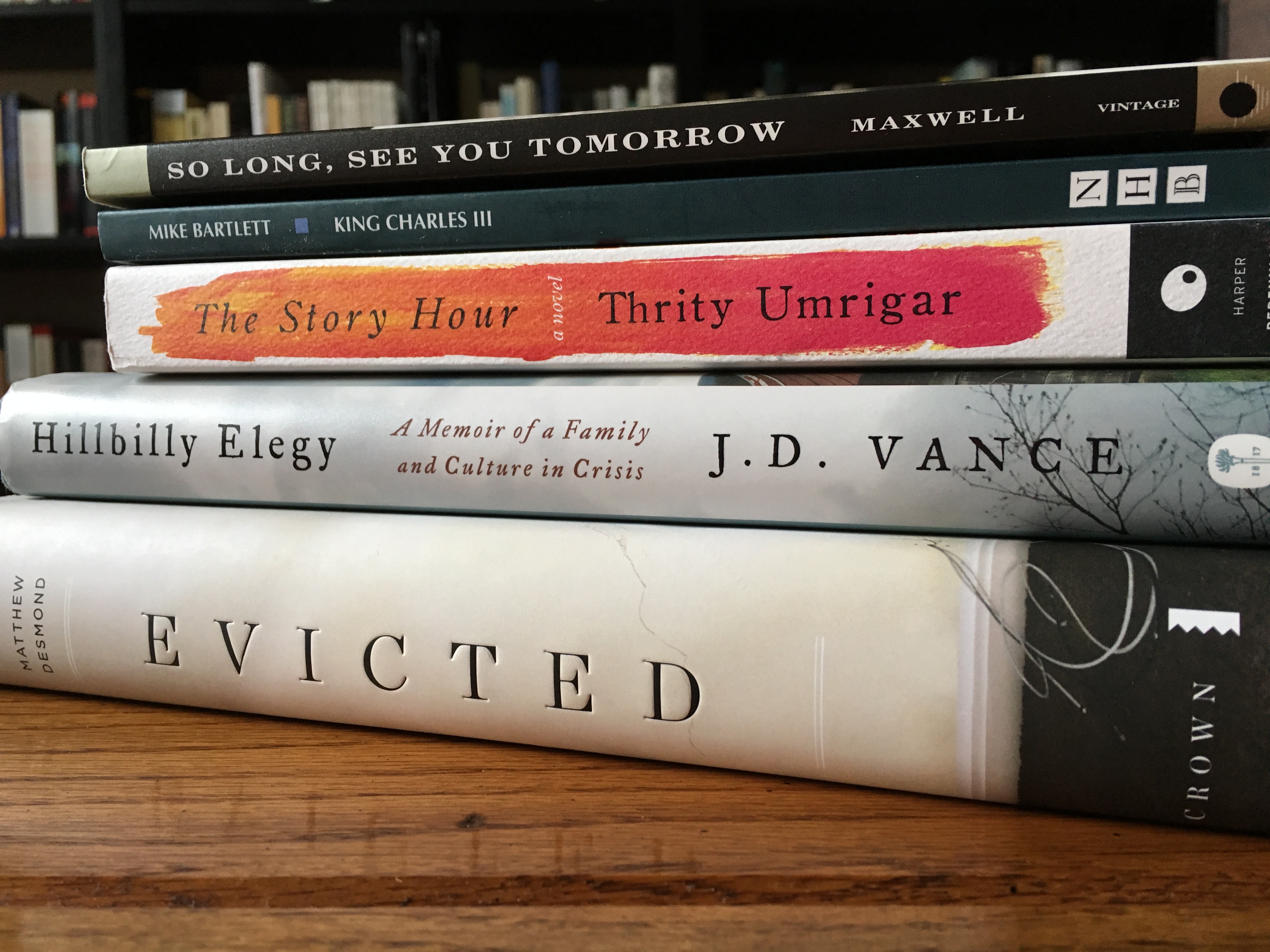
img_1162■ As much a meditation on loss and grief as it is an exploration of memory and how memory shapes (and haunts and robs from) the present, William Maxwell’s 1980 novel So Long, See You Tomorrow is as perfect a book as A Good School or Revolutionary Road (both by Richard Yates) or Olive Kittredge (Elizabeth Strout).

p. 9
What I didn’t say, across the few feet that separated our two beds, was that I couldn’t understand how it had happened to us. It seemed like a mistake. And mistakes ought to be rectified, only this one couldn’t be. Between the way things used to be and the the way they were now was a void that couldn’t be crossed. I had to find an explanation other than the real one, which was that we were no more immune to misfortune that anybody else, and the idea that kept recurring to me, perhaps because of that pacing the floor with my father, was that I had inadvertently walked through a door I shouldn’t have gone through and couldn’t get back to the place I hadn’t meant to leave.

p. 27
What we, or at any rate I, refer to confidently as memory — meaning a moment, a scene, a fact that has been subjected to a fixative and thereby rescued from oblivion — is really a form of storytelling that goes on continually in the mind and often changes with the telling. Too many conflicting emotional interests are involved for life ever to be wholly acceptable, and possibly it is the work of the storyteller to rearrange things so that they conform to this end. In any case, in talking about the past we lie with every breath we draw.

p. 113
In the face of a deprivation so great, what is the use of asking him to go on being the boy he was. He might as well start life over again as some other boy instead.

■ So thoroughly did my family enjoy the Chicago Shakespeare Theater production of King Charles III (reviews here and here) that I decided to read the play.

The Shakespeare Project of Chicago is hosted by libraries, and the library at which we saw King John is engaged in a “One Book, One Community” program for which The Story Hour (Thrity Umrigar) is the selection. It interested me enough to order a copy.

■ I wanted to add another passage from J.D. Vance’s Hillbilly Elegy to the commonplace book before shelving it:

p. 228
For kids like me, the part of the brain that deals with stress and conflict is always activated — the switch flipped indefinitely. We are constantly ready to fight or flee, because there is constant exposure to the bear, whether that bear is an alcoholic dad or an unhinged mom. We become hardwired for conflict. And that wiring remains, even when there’s no more conflict to be had.

■ As I mentioned last week, Elegy segues neatly into Evicted (Matthew Desmond). Fifty pages in, what I’ve noticed so far is that Desmond seems evenhanded in his depiction of the tenants and their landlords.

The year in books

img_9296In 2016, I completed 123 books. Of course, this unrepentantly promiscuous reader could easily add another 250-plus titles of books left in various stages of “undress,” but only cover-to-covers appear on my annual list. Although I completed 16 fewer books this year, I read the same number of fiction titles (excluding graphic works) as last year: 57. Of the remaining 66 books, 15 were plays; 18 were non-fiction books; and 33 were graphic fiction.

Here are a few more numbers:

Number of plays read that were attributed to Shakespeare: 10 (of which 5 were rereads)
Total number of rereads: 13
Number of books read in 2016 that were published in 2016: 46 (of which 16 were novels)

Best fiction read in 2016:
A Good School (Richard Yates; 1978. Fiction.)
The Mandibles: A Family, 2029-2047 (Lionel Shriver; 2016. Fiction.)
The Elementals (Michael McDowell; 1981. Fiction.)
The Shawl (Cynthia Ozick; 1990. Fiction.)
My Name Is Lucy Barton (Elizabeth Strout; 2016. Fiction.)

Honorable mention:
The Last Policeman (Ben Winters; 2013. Fiction.)
The Nest (Cynthia D’Aprix Sweeney; 2016. Fiction.)
The Girls (Emma Cline; 2016. Fiction.)

Best plays read in 2016:
Arcadia (Tom Stoppard; 1993. Drama.)
The Life of Galileo (Bertolt Brecht; 1940. (Trans. John Willett; 1994.) Drama.)

Most compelling non-fiction read in 2016:
One of Us: The Story of a Massacre in Norway — and Its Aftermath (Åsne Seierstad; 2015. Non-fiction.)
Life Reimagined: The Science, Art, and Opportunity of Midlife (Barbara Bradley Hagerty; 2016. Non-fiction.)
Neighbors (Jan T. Gross; 2001. Non-fiction.)

Honorable mention:
A Mother’s Reckoning: Living in the Aftermath of Tragedy (Sue Klebold; 2016. Non-fiction.)
Missoula: Rape and the Justice System in a College Town (Jon Krakauer; 2015. Non-fiction.)

Best graphic fiction read in 2016:
Fell, Volume 1, Feral City (Warren Ellis; 2007. Graphic fiction.)
The Silence of Our Friends (Mark Long; 2012. Graphic fiction.)

Best reread:
Heart of Darkness (Joseph Conrad; 1899. Fiction.)

Honorable mention:
The Sparrow (Mary Doria Russell; 1996. Fiction.)

Random remarks:
● Repeating this bit from one of my summer book posts: A Good School was, quite possibly, the best book I’ve read this year — which may have been the same thing I said about Richard Yates’ Revolutionary Road eight years ago. In “The Lost World of Richard Yates” (Boston Review, October/November 1999), Stewart O’Nan wrote:

Once the most vaunted of authors–praised by Styron and Vonnegut and Robert Stone as the voice of a generation–he seems now to belong to that august yet sad category, the writer’s writer. Andre Dubus, who was his student at Iowa, revered him, as does Tobias Wolff, and the jackets of Yates’s books are adorned with quotes by the likes of Tennessee Williams and Dorothy Parker, Ann Beattie and Gina Berriault. When authors talk his name pops up as the American writer we wish more people would read, just as Cormac McCarthy’s used to. In the acknowledgments section of his novellas, Women With Men, Richard Ford makes it plain: “I wish to record my debt of gratitude to the stories and novels of Richard Yates, a writer too little appreciated.”

With his insightful and ranging appreciation, O’Nan — also a writer too little appreciated (if you are not familiar with his work, begin with A Prayer for the Dying and Last Night at the Lobster) — all but ensured that Yates would be revisited: Many of Yates’ books are, of course, back in print, and his “painful and sad” first novel received big-screen treatment in 2008. In fact, I finally saw the film over the summer, which led to the mentally intoned assertion, “The book was better,” and to the shelves, where several Yates titles awaited me. By the way, fans of John Williams’ Stoner will also appreciate A Good School.

The Elementals deserves a much wider audience.

● My birthday wish is Fell, Volume 2.

● In this “Year of the House Sparrow,” I cannot imagine how I managed not to read Chris Chester’s Providence of a Sparrow: Lessons from a Life Gone to the Birds, which languished on my TBR pile all. year. long. (That’s not the worst of the indignity heaped upon it: I purchased the book — Shhhh! — nearly nine years ago.)

● Books like the brilliantly reported One of Us: The Story of a Massacre in Norway — and Its Aftermath (Åsne Seierstad, 2015) and the upliftingly informative Life Reimagined: The Science, Art, and Opportunity of Midlife (Barbara Bradley Hagerty, 2016) are the reason I read. I must read more non-fiction this coming year. It’s that simple.

● Speaking of Life Reimagined: The Science, Art, and Opportunity of Midlife, here are a few passages I have pressed into my commonplace book:

p. 219
You may be thinking, Who in midlife has the time for this? To which I say: Maybe you don’t now, but you will probably at some point. And how will you spend it? Frittering away the time? Or in full-throated pursuit of a passion? Even if you have full-time work and children at home, as many people in midlife do, you can still take small steps to punctuate the days and weeks with a hobby that gives you a little zing every time you think of it.

p. 235
Middle age makes no exclusive claim to stress, trauma, and the need for resilience. People break bones, lose their jobs, develop cancer at all points in their lives. But it seems that for many of us, troubles start to cluster in midlife: You are more likely to lose a parent or spouse after forty, more likely to be diagnosed with cancer after forty-five, and much more likely to be replaced by a younger, cheaper, more tech-savvy employee after fifty. I never gave much thought to rebounding from setbacks in my twenties and thirties because life was ascendant and setbacks were rare. Now I feel as if I spend half my time trying to plug leaks in the dam. Happily, the research indicates, I may be better equipped because I have lived for five and half decades.

Happy jólabókaflóð!

On jólabókaflóð, I feel sorrier for my TBR stacks than usual. Inevitably, a few books end up being ditched for the newcomers.

On jólabókaflóð, I feel sorrier for my TBR stacks than usual.
Inevitably, a few books end up being ditched for the newcomers.

For more than thirty years, well before we knew its name, my husband and I — and later, our children — have celebrated “Christmas book flood” on December 24. One of our favorite days of the year, we celebrate with a long walk in the woods, a feast, and, when night falls, an exchange of gifts, especially books.

Another of our winter traditions is to spend Thanksgiving and / or Christmas at the Brookfield or Milwaukee County zoo. For the last few Thanksgivings, our daughters’ studies have put the kibosh on the trip, but we’ve been consistent about visiting on or near Christmas, and on Friday, we had the Milwaukee County Zoo to ourselves. Tree kangaroos, fennec foxes, and tiger cubs! Oh, my!

Wishing you and yours a wonderful winter holiday!