

Today, though, I’m reading from the shelves: Breakfast of Champions (Kurt Vonnegut; 1973).
Today, though, I’m reading from the shelves: Breakfast of Champions (Kurt Vonnegut; 1973).
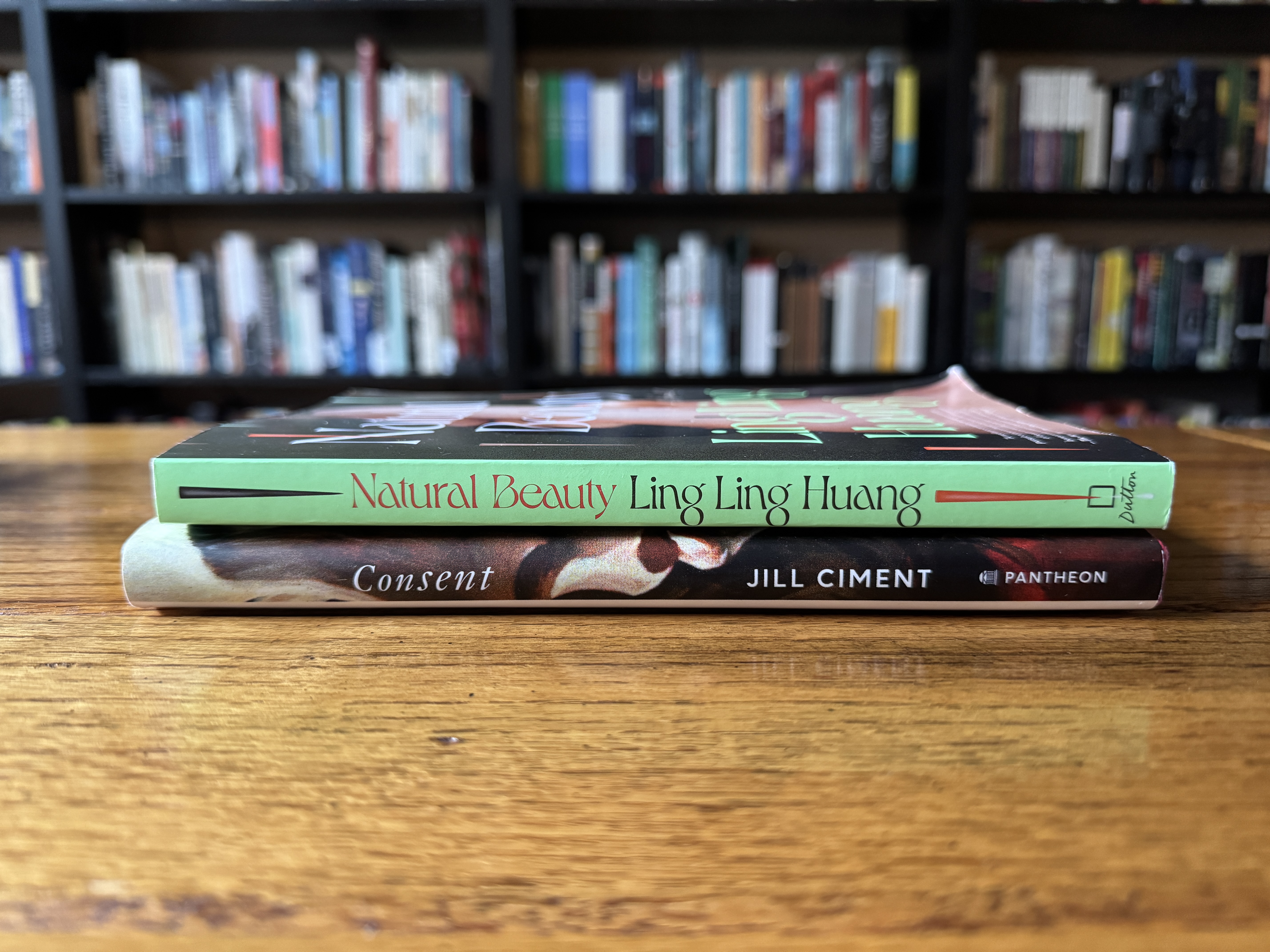
Yes, an argument could be made that I celebrate jólabókaflóð all year long.

May 2020 was the perfect time to first encounter Ross Gay’s The Book of Delights (2019). For some reason, this treasure was only in my Kindle library, so when I recently gave the book as a gift, I grabbed a hard copy for myself. Speaking of gifts, Brightly Shining (Ingvild Rishøi; 2024) was one that arrived yesterday.

Bought three; received the fourth as a gift.
Today I’m reading The Bell by Iris Murdoch (1958), my first encounter with this author. One hundred pages in, I can say that this wasn’t at all what I expected.

From lows in the teens and biting winds, we have temporarily arrived at upper forties and a breeze. Today we will walk without scarves and wash the windows.
This weekend, to prepare for an Academy of American Poets seminar, I am reading a selection of Emily Dickinson poems, including one that begins:
There’s a certain Slant of light,As they say, mood.
Other books on my nightstand include The Bell (Iris Murdoch; 1958), Daytripper (Fábio Moon and Gabriel Bá; 2010), and King Lear.

My younger daughter and I are planning to read works by Brazilian writers (in translation). First up? The profound and wonderful Daytripper (Fábio Moon and Gabriel Bá; 2010), a reread for me.

Holiday travel and adventures will leave little time for reading, so these have been shelved.

In which my plans and interests exceed my reading speed. Again.

Yesterday I finished reading Sandra Newman’s Julia, a feminist retelling of George Orwell’s 1984, which I finished rereading just a few days before. After this evening’s Middlemarch discussion (Book VI), I plan to continue reading Evil Eye by Joyce Carol Oates.

Continuing yesterday’s celebration of the delightful and often serendipitous intersections of interests and pursuits, consider the frog in “Home Sweet Home” by Thomas Dial, Jr. (1990) and Mr. Rigg Featherstone of Middlemarch. From Chapter XLI:
The copy in this case bore more of outside resemblance to the mother, in whose sex frog-features, accompanied with fresh-colored cheeks and a well-rounded figure, are compatible with much charm for a certain order of admirers. The result is sometimes a frog-faced male, desirable, surely, to no order of intelligent beings. Especially when he is suddenly brought into evidence to frustrate other people’s expectations—the very lowest aspect in which a social superfluity can present himself.
But Mr. Rigg Featherstone’s low characteristics were all of the sober, water-drinking kind. From the earliest to the latest hour of the day he was always as sleek, neat, and cool as the frog he resembled, and old Peter had secretly chuckled over an offshoot almost more calculating, and far more imperturbable, than himself.
 Nerdishly