







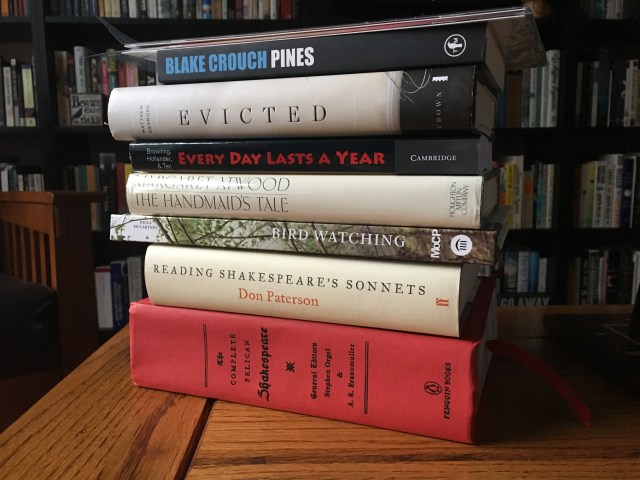
■ Wednesday is comics day. This week, my pull list comprised Saga #42 and Revival #46.
■ Crouch’s Dark Matter entertained three of us late last year, so I chose Pines for an easy, escapist read.
■ Move Evicted to the top of your TBR pile. Now. Really. I’ll wait. From my commonplace book:
p. 256
The Hinkstons expected more of their landlord for the money they were paying her. Rent was their biggest expense by far, and they wanted a decent and functional home in return. They wanted things to be fixed when they broke. But if Sherrena wasn’t going to repair her own property, neither were they. The house failed the tenants, and the tenants failed the house.
p. 257
Substandard housing was a blow to your psychological health: not only because things like dampness, mold, and overcrowding could bring about depression but also because of what living in awful conditions told you about yourself.
p. 285
Poverty could pile on; living it often meant steering through gnarled thickets of interconnected misfortunes and trying not to go crazy. There were moments of calm, but life on balance was facing one crisis after another.
p. 291
The home is the wellspring of personhood.
■ We will see the world premiere of The Book of Joseph at the Chicago Shakespeare Theater next month. The play adapts the correspondence collected in Every Day Lasts a Year.
■ Our family book club chose The Handmaid’s Tale for our winter selection. We listened to the audiobook for a bit during each of our drives in and out of Chicago and on the way back to campus. (Claire Danes does exceptional work with the narration.) My husband completed the audiobook, my daughters are reading the rest in between classes and research, and I finished by rereading my thirty-one-year-old hardback. Since I first read Tale, it has been a looming part of the landscape of my imagination, yet I was unprepared for how much more horrifying it seems now — now that I am the mother of adult daughters, now that the world appears to have gone a bit mad.
p. 181
No mother is ever, completely, a child’s idea of what a mother should be, and I suppose it works the other way around as well. But despite everything, we didn’t do too badly by one another, we did as well as most.
I wish she were here, so I could tell her I finally know this.
■ I picked up Bird Watching from a bargain table at the university bookstore. I want to adore McCartney’s playfulness, but I do not.
■ Maybe I should have declined the invitation because I knew I would not be able to give the “Shakespeare in a Year” project my complete attention until this weekend, but I am confident I will be completely caught up by Groundhog’s Day.
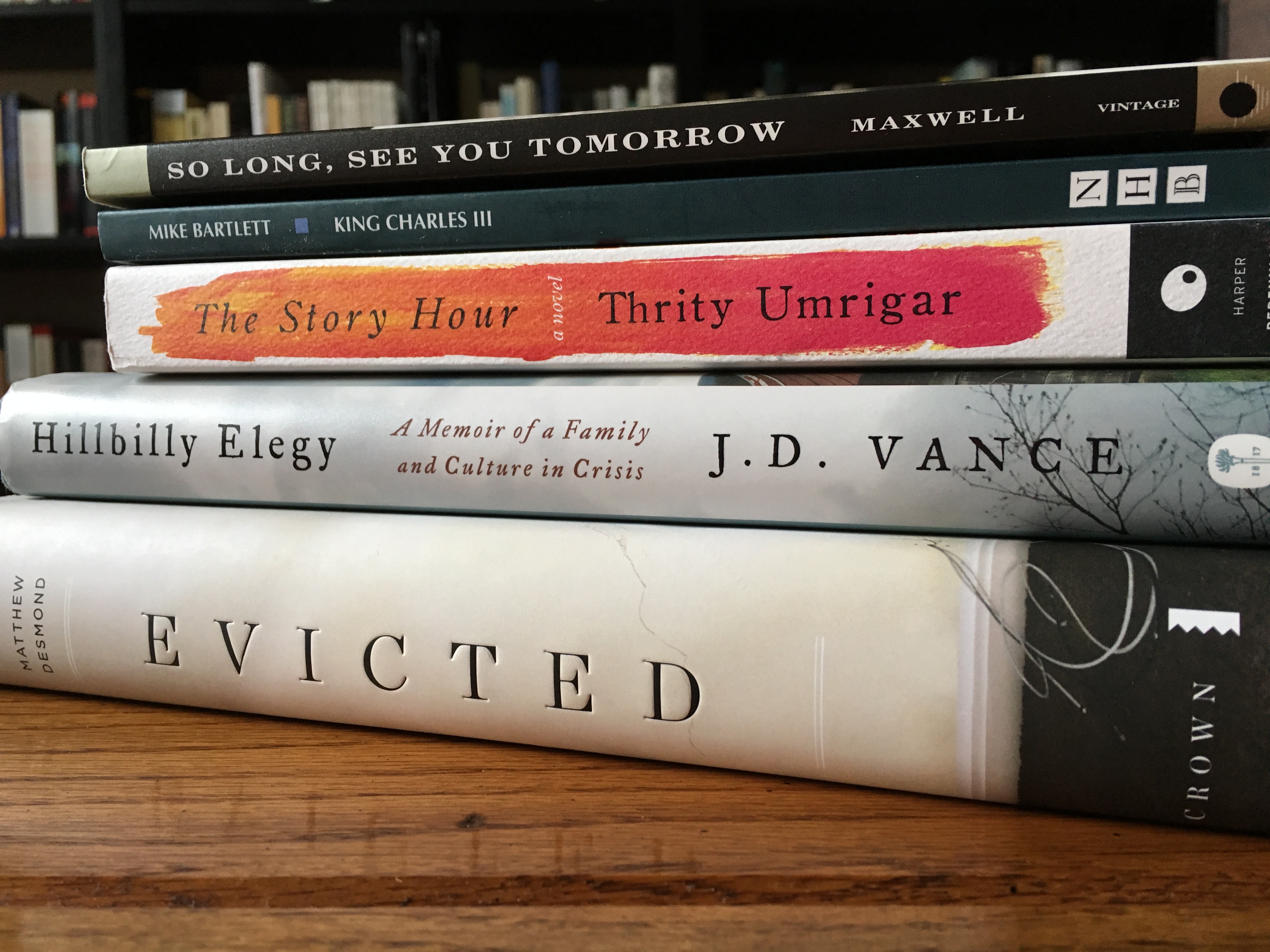 ■ As much a meditation on loss and grief as it is an exploration of memory and how memory shapes (and haunts and robs from) the present, William Maxwell’s 1980 novel So Long, See You Tomorrow is as perfect a book as A Good School or Revolutionary Road (both by Richard Yates) or Olive Kittredge (Elizabeth Strout).
p. 9
What I didn’t say, across the few feet that separated our two beds, was that I couldn’t understand how it had happened to us. It seemed like a mistake. And mistakes ought to be rectified, only this one couldn’t be. Between the way things used to be and the the way they were now was a void that couldn’t be crossed. I had to find an explanation other than the real one, which was that we were no more immune to misfortune that anybody else, and the idea that kept recurring to me, perhaps because of that pacing the floor with my father, was that I had inadvertently walked through a door I shouldn’t have gone through and couldn’t get back to the place I hadn’t meant to leave.
p. 27
What we, or at any rate I, refer to confidently as memory — meaning a moment, a scene, a fact that has been subjected to a fixative and thereby rescued from oblivion — is really a form of storytelling that goes on continually in the mind and often changes with the telling. Too many conflicting emotional interests are involved for life ever to be wholly acceptable, and possibly it is the work of the storyteller to rearrange things so that they conform to this end. In any case, in talking about the past we lie with every breath we draw.
p. 113
In the face of a deprivation so great, what is the use of asking him to go on being the boy he was. He might as well start life over again as some other boy instead.
■ So thoroughly did my family enjoy the Chicago Shakespeare Theater production of King Charles III (reviews here and here) that I decided to read the play.
■ The Shakespeare Project of Chicago is hosted by libraries, and the library at which we saw King John is engaged in a “One Book, One Community” program for which The Story Hour (Thrity Umrigar) is the selection. It interested me enough to order a copy.
■ I wanted to add another passage from J.D. Vance’s Hillbilly Elegy to the commonplace book before shelving it:
p. 228
For kids like me, the part of the brain that deals with stress and conflict is always activated — the switch flipped indefinitely. We are constantly ready to fight or flee, because there is constant exposure to the bear, whether that bear is an alcoholic dad or an unhinged mom. We become hardwired for conflict. And that wiring remains, even when there’s no more conflict to be had.
■ As I mentioned last week, Elegy segues neatly into Evicted (Matthew Desmond). Fifty pages in, what I’ve noticed so far is that Desmond seems evenhanded in his depiction of the tenants and their landlords.


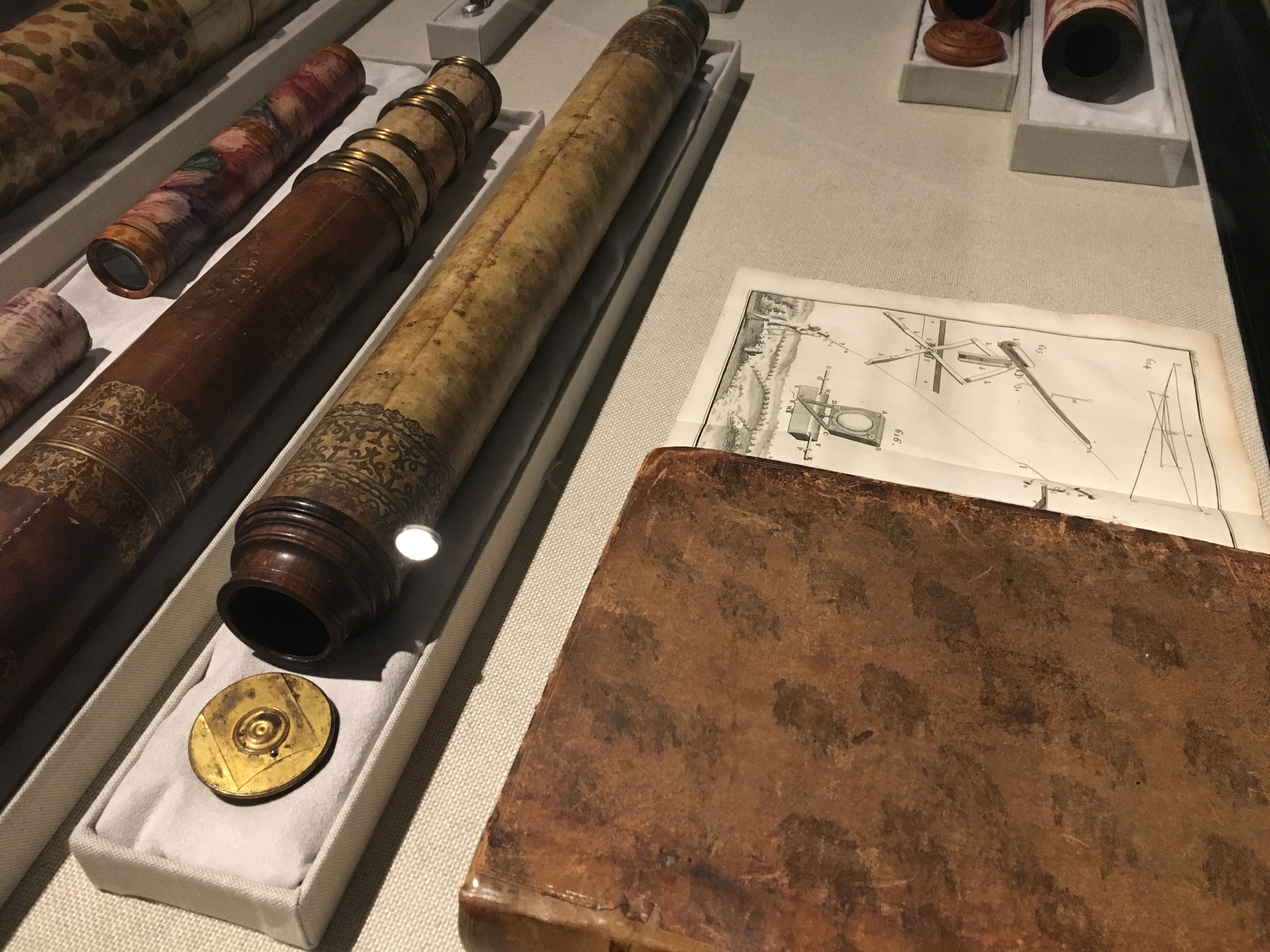
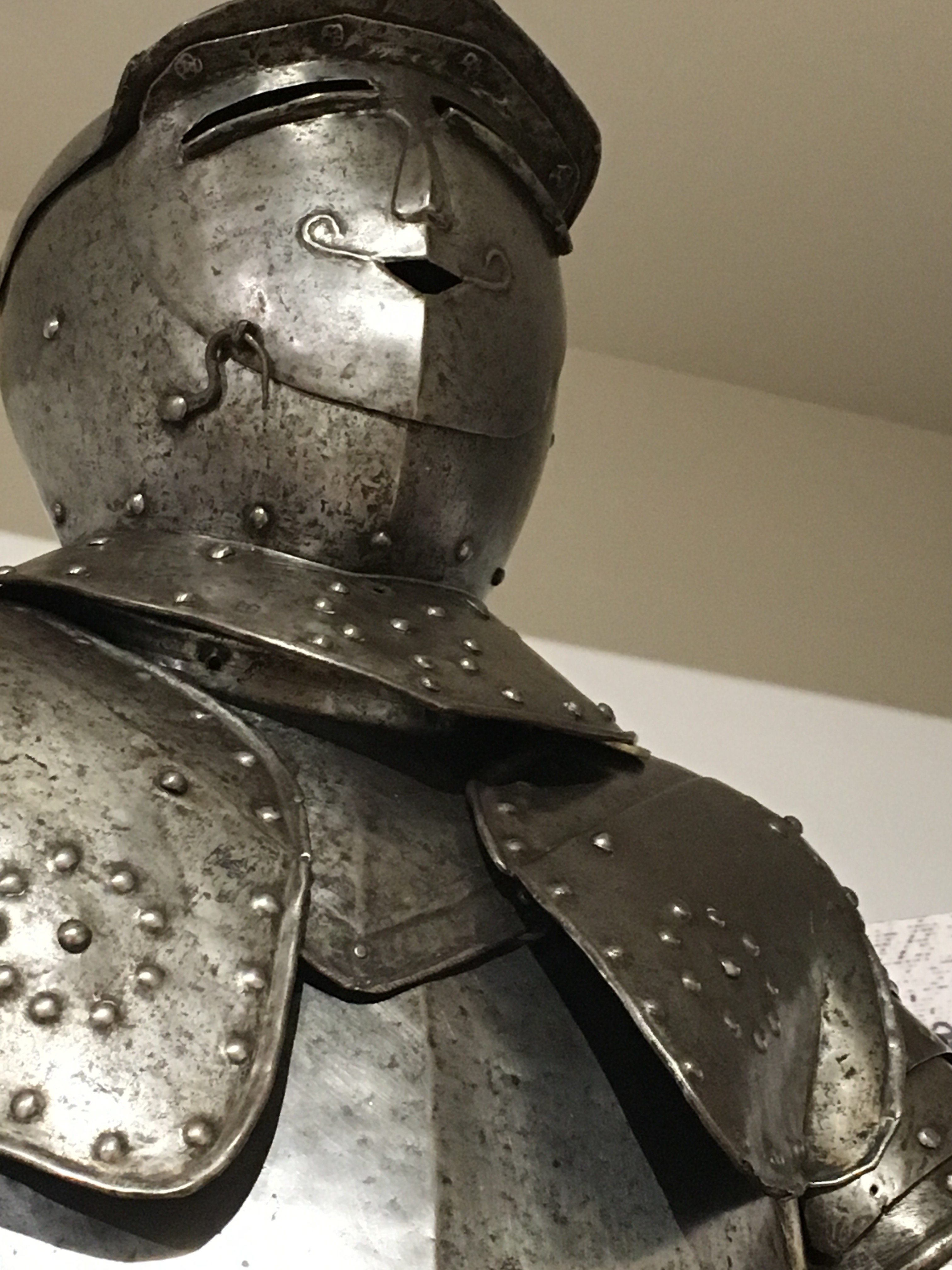
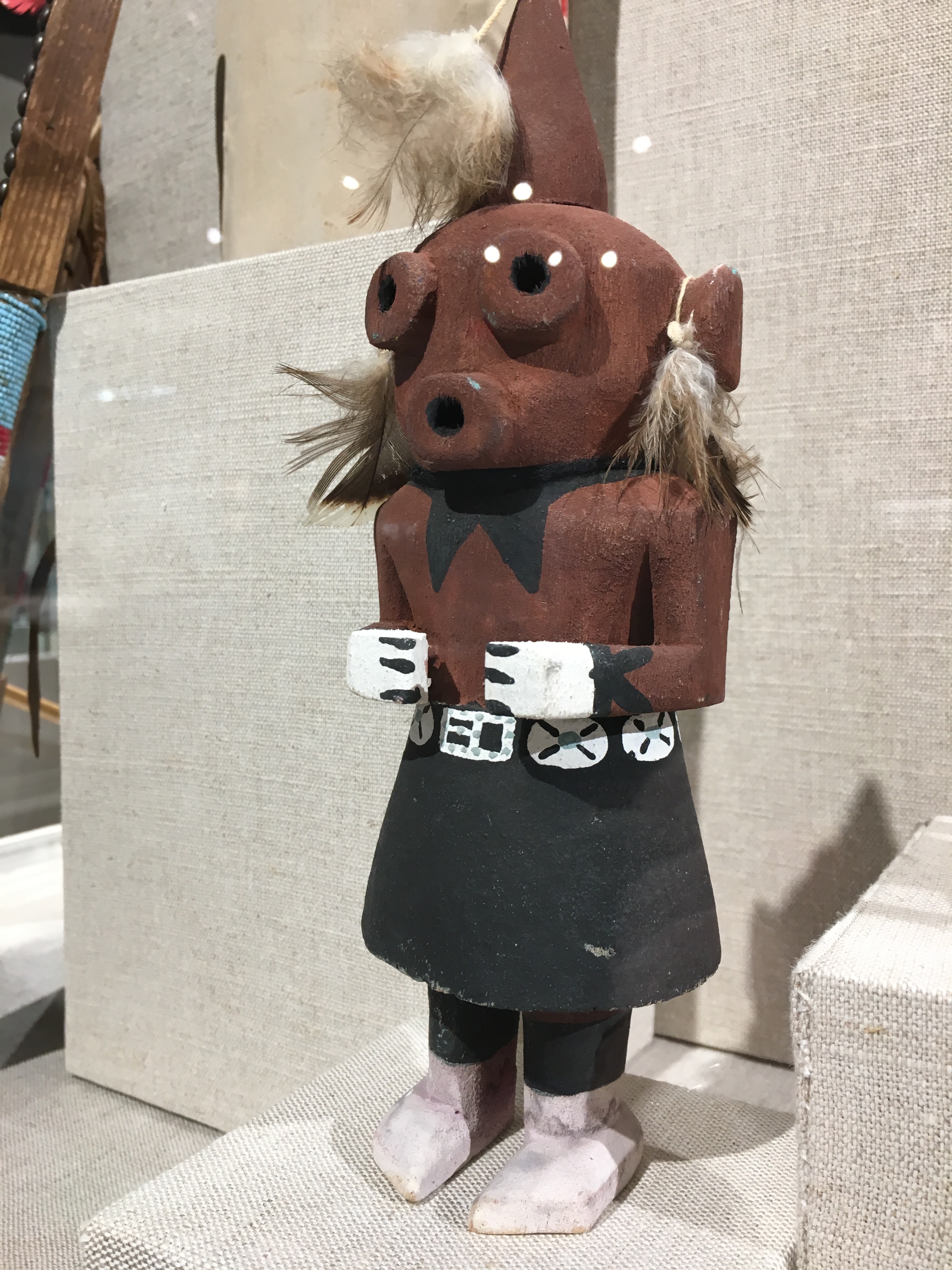
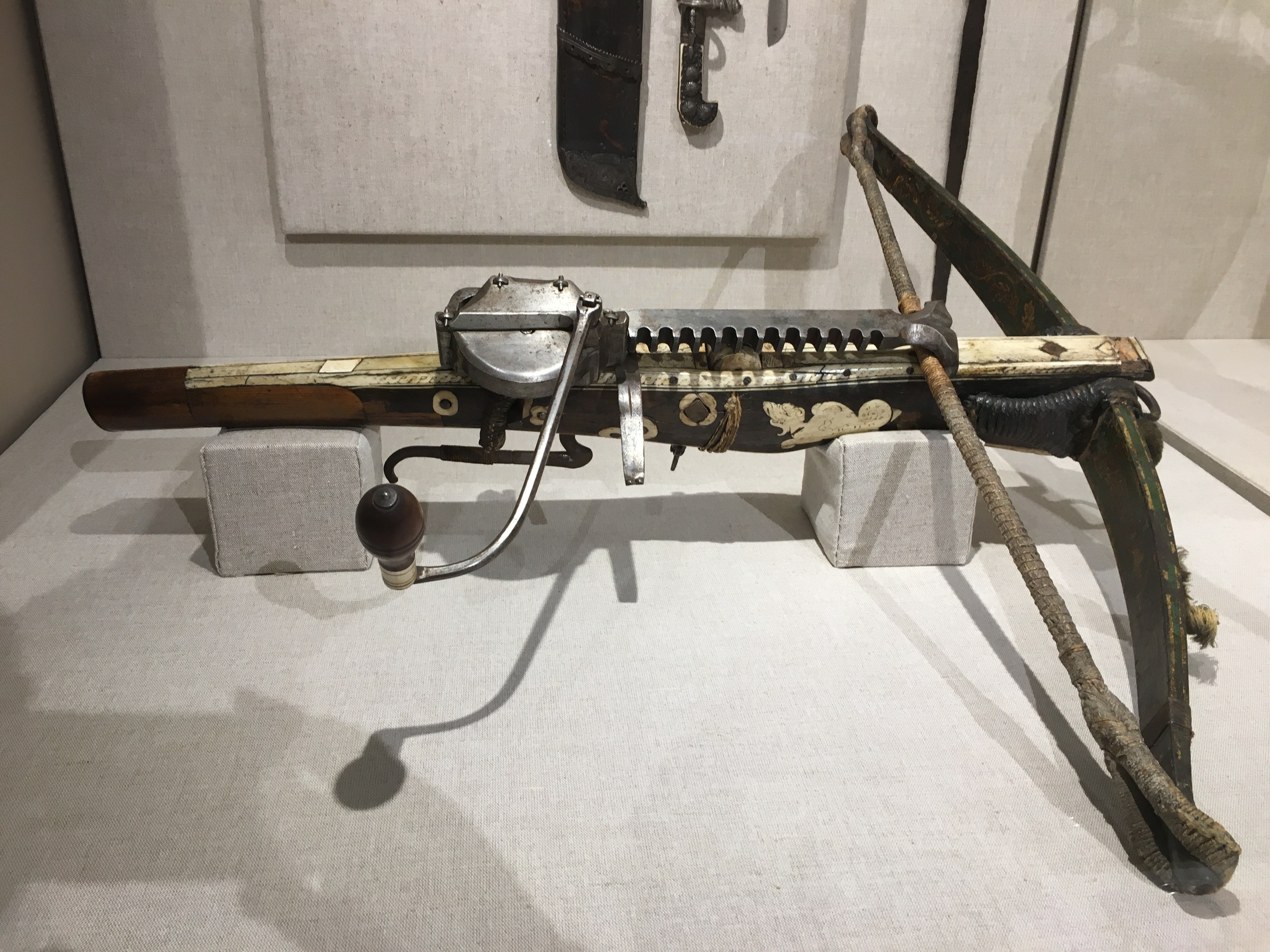
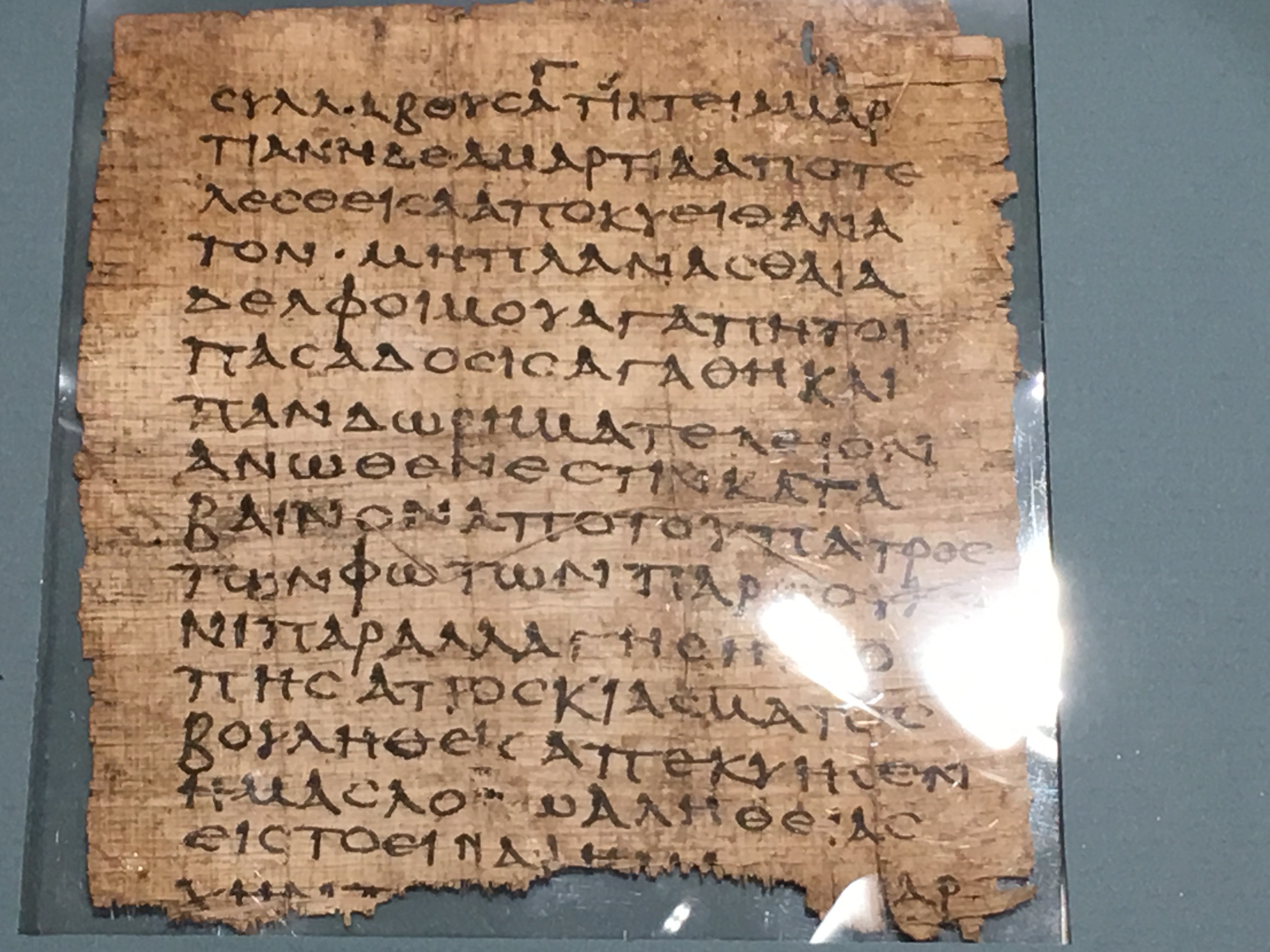
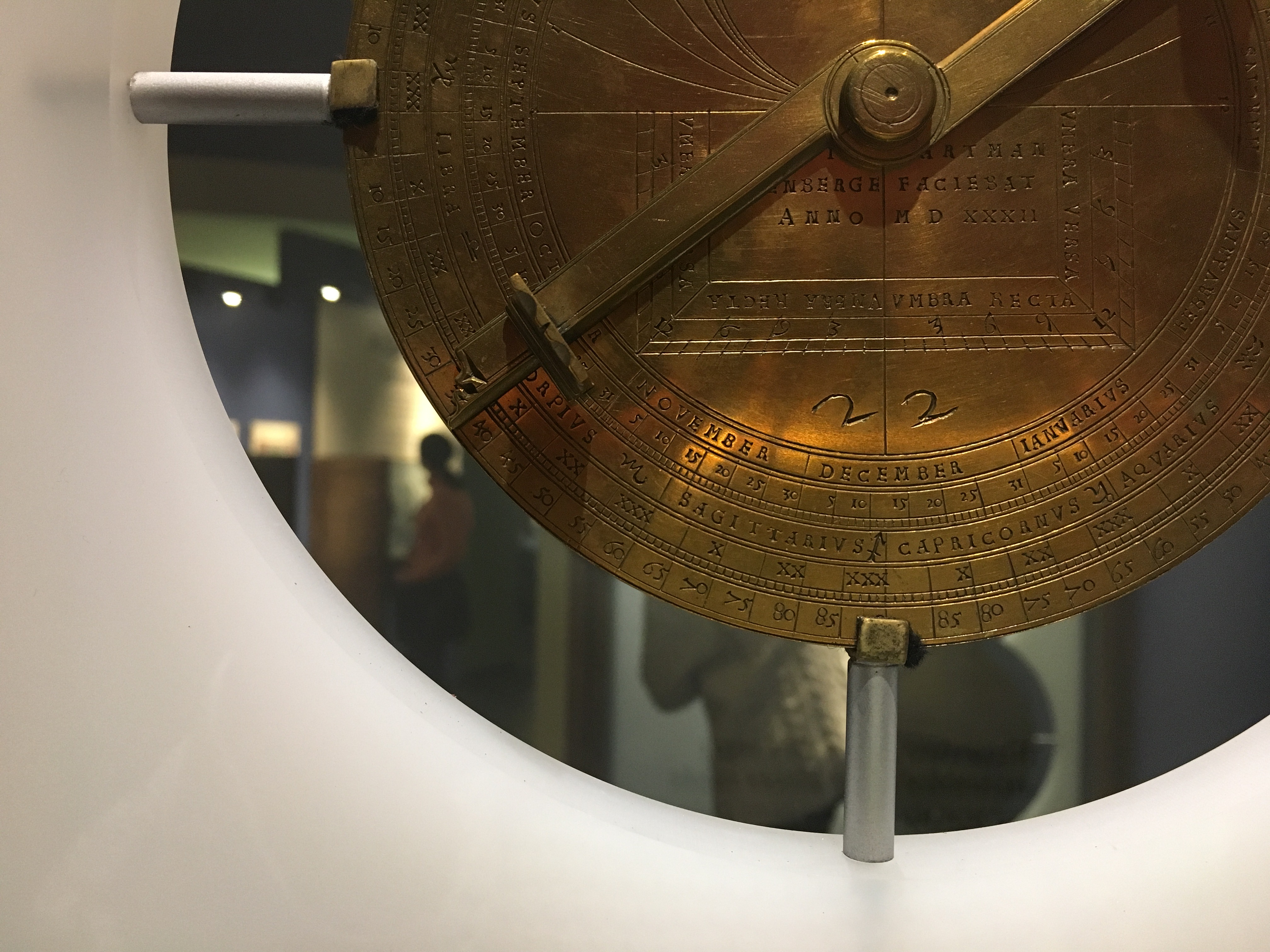 The above are images I took during our recent visit to the Adler Planetarium. What I love about the last one is that I can see my daughters through the display.
After the museum, we saw A Disappearing Number at the TimeLine Theatre. Yes, a play about math. What did you expect? My site is called “Nerdishly.” My youngest recently secured a spot with a high energy physics research group that is working on the ATLAS experiment, so insert a muted nerdgirl “Squeeeeee!” when Anish Jethmalani’s character, Aninda, announced that he was a physicist lecturing at CERN. The script is not a seamless one, but this production is so fabulous that one forgives the weaknesses in the text. Highly recommended.
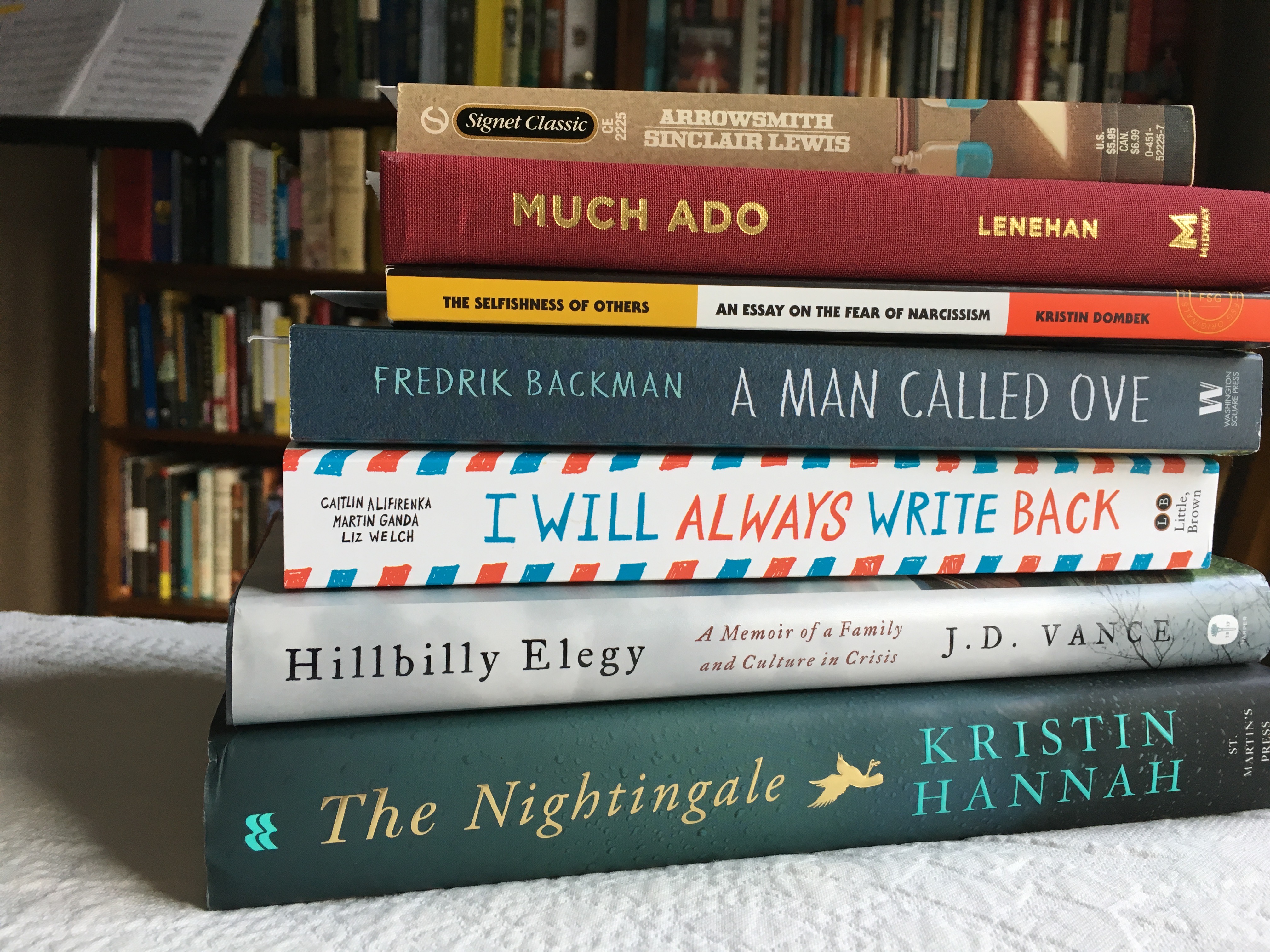 ■ I’ve only read a paragraph of Arrowsmith, but I pinky-swore with my younger daughter that I would finish it (before year’s end).
■ Rick Kogan’s interview with Michael Lenehan ran while that same daughter and I were working on one project or another early in our winter break. “He always says, ‘This is one of the best books I ever read!’ or ‘You’re truly one of the great writers!’ and I get duped every time,” I remarked. “What are you doing?” she asked me later. “Ordering that book about the American Players Theatre that Rick Kogan recommended,” I replied, and she chuckled. As it turns out, though, it is pretty good.
■ The Selfishness of Others: An Essay on the Fear of Narcissism is my “reading in the theater before the show begins” book, so it has been set aside several times. A fascinating look at our culture’s obsession with narcissism, it included a reference to Anders Breivik that reminded me that One of Us: The Story of Anders Breivik and the Massacre in Norway (Åsne Seierstad; 2015) is in my collection. (One of Us was one of the best books I read last year — and I don’t say that about every book I read, Mr. Kogan. Heh, heh, heh.) We have two more plays before our winter break concludes, so I suspect I will soon add Selfishness to my list of books read.
■ In the comments to this post, I asked Margaret if I should add a book she mentioned to my TBR pile. While awaiting her reply, I grabbed it and read the first three chapters. Imagine my relief when I saw her verdict: “A Man Called Ove seems to be wildly popular but I didn’t really like it. A cranky, aggressively rude man is loved by generous, warm-hearted women — why?” I knew everyone and her mother and uncle had read Ove, which is part of the reason I had resisted it, but then it came up as a possible book club selection. Thank you, Margaret, for validating my “Blergh.”
Characters need not be likeable, by the way. (Hello, Olive Kittredge.) But their movement through the world should reveal essential truths about what it means to be human. That is what the best fiction does — it tells us what is true.
■ I finished I Will Always Write Back in two sittings. It’s a simple (and utterly predictable), feel-good story framed by the correspondence between a privileged teenager and her pen pal from Zimbabwe. I’m surprised it’s not a movie.
■ After a few fits and starts, I returned to Hillbilly Elegy, which I first mentioned here. The following quote made me pull Evicted: Poverty and Profit in the American City (Matthew Desmond; 2015) from my shelves and add it to one of my TBR piles:
p. 52
Federal housing policy has actively encouraged homeownership, from Jimmy Carter’s Community Reinvestment Act to George W. Bush’s ownership society. But in the Middletowns of the world, homeownership comes at a steep social cost: As jobs disappear in a given area, declining home values trap people in certain neighborhoods. Even if you’d like to move, you can’t, because the bottom has fallen out of the market — you now owe more than any buyer is willing to pay. The costs of moving are so high that people stay put. Of course, the people trapped are usually those with the least money; those who can afford to leave do so.
■ All right, so The Nightingale (Kristin Hannah; 2015) was on and off my wishlist a number of times over the last year. Then it was on a table at the bookstore we visited before going to the theater last Thursday. I had recently vowed that I would make at least three in-store purchases each quarter… well, that’s how it ended up nearly getting left beneath my seat at the PrivateBank Theater and then being safely tucked into one of my TBR stacks.
■ In the background of the image above, you can make out my music stand. In the end, two things keep me from reading more: (1) talking or texting with my daughters and (2) practicing my music. And I do both. A. Lot. Learning a new instrument in your fifties is HARD but gratifying. Oh, sure, I experience days with terrible tone or counting woes or just a case of “Blergh” about a piece I don’t like. Mostly, though, the pursuit interests me; more often than I expected, it even delights me.
 While I loved every minute of the show, — and, yes, Miguel Cervantes and Joshua Henry as Hamilton and Burr, respectively, dazzle — my favorite bits belonged to Alexander Gemignani’s King George III.
I know him.
That can’t be.
That’s that little guy who spoke to me all those years ago…
What was it ’85?
That poor man; they’re going to eat him alive!Ocean’s rise; empires fall.
Next to Washington, they all look small.
Hamilton is not the only show in this theater-rich town, of course. Earlier this break, we saw Cheek by Jowl’s The Winter’s Tale, which I wrote about here; King Charles III, which features Robert Bathurst (yes, from Downton Abbey) in the title role; and Pygmalion, which reminded all of us that we need to read more Shaw. We heartily recommend King Charles III, which ends its run at the Chicago Shakespeare Theater on January 15, and Remy Bumppo’s Pygmalion, which closes tomorrow, so act fast.
Before the semester begins, we will also see the Chicago premiere of A Disappearing Number at the TimeLine Theatre and the Shakespeare Project of Chicago’s staged reading of King John.






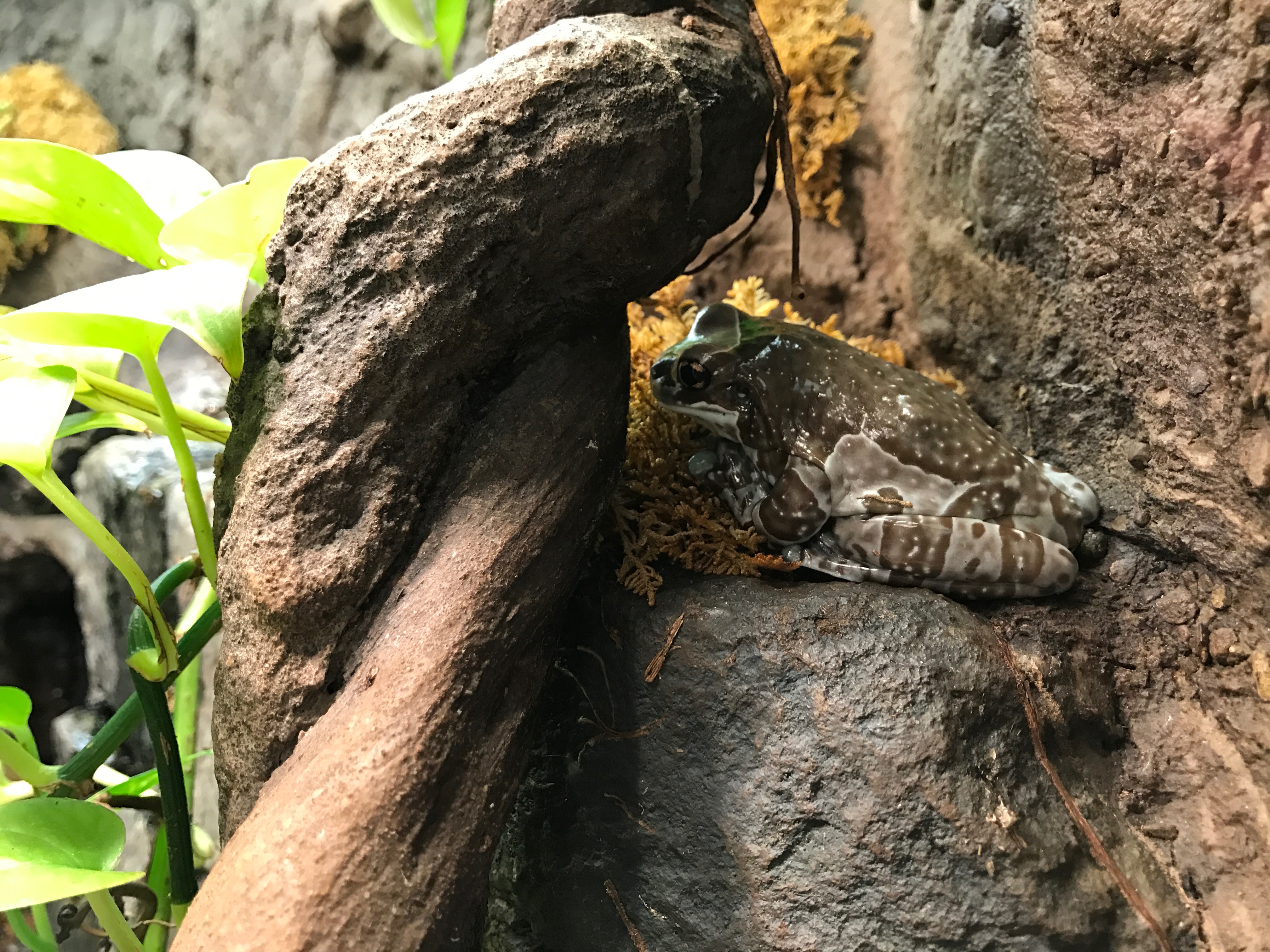 The Peggy Notebaert Nature Museum attracts young children and weary caregivers — and us. The Butterfly Haven alone is worth the cost of admission, but we also love visiting the Beecher Collections Laboratory and related exhibits, and I adore the “Heritage of the Chicago Academy of Sciences” room. Although smaller, “Frogs: A Chorus of Color” actually gives the Shedd’s “Amphibians” a run for its money. (Note that “Frogs” closes on January 22.)
In her paean to birding, Rare Encounters with Ordinary Birds, Lyanda Lynn Haupt writes:
There is a game birders play on New Year’s Day called “Bird of the Year.” The very first bird you see on the first day of the new year is your theme bird for the next 365 days. It might seem a curious custom, but people who watch birds regularly are always contriving ways to keep themselves interested. This is one of those ways. You are given the possibility of creating something extraordinary — a Year of the Osprey, Year of the Pileated Woodpecker, Year of the Trumpeter Swan. This game is an inspiration to place yourself in natural circumstances that will yield a heavenly bird, blessing your year, your perspective, your imagination, your spirit. New year, new bird.
After her breathless anticipation, Haupt is confronted with… an European Starling, or “sky-rat.”
The Year of the European Starling. Inauspicious, yes, but not without its charms, according to Haupt.
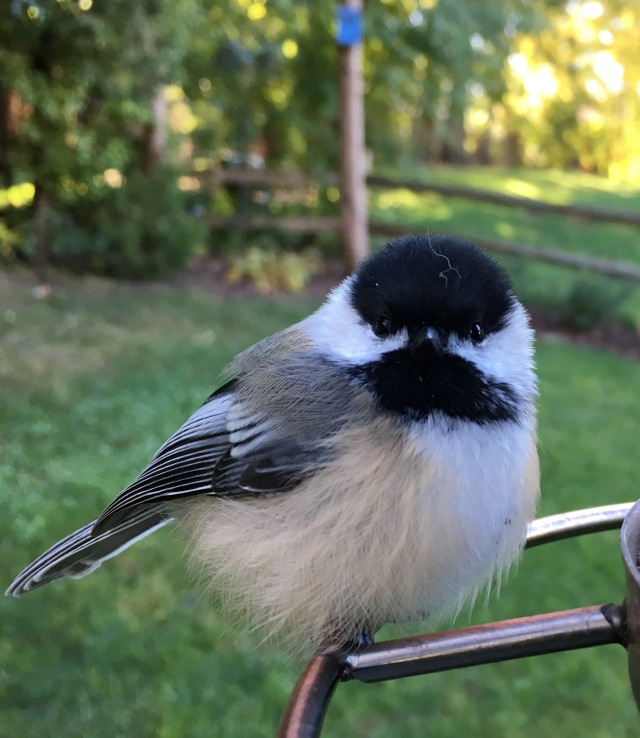
As I have on the past thirteen or so New Year’s Eves, I ensured that all of the feeders were topped off and that corn and nuts were scattered for the squirrels last night. (There are no squirrel-proof feeders, but I have learned that feed scattered away from the feeders will (mostly) keep those furry nuisances away from the birds and the more expensive seed.) Last year, I saw the first bird of the year before I had even left my bed: a house sparrow hopping and chatting with his friends in the yew hedge. This year, I espied a black-capped chickadee in the oak out back.
 Nerdishly