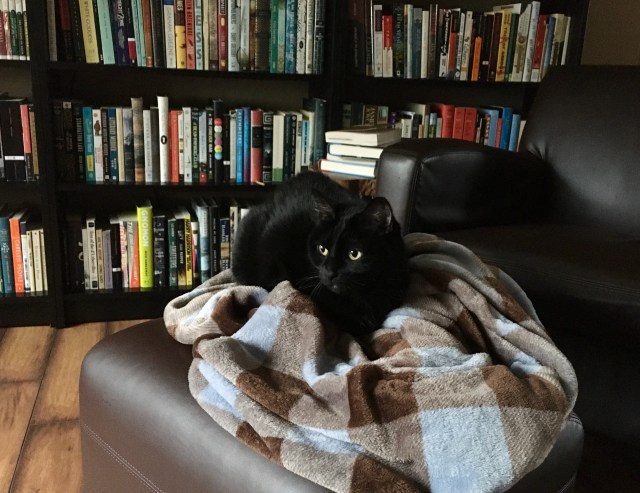
 Since my last list, I have read fifteen books, which means that I have completed Robin’s “Read 52 Books in 52 Weeks” challenge. But let’s keep going, eh?
■ Autobiography of a Face (Lucy Grealy; 1994. Non-fiction.) RFS
p. 7
The cruelty of children is immense, almost startling its precision. The kids at the parties were fairly young and, surrounded by adults, they rarely make cruel remarks outright. But their open, uncensored stares were more painful than the deliberate taunts of my peers at school, where insecurities drove everything and everyone like some looming, evil presence in a haunted machine. But in those backyards, where the grass was mown so short and sharp it would have hurt to walk on it, there was only the fact of me, my face, my ugliness.
■ The Plot Against America (Philip Roth; 2004. Fiction.) RFS
I had thought this would be a reread but then realized I had confused it with American Pastoral. The book is practically perfect, so although the first episode of the new HBO series was solid, it’s unlikely that I will continue watching.
p. 114
Turned wrong way round, the relentless unforeseen was what we schoolchildren studied as “history,” harmless history, where everything unexpected in its own time is chronicled on the page as inevitable. The terror of the unforeseen is what the science of history hides, turning a disaster into an epic.
p. 300
Whether outright government-sanctioned persecution was inevitable, nobody could say for sure, but the fear of persecution was such that not even a practical man grounded in his everyday tasks, a person who tried his best to contain the uncertainty and the anxiety and the anger and operate according to the dictates of reason, could hope to preserve his equilibrium any longer.
p. 316
To have enslaved America with this hocus-pocus! To have captured the mind of the world’s greatest nation without uttering a single word of truth! Oh, the pleasure we must be affording the most malevolent man on earth!
■ Aimless Love (Billy Collins; 2013. Poetry.) RFS
Billy Collins is a treasure.
■ My Dark Vanessa (Kate Elizabeth Russell; 2020. Fiction.) ATY
Read in two sittings. Timely and disturbing. Related links here and here.
■ Severance (Ming La; 2018. Fiction.) RFS
Prescient and gorgeously written. I cannot recommend it enough. Mr. Nerdishly agrees, wryly adding, “It’s also scary as hell.” Review here.
■ Trees, Vol. 3 (Warren Ellis; 2020. Graphic fiction.) LIB
Strong addition to the series.
■ Oblivion Song, Vol. 4 (Robert Kirkman; 2020. Graphic fiction.) LIB
Less so.
■ Say Nothing: A True Story of Murder and Memory in Northern Ireland (Patrick Radden Keene; 2019. Non-fiction.) RFS
Related links here and here.
■ Catch and Kill (Ronan Farrow; 2019. Non-fiction.) RFS
This reminded me of my experience reading Bad Blood: I could not put it down; hours disappeared. A review and an article about the related podcast.
■ The Old Man and the Sea (Ernest Hemingway; 1952. Fiction.) ATY
This is another of those books that I have reread as an adult and realized, “Wow, that was clearly wasted on my teenaged self.”
No one should be alone in their old age, he thought. But it is unavoidable.
■ Postal: Deliverance, Vol. 1 (Brian Edward Hill; 2019. Graphic fiction.) LIB
The owner of the comic book store we patronize has fruitfully recommended several series to me, so it’s odd that he didn’t mention that Postal, a series on my shortlist, had continued. Well, it was a treat to discover the first volume on Hoopla.
■ The Nose (Nikolai Gogol; 1835. Fiction.) RFS
We saw some of William Kentridge’s The Nose Series at the Milwaukee Art Museum, but a search of the museum’s website yields only a tax document mentioning that the prints were there. Weird. Well, in any event, I now plan to watch the Kentridge production of the Shostakovich opera via Met On Demand.
But nothing lasts long in this world, and so even joy is weaker one minute than the last, and by the third it has become something fainter still, until finally it fades imperceptibly back into the more usual state of one’s mind, just as a ripple on water, born from the drop of a pebble, will gradually merge back into the smooth surface of the lake.
■ The Book of M (Peng Shepherd; 2018. Fiction.) RFS
Too long by one hundred pages, and, boy, is the chapter for each narrator device one of the most overused in contemporary fiction, or what? Add to that the fact that I grew impatient with the fantastical elements by the final third, and you have the recipe for a Meh rating.
■ The Lion in Winter (James Goldman; 1966. Drama.) RFS
Reread one of my favorites because this is a season that requires such indulgences.
Act II, Scene 1
Eleanor: I adored you.
Henry: Never.
Eleanor: I still do.
Henry: Of all the lies, that one is the most terrible.
Eleanor: I know: that’s why I saved it up for now. (They throw themselves into each other’s arms.) Oh, Henry, we have mangled everything we’ve touched.
■ The Dream-Quest of Vellitt Boe (Kij Johnson; 2016. Fiction.) RFS
My ticket stub from Chicago Shakespeare Theater’s 2016 production of Tug of War: Friendly Fire marked page 41. My best guess, then, is that I began this unusual book four years ago and set it aside. Written as a feminist counterpoint to H.P. Lovecraft’s The Dream-Quest of Unknown Kadath, this short novel is certainly not my usual fare, but I returned to the beginning and gave it another shot. Still not my cuppa, but, hey, I finished it this time. Related article here.
—————————————
ATY Acquired this year
LIB Borrowed from library (including Hoopla and Overdrive)
OTH Other
RFS Read from shelves


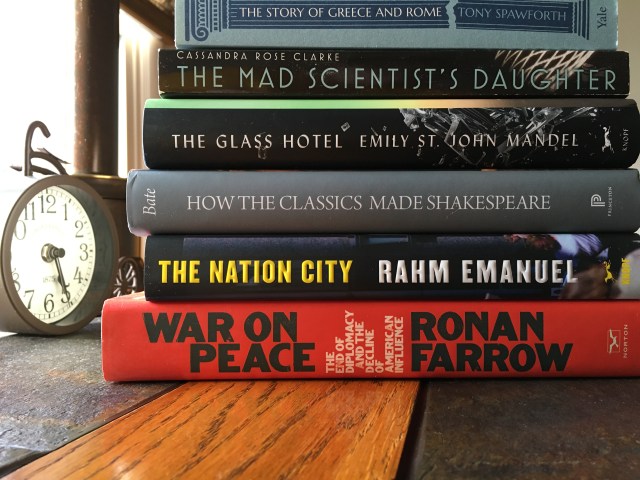 I ordered several of these from the
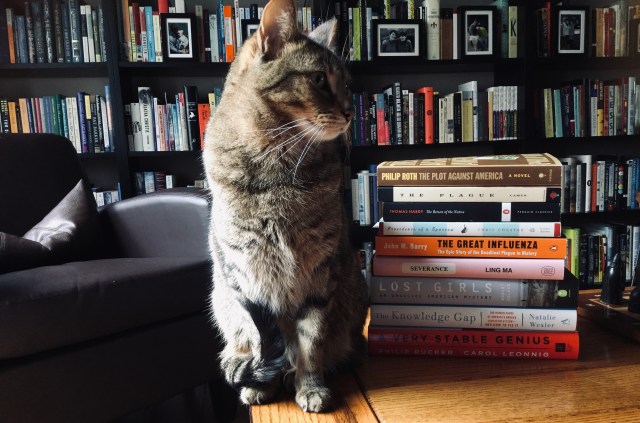 I may switch it up before week’s end, but this is what I’m working with right now.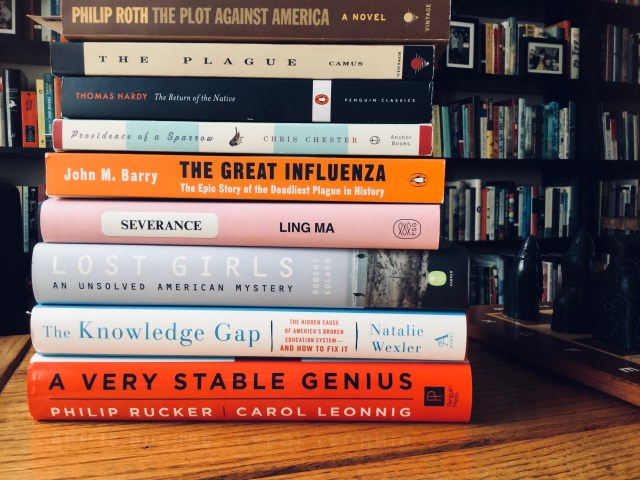
 It’s as if I had been preparing for this moment my entire life.






 At the

