
 On this gray, cold morning, all I really want to do is sip coffee, watch the birds in my yard (right now, three beautiful crows, my bird of the year), and read. Alas, I am covering the vacation of the gal who took over my tutoring gig, so I must rouse myself, don something more appropriate than these comfortable flannel pants and my favorite old sweater, and prepare the sort of nutritious lunch that will keep me going until 6 p.m. Sigh.
Author Archives: Nerdishly
Or, The Whale
 On Monday, in addition to Robert Salmon’s South Sea Whale Fishing II (1831), the Barry Moser-illustrated Moby Dick put me in a “Hast seen?” mood.
 On Wednesday, I watched the activity in the penguin exhibit on the main level of the New England Aquarium through the skeleton of a North American right whale.
Museum of Fine Arts


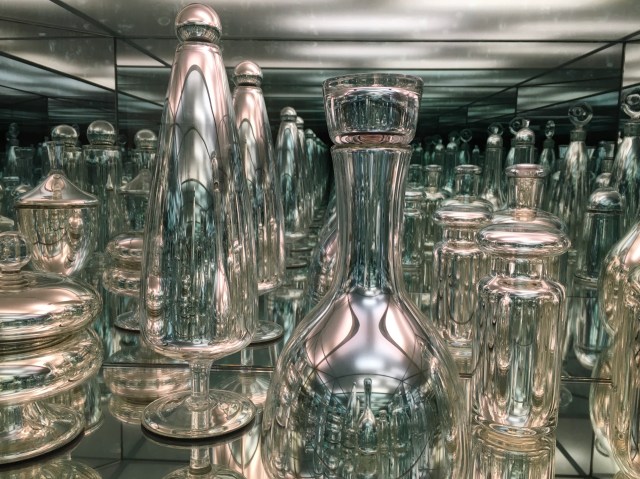
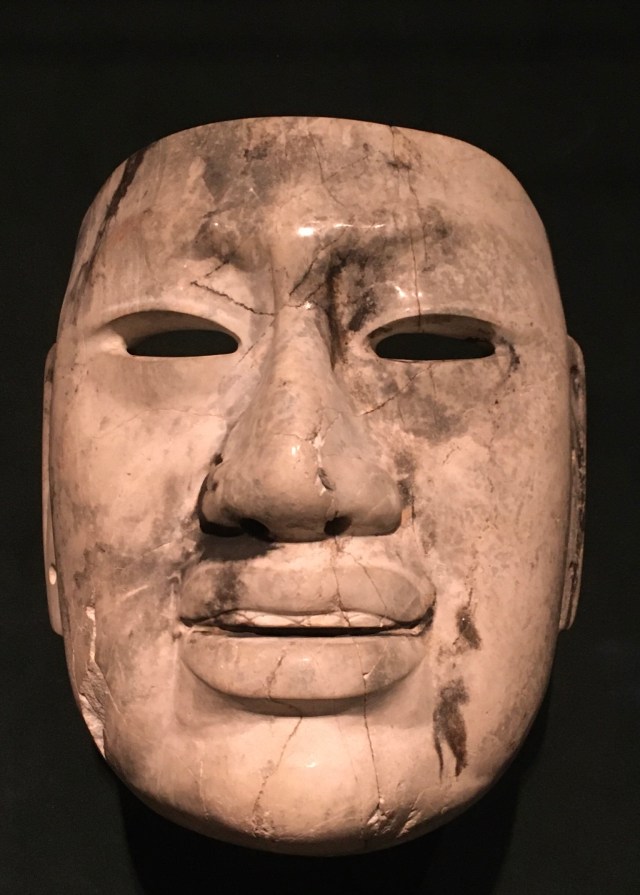
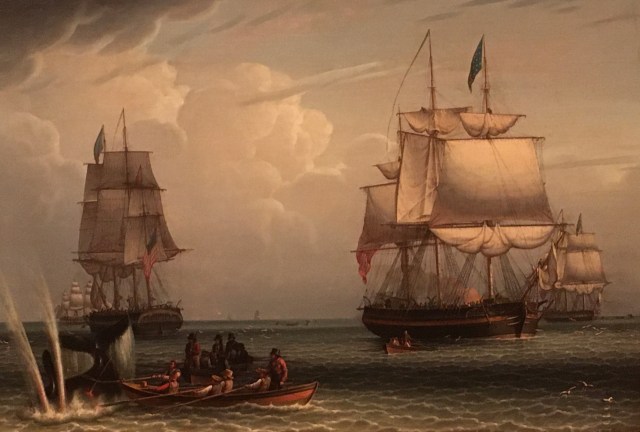 A few more photos captured on my recent trip to the Museum of Fine Arts, Boston.
■ Morning Sunlight on the Snow, Éragny-sur-Epte; Camille Pissarro, 1895
■ Seacoast at Trouville; Claude Monet, 1881
■ Seascape II; Hyman Bloom, 1974
■ Endlessly Repeating Twentieth Century Modernism; Josiah McElheny, 2007
■ Olmec mask; 900–600 BC
■ South Sea Whale Fishing II; Robert Salmon, 1831
Matters of Life and Death


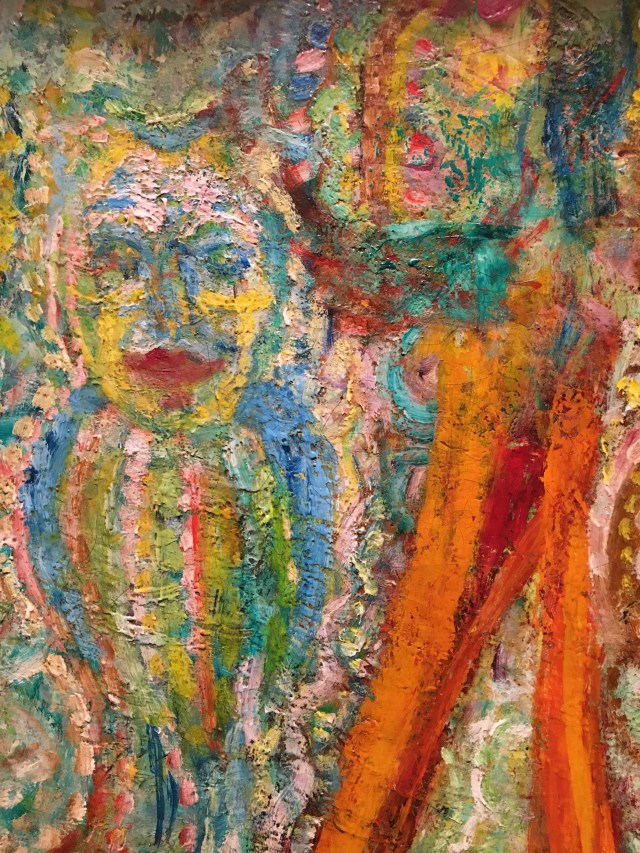
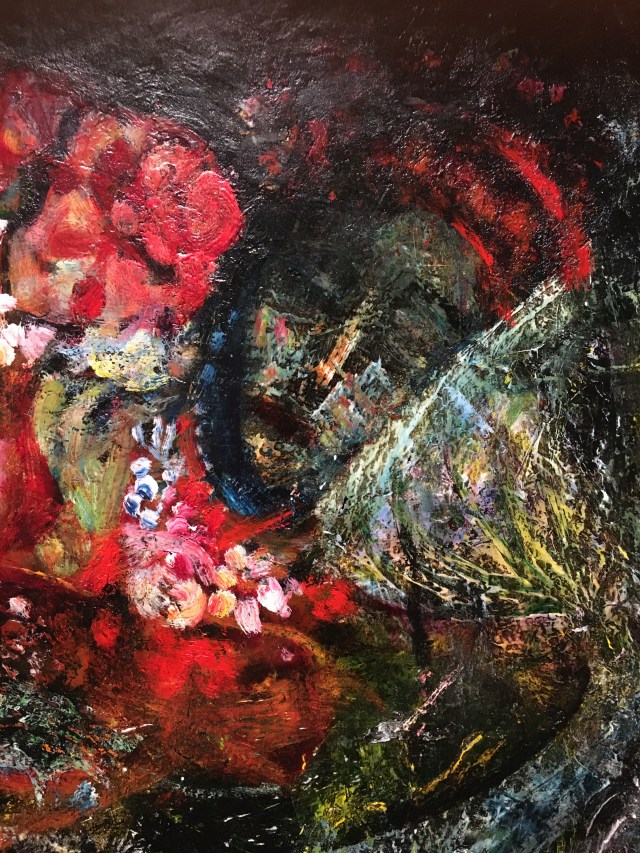
 The above are some of the images I captured today at Hyman Bloom: Matters of Life and Death, an exhibit I first saw last summer.
■ Boxer in His Corner, 1930
■ Old Woman Climbing, undated
■ Detail from The Bride, 1943-45
■ Detail from The Bride, 1941
■ Detail from Rocks and Autumn Leaves, 1949-51
An annotated reading list
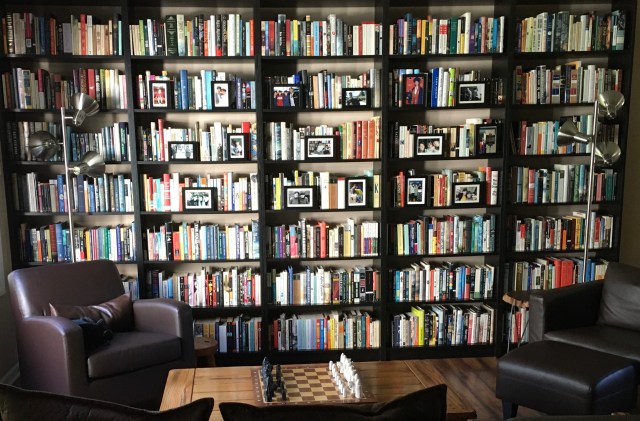 Once upon a time ago, I would cobble together a monthly (or so) review of books I’d been reading with notes, quotes, and / or links. I thought I’d do that today to get back into the posting groove. So far, I’ve read twenty-three books this year, fifteen of which are from my shelves and eleven of which are non-fiction titles. I’m off to a promising start, eh?
■ Highlights of the Collections of the Oriental Institute (Jean M. Evans; 2017. Non-fiction.) RFS
We revisited the Oriental Institute in December in anticipation of seeing An Iliad there next month.
■ The Mousetrap (Agatha Christie; 1952. Drama.) RFS
Read in advance of seeing the Court Theatre production.
■ Trust Exercise (Susan Choi; 2019. Fiction.) RFS
Interesting review here.
■ Rutherford and Sons (Githa Sowerby; 1912. Drama.) RFS
Read before seeing the TimeLine Theatre production.
■ Richard III (William Shakespeare; 1592. Drama.) RFS
Reread before seeing the Shakespeare Project of Chicago production.
■ In the Heart of the Sea (Nathan Philbrick; 2000. Non-fiction.) RFS
In a weird twist, I watched the movie before reading this terrific book. My interest was, of course, fueled by my Moby-Dick reread late last year.
■ Dear America (Jose Antonio Vargas; 2018. Non-fiction.) RFS
Related link here.
■ A Long Way Gone (Ishmael Beah; 2007. Non-fiction.) RFS
Arrived at this book a bit later than most. Here’s a related link.
■ Frogcatchers (Jeff Lemire; 2018. Graphic fiction.) LIB
Another of Lemire’s meditations on death, regret, and letting go.
■ On Tyranny (Timothy Snyder; 2017. Non-fiction.) RFS
Again, arrived at this later than most. I began marking passages for the commonplace book and soon realized I’d copy the entire text. Review here.
■ Tomten Tales (Astrid Lindgren; 2017 ed. (1960 and 1966). Juvenile fiction.) LIB
Small gnome ornaments topped the holiday gift bags I distributed this year. In a lovely note, my music teacher thanked me for, among other things, “the adorable tomten.” In pursuit of a definition, I stumbled on this delightful children’s book.
■ An Astronaut’s Guide to Life on Earth (Chris Hadfield; 2013. Non-fiction.) RFS
My younger daughter (insistently) recommended this.
p. 267
If you start thinking that only your biggest and shiniest moments count, you’re setting yourself up to feel like a failure most of the time. Personally, I’d rather feel good most of the time, so to me everything counts: the small moments, the medium ones, the successes that make the papers and also the ones that no one knows about but me. The challenge is avoiding being derailed by the big, shiny moments that turn other people’s heads. You have to figure out for yourself how to enjoy and celebrate them, and then move on.
■ Between the World and Me (Ta-Nehisi Coates; 2015. Non-fiction.) RFS
p. 51
Poetry aims for an economy of truth — loose and useless words must be discarded, and I found that these loose and useless words were not separate from loose and useless thoughts. Poetry was not simply the transcription of notions — beautiful writing rarely is. I wanted to learn to write, which was ultimately, still, as my mother had taught me, a confrontation with my own innocence, my own rationalizations. Poetry was the processing of my thoughts until the slag of justification fell away and I was left with the cold steel truths of life.
■ Keep It Moving (Twyla Tharp; 2019. Non-fiction.) LIB
Meh.
■ The Passengers (John Marrs; 2019. Fiction.) ATY
Flawed and a bit predictable but an altogether entertaining way to pass a Sunday evening.
■ Digital Minimalism (Cal Newport; 2019. Non-fiction.) RFS
This book is partially responsible for the gap in entries here.
■ We Should All Be Feminists (Chimamanda Ngozi Adichie; 2014. Non-fiction.) LIB
p. 18
Today, we live in a vastly different world. The person more qualified to lead is not the physically stronger person. It is the more intelligent, the more knowledgeable, the more creative, more innovative. And there are no hormones for those attributes. A man is as likely as a woman to be intelligent, innovative, creative. We have evolved. But our ideas of gender have not evolved very much.
■ Daughter of Time (Josephine Tey; 1951. Fiction.) RFS
I reread this after rereading Richard III.
p. 33
It was shocking how little history remained with one after a good education.
p. 196
“No, that doesn’t matter at all. Most people’s first books are their best anyway; it’s the one they wanted most to write….”
■ Blood Dazzler (Patricia Smith; 2009. Poetry.) LIB
Excerpts here.
■ Invisible Women: Data Bias in a World Designed for Men (Carolyn Criado Perez; 2019. Non-fiction.) RFS
Wow. Wow. Wow. This will certainly top my list of memorable reads this year. Related link here.
■ The Whisper Man (Alex North; 2019. Fiction.) ATY
Another meh.
■ The Warehouse (Rob Hart; 2019. Fiction.) LIB
Although I’m weary of the narrative device of alternating voices, it worked in this near-future dystopian novel.
■ Emma (Jane Austen; 1815. Fiction.) RFS
Austen’s prose sparkles; her wit pierces. But I wonder if I am too old to appreciate Emma. I reread the novel before seeing the new Chicago Shakespeare musical.
—————————————
ATY Acquired this year
LIB Borrowed from library
RFS Read from shelves
Flute adventures
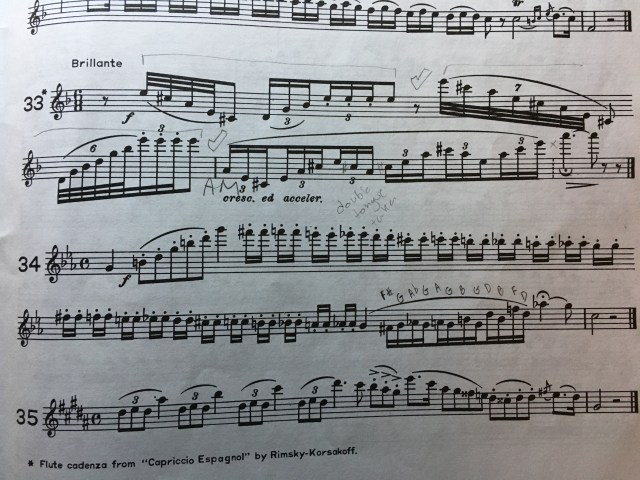
It’s impossible to explain the brain tic that made the Rimsky-Korsokov completely readable, while my repeated errors in 34 finally reduced me to writing it out during a particularly grueling practice session. (Yes, I probably should have erased it once I had “mastered” the passage, but that is, after all, how this sausage finally got made.)
In addition to scale and tone exercises and P. Bona’s rhythmical articulation studies, I am now working in Robert Cavally’s Melodious and Progressive Studies from Andersen, Gariboldi, Koehler, and Terschak for Flute, Book 1. And in addition to my solo piece (currently Handel’s Flute sonata in G major (HWV 363b)), I prepare my part of a new (reasonably short) duet each week.
My current daily practice schedule:
— 20 minutes: long tones and scales
— 20 minutes: Melodious and Progressive Studies
— 20 minutes: duet
— 15 minutes: rhythmical articulation
— 15 minutes: solo
Later this month, band rehearsals begin: twice weekly plus sectionals. At that point, I think I’m looking at another increase in practice time:
— 20 minutes: long tones and scales
— 20 minutes: Melodious and Progressive Studies
— 20 minutes: duet
— 15 minutes: rhythmical articulation
— 20 minutes: solo
— 20 minutes: band music or other
I’ve already met with musicians in my section and reviewed the selections from last semester. The music is fun but not too challenging — perfect for someone who wants to (re)learn how to play well with others before tackling the challenges of say, the first and second flute part of “Variations on a Korean Folk Song” or Shostakovich’s “Festive Overture.” * Preparation for duets with my husband, who has recently taken up the clarinet, and some exploration (e.g., sight reading exercises and revisiting the pieces in my repertoire, such as it is) will comprise “other.”
———————————————————————
* Which is what I was assigned when I joined the community band of the local college two years ago this month. The group is lovely, and the flute players I sat between were not only solid musicians but kind, patient teachers. Still… The music would represent a challenge to me now. Then? It was almost impossible. “Play what you can,” everyone says, but I felt as if I had missed a key step in my development as a musician. In high school, you usually do some learning and growing in concert band before you earn a spot in wind ensemble, you know? So I have joined the adult equivalent of concert band.
New books
 This is the last of my Jólabókaflóðið haul.
Jólabókaflóðið treasures
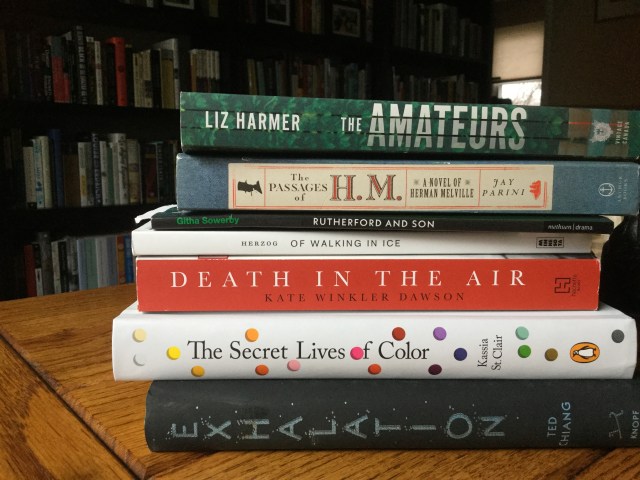 My winter break is moving fast! My daughters, who spent Christmas week with us, have returned to Boston, and my husband and I have begun Part II of our two-week vacation. I know I’m not the only parent of adult children who wonders, “Where did the time go?” Today, though, I am choosing book talk over melancholic musings, so here are a few titles from my Jólabókaflóðið haul. More to follow.
The year in books
 With nearly a week remaining in the year, I am calling it at 120 books read this year. (As always, I have included only cover-to-covers.) Here is my complete list, and here are a few numbers:
— 50 novels (not including graphic works)
— 37 non-fiction titles (not including graphic works)
— 3 poetry selections
— 6 plays
— 24 graphic works (six of which were non-fiction selections)
As I recounted in October, I crafted a bold challenge for this year: Read one hundred books from my shelves (i.e., books in my collection before the end of 2018), including at least 24 non-fiction titles and at least one book from each of the following “special collections”: Shakespeare, poetry, NYRB, Vonnegut, Joyce Carol Oates, philosophy, art, and children’s / YA. I also planned to make short work of 2018’s unfinished business and to closely (re)read Moby-Dick.
Knowing that my daughters’ relocation would consume a great deal of my spring and summer, I chose a goal of 104 books total for the year, but I happily surpassed that goal by 16. So, while I did not meet my challenge of one hundred from the shelves, it was certainly a fascinating and productive year of reading! I read a total of 42 non-fiction books — a substantial increase over previous years; 18 of these were from my shelves. Well before my October review I had completed the books I carried over from last year, and I completed my reread of Moby-Dick on Christmas Eve. I met all of my mini-challenges, too:
Shakespeare RFS: Hamlet
Poetry RFS: Lunch Poems (Frank O’Hara)
NYRB RFS: The Summer Book (Tove Jansson)
Vonnegut RFS: Player Piano
Joyce Carol Oates RFS: The Rise of Life on Earth
Philosophy RFS: Letters from a Stoic (Seneca)
Art RFS: But is it art? (Cynthia Freeland)
Children’s / YA RFS: Milkweed (Jerry Spinelli)
Here are a few more facts about this year’s 120 books, 32 of which were published this year:
— 53 read from shelves
— 31 acquired this year
— 28 borrowed from the library
— 8 other
And here are the standouts:
Even better on rereading:
■ Moby-Dick; Or, The Whale (Herman Melville; 1851. Fiction.)
■ Beowulf (Trans. Seamus Heaney; 2000. Poetry.)
■ Oedipus the King (Sophocles (Trans. Ian Johnston; 2007); 429 B.C. Drama.)
The most engrossing books I read this year (not including rereads):
■ Ghost Wall (Sarah Moss; 2018. Fiction.)
■ A Loss for Words: The Story of Deafness in a Family (Lou Ann Walker; 1986. Non-fiction.)
■ The Wall (John Lanchester; 2019. Fiction.)
■ Charmed Particles (Chrissy Kolaya; 2015. Fiction.)
■ Dopesick: Dealers, Doctors, and the Drug Company that Addicted America (Beth Macy; 2018. Non-fiction.)
■ An Odyssey: A Father, a Son, and an Epic (Daniel Mendelsohn; 2017. Non-fiction.)
■ The Mighty Franks (Michael Frank; 2017. Non-fiction.)
■ In the Woods (Tana French; 2007. Fiction.)
Honorable mention:
■ The Story of Arthur Truluv (Elizabeth Berg; 2017. Fiction.)
■ American Spy (Lauren Wilkinson; 2019. Fiction.)
■ Wild Game (Adrienne Brodeur; 2019. Non-fiction.)
■ All the Names They Used for God (Anjali Sachdeva; 2018. Fiction.)
Fabulous story for a long car trip:
■ Paddle Your Own Canoe (Nick Offerman; 2013. Non-fiction.)
Fabulous story to read while waiting in airports:
■ My Sister, The Serial Killer (Oyinkan Braithwaite; 2018. Fiction.)
Cannot stop talking about the ideas in these books:
■ Paying for the Party: How College Maintains Inequality (Elizabeth Armstrong and Laura Hamilton; 2013. Non-fiction.)
■ The Class Ceiling: Why it Pays to be Privileged (Sam Friedman and Daniel Laurison; 2019. Non-fiction.)
■ The Years That Matter Most (Paul Tough; 2019. Non-fiction.)
■ The Privileged Poor (Anthony Abraham Jack; 2019. Non-fiction.)
Best graphic works I read this year:
■ Nobody’s Fool: The Life and Times of Schlitzie the Pinhead (Bill Griffith; 2019. Graphic non-fiction.)
■ They Called Us Enemy (George Takei; 2017. Graphic non-fiction.)
At this writing, I am still drafting my 2020 goals, but 120 will likely be my minimum total, with at least 24 non-fiction. Otherwise? In 2017, I completed “Shakespeare in a Year,” and the group is reconvening in 2020 to follow this schedule. Although I posted the schedule and accepted an invitation to serve as a moderator, I remain ambivalent. I had planned to reread at least four of the plays in 2020 (in anticipation of productions we are slated to see), but I have the ingredients of several other projects — including the Bible, Ovid’s Metamorphoses, and a reread of George Eliot’s Middlemarch — any of which would prove more compelling than revisiting the sonnets. Heh, heh, heh. (This year’s projects included rereading James Joyce’s Ulysses and Herman Melville’s Moby-Dick.)
No matter what I decide, I will continue to participate in Robin’s “52 Books in 52 Weeks.” Speaking of which, one of her suggested challenges is to read three Agatha Christie works in 2020. Because Robin got me hooked on Louise Penny’s Inspector Gamache series, the recommendation to return to Christie, an author I once adored, has that serendipity / synchronicity / synthesis vibe that I so appreciate.
“Hast seen the White Whale?”

My November 2013 image of the sperm whale sculpture by Preston Jackson.
One often hears of writers that rise and swell with their subject, though it may seem but an ordinary one. How, then, with me, writing of this Leviathan? Unconsciously my chirography expands into placard capitals. Give me a condor’s quill! Give me Vesuvius’ crater for an inkstand! Friends, hold my arms! For in the mere act of penning my thoughts of this Leviathan, they weary me, and make me faint with their outreaching comprehensiveness of sweep, as if to include the whole circle of the sciences, and all the generations of whales, and men, and mastodons, past, present, and to come, with all the revolving panoramas of empire on earth, and throughout the whole universe, not excluding its suburbs. Such, and so magnifying, is the virtue of a large and liberal theme! We expand to its bulk. To produce a mighty book, you must choose a mighty theme. No great and enduring volume can ever be written on the flea, though many there be who have tried it.
Chapter 113: The Forge
“Well, well; no more. Thy shrunk voice sounds too calmly, sanely woeful to me. In no Paradise myself, I am impatient of all misery in others that is not mad. Thou should’st go mad, blacksmith; say, why dost thou not go mad? How can’st thou endure without being mad? Do the heavens yet hate thee, that thou can’st not go mad?—What wert thou making there?”
Chapter 115: The Pequod Meets the Bachelor
“Hast seen the White Whale?” gritted Ahab in reply.
“No; only heard of him; but don’t believe in him at all,” said the other good-humoredly. “Come aboard!”
“Thou art too damned jolly. Sail on. Hast lost any men?”
“Not enough to speak of — two islanders, that’s all; — but come aboard, old hearty, come along. I’ll soon take that black from your brow. Come along, will ye (merry’s the play); a full ship and homeward-bound.”
“How wondrous familiar is a fool!” muttered Ahab….
Chapter 135: The Chase
“Cherries? I only wish that we were where they grow. Oh, Stubb, I hope my poor mother’s drawn my part-pay ere this; if not, few coppers will now come to her, for the voyage is up.”

