

Late August book notes

imageDespite my best intentions, I have only finished four of the ten books I assembled for this post):

You Will Know Me (Megan Abbott; 2016. Fiction.)
My Name Is Lucy Barton (Elizabeth Strout; 2016. Fiction.)
A Study in Scarlet (Sir Arthur Conan Doyle; 1887. Fiction.)
Eileen (Ottessa Moshfegh; 2015. Fiction.)

This puts me at only six books for August, a number that makes sense when I consider that (1) we spent most of the month preparing for our daughters’ departure; (2) we’re all adjusting to new routines and communicating (phone, text, email, packages, etc.) takes much longer now that we all spend most days apart; and (3) I’ve been under the weather for a week… which reminds me: When I was much younger, I had an idea — crafted from a complete misunderstanding of the subtext of stories about genteel characters recovering in sanatoriums — that illness translates into more time to read. I clung to this misinformed idea into my early twenties, when a bout with sinusitis and later with the flu (not a really bad head cold but influenza) taught me that I can’t read — At. All. — when I’m sick. This may be because I am the world’s worst patient, but it may also be that everyone finds it difficult to focus when feverish, congested, drowsy, in pain, coughing, or [insert symptom(s) here].

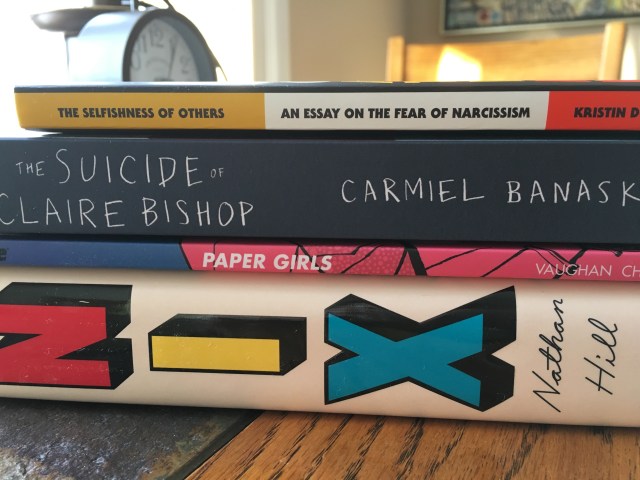
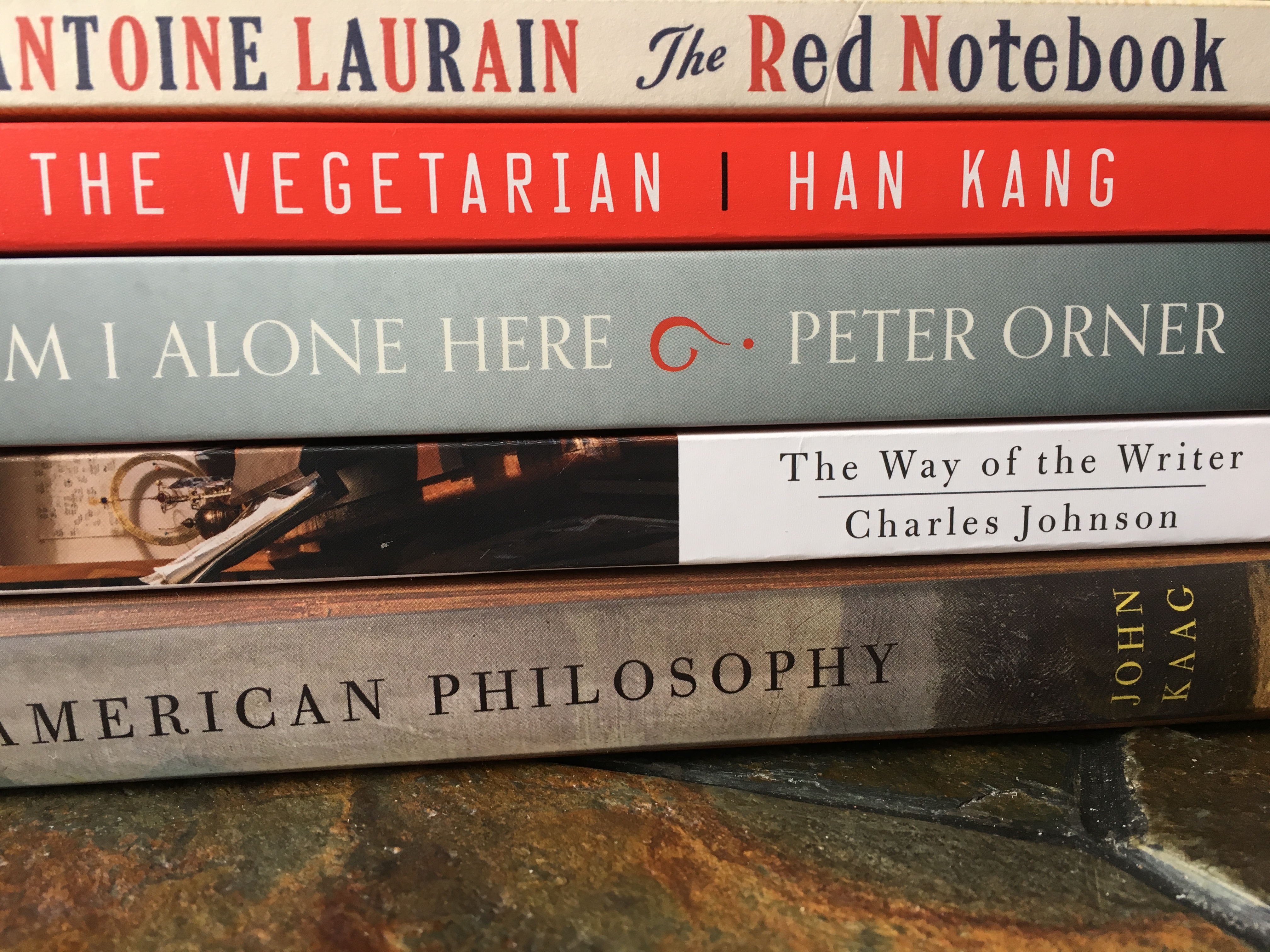
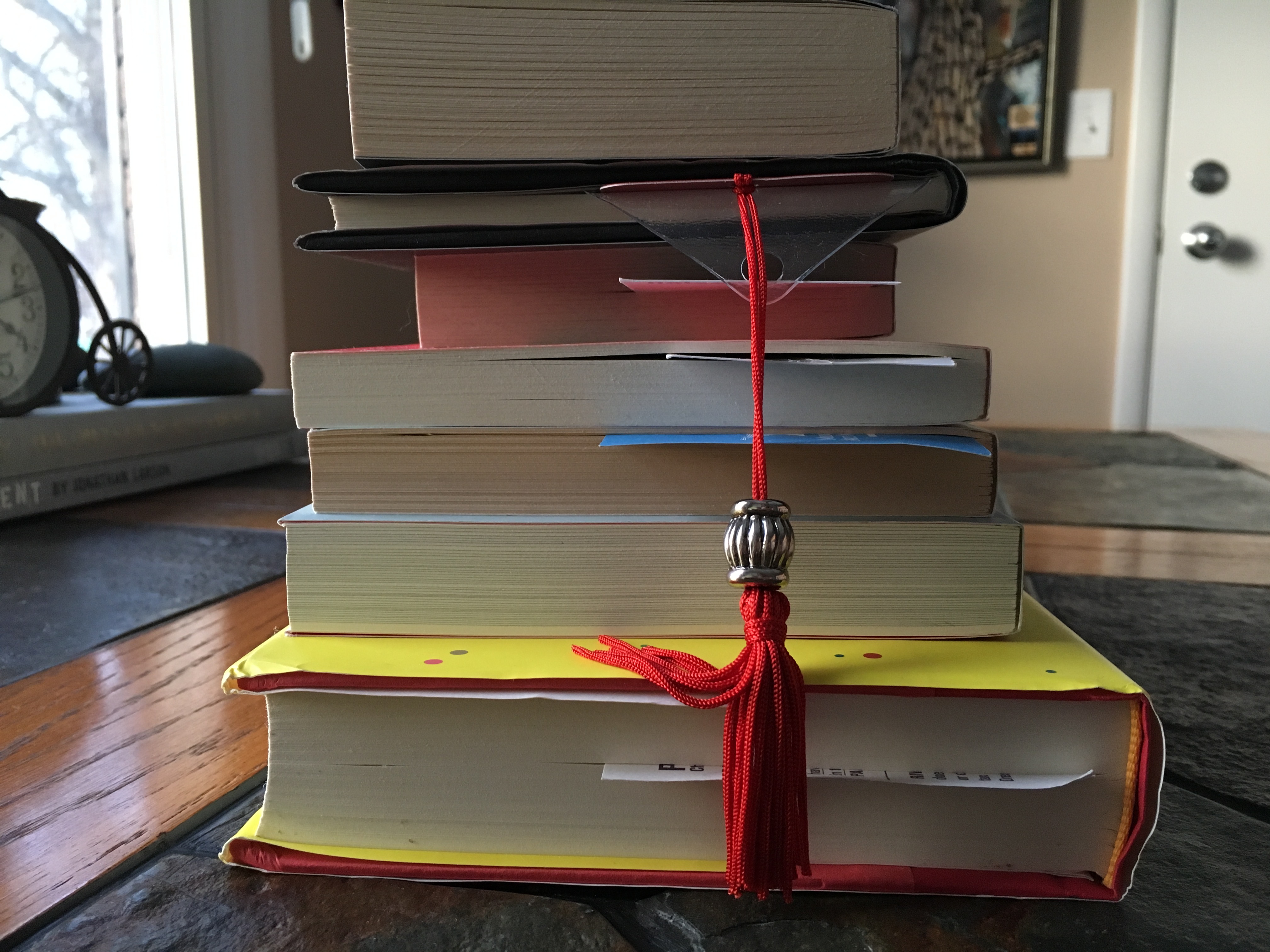
So, six books this month — although if I’m feeling particularly motivated later this afternoon, I may be able to finish Duhigg’s Smarter Faster Better. My current plan for September, though, is simply to return to reading at whim — hence, the rather anonymous-looking stack pictured above.

Regarding the only book I’ve finished this week: I understand how Eileen made the Man Booker Prize longlist, but it was a claustrophobic read for me — too small, too sordid. Two passages made it into my commonplace book, though:

p. 65
Nobody missed me. I know other young women have suffered far worse than this, and I myself went on to suffer plenty, but this experience in particular was utterly humiliating. A psychoanalyst may term it something like a formative trauma, but I know little about psychology and reject the science entirely. People in that profession, I’d say, should be watched very closely. If we were living several hundred years ago, my guess is that they’d all be burned as witches.

p. 256
I don’t know where we went wrong with my family. We weren’t terrible people, no worse than any of you. I suppose it’s the luck of the draw, where we end up, what happens.

Another summer gone

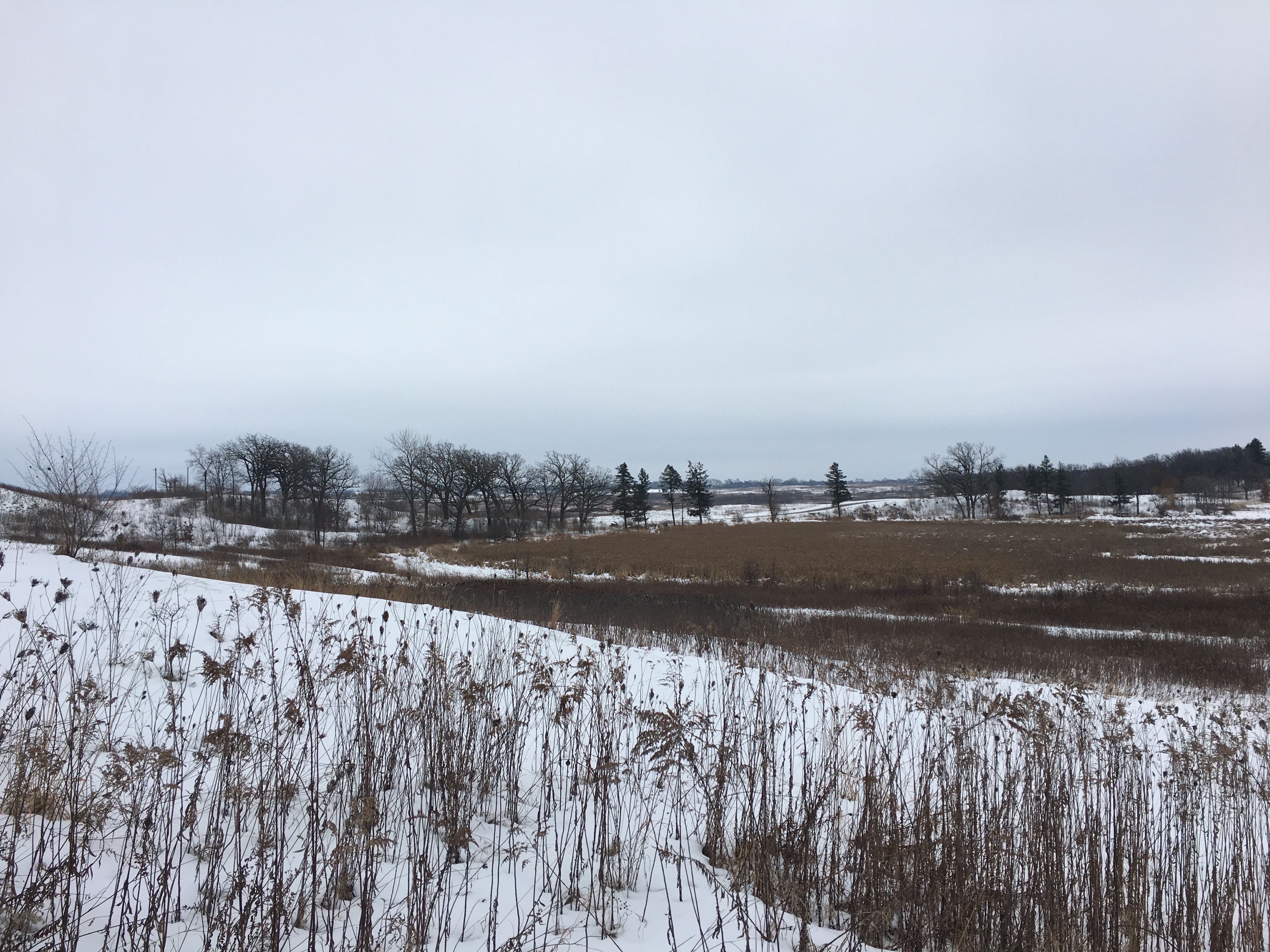
IMG_7586Have you observed the continued changing of the light as summer slides into autumn? Sure, summer is putting up a fight, but for all intents and purposes, it’s over, isn’t it? Why, the students in our neighborhood have already returned to school! If that doesn’t herald fall, what does?

Speaking of school, since my last post, my husband and I moved our daughters into their university residence. A well-organized, dry-eyed endeavor, move-in included a midnight run to stock the refrigerator and a visit over the weekend to replace some shelving and bring a few additional items. I think the fact that each of us has absorbing plans and projects for the fall contributed to the (admittedly surprising) lack of tears. At some point, I found myself thinking, There is so much more to celebrate and anticipate than to regret. Of course, we won’t discount how helpful technology has been: The iPhones and iPads are getting quite a workout with messages, email, and FaceTime. Still, although I’m a cautious woman, I believe that this can be declared a fairly successful transition for all of us.

Some of my plans: This week, after an eight-month hiatus, I have resumed my service as a literacy volunteer. I have also returned to my daily music practice after a nearly ten-day break. And now that I have time to read more than a page here or there, I will (finally!) finish Eileen today. Unfortunately, this week I am also fighting a cold, one that I felt arrive with startling all-at-onceness yesterday afternoon. My sinuses filled, as if I were experiencing an allergic reaction, then my throat became scratchy, and then I became heavily tired — all within thirty minutes. I’ve been in defense mode ever since, taking advantage of my retiree status to lay my head down regularly and to drink a river of juice, tea, and water. It’s too early to say that I am winning, but I am hopeful that my tussle with sickness is more successful than summer’s losing battle with fall. Heh, heh, heh.

Book notes should follow Thursday or Friday.

Mid-month reading notes

imageWell, we’ve arrived at the month’s midpoint. My reading plans (described in this post) included:

A Study in Scarlet (Sir Arthur Conan Doyle; 1887. Fiction.)
Letters from a Stoic (Seneca; 1494.)
A Woman in Charge: The Life of Hillary Clinton (Carl Bernstein; 2007. Non-fiction.)
The Last Policeman (Ben Winters; 2012. Fiction.)
Shylock Is My Name (Howard Jacobson; 2016. Fiction.)
Eileen (Ottessa Moshfegh; 2015. Fiction.)
My Name Is Lucy Barton (Elizabeth Strout; 2016. Fiction.)
You Will Know Me (Megan Abbott; 2016. Fiction.)
An Astronaut’s Guide to Life on Earth (Col. Chris Hadfield; 2013. Non-fiction.)
Smarter Faster Better (Charles Duhigg; 2016. Non-fiction.)

From the above list, I have already completed:

You Will Know Me (Megan Abbott; 2016. Fiction.)
My Name Is Lucy Barton (Elizabeth Strout; 2016. Fiction.)
A Study in Scarlet (Sir Arthur Conan Doyle; 1887. Fiction.)

Although I have not been following the Games, I couldn’t help but wonder, after reading Abbott’s novel, if I now understand the grim-faced masks women gymnasts don. As for questions about whether Strout’s novel deserves its place on the Man Booker Prize long list, I’d say yes. From My Name Is Lucy Barton:

p. 14
This must be the way most of us maneuver through the world, half knowing, half not, visited by memories that can’t possibly be true. But when I see others walking with confidence down the sidewalk, as though they are free completely from terror, I realize I don’t know how others are. So much of life seems speculation.

p. 170
When Chrissie left for college, then Becka the next year, I thought — and it’s not an expression, I’m saying the truth — I did think I would die. Nothing had prepared me for such a thing. And I have found this to be true: Certain women feel like this, that their hearts have been ripped from their chests, and other women find it very freeing to have their children gone. The doctor who makes me not look like my mother, she asked me what I did when my daughters went to college, and I said, “My marriage ended.” I added quickly, “But yours won’t.” She said, “It might. It might.”

I finished A Study in Scarlet well in advance of the online book club / MOOC outline because much of the rest of the month is already spoken for.

From A Study in Scarlet, Part I, Chapter V:
“It was magnificent,” he said, as he took his seat. “Do you remember what Darwin says about music? He claims that the power of producing and appreciating it existed among the human race long before the power of speech was arrived at. Perhaps that is why we are so subtly influenced by it. There are vague memories in our souls of those misty centuries when the world was in its childhood.”

From Part I, Chapter VII:
“All this seems strange to you,” continued Holmes, “because you failed at the beginning of the inquiry to grasp the importance of the single real clue which was presented to you. I had the good fortune to seize upon that, and everything which has occurred since then has served to confirm my original supposition, and, indeed, was the logical sequence of it. Hence things which have perplexed you and made the case more obscure, have served to enlighten me and to strengthen my conclusions. It is a mistake to confound strangeness with mystery. The most commonplace crime is often the most mysterious because it presents no new or special features from which deductions may be drawn. This murder would have been infinitely more difficult to unravel had the body of the victim been simply found lying in the roadway without any of those outré and sensational accompaniments which have rendered it remarkable. These strange details, far from making the case more difficult, have really had the effect of making it less so.”

From Part II, Chapter VII:
“I hardly expected that you would. Let me see if I can make it clearer. Most people, if you describe a train of events to them, will tell you what the result would be. They can put those events together in their minds, and argue from them that something will come to pass. There are few people, however, who, if you told them a result, would be able to evolve from their own inner consciousness what the steps were which led up to that result. This power is what I mean when I talk of reasoning backwards, or analytically.”

I think I will finish Eileen later today, after which I plan to carry on with Shylock Is My Name. Related aside: We saw the Shakespeare’s Globe production of Merchant at the Chicago Shakespeare Theater over the weekend. Haunting. Reviews here and here. And because I so thoroughly disagreed with Steven Franks, I appreciated this bit from Chris Jones’ review:

And yet, just last week, my own newspaper published an editorial, penned by a Washington attorney, arguing, in essence, that “The Merchant of Venice” should never be performed again, on the grounds that it is incurably anti-Semitic.

That’s ridiculous, of course, not least because it is only in performance that the play proves its worth. In the hands of a competent director like Jonathan Munby, “The Merchant of Venice” can and does play as a cautionary tale of the perils of anti-Semitism. His work here in concert with the designer Mike Britton is the best I’ve seen from this oft-in-Chicago director. Only in performance can this be a work about how hate can poison an otherwise prosperous and privileged community, extracting a price on victims and perpetrators alike, destroying all that is good, really. This particular production, which features an especially devastating coda, is especially rich in the painting of that picture.

The other books I have finished this month are

You’re Never Weird on the Internet (Almost) (Felicia Day; 2015. Non-fiction.)
Injection, Volume 2 (Warren Ellis; 2016. Graphic fiction.)

On the shelves

imageEarlier this week, my daughters helped me with yet another large book reorganization project. For the last 5.5 years, the shelves in the master bedroom (three pine bookcases my husband finished for me — complete with our heart-enclosed initials on the back — in 1983, 1985, and 1986) housed my Joyce Carol Oates and Kurt Vonnegut collections, as well as the remnants of my Arthurian literature obsession and my stash of mass paperbacks. The remaining shelves held new acquisitions, which, after being read, would be sold, donated, or blended into the main library.

The obvious flaw in this system was, of course, that my acquisition rate continued to outpace my reading rate — this despite the radical reduction of the former and the uptick in the latter. We were, therefore, routinely shifting “new” acquisitions into the main library before a verdict (Sell? Donate? Keep?) had been rendered. Why? In order to make room for newer and newest acquisitions.

As we prepared to shift and file, my youngest suggested that the bedroom become a more static collection. Brilliant! Shakespeare, Sherlock, Melville, Fitzgerald, poetry, and the volumes of Lyttleton / Hart-Davies Letters joined Oates, Vonnegut, and Arthur; the smallest (and oldest) of the original bookcases, which serves as my nightstand, became a true TBR station; and the main library, which stretches from the living room, over to the piano room, down the hallway, and into the so-called “girl cave” (essentially, a second living room) was shifted to accommodate all of the rest. Several boxes of books were donated, and we brought three large bags of books and movies to Half-Price Books over the weekend.

Between that project and preparing my daughters for their move to university, I haven’t read as much as I had planned this week, but I will be able to post some notes tomorrow.

August reading plans

IMG_0135

A Study in Scarlet (Sir Arthur Conan Doyle; 1887. Fiction.)
Letters from a Stoic (Seneca; 1494.)
A Woman in Charge: The Life of Hillary Clinton (Carl Bernstein; 2007. Non-fiction.)
The Last Policeman (Ben Winters; 2012. Fiction.)
Shylock Is My Name (Howard Jacobson; 2016. Fiction.)
Eileen (Ottessa Moshfegh; 2015. Fiction.)
My Name Is Lucy Barton (Elizabeth Strout; 2016. Fiction.)
You Will Know Me (Megan Abbott; 2016. Fiction.)
An Astronaut’s Guide to Life on Earth (Col. Chris Hadfield; 2013. Non-fiction.)
Smarter Faster Better (Charles Duhigg; 2016. Non-fiction.)

Although I prefer to, as Sheila says, “read at whim,” I have had some luck this year with assembling small stacks and making my way through them. This one seems built to work.

Some notes: The Doyle is for the online book club / MOOC in which I participate, and I am already halfway through the Duhigg. (In 2012, I received a review copy of Duhigg’s The Power of Habit and thoroughly enjoyed it. While somewhat engaging, this latest effort seems slapped together from research assembled when that earlier book was being written.) I’m motivated to complete Jacobson’s entry in the Hogarth Shakespeare series before we see The Merchant of Venice. The Last Policeman, Eileen, My Name Is Lucy Barton, and You Will Know Me were shelved in my bedroom, which is as good as saying, “They were already on a TBR stack.” My youngest maintains that Astronaut’s Guide will be the perfect antidote to the angsty whine of Lab Girl. I put Seneca’s Letters and the Clinton bio on my summer reading shelf in May, then promptly forgot they were there! The former will be perfect for the drive home from university, eh? And the latter will probably be read in bites over this month and next.

Can you believe it’s August 1?

august
From one of my favorite Mary Schmich columns (Chicago Tribune, August 1, 2008):

If you merely count the days from summer’s official start in June until its finale in September, August 1 doesn’t even mark the summer midpoint. But it does mark the high point, which means the beginning of the end.

The light shifts, softens. The shadows on the leaves and the living room floor make you wonder: When exactly did the wane start?

People in other places may not wonder, but Chicagoans are connoisseurs of summer light. We spot the changes as surely as a foodie detects the difference between fennel and star-anise.

The light has most certainly changed, but there have been other reminders:

● This is the time of year I plan most of our theater, opera, and concert adventures for the upcoming season, and my calendar notes that single tickets are now on sale for performances at the Court Theatre and Remy Bumppo.

● My daughters have all but concluded their summer work obligations, and the younger daughter’s summer class ends this week.

● The linens, rugs, and homey touches for their university residence have been purchased and are arranged in orderly stacks in the “girl cave.”

I knew this summer would pass quickly because I so desperately wanted it to go on and on. Therefore, it should not surprise me that it is, in fact, nearly over. Still, there’s a bit more to savor, at least for a couple of weeks.

So we will sleep in.
Sit beneath the oaks and read.
Take a few more long bike rides.
Eat the cherry tomatoes we grew.
Keep an eye out for the hummingbirds and orioles that visit our yards.
Play Bananagrams. And Ticket to Ride. And Exploding Kittens.
Finish Season 9 of The X Files.
Learn something.
Talk. And talk some more.

And then we will pack. And then… Well, I will think about that later. Right now, I want to pretend the summer has just begun, that all of its hot, dew-drenched possibilities await me like the shelf of books I assembled over Memorial Day weekend with firm plans to finish everything by today.

Can you believe it’s August 1?

Reading and watching

This month, I finished seventeen books —

seven novels:

Where They Found Her (Kimberly McCreight; 2015. Fiction.)
The Hidden Child (Camilla Läckberg; 2014. Fiction.)
Wonder (RJ Palacio; 2012. Fiction.)
The Easter Parade (Richard Yates; 1976. Fiction.)
The Elementals (Michael McDowell; 1981. Fiction.)
I’m Thinking of Ending Things (Iain Reid; 2016. Fiction.)

one play:

The Merchant of Venice (William Shakespeare; 1599. Drama.)

one collection of short stories:

Dubliners (James Joyce; 1914. Fiction.)

two non-fiction titles:

The Curse of the Good Girl (Rachel Simmons; 2009. Non-fiction.)
Lab Girl (Hope Jahren; 2016. Non-fiction.)

and six works of graphic fiction:

Huck, Volume 1 (Mark Millar; 2016. Graphic fiction.)
Kill Shakespeare, Volume 3: The Tide of Blood (Conor McCreery Millar; 2013. Graphic fiction.)
Fell, Volume 1, Feral City (Warren Ellis; 2007. Graphic fiction.)
Injection, Volume 1 (Warren Ellis; 2015. Graphic fiction.)
Trees, Volume 1 (Warren Ellis; 2015. Graphic fiction.)
Skim (Mariko Tomaki; 2008. Graphic fiction.)

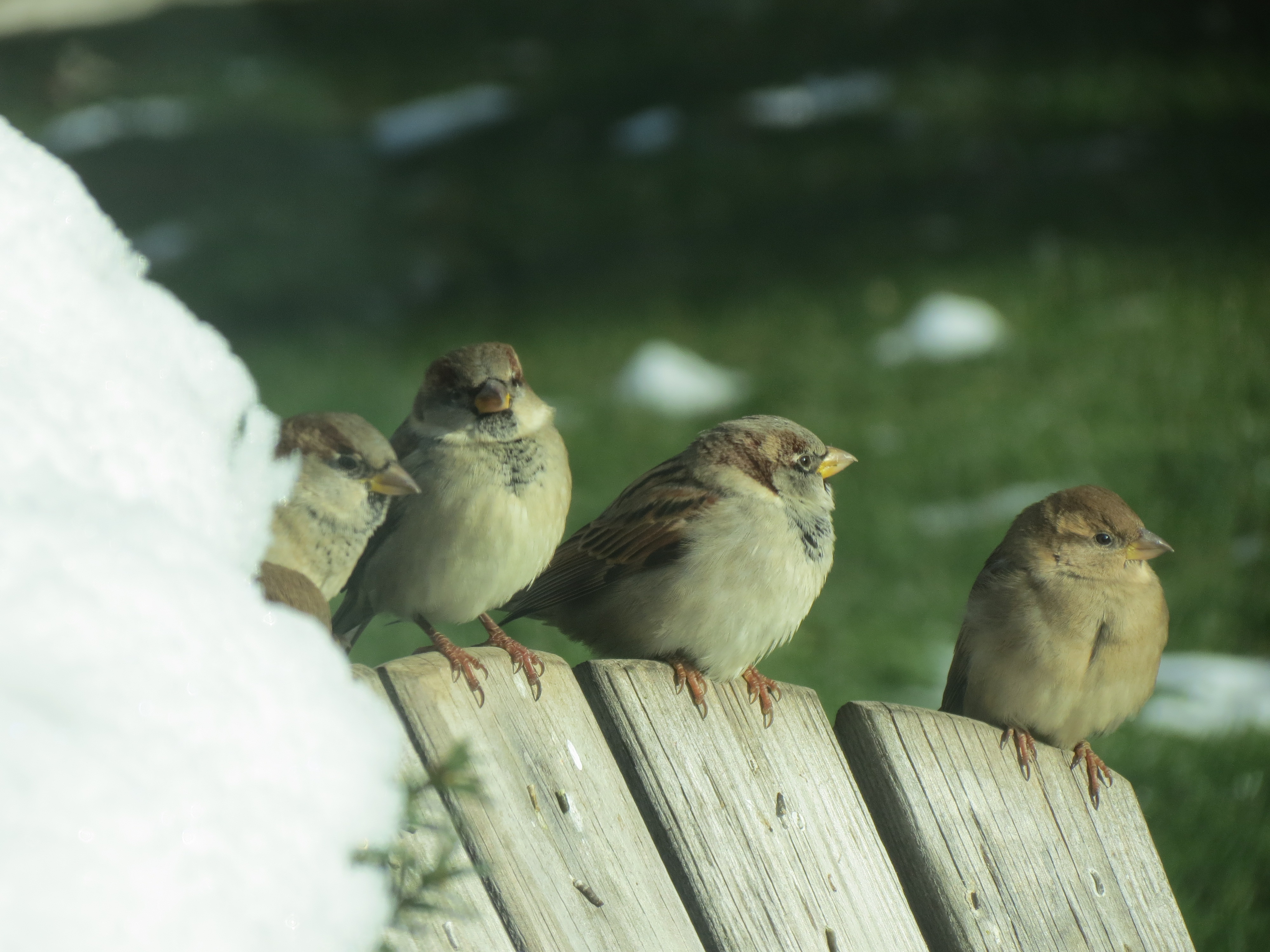
Right now, I’m in more of a watching mood than a reading mood, though. Does that ever happen to you? This afternoon, I’ve been watching the birds in our yards. We’ve had a lot of success with our latest food and feeder configuration: hummingbirds, orioles, and goldfinches, oh, my! Many of the regular visitors have been by, too — jays, cardinals, mourning doves, robins, cowbirds, house finches, black-capped chickadees, red-bellied and downy woodpeckers, and a few grackles, starlings, and house sparrows. And, of course, the Cooper’s hawks. So busy out there!

Now I am toying with watching Episode 4 of Mr. Robot. Gosh, is that a terrific show! Earlier this weekend, my daughters and I watched The Merchant of Venice with Al Pacino as Shylock. It was my second time, and it was just as excellent as the first. We will see the Shakespeare’s Globe production with Jonathan Pryce as Shylock at the Chicago Shakespeare Theater soon, and I so enjoy comparing various interpretations. The three of us are also watching The X Files. We’ve made it to Episode 9 of Season 9, and we think we will finish before they move to their university residence. That said, all of us agree that the show’s reputation outstrips its content, which how we also felt about Buffy the Vampire Slayer. Shrug. Not every program can be Slings & Arrows or LOST, though, right?

Speaking of watching things for a second time, I saw The Dead again this week. The closing paragraph of Joyce’s story is one of my favorites in all of literature, so it was with much scoffing that I first approached Huston’s film nearly thirty years ago. Of course the book will be better, I maintained. How could I have known that it would actually render the story a permanent part of my imagination? Both faithful to its source material and a work of its own many merits, the film draws much of its strength from flawless performances from the entire cast. It also benefits from meticulous attention to period detail and a score that is a character itself. Rewatching the film, I was reminded of its perfection, particularly the emotionally shattering redefinition of the Conroy marriage that occurs in the final scene.

Before I settle in with Mr. Robot I think I will assemble my proposed TBR stack for August. I already own a few of the books on the Man Booker Prize long list, and Lab Girl (which was good, really, but does anyone else wish that all of that imagination and talent had been mixed with less angst and whine?) made me pine for an upbeat if not stoic science memoir, and the Abbott book arrived last Tuesday… I’m off to assemble my pile.