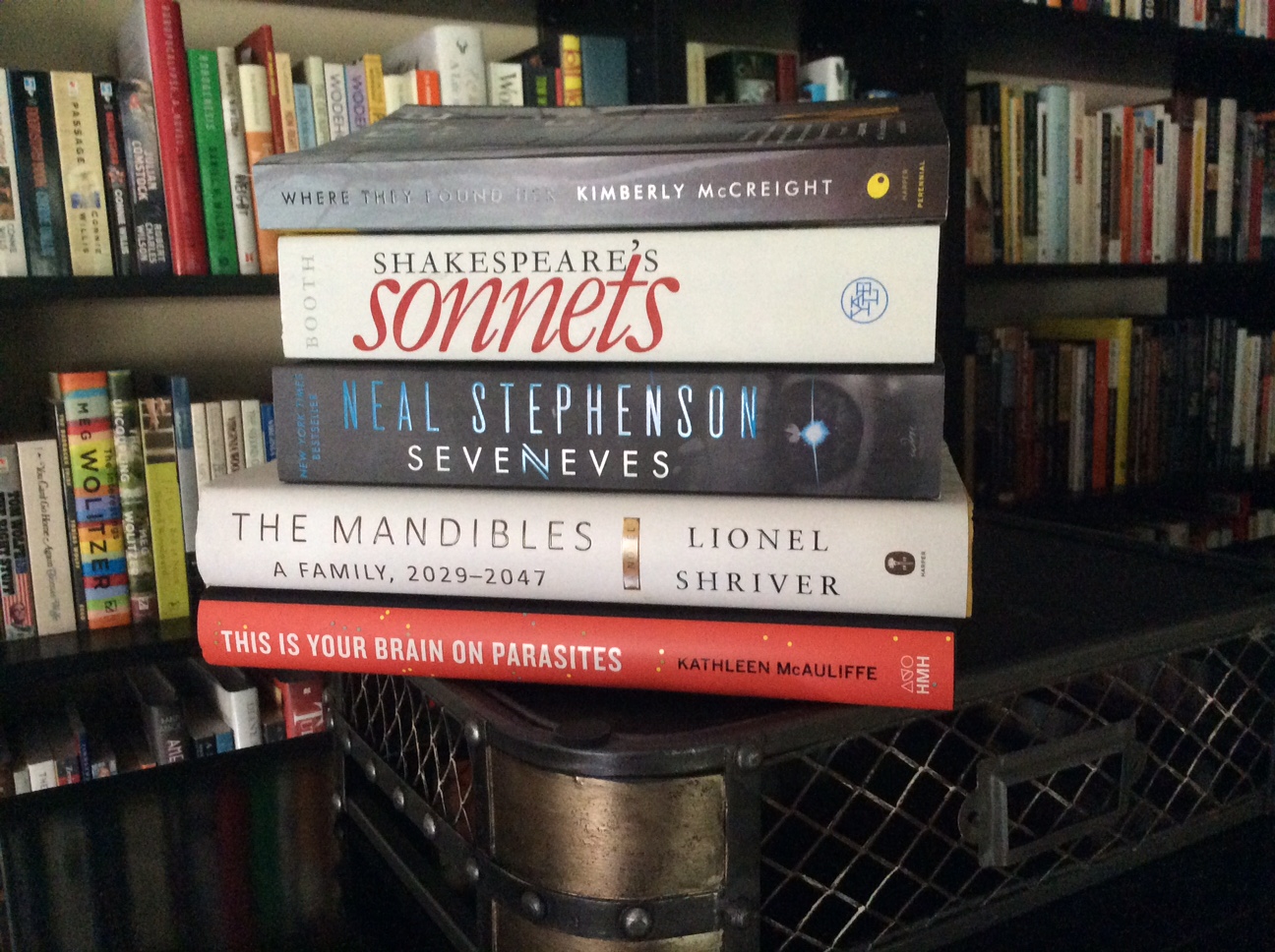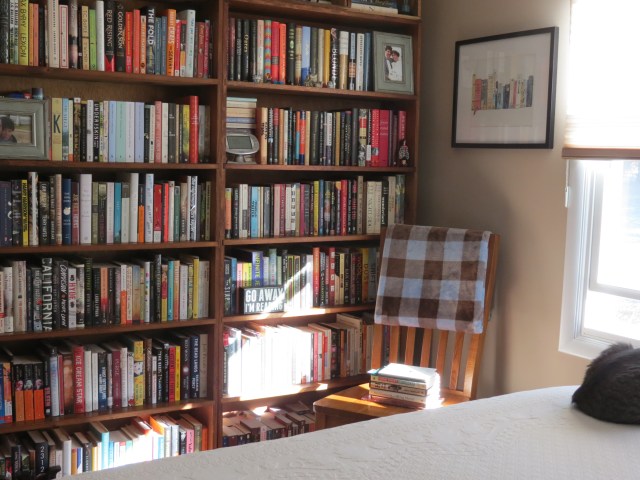
The year of the ….

I first read about “Bird of the Year” a dozen years ago, in Lyanda Lynn Haupt’s paean to birding, Rare Encounters with Ordinary Birds. She writes:

There is a game birders play on New Year’s Day called “Bird of the Year.” The very first bird you see on the first day of the new year is your theme bird for the next 365 days. It might seem a curious custom, but people who watch birds regularly are always contriving ways to keep themselves interested. This is one of those ways. You are given the possibility of creating something extraordinary — a Year of the Osprey, Year of the Pileated Woodpecker, Year of the Trumpeter Swan. This game is an inspiration to place yourself in natural circumstances that will yield a heavenly bird, blessing your year, your perspective, your imagination, your spirit. New year, new bird.

After her breathless anticipation, Haupt is confronted with… a European Starling, or “sky-rat.”

The Year of the European Starling. Inauspicious, yes, but not without its charms, according to Haupt.

Before heading to bed on New Year’s Eve, I ensured that all of the feeders were topped off and that corn and nuts were scattered for the squirrels. (As any seasoned backyard birder knows, there are no squirrel-proof feeders. Cheap feed scattered away from the feeders will (mostly) keep those furry nuisances away from the birds and the more expensive seed, though.) Last year, the Year of the American Goldfinch, I hung a Post-It on the big window to remind everyone to note his or her first bird. This year, I forgot the note, but it didn’t matter. The weather has been so warm that the window in my bedroom — and thus, the pleated blind — is often open a bit each night. I saw the first bird of the year before I had even left my bed: a house sparrow hopping and chatting with his friends in the yew hedge.

Scan_20160108
I took the above photo in Spring 2007.

The New Contemporary

The Art Institute exhibition “The New Contemporary” (re)opened in mid-December. Once we had made our way through, I was glad to climb the stairs to the modern galleries — some Picasso, Ernst, Dali, Beckman, et al. to clear my head. Oh, there were some high points in “The New Contemporary“: The Hockney that looks like an Updike novel to me (“American Collectors“) has a wonderful space, for example. But Pollock’s “The Key” is off-exhibit, and its replacements don’t interest me as much. The underlying narrative of many of the featured works in the contemporary galleries isn’t as clear or, when it is clear, as compelling to me, as, say, the modern galleries.

To me. Those two words explain, of course, why it is impossible to define art. “To me” varies so widely. One man’s sculpture, book, movie, play (see below), etc. is another’s bit of rubbish, and all that. There are some who say that primitive pieces, like the Venus of Willendorf, aren’t art, for example, or the Chauvet Cave paintings. I’d heartily disagree, but then who am I? I had trouble seeing the art in “The New Contemporary” but have absolutely no trouble seeing how typeface could be described as art. Shrug and chuckle. There is so much to see. No need to get hung up on what doesn’t speak to me. I just climbed some stairs and (re)discovered something that does.

I keep meaning to return to Cynthia Freeland’s short treatise But Is It Art, but then I remember that it sort of annoyed me when I first began it, and I’m really more of a Sister Wendy or Simon Schama sort of gal. So it mocks me from the art bookcase.

Speaking of rubbish, one man’s and not another’s, I disliked The Heir Apparent. David Ives drew from Moliere’s The Misanthrope for The School for Lies, both of which delighted me two seasons ago. He drew from a contemporary of Moliere for Heir, but the results were just not my cuppa. Too much potty humor and too thin a plot, which was actually a damned shame because the cast they assembled was superb — comedic timing and delightful verbal gymnastics galore. And the set was stunning. Oh, well. Not every play can be four stars.

The following images include detail from works seen during my most recent visit to the Art Institute of Chicago.

IMG_6086

IMG_6091

IMG_6092

IMG_6095

IMG_6099

IMG_6112

IMG_6114

■ Jackson Pollock’s “Number 17A” (1948)
■ Jackson Pollock’s “Greyed Rainbow” (1953)
■ David Hockney’s “American Collectors” (1968)
■ Jasper Johns’ “Alphabet” (1959)
■ Jean Dubuffet’s “Head of a Man” (1945)
■ Alberto Giacometti’s “Couple” (1926)
■ Fernand Léger’s “Reclining Woman” (1922)

Field trip

IMG_5937

IMG_5947

IMG_5961

IMG_5988

IMG_6022

IMG_6026

IMG_6030

For twenty years, I have mostly avoided visiting the museum campus during spring and winter breaks and summer camp days, but scheduling constraints dictated that the winter holiday was the most convenient time for an all-day visit. Oh, the noise, noise, NOISE! Still, the Field Museum is such an amazing place that I nearly put the pressing crowds out of mind, particularly when wandering exhibits like the Gidwitz Hall of Birds and the Cyrus Tang Hall of China. The following images were captured in “The Greeks: Agamemnon to Alexander the Great” and the Cyrus Tang Hall of China.

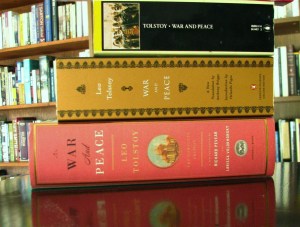
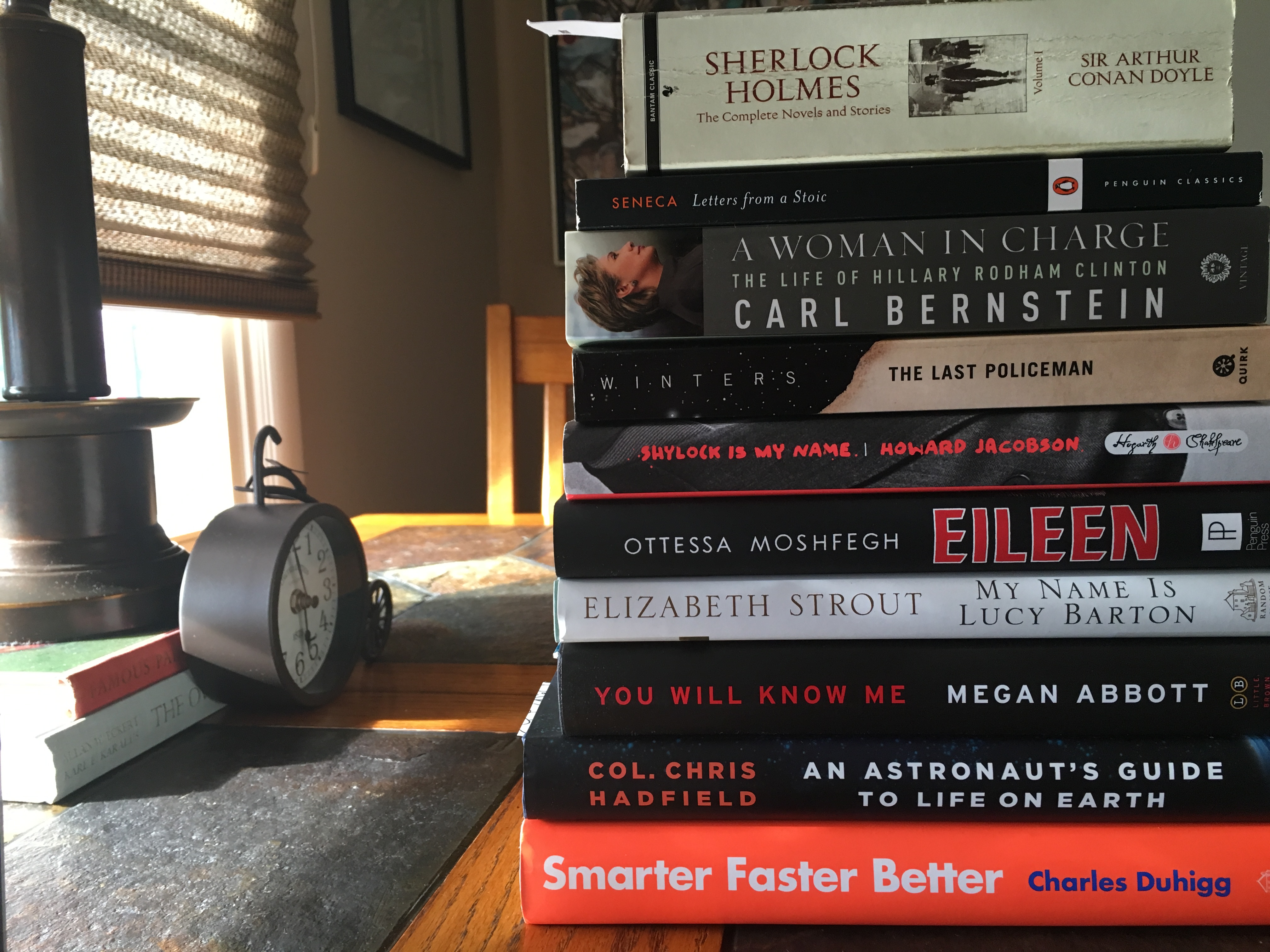
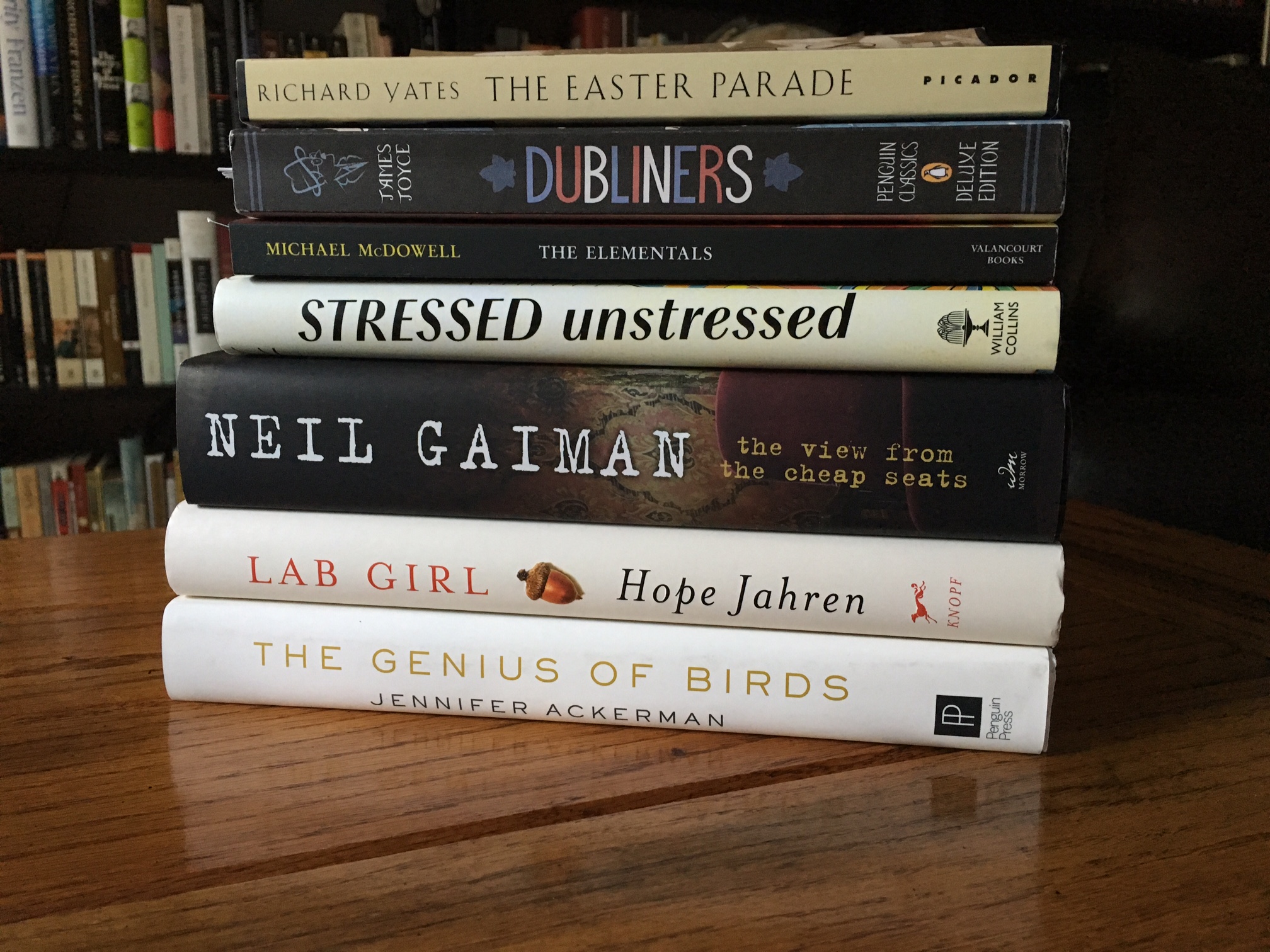
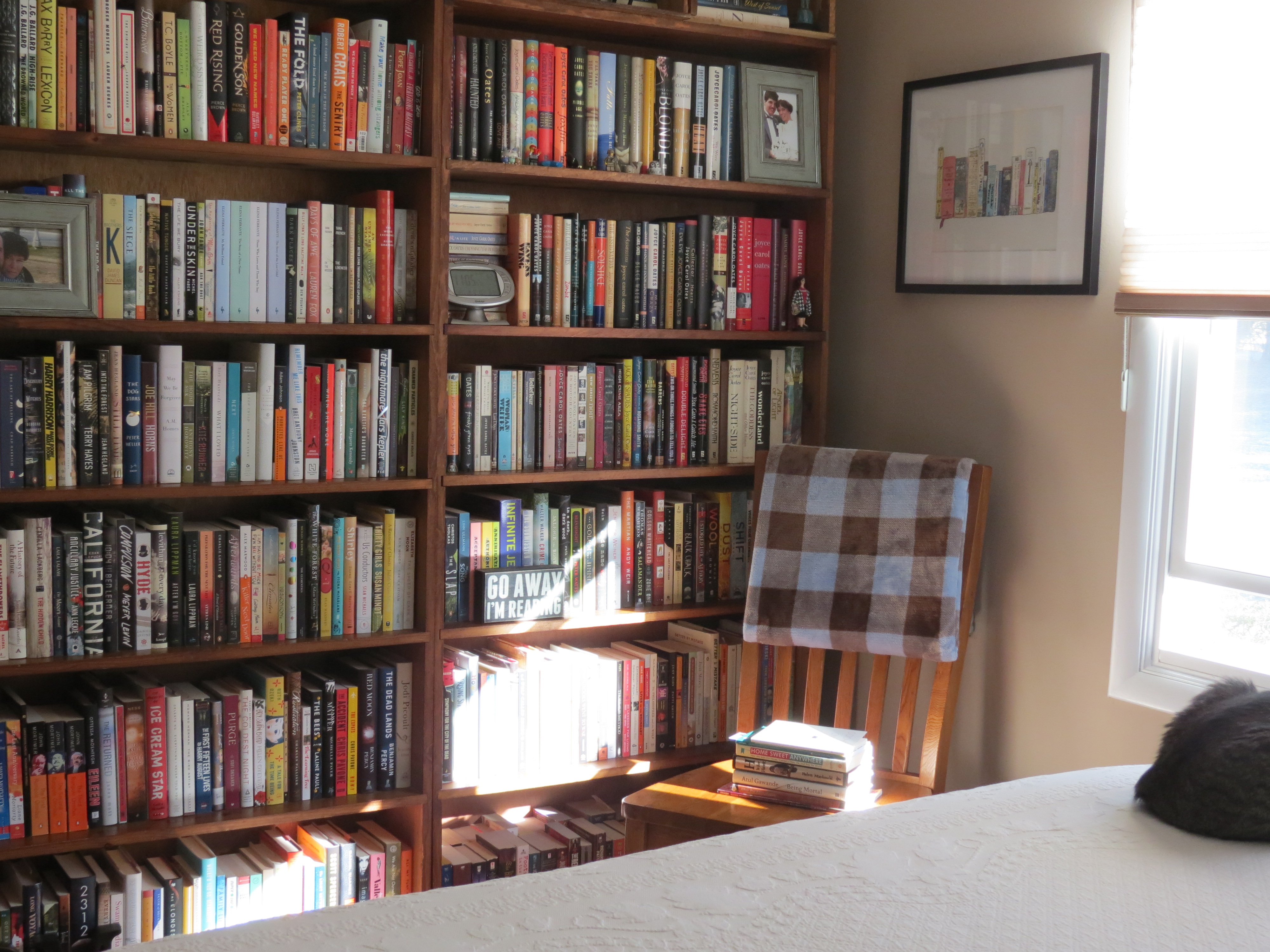
The year in books

IMG_6062
My chief reading goal for 2015 was to read from the shelves of my home library. Although I’ve certainly reduced my, ahem, acquisition habit, I have much room for improvement. Enough said.

I completed 137 books this year. The complete list can be found here. I actually read many, many more (I am an unrepentantly promiscuous reader, bouncing from one book to another, leaving a trail of only just begun, unfinished, and nearly finished books in my wake), but I have listed only books read cover-to-cover. Of those 137 books, 57 were novels (excluding graphic works), nine were plays, 30 were non-fiction titles (again, excluding graphic works), and 41 were graphic works – three of which were non-fiction.

Best Fiction Read in 2015:
Did You Ever Have a Family (Bill Clegg; 2015. 304 pages. Fiction.)
The Other Side of the Mountain (Michel Bernanos; 1967 (2007 edition). 116 pages. Fiction.)
Hermine (Maria Beig; 1984 (2004 translation). 186 pages. Fiction.)
Fates and Furies (Lauren Groff; 2015. 400 pages. Fiction.)
The One and Only Ivan (Katherine Applegate; 2012. 336 pages. Fiction.)
My Wish List (Gregoire Delacourt; 2014. 176 pages. Fiction.)
Passing (Nella Larsen; 1929 (2003). 160 pages. Fiction.)
The Expendable Man (Dorothy B. Hughes; 1963 (2012). 264 pages. Fiction.)

Honorable Mention in Fiction:
The Strange Case of Dr. Jekyll and Mr. Hyde (Robert Louis Stevenson; 1884 (2012). 144 pages. Fiction.)
Private Peaceful (Michael Morpurgo; 2003. 202 pages. Fiction.)
The Water Knife (Paolo Bacigalupi; 2015. 384 pages. Fiction.)
The Subprimes (Karl Taro Greenfeld; 2015. 320 pages. Fiction.)

Best Play Read in 2015:
Marjorie Prime (Jordan Harrison; 2013. Drama.)

Best Non-fiction Read in 2015:
Being Mortal: Medicine and What Matters in the End (Atul Gawande; 2014. 304 pages. Non-fiction.)
Somewhere Towards the End: A Memoir (Diane Athill; 2009. 192 pages. Non-fiction.)

Honorable Mention in Non-fiction:
The Psychopath Test (Jon Ronson; 2011. 288 pages. Non-fiction.)
So You’ve Been Publicly Shamed (Jon Ronson; 2015. 304 pages. Non-fiction.)

Best Graphic Work Read in 2015:
The Collected Essex County (Jeff Lemire; 2009. 512 pages. Graphic Fiction.)

Honorable mention in Graphic Work:
Killing and Dying (Adrian Tomine; 2015. 160 pages. Graphic Fiction.)

Random comments:
Naked Statistics: Stripping the Dread from the Data was certainly a book far afield of my usual choices. This book was really quite terrific, though – informative, accessible, and interesting. Charles Wheelan’s gift is presenting difficult material in a “sticky” manner: Long after I had read Naked Statistics, I remembered concepts and examples.

● Quite simply, Maria Beig’s 1984 novel Hermine is perfect.

From page 154:

Earlier, years earlier, she had tried to tell that kind of story, to explain that kind of experience to other people and herself. In the best cases she had reaped incomprehension for her trouble, more usually disapproval, ridicule most often of all. Inside of her she had a secret chamber for such things. What had happened to her today was already within, and the door shut tight.

● It is said that each of us experiences grief differently. Agreed. No judgment. Let’s just say that I had thought Roger Rosenblatt (Kayak Morning: Reflections on Love, Grief, and Small Boats) and I would have more in common than we actually do.

● I would like to recommend that any reader who has decided graphic works are not for her must read one or both of the following two books:

The Collected Essex County (Jeff Lemire; 2009. 512 pages. Graphic Fiction.)
Killing and Dying (Adrian Tomine; 2015. 160 pages. Graphic Fiction.)

Folks who already appreciate graphic works but missed these two titles are also urged to add them to their library holds.

Milwaukee Art Museum

MAM1

MAM3

MAM4

MAM5

MAM6

MAM8

The images in this post were captured with my iPad. The above are details from

■ Yinka Shonibare’s “The Age of Enlightenment — Immanuel Kant” (2008)
■ Philippe de Champaigne’s “Moses Presenting the Tablets of the Law” (ca. 1648)
■ Roy Lichtenstein’s “Crying Girl” (1964)
■ ?
■ Paul Klee’s “Hot-Blooded Girl” (1938)
■ Anselm Kiefer’s “Midgard” (1982-85)

Yesterday we visited the Milwaukee Art Museum for the first time since its “grand reopening” following the expansion and redesign. My “discovery” this time was the mental juxtaposition of two St. Francis portraits separated by three centuries: Franciso de Zurbarán’s “Saint Francis of Assisi in His Tomb” (1630/34) and Préfète Duffaut’s “Sen Franswa” (1955).

MAM2
MAM7

The year in theater

Waiting for Godot at the always excellent Court Theatre, the National Theatre of Scotland and Royal Shakespeare Company’s Dunsinane at the Chicago Shakespeare Theater, and Moby Dick at the Lookingglass Theatre were the best of my 2015 theater experiences. In a year that included Shannon Cochran in Little Foxes, the unsettling but superbly acted Never the Sinner, the wildly offbeat Pilgrim’s Progress (one of the hottest tickets in the city), two Q Brothers’ productions, and my second time seeing The Book of Mormon, that is saying volumes. The finest performances of the year were Christopher Donahue as Ahab in Moby Dick, Mike Nussbaum as Gregory Solomon in The Price, and Lance Baker as Mr. Van Daan and O’Neill in Anne Frank and 1984, respectively. Again, singling out these actors when one considers Cochran as the imperious Regina Gidden, Alfred H. Wilson and Allen Gilmore as, respectively, Estragon and Vladimir, and Karen Janes Woditsch as Sister Aloysius in Doubt, is high, high praise.

Waiting for Godot (January; Court Theatre)
Dunsinane (March; Chicago Shakespeare Theater)
The Book of Mormon (March; Broadway in Chicago: Bank of America Theatre)
The Good Book (March; Court Theatre)
Les Miserables (March; Paramount Theatre)
The Little Foxes (May; Goodman Theatre)
Sense and Sensibility (May; Chicago Shakespeare Theater)
Doubt (June; Writers Theatre)
The Diary of Anne Frank (July; Writers Theatre)
Moby Dick (July; Lookingglass Theatre)
Q Gents (August; Illinois Shakespeare Festival)
Grand Concourse (August; Steppenwolf Theatre)
The Price (September; TimeLine Theatre)
East of Eden (September; Steppenwolf Theatre)
The Tempest (October; Chicago Shakespeare Theater)
1984 (October; Steppenwolf Theatre)
Agamemnon (November; Court Theatre)
Never the Sinner (November; Victory Gardens Theater)
Pilgrim’s Progress (December; A Red Orchid Theatre)
Fallen Angels (December; Remy Bumppo Theatre Company)
Treasure Island (December; Lookingglass Theatre)
A Q Brothers’ Christmas Carol (December; Chicago Shakespeare Theater)

I also thoroughly enjoyed the following cinema broadcasts:

Aida (July; The Met: Live in HD (Fathom Events))
Hamlet (October; National Theatre Live (Cinema Broadcast))
The Winter’s Tale (November; Kenneth Branagh Theatre Live (Cinema Broadcast))
Coriolanus (December; National Theatre Live (Cinema Broadcast))