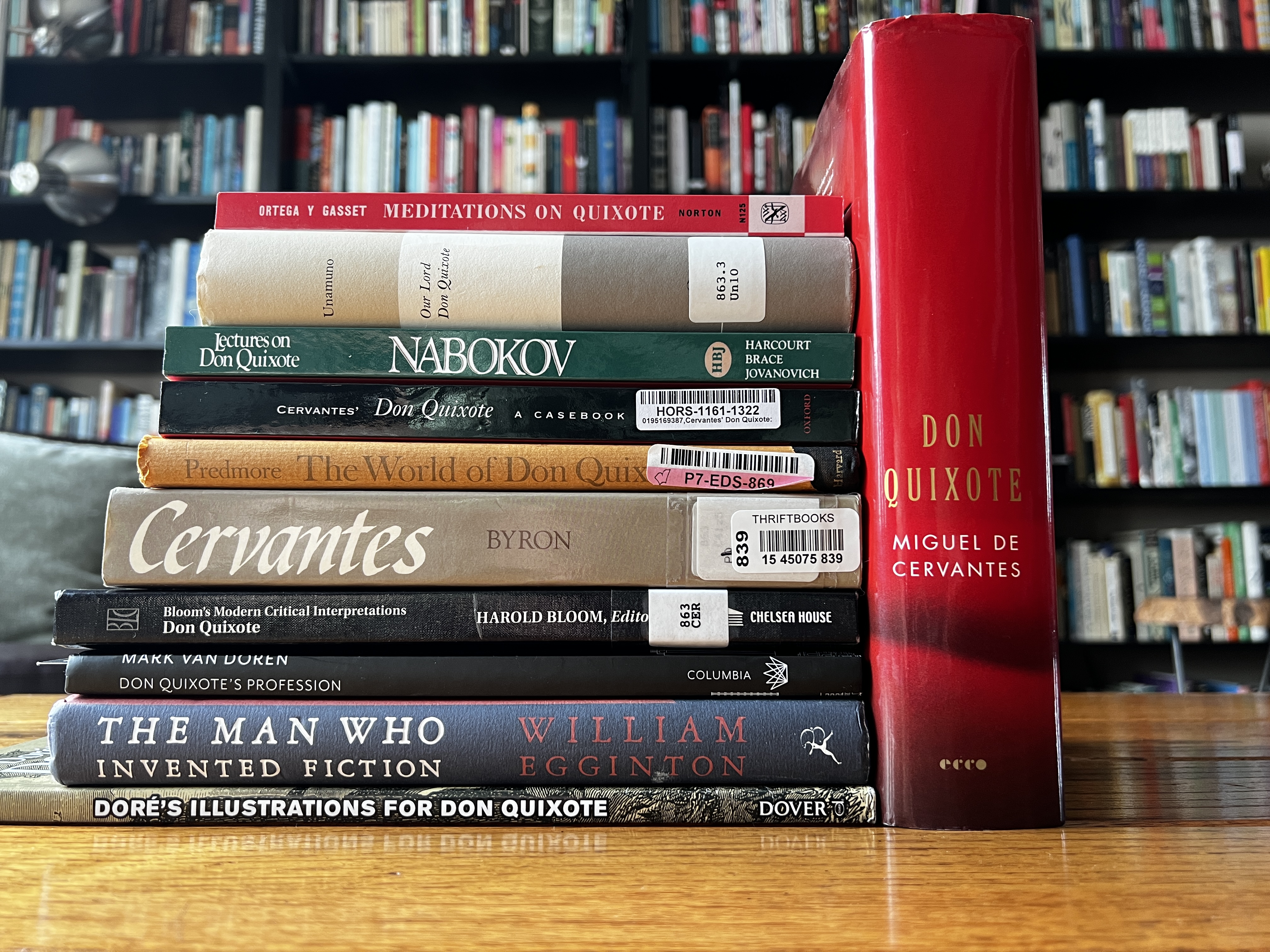
the pastoral concerning Marcela’s refusal of Grisóstomo
Cardenio’s story (Cardenio and Luscinda)
Dorotea’s story (Dorotea and Don Fernando)
the novella (The Man Who Was Recklessly Curious)
the captive’s story (Captain Viedma and Zoraida)
Doña Clara’s story (Doña Clara and Don Luis)
the pastoral concerning Leandra’s refusal of Eugenio and his rival, Anselmo
Over the last few weeks, I have tried to discern the structure of this novel – no easy task for me, on this, my first encounter with the text. In my last Don Quixote post, though, I did note, “Whatever Cervantes is telling us about storytelling, he intends for us to notice how he positions narrators and listeners in the book’s nested narratives.” (Emphasis added.) And, as it turns out, the structure can be described as a nest:
I sketched my idea on a whiteboard before reducing it to the formula above and immediately identified some (admittedly superficial) similarities between the Ps. Both are narrated by animal tenders (shepherds, a goatherd), for example, and both concern a woman’s virtue or chastity. Marcela clearly possesses more agency than Leandra, though – a difference. And subtle differences exist between the R1s, too; for example, how are the plights of Cardenio and Luis alike? After identifying a similarity in Dorotea’s social situation to Don Fernando and the captive’s to Zoraida (R2s), I set my marker down and turned to the computer. Before yielding to the temptation to type my idea in JSTOR’s search bar, though, I gave myself credit for noticing that Cervantes employs symmetry in the knight’s undergirding (or enveloping) narrative. Consider, for example, that it opens and closes with scenes of Don Quixote in his home and that he encounters friars as he sets out for the second time and penitents as he returns home. More, the knight’s story is framed by the discovered history, as well as verses.
My idea about the structure merited research, if for no other reason than to satisfy a good hunch that others had already mined this territory far more thoroughly and thoughtfully. It did not take long to locate articles exploring the symmetrical structure of the novel. Here are two:
“Structural Symmetry in the Episodic Narratives of Don Quijote, Part One” by Raymond Immerwahr. Comparative Literature, Vol. 10, No. 2 (Spring, 1958), pp. 121-135 (15 pages). Published By: Duke University Press.
“Narrative Framing and the Structure of “Don Quijote” Part I” by Jeremy T. Medina. Confluencia, Vol. 14, No. 2 (SPRING 1999), pp. 165-175 (11 pages). Published By: Colorado State University.
Quick takeaways: Immerwahr discusses the mirroring aspect of the symmetrical structure, including a compelling idea about Don Quixote’s relationship to The Man Who Was Recklessly Curious. Medina considers the novel’s frames within frames (plus he includes a diagram of the structure; see page 169).
I will close with a passage that I marked from this week’s reading (p. 444):
“[I]t’s a fine thing to be out looking for things to happen, crossing mountains, searching forests, climbing peaks, visiting castles, and staying in inns whenever you please and not paying a devil’s maravedí for anything.”
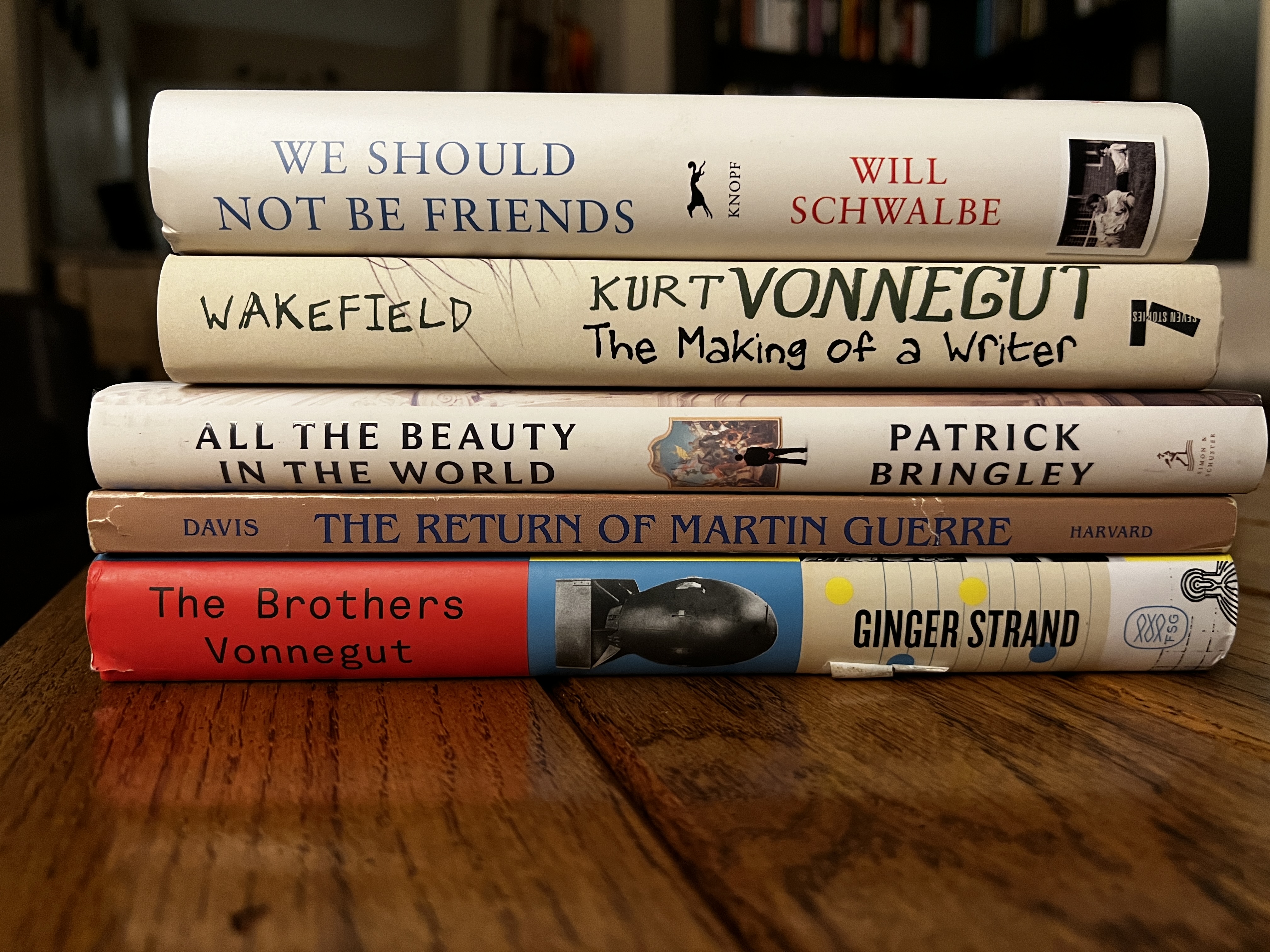
Last night, my goals for the evening included writing about Don Quixote, reading about Pompeii, outlining Chapter Five of SPQR, and reviewing my Latin vocabulary. What did I actually accomplish? I watched The Lego Movie (because it came up in a discussion with my younger daughter yesterday), shelved new arrivals (pictured above), spent some time gazing at the night sky, outlined Chapter Five of SPQR, and marked up two academic articles on the topic of narrative structure in Don Quixote. Meh; not bad.
The only thing that went according to plan today was the Don Quixote tutorial, and I was actually a few minutes late to that. Now the day is nearly over, but apart from the tutorial, a decent lunch, and a much needed nap, I haven’t much to show for it. Time for a walk, I think. A speck of sun. A talk with the neighborhood crows. A bit of movement. Then I will settle in for some reading.
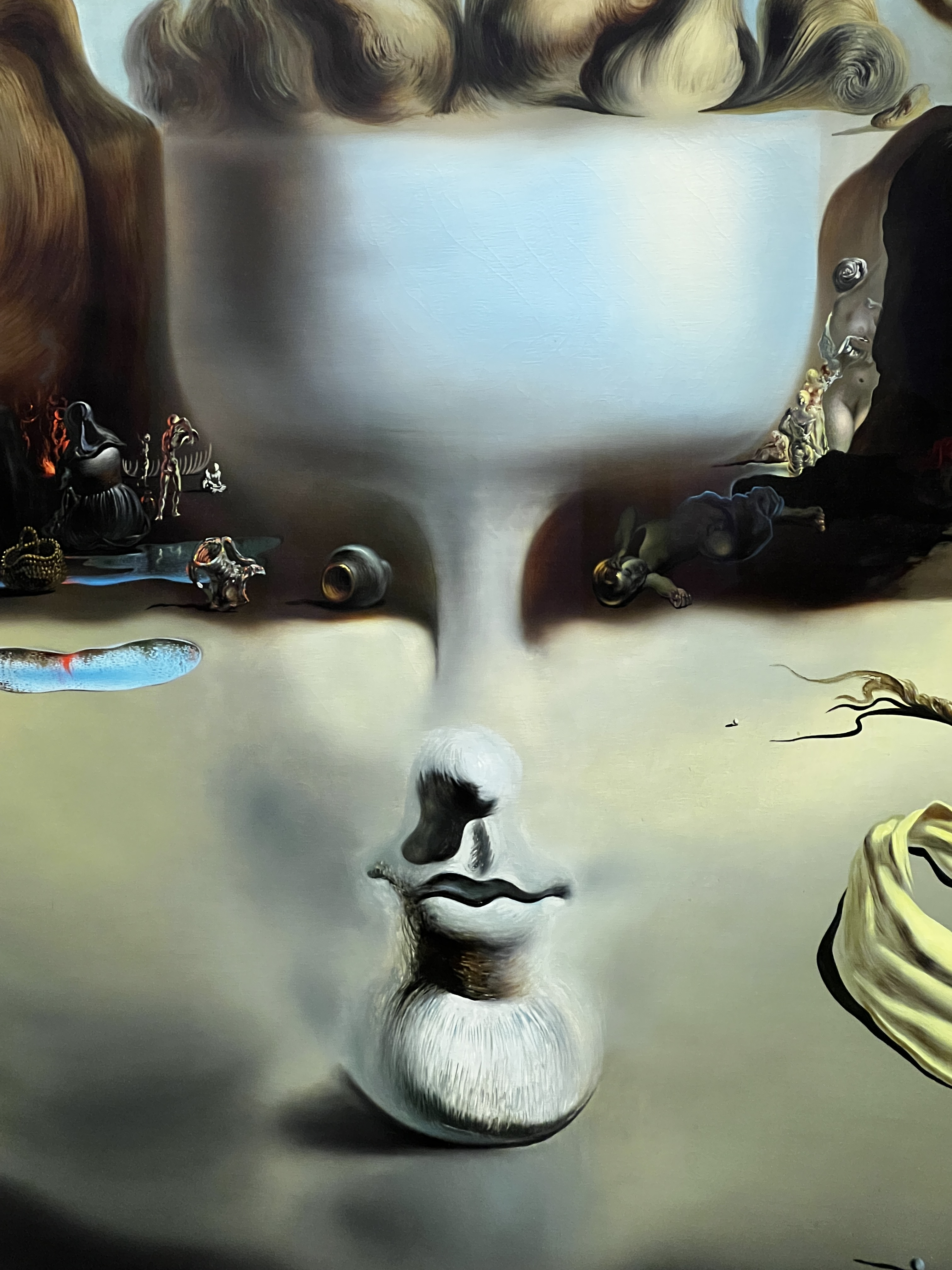
My image of detail from Salvador Dalí’s Apparition of Face and Fruit Dish on a Beach (1938).
Unsurprisingly, the story of Cardenio’s madness concludes when he is reunited with Luscinda, and Fernando is persuaded by Dorotea: “You have conquered, O beautiful Dorotea, you have conquered because I do not have the heart to deny so many truths spoken together” (p. 318; and there it is again, truth – my literary kryptonite). Tender feeling, undeniable signs of love and repentance, and several pages later, Don Fernando displays “great love and courtesy” (p. 320) to Cardenio and Luscinda, who have knelt before him. Yes, apparently all’s well that ends well in this story that bears a remarkable resemblance to Shakespeare’s The Two Gentlemen of Verona, which, according toProfessor Michael Delahoyde, makes sense:
The closest source of [The Two Gentlemen of Verona] seems to be Diana Enamorada, written in Spanish by the Portuguese Jorge de Montemayor in 1542 but not translated into English until 1598 (Asimov 465). The Felix and Felismena story had other incarnations, such as Felix and Philiomena (1585) and in Part I of Don Quixote in which the Valentine character is named Cardenio (Barton 178). The friendship theme, or friendship vs. love, could be found in the Palamon and Arcite stories, and perhaps Damon and Pithias (credited to Richard Edwards in 1565) was an influence (Barton 178).
For two weeks, though, I have been trying to recall where else I have encountered the material in the first interpolated novel. It was only by chance that I finally stumbled on a reading note from 2016. In April of that year, we attended the Shakespeare Project of Chicago’s staged reading of Stephen Greenblatt and Charles Mee’sCardenio, after which I noted that only the Project’s excellence made the tedious work watchable. Although I may be drifting dangerously far from Don Quixote, I must share my favorite bit from the reading of Cardenio, spoken by the much maligned Doris:
To be honest, I’ve never understood Why I shouldn’t tell the truth. I mean the assumption that this is beneficial to the world, to be nice, to be pleasant, is just unproven.
[Is she suddenly close to tears?]
Difficult people are always the ones who advance civilization.
To be honest, I’ve never understood / Why I shouldn’t tell the truth. Yes, I am circling back to truth and storytelling, and I know I am not the only one who is struck by the following moment in this week’s reading: “[T]hey wanted the story to last longer; such was the charm with which Dorotea recounted her misfortunes” (p. 320). That such “complex and desperate affairs” (p. 321) resolve so readily into a charming story (narrated by one of that story’s victims!) boggles the mind – even one that has already suspended disbelief. Later, the priest recounts for Don Fernando and company the madness of Don Quixote, which provokes laughter and the observation that “it was the strangest kind of madness that ever affected an irrational mind” (p. 323). In the margins, I shouted, What?!?! Stranger, madder, more irrational than the story they just lived?!?!? (In the margins, one may indulge in frantic punctuation.) This is followed by a second interpolated novel (concerning the captive and Zoraida), which, however quickly, happily, and improbably resolved, shifts our focus, once again, away from the titular character. Whatever Cervantes is telling us about storytelling, he intends for us to notice how he positions narrators and listeners in the book’s nested narratives.
Speaking of nested narratives, in anticipation of attending the preview of “Salvador Dalí: The Image Disappears,” I recently read three short biographies of the artist and reviewed several books of his art. Of course, nothing compares to seeing paintings like Apparition of Face and Fruit Dish on a Beach (1938) or, one of my favorites, Inventions of the Monsters (1937) in person. On Friday, as I jockeyed for ever closer positions to the works, I paused periodically to focus on what I could see from the intermediate distances. After all, the dog in Apparition is most apparent when you stand back; the burning giraffe in Monsters, when you lean in. Oh, I thought, what a collection of stories, dreams, nightmares, and visions Dalí’s work comprises! In one of those moments of synthesis that shape the reading and thinking life, I was reminded that discerning the many narratives at play in his paintings (in many works of art, period) is dependent on the viewer’s perspective. Our attempts to resolve or make sense of the narratives in a Dalí painting require that we see the work from multiple angles. Where I stand shapes which story I see, as well as my impressions of that story. By extension, then, I might posit that with Don Quixote, Cervantes not only reimagines how a novel can be structured (I am currently envisioning a nesting doll or onion) but also slyly critiques our relationship to stories. So much depends on, among other things, who is narrating and where the listeners are positioned in a narrative (to say nothing of the listeners’ prejudices and limitations; yes, I am looking at you, good priest and barber).
Two more notes:
(1) The Homer reference at the conclusion of Chapter XXXVII, in which Don Quixote describes academics as passing “through these shoals, these Scyllas and Charybdises” (p. 330), delighted me.
(2) You will find more about Greenblatt and his work on Cardeniohere.
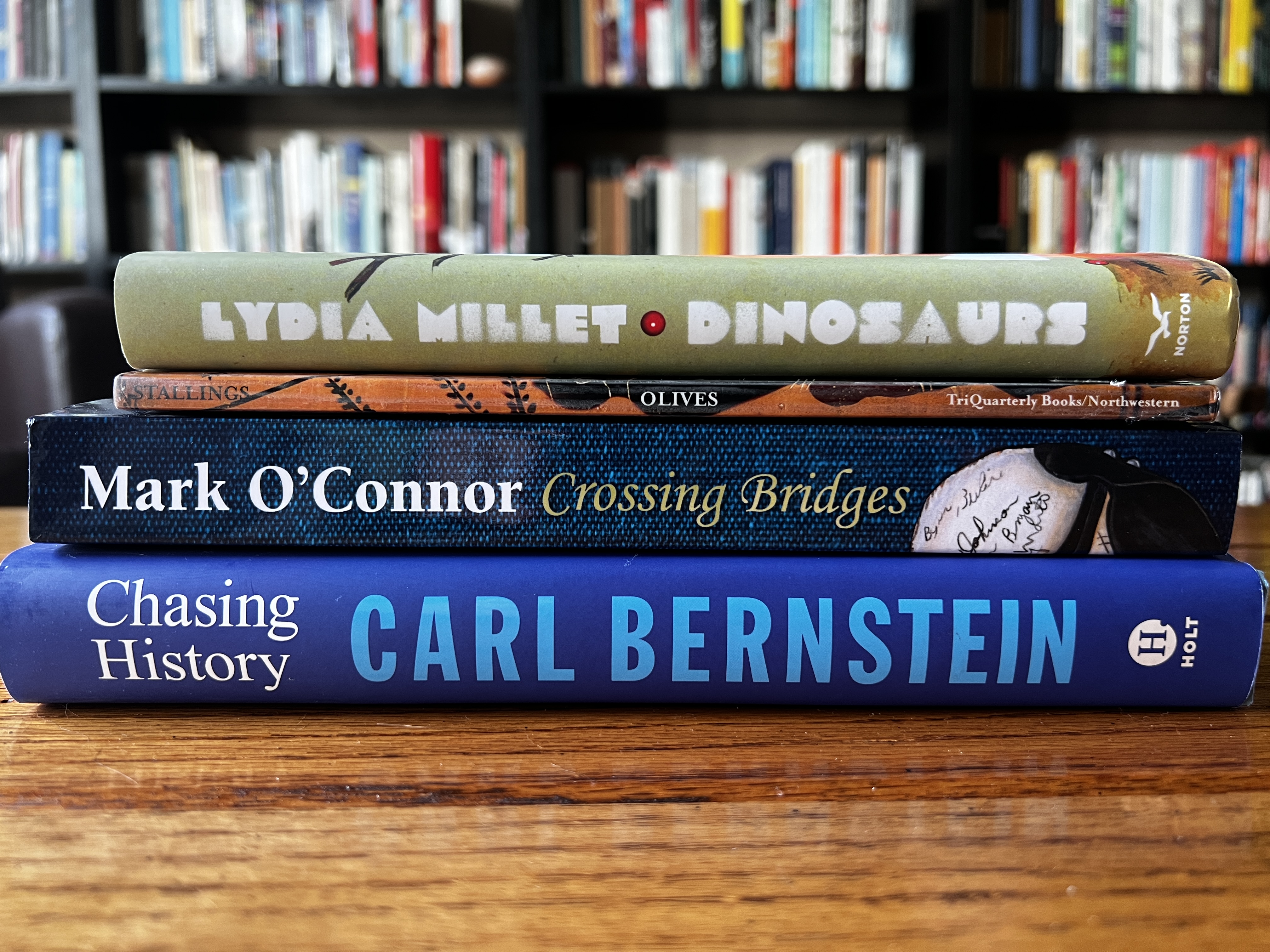
A.E. Stallings is a former student of my Latin tutor; he recommended her work to his students in an email earlier this year. (In a neat readerly intersection, her work is mentioned in Will Buckingham’s Hello, Stranger, which I recently read for an author-led class with the Premise Institute.) Journalism major explains Bernstein; algorithm explains Millet. And I heard an interview with O’Connor on NPR.
The material in this post was adapted from a September 8, 2005, post to my previous site.
An online acquaintance once observed that there is nothing less revealing than a “ten books list” that contains nothing but classics. Truth. So, what if we talked about ten books that reveal something about ourselves, instead? That’s a challenge. What books tell (part of) the stories of our lives? Which books say something about where we’ve been or where we’re headed? Which books helped shape and define our sense of ourselves? Of our world?
An annotated list:
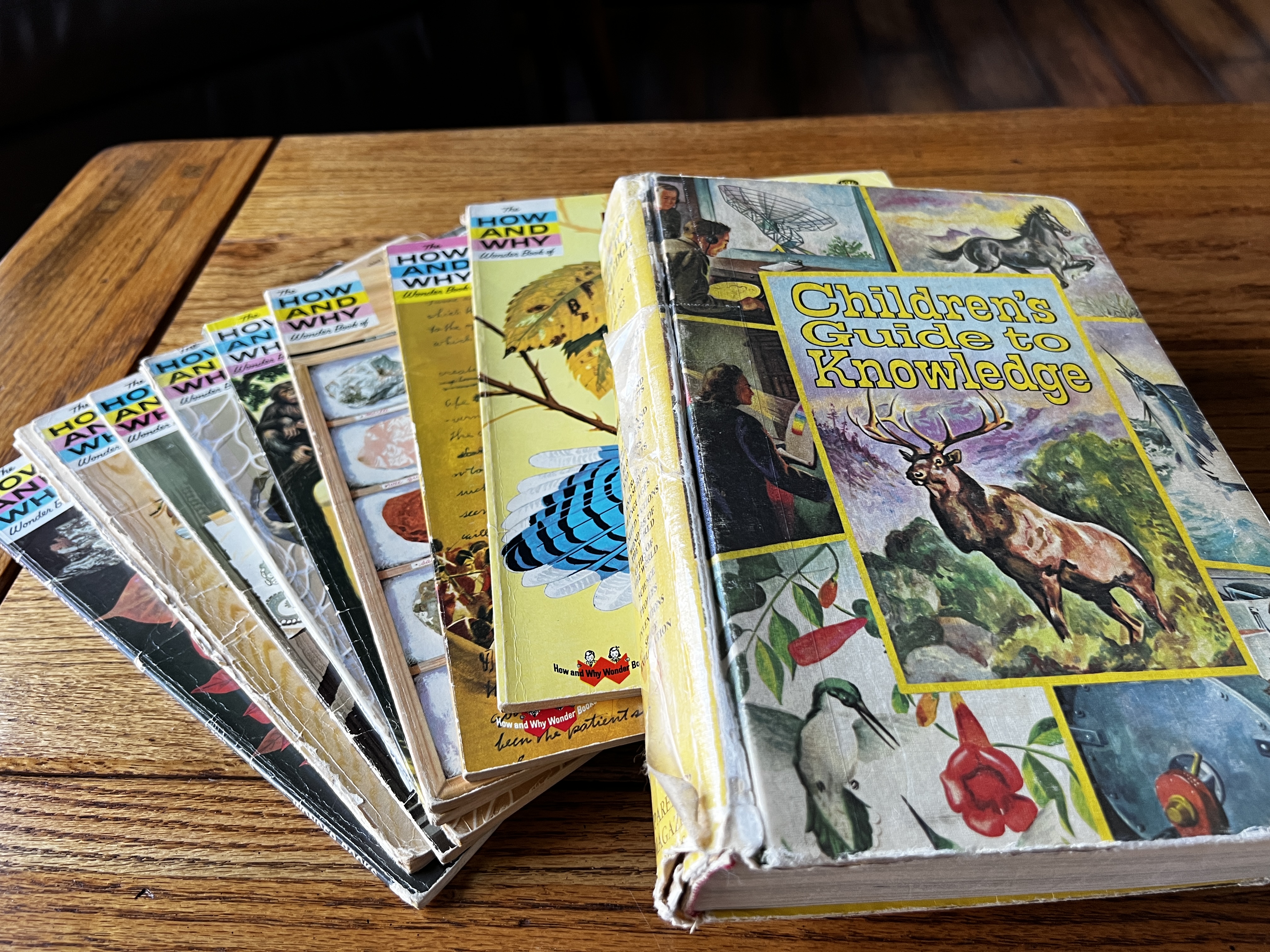
1. Children’s Guide to Knowledge (1971 edition)
I’ve written about this treasure before. It is, as I have said, partially responsible for preventing my young mind from atrophying in my parents’ blue-collar, book-barren home. Published by Parents’ Magazine Press, the subtitle is Wonders of Nature, Marvels of Science and Man. Fifty years ago, an aunt inscribed it, “This book will help you with your 4th grade reports!” And it did. Children’s Guide to Knowledge delivered a compelling world of animals, plants, history, geography, and scientific achievement (through early space exploration, anyway). The spine of my original copy is crumbling, and the book has a damp, forgotten smell, but, like my tiny collection of “How and Why” books, it still beguiles.
2. Blubber (Judy Blume; 1974)
My closest friend in fifth grade, Mary Ann, pressed this book on me. “It is just like this class,” she said. “It’s true.”
Mary Ann and I formed a two-student workshop led by our newly minted teacher. Miss T. had identified us as “advanced” readers and writers (“Well, no kidding,” Mary Ann muttered), but we suspected that the “workshop” was about isolating us from the other students while she was teaching. She certainly didn’t do well under our scrutiny: “But Miss T.,” coming from Mary Ann or me was capable of reducing her to tears. (Unsurprisingly, my preoccupation with exposing mediocrity began around this time.)
In workshop, Mary Ann and I read books like The Red Badge of Courage and collections of O. Henry and Edgar Allan Poe stories (most of which I reread in adulthood and realized, “Man, I never appreciated these until now”) and (over)wrote and illustrated wildly creative stories about our secret lives as witches.
We didn’t spend much time trying to play well with the other girls in our class.
And our inexperienced fifth-grade teacher watched us carefully.
Anyway, the ease and truthfulness with which Blubber unfolded resonated with me in a way that the Little House books or even A Wrinkle in Time hadn’t. I knew I was a writer by the time I was in third grade, but with Blubber, I became fascinated with writing “the truth.”
Mary Ann and I didn’t write many more stories about witches after that.
3. Harriet the Spy (Louise Fitzhugh; 1964)
I popped the lenses from my sunglasses, donned an old hooded sweatshirt, and took to carrying a composition notebook wherever I went. My classmates never read the notebooks, but my mother did. Let’s leave it at “That wasn’t the best day of my childhood.”
4. Ronnie and Rosey (Judy Angell; 1977)
By any standard, this book is, if not ridiculous, then overwrought, as many “problem novels” are. But when I first read it, its truth electrified me. Ronnie and Rosey helped me realize, “Someday, perhaps someday soon, I will feel strong enough as a person to act and think without worrying about what Mom will say and do.” So, yeah, I credit this sometimes silly book with helping me grow up (which means, of course, that at the time, it wasn’t silly to me, at all).
5. Charlotte’s Web (E.B. White; 1952)
Wilbur never forgot Charlotte. Although he loved her children and grandchildren dearly, none of the new spiders ever quite took her place in his heart. She was in a class by herself. It is not often that someone comes along who is a true friend and a good writer. Charlotte was both.
E.B. White died when I was an undergraduate. To mark his passing, I reread Charlotte’s Web.
And cried.
Just as I had when Mrs. S. read it aloud to our third-grade class.
I have, since then, reread it several times. And cried each time.
Rereading Charlotte’s Web as a first-generation college student hovering between childhood and adulthood reawakened in me the desire to arrive at essential truths through clear, measured writing.
6. The Mists of Avalon (Marion Zimmer Bradley; 1983)
Through this now-cancelled book, I met Arthur, which sent me on a quest that filled several shelves and many of my mind’s rooms and chambers, so it is important to me. A belated thank-you to Ines, who recommended it as I headed home for the summer before my junior year of college.
7. Slaughterhouse-Five (Kurt Vonnegut; 1969)
I read this during my final semester as an undergraduate. Mr. R., my mentor, insisted. It is heresy, I know, to mention these two books in the same entry, let alone the same sentence, but, like The Mists of Avalon, Slaughterhouse-Five sent me on a journey of discovery that, again, filled several shelves and many of my mind’s rooms and chambers.
Years later, while in grad school, I spent the day with Vonnegut. I was a grad assistant at a small liberal arts school where he offered two workshops for the English department and a ninety-minute address followed by a book-signing for the general college population. By then, I had read everything of his that was in print. My assignment that day was to help usher him from here to there. Trust me, faculty members vied for his attention, and my services proved non-critical.
But I sat beside him for both workshops. “And this is enough,” I thought. “To know that he is a real person who grows impatient and smells old and loses his train of thought sometimes. This writer is real.”
Perhaps that is the essence of my reading and writing life: discerning what is real and true for me and recommitting to it periodically.
8. (Wo)Man Writer: Occasions and Opportunities (Joyce Carol Oates; 1988)
The work of Joyce Carol Oates was partially responsible for my success in graduate school: One of two scholarly essays of mine to capture honors in my second year of study concerned JCO, and part of my oral defense concerned Oates and the Burkean pentad. In many ways, she is to me what Joan Didion was to other women readers and writers — both writer and subject, an icon, an impossible ideal.
9. The Complete Pelican Shakespeare, 10. Shakespeare: The Invention of the Human (Harold Bloom; 1998), and 11. Asimov’s Guide to Shakespeare (1970)
(Yes, I’m aware that I have listed more than ten books.)
I’ve amassed a collection of thousands of volumes, but if it were all lost tomorrow, the only books I would need to replace immediately are these three. Nothing has reworked the geography of my imagination like my (re)discovery of Shakespeare. (Except maybe parenting, but that’s an altogether different subject, isn’t it?)
Shakespeare. Talk about a recommitment to what is real and true.
Postscript: Nearly eighteen years have passed since I first assembled this annotated list. I must now add Moby-Dick; or, The Whale (Herman Melville; 1851). Enough said.
The above is my image of the fragment of Homer’s Iliad (Book 5, lines 824-841), papyrus manuscript, c. 150 – 199 CE, currently on display at the University of Chicago. From “But Is It a Book?”:
This papyrus fragment bears 17 lines from Book 5 of Homer’s Iliad. Although epic poems from antiquity are typically divided up into books, the word would not have been understood in the way it is used today. The term comes from the papyrus “bookroll,” which was formed by affixing approximately 20 standard sheets of papyrus together that could be rolled up into a compact unit and hold roughly 700 lines of poetry – close to the typical book divisions of ancient epics.
In last week’s reading (Chapter XXVI), the barber and the priest “were astonished again as they considered how powerful the madness of Don Quixote was, for it had pulled along after it the good sense of this poor man” – that is, Sancho Panza. In this week’s reading (Chapter XXX), however, it is from Sancho Panza and not from those who “mocked and deceived” Don Quixote that the “quick-witted and very spirited” Dorotea takes her cues. Faced with an incensed knight, she flatters and placates him and reminds him of the boon he has promised her. She then narrates a clever tale featuring an imperiled kingdom, ghastly giants, and an orphaned princess. In short, she enters Don Quixote’s world and does so seemingly without patronizing him. Later, she privately acknowledges to the priest that she, too, “had often spent time reading” the books of chivalry that have reframed Don Quixote’s reality (p. 257), yet she clearly has not succumbed to their spell since she can so readily recognize that the innkeeper (Chapter XXXII) “doesn’t have far to go to be a second Don Quixote.” (p. 270) My initial – and overly simple – observation concerned the ways in which one may engage with, perhaps even indulge others: Sancho Panza and Dorotea do so in a positive manner; the priest and the barber, less so. A more significant idea that occurred to me this week is that even if they dismiss Don Quixote as mad, members of the ever-expanding cast of characters inevitably engage with him where and how he is.
As I have shared, I am fascinated by the uses and definitions of “true” and “truth” in this work. While I am not setting that line of inquiry aside, I must, in the wake of Chapters XXXIII, XXXIV, and XXXV, wonder if Cervantes is pointing readers to compelling questions about life and literature. After all, there must be a reason our titular character’s adventures occur between and among so many other stories – including a short book read aloud by, of all characters, the priest. (Yes, while Don Quixote sleeps, the priest reads aloud The Man Who Was Recklessly Curious, and when he finishes, he asserts that while the novel “seems fine,” he “cannot persuade himself that it is true….” (p. 312) He cannot “persuade himself that it is true”? It is a novel! What does he mean? Ah, me and notions of truth; moth and flame.)
Last week, I posited that the manner in which Cardenio’s story sidelines Don Quixote’s may be a juxtaposition of two types of “madness” – the (apparently) unceasing and the (likely) temporary. (I suspect that once his narrative is resolved, Cardenio will have renounced his wandering and fits and be restored to his “true” life.) When the adventures of the Knight of the Sorrowful Face are again upstaged, this time by the novella, I was compelled to review the previous iterations of story that have occurred. The Grossman translation includes a footnote indicating that Cervantes himself was likely criticized for the “interpolated novels,” of which The Man Who Was Recklessly Curious was the first, but Don Quixote’s story has already intersected with several other narratives: histories, ballads, verses, confessions, autobiography, diary, letters; now a novella. In The World of Don Quixote (1967), Richard L. Predmore notes that critics once reviewed this material as “merely literary baggage.” Even after critics agreed that the additional literature “does fulfill an essential function” in the novel, they could not agree what, but later in the same section, Predmore writes, “Cervantes’ masterpiece suggests that any kind of reading is revolutionary.” Isn’t that a remarkable reminder? Any kind of reading is revolutionary. From that, it might follow that any kind of storytelling can also be revolutionary; therefore, the stories in which the central tale of the mad knight is nested will likely prove as integral to Cervantes’ larger narrative as Don Quixote’s battles with windmills and wine sacks.
Two additional notes:
(1) In Chapter XXXI, Don Quixote encounters Andrés, the servant he believes he rescued in Chapter IV. The unfortunate boy joins the growing chorus of characters who maintain that the knight’s intervention caused more harm than good. Ordinarily, I would be inclined to read this as an indictment, but this week, the reappearance of Andrés provoked laughter.
(2) From page 257:
“Well, there’s something else in this,” said the priest. “Aside from the foolish things this good gentleman says with reference to his madness, if you speak to him of other matters, he talks rationally and shows a clear, calm understanding in everything; in other words, except if the subject is chivalry, no one would think he does not have a very good mind.”
Do we agree with the priest’s assessment? If so, are there places in the text in which Don Quixote has discussed “other matters,” or are we meant to take the priest’s word for it? Is it madness if he is rational?