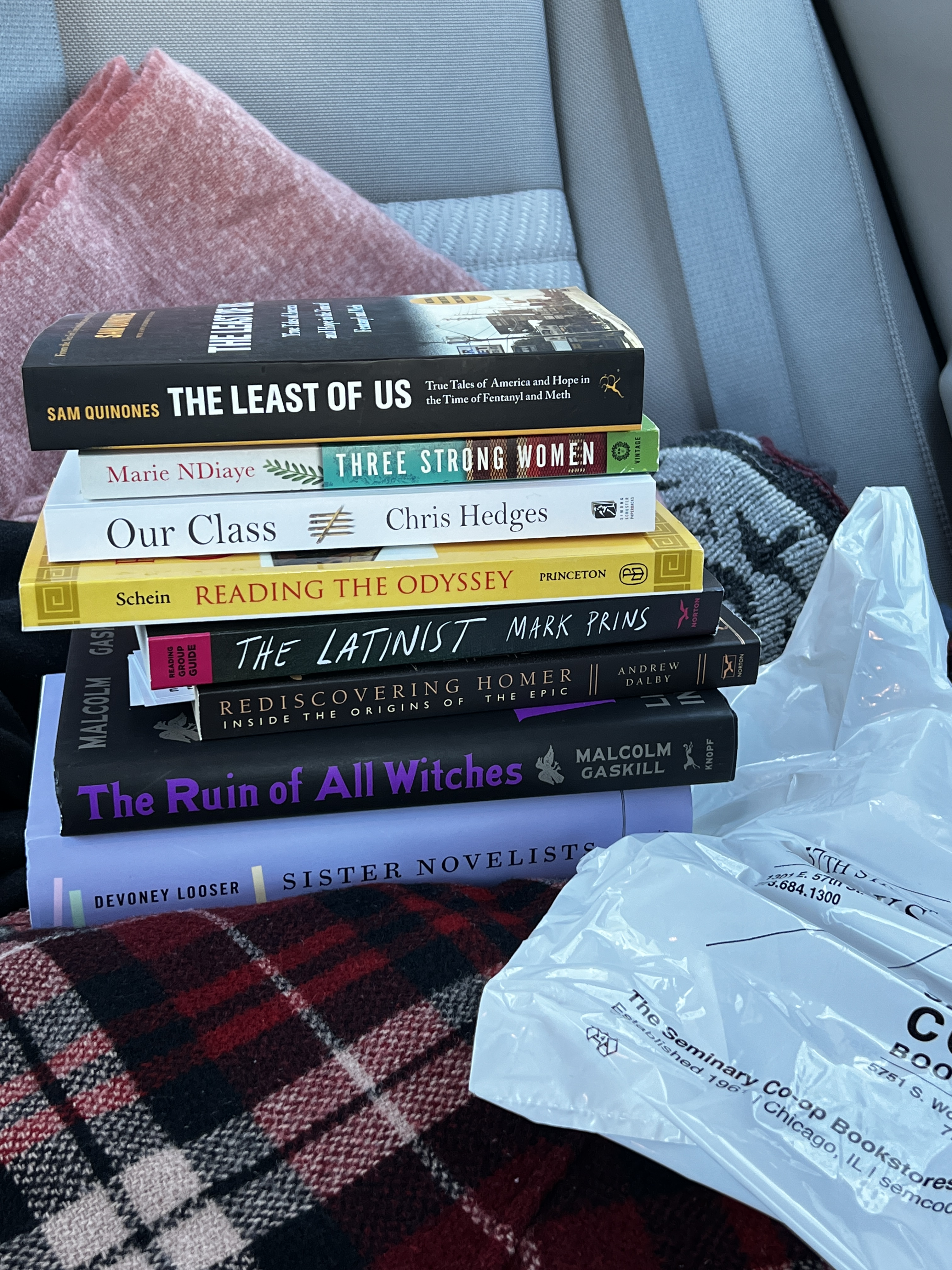
In what is perhaps best described as an embarrassment of riches, I am, in addition to a Catherine Project tutorial on Don Quixote and both University of Chicago Graham School and Night School Bar courses on Moby-Dick, enrolled in a short course on The Odyssey with the Brooklyn Institute for Social Research. It may not surprise you, then, to learn that I have begun to discern not only the debt Melville owes Cervantes but the debt both authors owe the oral tradition that yielded the Homeric epics. In the Don Quixote reading over the last three weeks, I encountered many narrative forms (e.g., “found” history, ballad, verses, confessions, autobiography, diary, letter), as well as a diverse cast of narrators. Although their mastery of the craft varies widely, these storytellers generally receive from their audiences the time and space needed to share their tales in full (or, in the case of the Knight of the Sorrowful Face, to expound on the virtues and vicissitudes of knight errantry). Might these plot-advancing soliloquys be the kin of the poets’ songs to the guests of kings, of Nestor’s rueful recollections of Odysseus and Agamemnon, and of Odysseus’ calculated retelling of the (mis)adventures that befell him following the sack of Troy? Not long after making this tentative connection, I encountered the following passage, in which Don Quixote is, once again, schooling Sancho Panza on the chivalric code:
I say, too, that when a painter wishes to win fame in his art, he attempts to copy the original works of the most talented painters he knows; this same rule applies to all the important occupations and professions that serve to embellish nations, and it must be, and is, followed when the man who wishes to be known as prudent and long-suffering imitates Ulysses [Odysseus], in whose person and hardships Homer painted a living portrait of prudence and forbearance; Virgil, too, in the person of Aeneas, portrayed for us the valor of a devoted son and the sagacity of a valiant and experienced captain; they were depicted and described not as they were, but as they should have been, to serve as examples of virtue to men who came after them. (Chapter XXV, p. 193)
Prudence and forbearance? Perhaps Don Quixote and I have not read the same translations of The Odyssey.Where the crafty, cunning Odysseus repeatedly shape-shifts through his layered lies stories, Don Quixote commits unswervingly to the code of conduct espoused by chivalric romances: “‘I thank you for your good intentions, friend Sancho,’” responded Don Quixote, ‘but I want you to realize that all the things I am doing are not jokes but very real; otherwise, I would be contravening the rules of chivalry that command us never to lie….’” Although the knight better exemplifies virtue, suffering, and forbearance than does adroitly deceptive Odysseus, the mad knight and the many-minded Greek do seem to share a need (compulsion?) to “rewrite” the world to conform to their own stories. That said, while Odysseus ostensibly achieves his goal (with Athena’s considerable intervention), Don Quixote seems destined to endure beating after beating.
I made three other notes about this week’s reading:
(1) The (apparently) temporary madness of the tattered Knight of the Sierra and the unrelenting madness of Don Quixote. I moved no further along that line of inquiry than a sentence fragment and the idea that if I fronted it with the word “discuss” (i.e., “Discuss the (apparently) temporary madness….”), it would make an infuriating essay question.
(2) Don Quixote’s antics in Chapter XXVI reminded me both of Edgar disguised as “poor Tom” and Lear on the heath. These two old men – Lear and Quixote – seem like psychological brothers. I revisited Bloom’s introduction to the Grossman translation, and he seems to list toward Hamlet.
(3) “And to conclude, I imagine that everything I say is true, no more and no less….” (p. 201) While it may be a fool’s quest, I remain fascinated by the uses and definitions of “true” and “truth” in this work. In the comments last week, Jeanne suggested that Cervantes is “foregrounding something about the perspective of the storytellers in relation to what we commonly think of as truth.” Similarly, Mcanultymaccom observed, “Since its naming/defining is so allusive, perhaps we need better terms: framing devices, constructions, peculiar assertions, etc. All of which foreground the actor/framer vs any claim to ‘truth’ with all its classical undertones.”


 The year opened with the usual goal: read 100 books from my shelves (i.e., books in my collection before the end of 2021), including at least 24 non-fiction titles and at least one book from each of the following categories: Shakespeare (about or retold), poetry, NYRB, Kurt Vonnegut (by or about), Joyce Carol Oates, philosophy, art, and children’s / YA. As it turns out, I read 139 books in 2022, of which 76 were from the shelves. Of those read from the shelves, nineteen were non-fiction titles; and while I met the poetry, NYRB, philosophy, and art challenges, I missed Shakespeare, Vonnegut, Oates, and children’s / YA.