We biked again last Saturday and hope to return to the trail this weekend.
Although the city has not yet implemented watering restrictions, our part of the world is experiencing a severe drought. It may not be apparent on the trail, but in our neighborhood, lawns are dormant, lake and creek levels are low, and new plants are dying. According to our contractor, however, this is excellent house-painting weather, so there’s that. Between you and me? I’m willing to wager that if not the snap of burlap stretched over the ornamentals then the slap of primer on the siding will be the magic rainstick that shakes some precipitation from the sky next week.
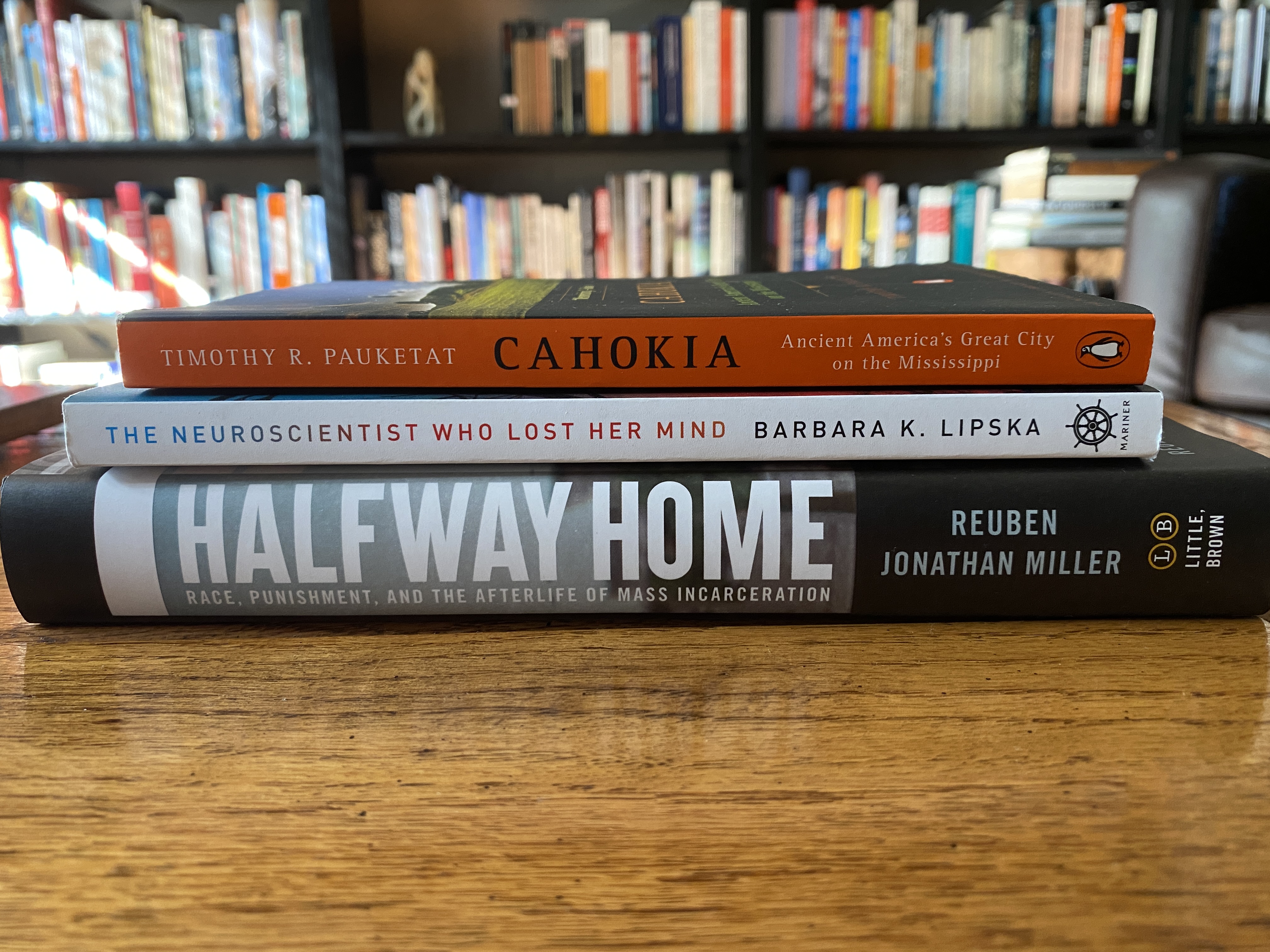
■ Harry Potter and the Half-Blood Prince (J.K. Rowling; 2005. Fiction.) Perhaps I was a bit harsh when writing about my HP reread last year, “[T]he flaws have become too big to hide under a long sweater of sentiment. They’re just not particularly well-stitched, are they?” This from a woman who has (speaking of sweaters), year in and year out, from the first cool-enough morning in October until the first too-warm morning in April, donned the same tatty, misshapen gray bundle of yarn with sleeves to take her first cup of coffee. Well-stitched or not, both the stories and my ugly old sweater comfort me. And that’s not a bad thing. No, not at all.
■ The Goshawk (T.H. White; 1951. Non-fiction.) p. 23 It has never been easy to learn life from books.
p. 38 Here comes (one thought, suddenly catching oneself out) that excellent piece of work called man, with his capacity for looking before and after, his abilities to reflect upon the enigmas of philosophy, and the minted storehouse of an education that had cost between two and three thousand pounds, walking sideways to a tied bird, with his hand held out in front of him, looking the other way and meowing like a cat.
To the list “Things I did when I wasn’t reading this weekend,” add “Biking.” With the ghosts of two memorable spills in mind, we stuck to walks and the exercise bike last year to avoid the ER and urgent care during the pandemic. Today’s, then, was our first ride in twenty months.
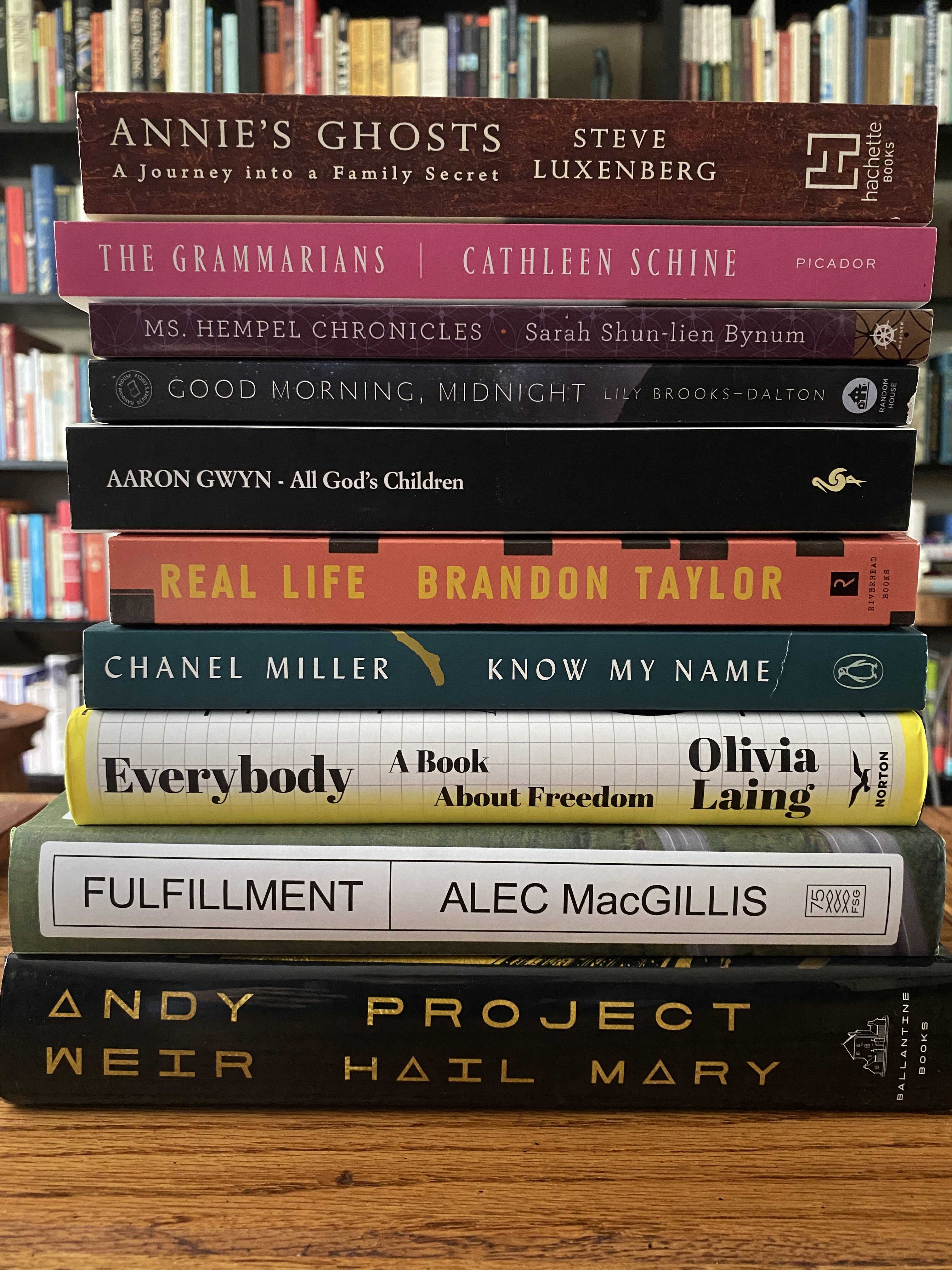
Since my last annotated list, I’ve read eight books for a year-to-date total of ninety-four. At the end of next month, I’ll sort out how this positions me to meet my goals.
Three graphic works:
■ Imagine Wanting Only This (Kristen Radtke; 2017. Graphic non-fiction.) ■ Drawn to Berlin: Comic Workshops in Refugee Shelters and Other Stories from a New Europe (Ali Fitzgerald; 2018. Graphic non-fiction.) ■ The Book Tour (Andi Watson; 2019. Graphic fiction.)
A gorgeous (and highly recommended) volume of poetry:
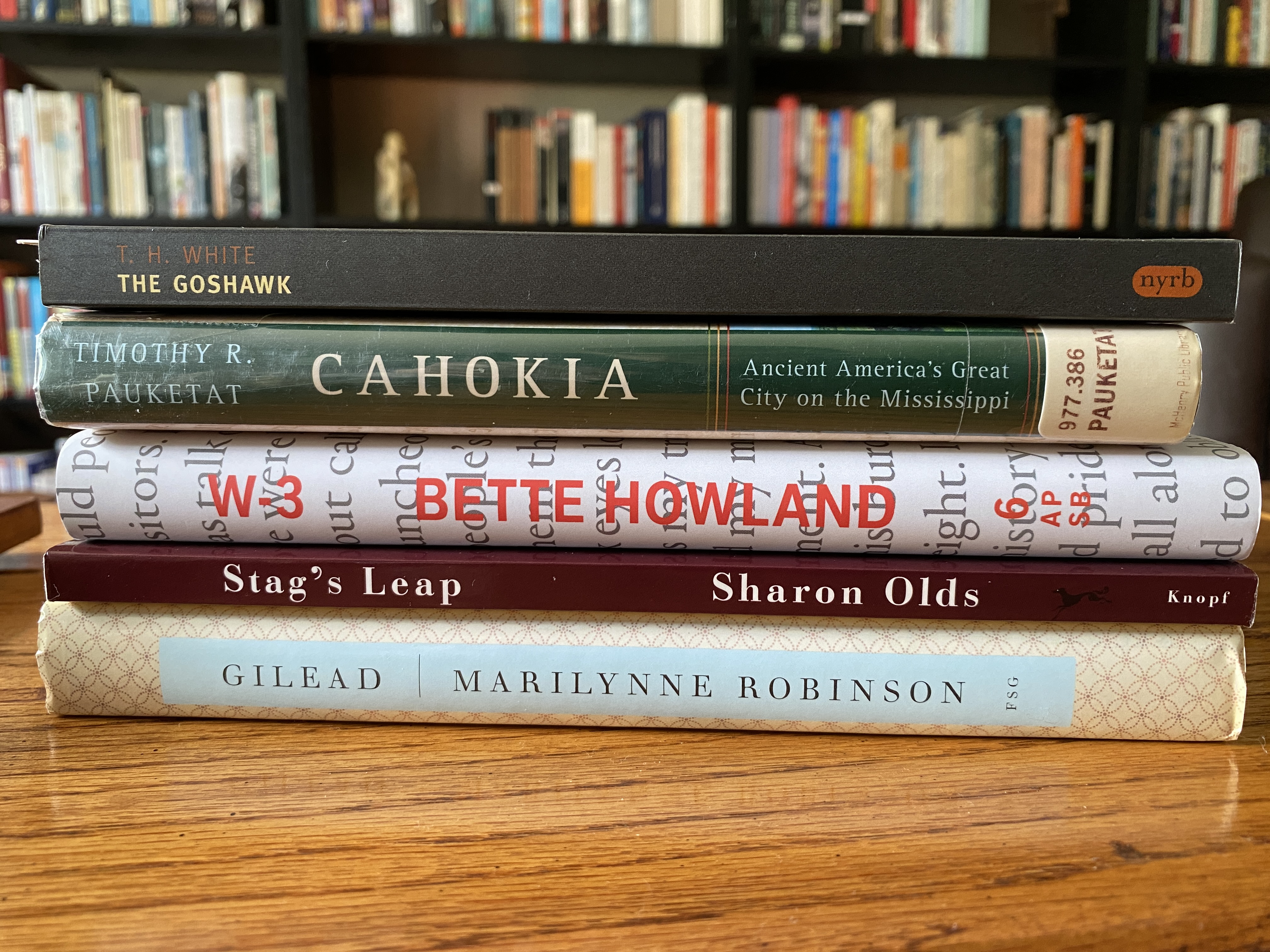
■ Stag’s Leap (Sharon Olds; 2012. Poetry.)
Two “vacation books”:
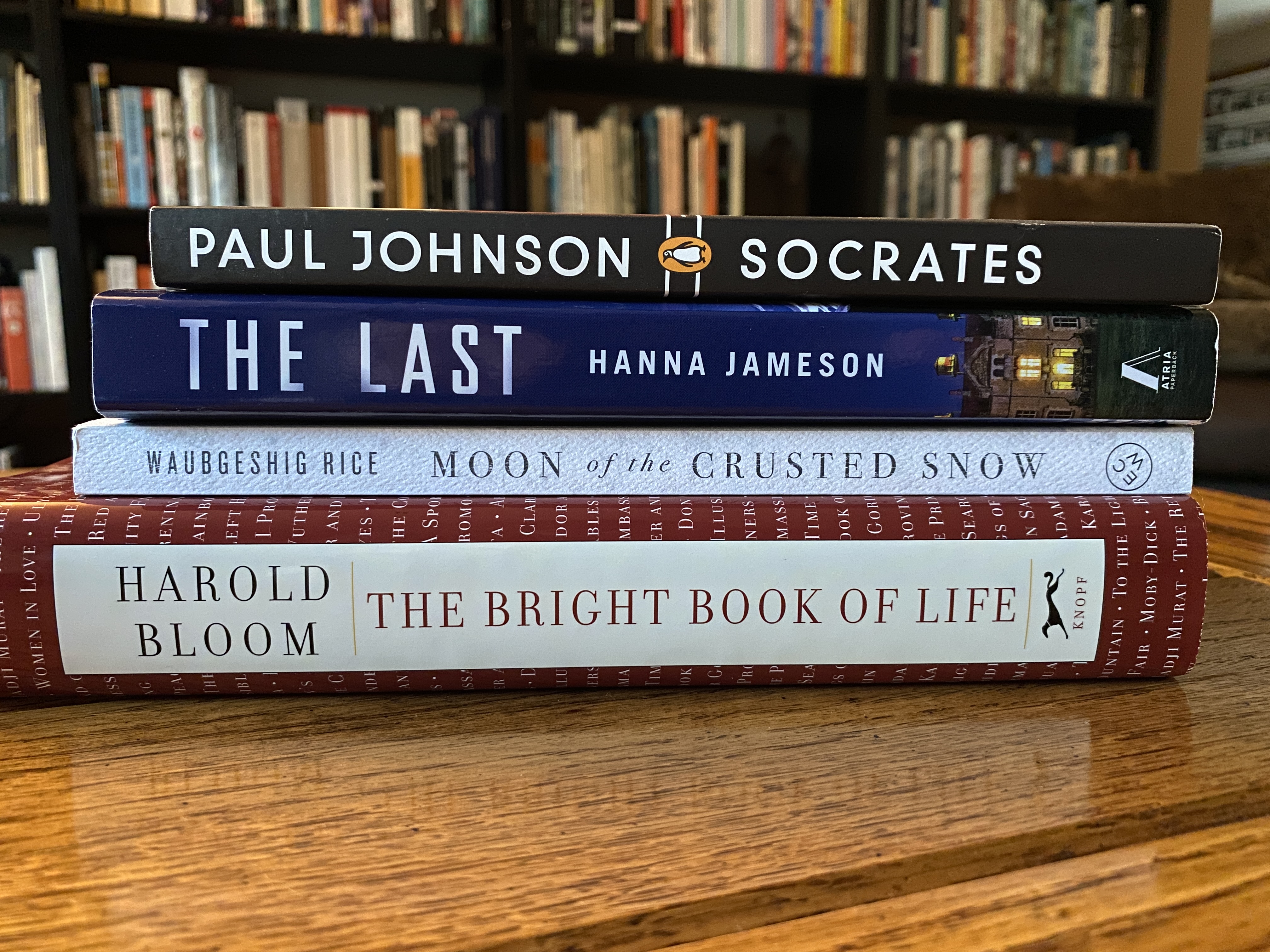
■ The Brutal Telling (Louise Penny; 2009. Fiction.) ■ The Last (Hanna Jameson; 2019. Fiction.)
The twentieth in my quest to reread all of Shakespeare’s plays:
■ Richard III (William Shakespeare; 1594. Drama.)
For the Cardiff BookTalk:
■ To the Lighthouse (Virginia Woolf; 1927. Fiction.) From Chapter XVII of “The Window”:
But what have I done with my life? thought Mrs. Ramsay, taking her place at the head of the table, and looking at the plates making white circles on it. “William, sit by me,” she said. “Lily,” she said, wearily, “over there.” They had that — Paul Rayley and Minta Doyle — she, only this — an infinitely long table and plates and knives. At the far end, was her husband, sitting down, all in a heap, frowning. What at? She did not know. She did not mind. She could not understand how she ever felt any emotion or affection for him. She had a sense of being past everything, through everything, out of everything, as she helped the soup, as if there were an eddy — there — and one could be in it, or one could be out of it, and she was out of it. It’s all come to an end, she thought, while they came in one after another, Charles Tansley — “Sit there, please,” she said — August Carmichael — and sat down. And meanwhile she waited, passively, for some one to answer her, for something to happen. But this is not a thing, she thought, ladling out soup, that one says.
From Chapter V of “The Lighthouse”:
And she wanted to say not one thing, but everything. Little words that broke up the thought and dismembered it said nothing. “About life, about death; about Mrs. Ramsay” — no, she thought, one could say nothing to nobody. The urgency of the moment always missed its mark. Words fluttered sideways and struck the object inches too low. Then one gave it up; then the idea sunk back again; then one became like most middle-aged people, cautious, furtive, with wrinkles between the eyes and a look of perpetual apprehension.
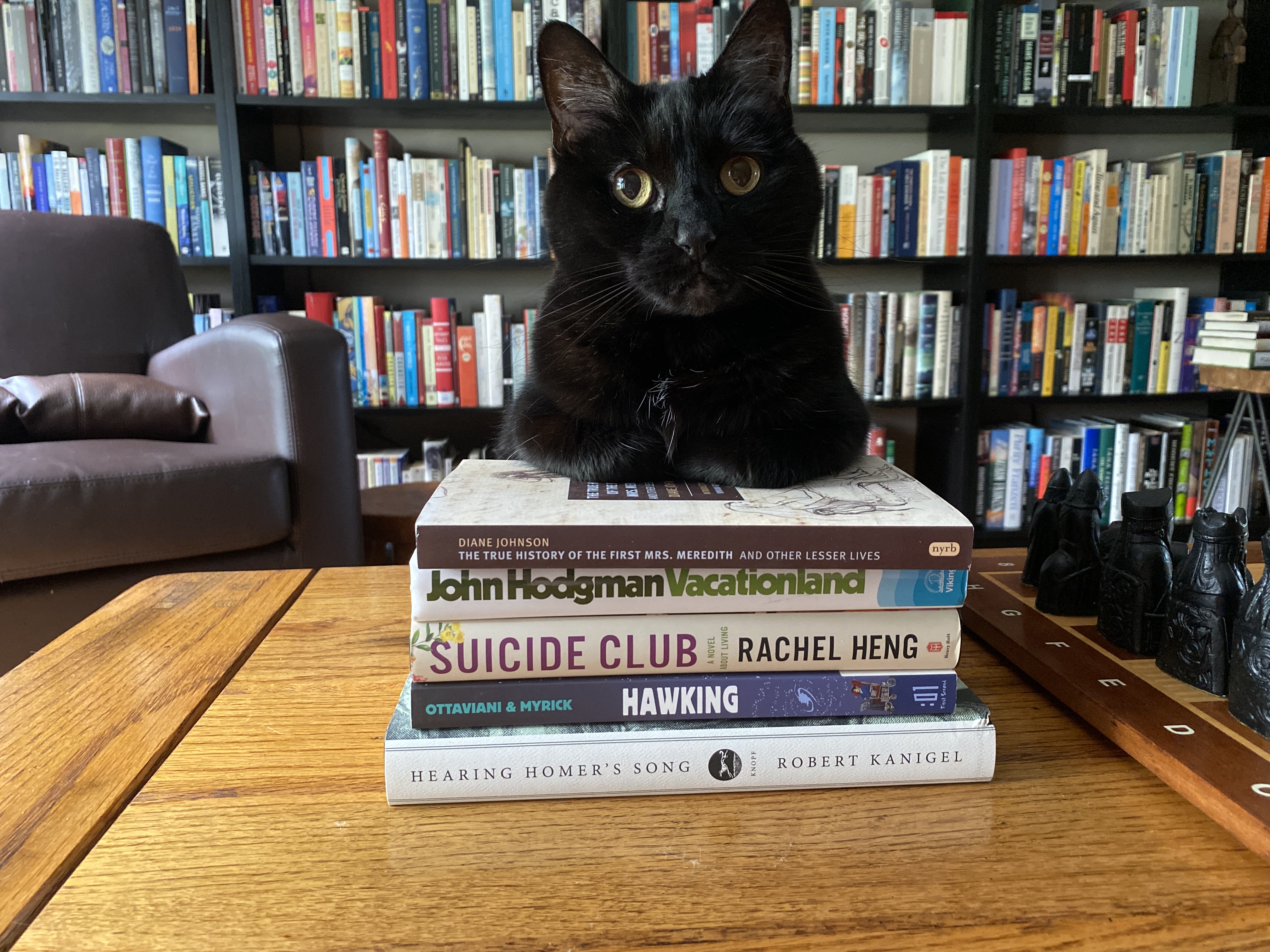
She has always done this, bellied up to a ledge, a box, a pillow, a leg, an armrest, a stack of books, then crossed her arms to hang out for a bit. That she did it when I set down my new books to photograph — and that she then looked me right in the eye as I held the camera — was unheard of.
Recently, Joseph asked how I decide which books to add to the collection. I located an entry on that topic from the archive of my original site, but much has changed in the sixteen years since that was posted. Besides, although I talk about living in a library, it really is a sort ofantilibrary, as more than half of its contents are books I haven’t yet read. As I’ve written before, while this once embarrassed me, it now alternately enlivens and frightens me. From early in Nassim Nicholas Taleb’s The Black Swan: The Impact of the Highly Improbable:
The writer Umberto Eco belongs to that small class of scholars who are encyclopedic, insightful, and nondull. He is the owner of a large personal library (containing thirty thousand books), and separates visitors into two categories: those who react with “Wow! Signore professore dottore Eco, what a library you have! How many of these books have you read?” and the others — a very small minority — who get the point that a private library is not an ego-boosting appendage but a research tool. Read books are far less valuable than unread ones. The library should contain as much of what you do not know as your financial means, mortgage rates, and the currently tight real-estate market allows you to put there. You will accumulate more knowledge and more books as you grow older, and the growing number of unread books on the shelves will look at you menacingly. Indeed, the more you know, the larger the rows of unread books. Let us call this collection of unread books an antilibrary.
The independent bookstore we chose to visit was every bit as lovely as the reviews and local word-of-mouth had suggested, even though it had only recently reopened to the public. Apart from the garden center and an IKEA stop last summer, this adventure was the first in-person shopping I’d done since March 8, 2020.
Since my last annotated list, I’ve read thirteen books, for a total of eighty-six so far this year, sixty-five of which were from my shelves. My reading goals mirror last year’s: one hundred books from my shelves (i.e., books in my collection before the end of 2020), including at least twenty-four non-fiction titles and at least one book from each of the following categories: Shakespeare (by, about, retold, etc.) poetry, NYRB, Kurt Vonnegut (by or about), Joyce Carol Oates, philosophy, art, and children’s / YA. At this writing, all of this seems achievable as I have more than six months to read thirty-five more books from the shelves, including eight non-fiction works and something from the Vonnegut, NYRB, and art collections.
My quest to reread all of Shakespeare’s plays this year is going well; I’ve now finished twenty, most recently:
■ Henry VI, Part One (William Shakespeare; 1591. Drama.) ■ Henry VI, Part Two (William Shakespeare; 1591. Drama.) ■ Henry VI, Part Three (William Shakespeare; 1591. Drama.) ■ Julius Caesar (William Shakespeare; 1599. Drama.) ■ Coriolanus (William Shakespeare; 1605. Drama.)
Julius Caesar (“You blocks, you stones, you worse than senseless things!”) and Coriolanus (“Hear you this Triton of the minnows?”) have always been particular favorites of mine, so it is unsurprising that I loved rereading them, but this, my third, time through the Henry IV plays was so much more rewarding than the prior two. In addition to better understanding the history that informs the plays, I also have a firmer grasp on the many characters’ relationships to one another.
Other books:
■ The Brothers Karamazov (Fyodor Dostoevsky; 1880. (Trans. Constance Garnett.) Fiction.) Three posts about reading this with an online book group: one, two, three.
■ A Swim in a Pond in the Rain (George Saunders; 2021. Non-fiction.) I recommended this book in the third of my book group posts (linked above). Here are two commonplace book passages:
p. 103 We’re always rationally explaining and articulating things. But we’re at our most intelligent in the moment just before we start to explain or articulate. Great art occurs — or doesn’t — in that instant. What we turn to art for is precisely this moment, when we “know“ something (we feel it) but can’t articulate it because it’s too complex and multiple. But the “knowing” at such moments, though happening without language, is real. I’d say this is what art is for: to remind us that this sort of knowing is not only real, it’s superior to our usual (conceptual, reductive) way.
p. 283 There is no world save the one we make with our minds, and the mind’s predisposition determines the type of world we see.
■ Gideon Falls, Vol. 6: The End (Jeff Lemire; 2021. Graphic fiction.) This concluded the series.
■ The Collector of Hearts (Joyce Carol Oates; 1998. Fiction.) In his Cardiff BookTalk, Tyler Keevil mentioned that this short story collection not only inspired his most recent novel, Your Still Beating Heart, but also serves as a work he teaches in his university classes. I actually preferred Oates’ most recent collection, The (Other) You.
■ Meditations (Marcus Aurelius; 180 A.D. (Trans. Gregory Hays.) Non-fiction.) From entry 4.3:
Men seek retreats for themselves – in the country, by the sea, in the hills – and you yourself are particularly prone to this yearning. But all this is quite unphilosophic, when it is open to you, at any time you want, to retreat into yourself. No retreat offers someone more quiet and relaxation than that into his own mind, especially if he can dip into the thoughts there which put him at immediate and complete ease: and by ease I mean a well-ordered life. So constantly give yourself this retreat, and renew yourself. The doctrines you will visit there should be few and fundamental, sufficient at one meeting to wash away all your pain and send you back free of resentment at what you must rejoin.
From entry 11.1:
It reflects that our successors will see nothing new, just as our predecessors saw nothing more than we do: such is the sameness of things, a man of forty with any understanding whatsoever has in a sense seen all the past and all the future.
■ The Woman Upstairs (Claire Messud; 2013. Fiction.) When I reshelved The Burning Girl, I pulled this down. NPR interview here and review here
My quest to reread all of Shakespeare’s plays this year is going well: I’ve completed nineteen at this writing. Right now, the last two books of the Meditations of Marcus Aurelius and the feverishly unreliable narrator of Claire Messud’s The Woman Upstairs have captured my attention.
The book group will discuss Book XI this week, but Theater of War will present Oedipus at Colonus at the same time, so I must miss the meeting.
Having finished the bookahead of schedule, I’ve been reviewing a few resources, including the fourth lecture in the course “Life Lessons from the Great Books,” in which J. Rufus Fears outlines helpful historical context; for example, how orthodoxy and autocracy defined nineteenth-century Russia.
In the course’s supplementary text, Fears notes, “In Dostoevsky’s mind, each of the four sons represents a part of the Russian soul: the violent and sensuous (Dmitri), the misguided (Ivan, trying to import Western ideas), the strong in faith and conviction (Alexei, the true spirit of Russia), and the mysterious and vile (Smerdyakov).” This sorted well with an early observation in book group that the sons seemed to represent body (Dmitri), mind (Ivan), and soul (Alexei).
(Related aside: In a neat bit of readerly synchronicity / synthesis / serendipity, I recently (re)read the following passage in the Meditations of Marcus Aurelius:
Body, soul, mind. To the body belong sense perceptions, to the soul impulses, to the mind judgements. The receipt of sense impressions is shared with cattle; response to the puppet-strings of impulse is shared with the wild beasts, with catamites, with a Phalaris or a Nero; having the mind as guide to what appears appropriate action is shared with those who do not believe in the gods, those who betray their country, those who get up to anything behind closed doors.
So if all else is held in common with the categories mentioned above, it follows that the defining characteristic of the good person is to love and embrace whatever happens to him along his thread of fate; and not to pollute the divinity which is seated within his breast, or trouble it with a welter of confused impressions, but to preserve its constant favor, in proper allegiance to god, saying only what is true, doing only what is just.
Oh, the unintentional parallels that occur in the reading life, eh? I love the way one book can inform another.)
I also read Harold Bloom’s essay on The Brothers Karamazov in The Bright Book of Life (2020). While it seems apparent that Dostoevsky intended Alyosha (Alexei) to be the novel’s hero, I am with Bloom in preferring Ivan: Doubtless because of because of my own peculiarities, I prefer Ivan: enormously intelligent, skeptical, tragically caught between a Western regard for cognition and his own Russian soul, whatever that is. (p. 246)
To me, Dostoevsky’s depiction of women was not particularly charitable, so I was heartened to read Bloom’s comment, “Unlike Tolstoy, Dostoevsky seems to me uneasy in representing women.” (p. 246)
(Speaking of Tolstoy, last night I read “Master and Man,” the fourth story George Saunders discusses in his wonderful A Swim in the Pond in the Rain (2021). After spending the last two-plus months (trying to) decipher Dostoevsky, I found Tolstoy startlingly… clear. As Saunders writes:
Some stories — let’s admit it — we read from a sense of duty, the way we walk through a middling local museum: noting things we should feel interested in but aren’t, really. Reading such stories, we are merely reading them. They keep being a series of words we’re dutifully decoding. They’re a clever dance the writer is doing, which we are politely enduring. Reading “Master and Man“ we begin living it; the words disappear and we find ourselves thinking not about word choice but about the decisions the characters are making and the decisions we have made, or might have to make some day, in our actual lives.
That’s the kind of story I want to write, the kind that stops being writing and starts being life. (p. 223)
At the Chicago Humanities Festival, Joyce Carol Oates observed that Tolstoy offers readers sweeping vistas while Dostoevsky remains primarily in our heads, his characters talking, talking, talking. She stopped short of specifying a preference, but when Saunders later used the phrase “cinematic propulsion” to describe Tolstoy’s story structure, I realized that maybe I have one. By the way, I highly recommend A Swim in the Pond in the Rain, which is drawn from the Russian short story class Saunders has taught at Syracuse for two decades.)
For the commonplace book:
Book X: The Boys Chapter IV: The Lost Dog “Oh, no; there are people of deep feeling who have been somehow crushed. Buffoonery in them is a form of resentful irony against those to whom they daren’t speak the truth, from having been for years humiliated and intimidated by them. Believe me, Krassotkin, that sort of buffoonery is sometimes tragic in the extreme. His whole life now is centered in Ilusha, and if Ilusha dies, he will either go mad with grief or kill himself. I feel almost certain of that when I look at him now.”
“I understand you, Karamazov. I see you understand human nature,” Kolya added, with feeling.
Chapter VI: Precocity “[…] But I am convinced now that you don’t despise me; it was all my imagination. Oh, Karamazov, I am profoundly unhappy. I sometimes fancy all sorts of things, that every one is laughing at me, the whole world, and then I feel ready to overturn the whole order of things.”
“And you worry every one about you,” smiled Alyosha.
“Yes, I worry every one about me, especially my mother. Karamazov, tell me, am I very ridiculous now?”
“Don’t think about that, don’t think of it at all!” cried Alyosha. “And what does ridiculous mean? Isn’t every one constantly being or seeming ridiculous? Besides, nearly all clever people now are fearfully afraid of being ridiculous, and that makes them unhappy. All I am surprised at is that you should be feeling that so early, though I’ve observed it for some time past, and not only in you. Nowadays the very children have begun to suffer from it. It’s almost a sort of insanity. The devil has taken the form of that vanity and entered into the whole generation; it’s simply the devil,” added Alyosha, without a trace of the smile that Kolya, staring at him, expected to see. “You are like every one else,” said Alyosha, in conclusion, “that is, like very many others. Only you must not be like everybody else, that’s all.”
“Even if every one is like that?”
“Yes, even if every one is like that. You be the only one not like it. You really are not like every one else, here you are not ashamed to confess to something bad and even ridiculous. And who will admit so much in these days? No one. And people have even ceased to feel the impulse to self‐ criticism. Don’t be like every one else, even if you are the only one.”
Chapter VII: Ilusha “I don’t want a good boy! I don’t want another boy!” he muttered in a wild whisper, clenching his teeth. “If I forget thee, Jerusalem, may my tongue—” He broke off with a sob and sank on his knees before the wooden bench. Pressing his fists against his head, he began sobbing with absurd whimpering cries, doing his utmost that his cries should not be heard in the room.
Book XI: Ivan Chapter IX: The Devil. Ivan’s Nightmare “C’est du nouveau, n’est‐ce pas? This time I’ll act honestly and explain to you. Listen, in dreams and especially in nightmares, from indigestion or anything, a man sees sometimes such artistic visions, such complex and real actuality, such events, even a whole world of events, woven into such a plot, with such unexpected details from the most exalted matters to the last button on a cuff, as I swear Leo Tolstoy has never invented. Yet such dreams are sometimes seen not by writers, but by the most ordinary people, officials, journalists, priests…. The subject is a complete enigma. A statesman confessed to me, indeed, that all his best ideas came to him when he was asleep. Well, that’s how it is now, though I am your hallucination, yet just as in a nightmare, I say original things which had not entered your head before. So I don’t repeat your ideas, yet I am only your nightmare, nothing more.”
“You are lying, your aim is to convince me you exist apart and are not my nightmare, and now you are asserting you are a dream.”
It has been two weeks since Mr. Nerdishly and I received our second vaccine dose, so even though the semester is concluding, I decided to accept my music teacher’s invitation: This afternoon, I attended my first in-person music lesson in fourteen months. That plus a box of books? It was a pretty good day.
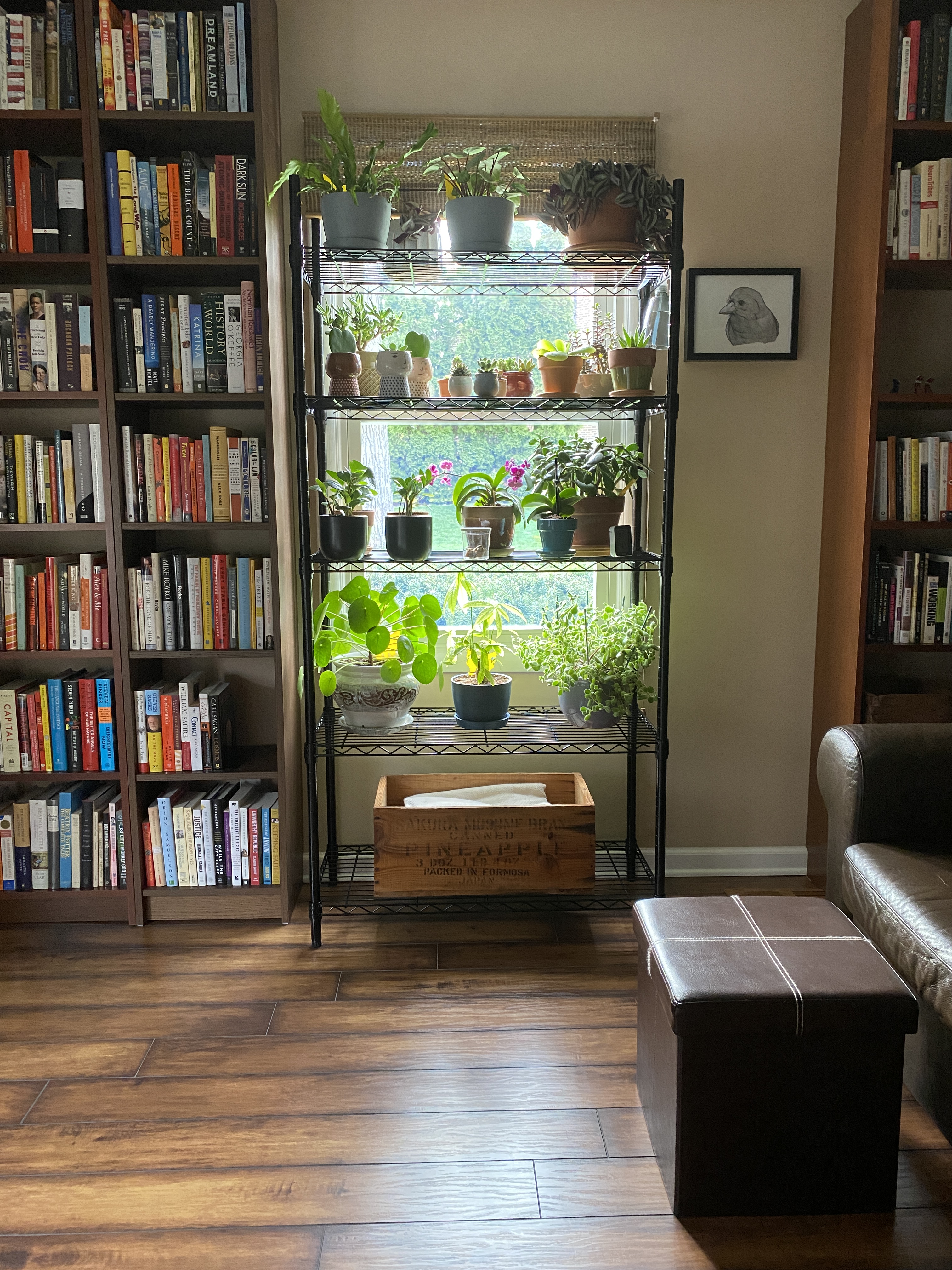
In search of succor, people adopted pets and plants during the uncertain and difficult months of the pandemic. In March 2020, we already had two cats and several houseplants, but successfully splitting the sansevieria, propagating the inchplant, and harvesting pilea sprouts contributed to the increasing number of the latter, as did, yes, a few gifts and purchases. Although the heart of the collection (above) thrives in the girl cave, we now keep plants in the Annex and dining room, too. (And, yes, the orchid has bloomed again.)
Speaking of collections, since my last annotated list, I have read fourteen books, putting me at seventy-three total, fifty-five of which were from my shelves. Right now, I’m reading Book Eleven of The Brothers Karamazov and Joyce Carol Oates’ The Collector of Hearts: New Tales of the Grotesque. On my shelves since 1998, these short stories earned a spot on the nightstand after Tyler Keevil mentioned that they were not only an inspiration for his most recent novel but also works he teaches in his university classes.
■ Elegy for Mary Turner (Rachel Marie-Crane Williams; 2021. Graphic non-fiction.) Related article here.
■ The Dog Stars (Peter Heller; 2012. Fiction.) Review here.
■ Harry Potter and the Prisoner of Azkaban (J.K. Rowling; 1999. Fiction.) ■ Harry Potter and the Goblet of Fire (J.K. Rowling; 2000. Fiction.) Soothing rereads.
■ The Glass Hotel (Emily St. John Mandel; 2020. Fiction.) Excellent. Review here.
■ The Gospel According to Jesus: A New Translation and Guide to His Essential Teachings for Believers and Unbelievers (Stephen Mitchell; 1993. Non-fiction.) Mitchell is a genius.
■ War Music: An Account of Homer’s Iliad (Christopher Logue; 2015. Poetry.) My selection for National Poetry Month.
■ Let the Lord Sort Them: The Rise and Fall of the Death Penalty (Maurice Chammah; 2021. Non-fiction.) Although somewhat drily and awkwardly written, this meticulously researched history is both timely and important. Related article here.
p. 192 Then came the DNA. Beginning in the 1980s, the analysis of genetic material started to be marshaled by defense teams to prove, with an unprecedented degree of scientific certainty, that their clients could not have committed the crimes for which they were sitting in prison. The legal system had always aspired to establish truth, while hedging with language about “reasonable doubt.“ Now the actual truth appeared within reach, and the public and politicians could no longer dismiss innocence claims as desperate efforts to avoid execution. In case after case around the country, men were freed from death row when DNA helped them prove their innocence, and in late 1998, at a conference on wrongful convictions at the Northwestern University School of Law, more than two dozen people exonerated from death row appeared together on a stage. “Had the state of Illinois gotten its way, I’d be dead today,“ one said. The political implications were big: Even if the justice system had not killed someone innocent yet, it had gotten awfully close, over and over again.
■ The Talented Mr. Ripley (Patricia Highsmith; 1955. Fiction.) A reread, for T Book Club. The June selection is Ralph Ellison’s Invisible Man.
p. 89 They were not friends. They didn’t know each other. It struck Tom like a horrible truth, true for all time, true for the people he had known in the past and for those he would know in the future: each had stood and would stand before him, and he would know time and time again that he would never know them, and the worst was that there would always be the illusion, for time, that he did know them, and that he and they were completely in harmony and alike. For an instant the wordless shock of his realization seemed more than he could bear. He felt in the grip of a fit, as if he would fall to the ground. It was too much: the foreignness around him, the different language, his failure, and the fact that Dickie hated him. He felt surrounded by strangeness, by hostility. He felt Dickie yank his hands down from his eyes.
■ Your Still Beating Heart (Tyler Keevil; 2020. Fiction.) For the Cardiff BookTalk. The second-person narrative point of view hasn’t worked this well since Stewart O’Nan’s A Prayer for the Dying, which I must now reread.
■ Measure for Measure (William Shakespeare; 1604. Drama.) As part of my effort to reread all of the plays this year and in advance of the Goodman Theatre stream.
■ The Burning Girl (Claire Messud; 2017. Fiction.) Accidental and worthy complement to Vendela Vida’s We Run the Tides, which I read earlier this year.
p. 111 Sometimes I felt that growing up and being a girl was about learning to be afraid. Not paranoid, exactly, but always alert and aware, like checking out the exits in the movie theater or the fire escape in a hotel. You came to know, in a way you hadn’t as a kid, that the body you in habited was vulnerable, imperfectly fortified.
p. 197 [B]ut this is what I think: you only see what you expect to see. Your brain lets the rest go. Because life’s tumult, with its infinite sounds and smells and signs, rushes around you like a river in flood: you can only take in, you can only grasp, so much.





 Nerdishly