Late August book notes

imageDespite my best intentions, I have only finished four of the ten books I assembled for this post):

You Will Know Me (Megan Abbott; 2016. Fiction.)
My Name Is Lucy Barton (Elizabeth Strout; 2016. Fiction.)
A Study in Scarlet (Sir Arthur Conan Doyle; 1887. Fiction.)
Eileen (Ottessa Moshfegh; 2015. Fiction.)

This puts me at only six books for August, a number that makes sense when I consider that (1) we spent most of the month preparing for our daughters’ departure; (2) we’re all adjusting to new routines and communicating (phone, text, email, packages, etc.) takes much longer now that we all spend most days apart; and (3) I’ve been under the weather for a week… which reminds me: When I was much younger, I had an idea — crafted from a complete misunderstanding of the subtext of stories about genteel characters recovering in sanatoriums — that illness translates into more time to read. I clung to this misinformed idea into my early twenties, when a bout with sinusitis and later with the flu (not a really bad head cold but influenza) taught me that I can’t read — At. All. — when I’m sick. This may be because I am the world’s worst patient, but it may also be that everyone finds it difficult to focus when feverish, congested, drowsy, in pain, coughing, or [insert symptom(s) here].

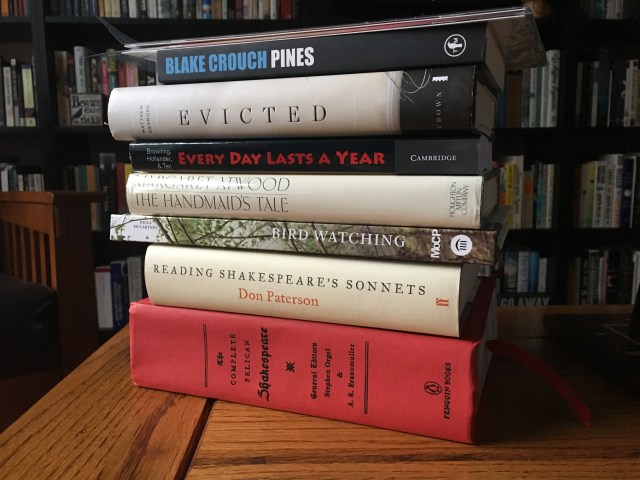
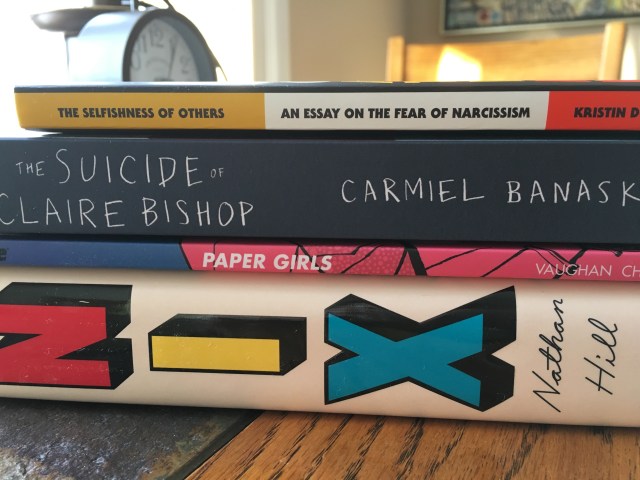
So, six books this month — although if I’m feeling particularly motivated later this afternoon, I may be able to finish Duhigg’s Smarter Faster Better. My current plan for September, though, is simply to return to reading at whim — hence, the rather anonymous-looking stack pictured above.

Regarding the only book I’ve finished this week: I understand how Eileen made the Man Booker Prize longlist, but it was a claustrophobic read for me — too small, too sordid. Two passages made it into my commonplace book, though:

p. 65
Nobody missed me. I know other young women have suffered far worse than this, and I myself went on to suffer plenty, but this experience in particular was utterly humiliating. A psychoanalyst may term it something like a formative trauma, but I know little about psychology and reject the science entirely. People in that profession, I’d say, should be watched very closely. If we were living several hundred years ago, my guess is that they’d all be burned as witches.

p. 256
I don’t know where we went wrong with my family. We weren’t terrible people, no worse than any of you. I suppose it’s the luck of the draw, where we end up, what happens.

Mid-month reading notes

imageWell, we’ve arrived at the month’s midpoint. My reading plans (described in this post) included:

A Study in Scarlet (Sir Arthur Conan Doyle; 1887. Fiction.)
Letters from a Stoic (Seneca; 1494.)
A Woman in Charge: The Life of Hillary Clinton (Carl Bernstein; 2007. Non-fiction.)
The Last Policeman (Ben Winters; 2012. Fiction.)
Shylock Is My Name (Howard Jacobson; 2016. Fiction.)
Eileen (Ottessa Moshfegh; 2015. Fiction.)
My Name Is Lucy Barton (Elizabeth Strout; 2016. Fiction.)
You Will Know Me (Megan Abbott; 2016. Fiction.)
An Astronaut’s Guide to Life on Earth (Col. Chris Hadfield; 2013. Non-fiction.)
Smarter Faster Better (Charles Duhigg; 2016. Non-fiction.)

From the above list, I have already completed:

You Will Know Me (Megan Abbott; 2016. Fiction.)
My Name Is Lucy Barton (Elizabeth Strout; 2016. Fiction.)
A Study in Scarlet (Sir Arthur Conan Doyle; 1887. Fiction.)

Although I have not been following the Games, I couldn’t help but wonder, after reading Abbott’s novel, if I now understand the grim-faced masks women gymnasts don. As for questions about whether Strout’s novel deserves its place on the Man Booker Prize long list, I’d say yes. From My Name Is Lucy Barton:

p. 14
This must be the way most of us maneuver through the world, half knowing, half not, visited by memories that can’t possibly be true. But when I see others walking with confidence down the sidewalk, as though they are free completely from terror, I realize I don’t know how others are. So much of life seems speculation.

p. 170
When Chrissie left for college, then Becka the next year, I thought — and it’s not an expression, I’m saying the truth — I did think I would die. Nothing had prepared me for such a thing. And I have found this to be true: Certain women feel like this, that their hearts have been ripped from their chests, and other women find it very freeing to have their children gone. The doctor who makes me not look like my mother, she asked me what I did when my daughters went to college, and I said, “My marriage ended.” I added quickly, “But yours won’t.” She said, “It might. It might.”

I finished A Study in Scarlet well in advance of the online book club / MOOC outline because much of the rest of the month is already spoken for.

From A Study in Scarlet, Part I, Chapter V:
“It was magnificent,” he said, as he took his seat. “Do you remember what Darwin says about music? He claims that the power of producing and appreciating it existed among the human race long before the power of speech was arrived at. Perhaps that is why we are so subtly influenced by it. There are vague memories in our souls of those misty centuries when the world was in its childhood.”

From Part I, Chapter VII:
“All this seems strange to you,” continued Holmes, “because you failed at the beginning of the inquiry to grasp the importance of the single real clue which was presented to you. I had the good fortune to seize upon that, and everything which has occurred since then has served to confirm my original supposition, and, indeed, was the logical sequence of it. Hence things which have perplexed you and made the case more obscure, have served to enlighten me and to strengthen my conclusions. It is a mistake to confound strangeness with mystery. The most commonplace crime is often the most mysterious because it presents no new or special features from which deductions may be drawn. This murder would have been infinitely more difficult to unravel had the body of the victim been simply found lying in the roadway without any of those outré and sensational accompaniments which have rendered it remarkable. These strange details, far from making the case more difficult, have really had the effect of making it less so.”

From Part II, Chapter VII:
“I hardly expected that you would. Let me see if I can make it clearer. Most people, if you describe a train of events to them, will tell you what the result would be. They can put those events together in their minds, and argue from them that something will come to pass. There are few people, however, who, if you told them a result, would be able to evolve from their own inner consciousness what the steps were which led up to that result. This power is what I mean when I talk of reasoning backwards, or analytically.”

I think I will finish Eileen later today, after which I plan to carry on with Shylock Is My Name. Related aside: We saw the Shakespeare’s Globe production of Merchant at the Chicago Shakespeare Theater over the weekend. Haunting. Reviews here and here. And because I so thoroughly disagreed with Steven Franks, I appreciated this bit from Chris Jones’ review:

And yet, just last week, my own newspaper published an editorial, penned by a Washington attorney, arguing, in essence, that “The Merchant of Venice” should never be performed again, on the grounds that it is incurably anti-Semitic.

That’s ridiculous, of course, not least because it is only in performance that the play proves its worth. In the hands of a competent director like Jonathan Munby, “The Merchant of Venice” can and does play as a cautionary tale of the perils of anti-Semitism. His work here in concert with the designer Mike Britton is the best I’ve seen from this oft-in-Chicago director. Only in performance can this be a work about how hate can poison an otherwise prosperous and privileged community, extracting a price on victims and perpetrators alike, destroying all that is good, really. This particular production, which features an especially devastating coda, is especially rich in the painting of that picture.

The other books I have finished this month are

You’re Never Weird on the Internet (Almost) (Felicia Day; 2015. Non-fiction.)
Injection, Volume 2 (Warren Ellis; 2016. Graphic fiction.)

On the shelves

imageEarlier this week, my daughters helped me with yet another large book reorganization project. For the last 5.5 years, the shelves in the master bedroom (three pine bookcases my husband finished for me — complete with our heart-enclosed initials on the back — in 1983, 1985, and 1986) housed my Joyce Carol Oates and Kurt Vonnegut collections, as well as the remnants of my Arthurian literature obsession and my stash of mass paperbacks. The remaining shelves held new acquisitions, which, after being read, would be sold, donated, or blended into the main library.

The obvious flaw in this system was, of course, that my acquisition rate continued to outpace my reading rate — this despite the radical reduction of the former and the uptick in the latter. We were, therefore, routinely shifting “new” acquisitions into the main library before a verdict (Sell? Donate? Keep?) had been rendered. Why? In order to make room for newer and newest acquisitions.

As we prepared to shift and file, my youngest suggested that the bedroom become a more static collection. Brilliant! Shakespeare, Sherlock, Melville, Fitzgerald, poetry, and the volumes of Lyttleton / Hart-Davies Letters joined Oates, Vonnegut, and Arthur; the smallest (and oldest) of the original bookcases, which serves as my nightstand, became a true TBR station; and the main library, which stretches from the living room, over to the piano room, down the hallway, and into the so-called “girl cave” (essentially, a second living room) was shifted to accommodate all of the rest. Several boxes of books were donated, and we brought three large bags of books and movies to Half-Price Books over the weekend.

Between that project and preparing my daughters for their move to university, I haven’t read as much as I had planned this week, but I will be able to post some notes tomorrow.

August reading plans

IMG_0135

A Study in Scarlet (Sir Arthur Conan Doyle; 1887. Fiction.)
Letters from a Stoic (Seneca; 1494.)
A Woman in Charge: The Life of Hillary Clinton (Carl Bernstein; 2007. Non-fiction.)
The Last Policeman (Ben Winters; 2012. Fiction.)
Shylock Is My Name (Howard Jacobson; 2016. Fiction.)
Eileen (Ottessa Moshfegh; 2015. Fiction.)
My Name Is Lucy Barton (Elizabeth Strout; 2016. Fiction.)
You Will Know Me (Megan Abbott; 2016. Fiction.)
An Astronaut’s Guide to Life on Earth (Col. Chris Hadfield; 2013. Non-fiction.)
Smarter Faster Better (Charles Duhigg; 2016. Non-fiction.)

Although I prefer to, as Sheila says, “read at whim,” I have had some luck this year with assembling small stacks and making my way through them. This one seems built to work.

Some notes: The Doyle is for the online book club / MOOC in which I participate, and I am already halfway through the Duhigg. (In 2012, I received a review copy of Duhigg’s The Power of Habit and thoroughly enjoyed it. While somewhat engaging, this latest effort seems slapped together from research assembled when that earlier book was being written.) I’m motivated to complete Jacobson’s entry in the Hogarth Shakespeare series before we see The Merchant of Venice. The Last Policeman, Eileen, My Name Is Lucy Barton, and You Will Know Me were shelved in my bedroom, which is as good as saying, “They were already on a TBR stack.” My youngest maintains that Astronaut’s Guide will be the perfect antidote to the angsty whine of Lab Girl. I put Seneca’s Letters and the Clinton bio on my summer reading shelf in May, then promptly forgot they were there! The former will be perfect for the drive home from university, eh? And the latter will probably be read in bites over this month and next.

Reading and watching

This month, I finished seventeen books —

seven novels:

Where They Found Her (Kimberly McCreight; 2015. Fiction.)
The Hidden Child (Camilla Läckberg; 2014. Fiction.)
Wonder (RJ Palacio; 2012. Fiction.)
The Easter Parade (Richard Yates; 1976. Fiction.)
The Elementals (Michael McDowell; 1981. Fiction.)
I’m Thinking of Ending Things (Iain Reid; 2016. Fiction.)

one play:

The Merchant of Venice (William Shakespeare; 1599. Drama.)

one collection of short stories:

Dubliners (James Joyce; 1914. Fiction.)

two non-fiction titles:

The Curse of the Good Girl (Rachel Simmons; 2009. Non-fiction.)
Lab Girl (Hope Jahren; 2016. Non-fiction.)

and six works of graphic fiction:

Huck, Volume 1 (Mark Millar; 2016. Graphic fiction.)
Kill Shakespeare, Volume 3: The Tide of Blood (Conor McCreery Millar; 2013. Graphic fiction.)
Fell, Volume 1, Feral City (Warren Ellis; 2007. Graphic fiction.)
Injection, Volume 1 (Warren Ellis; 2015. Graphic fiction.)
Trees, Volume 1 (Warren Ellis; 2015. Graphic fiction.)
Skim (Mariko Tomaki; 2008. Graphic fiction.)

Right now, I’m in more of a watching mood than a reading mood, though. Does that ever happen to you? This afternoon, I’ve been watching the birds in our yards. We’ve had a lot of success with our latest food and feeder configuration: hummingbirds, orioles, and goldfinches, oh, my! Many of the regular visitors have been by, too — jays, cardinals, mourning doves, robins, cowbirds, house finches, black-capped chickadees, red-bellied and downy woodpeckers, and a few grackles, starlings, and house sparrows. And, of course, the Cooper’s hawks. So busy out there!

Now I am toying with watching Episode 4 of Mr. Robot. Gosh, is that a terrific show! Earlier this weekend, my daughters and I watched The Merchant of Venice with Al Pacino as Shylock. It was my second time, and it was just as excellent as the first. We will see the Shakespeare’s Globe production with Jonathan Pryce as Shylock at the Chicago Shakespeare Theater soon, and I so enjoy comparing various interpretations. The three of us are also watching The X Files. We’ve made it to Episode 9 of Season 9, and we think we will finish before they move to their university residence. That said, all of us agree that the show’s reputation outstrips its content, which how we also felt about Buffy the Vampire Slayer. Shrug. Not every program can be Slings & Arrows or LOST, though, right?

Speaking of watching things for a second time, I saw The Dead again this week. The closing paragraph of Joyce’s story is one of my favorites in all of literature, so it was with much scoffing that I first approached Huston’s film nearly thirty years ago. Of course the book will be better, I maintained. How could I have known that it would actually render the story a permanent part of my imagination? Both faithful to its source material and a work of its own many merits, the film draws much of its strength from flawless performances from the entire cast. It also benefits from meticulous attention to period detail and a score that is a character itself. Rewatching the film, I was reminded of its perfection, particularly the emotionally shattering redefinition of the Conroy marriage that occurs in the final scene.

Before I settle in with Mr. Robot I think I will assemble my proposed TBR stack for August. I already own a few of the books on the Man Booker Prize long list, and Lab Girl (which was good, really, but does anyone else wish that all of that imagination and talent had been mixed with less angst and whine?) made me pine for an upbeat if not stoic science memoir, and the Abbott book arrived last Tuesday… I’m off to assemble my pile.

From the stacks

IMG_0103
Sigh. How to explain How to Be Your Dog’s Best Friend and The Other End of the Leash, the first of which I am nearly halfway through? All right. My daughters head off to university next month, and it seemed like as good a time as any to investigate adding a dog to our little company. A project (e.g., training a new companion) would certainly keep me from dwelling on the girls’ absence (overmuch), and multiple daily walks would burn off (some of) my tendency to worry. I had thought I wanted a puppy, but at the shelter, I fell in love with a young new mother whose adorable puppies are about to be put up for adoption. Maybe she and I will work through our separation issues together. We will see….

Speaking of mothers, Cindy Rollins kindly linked my old blog several times back in the day. Her memoir of homeschooling her eight children was released last week, and I wanted to return the favor. Congratulations, Cindy!

And speaking of memoirs, my daughter and I are about halfway through Jahren’s Lab Girl. Given how busy she is and how many books I am reading, that should serve as a recommendation, but if you need more, I tweeted a Los Angeles Review of Books review earlier this week: “A Lab of Her Own.”

The MOOC / online book club in which I participate will complete Dubliners this week. In August, we tackle A Study in Scarlet. With all of the Sherlockian studies our family-centered learning project has undertaken, it’s difficult to believe I have never read this, but I haven’t.

At the bottom of the pictured stack are my flute books. I’m nearly finished with Rubank Intermediate Method, a fact that stuns me a bit, actually. I am on songs 25 and 26 in Forty Little Pieces in Progressive Order, and my teacher has begun adding assignments in the Pares Scales book.

From The Elementals:

There’s no point in advertising a circus when everybody hates the clown.

McDowell’s The Elementals, which appeared in last week’s stack, will likely make my 2016 “best” list. When I was younger, I devoured horror fiction: With my first paycheck I purchased two paperback novels, Stephen King’s The Stand and The Shining. Eventually, I believed I had outgrown the genre, but looking back, I think I had simply been selecting from too shallow a pool. The familiar writers became repetitive, and I moved on. The Elementals, with its engaging dialogue, place as character, and a pervasive sense of danger, has reminded me how good a horror novel can be.

On and near the nightstand

IMG_0083

Neither of the Grimes sisters would have a happy life, and looking back it always seemed that the trouble began with their parents’ divorce.

So begins Richard Yates’ The Easter Parade, a novel that is by turns wry and bleak. Here are two more passages for the commonplace book:

p. 47
But there was more to being an intellectual than a manner of speaking, more even than making the dean’s list every semester, or spending all your free time at museums and concerts and the kind of movies called “films.” There was learning not to be stricken dumb when you walked into a party full of older, certified intellectuals — and not to make the opposite mistake of talking your head off, saying one inane or outrageous thing after another in a hopeless effort to atone for whatever inane or outrageous thing you’d said two minutes before. And if you did make a fool of yourself at parties like that, you had to learn not to writhe in bed afterwards in an agony of chagrin.

p. 79
[B]esides, college had taught her that the purpose of a liberal-arts education was not to train but to free the mind. It didn’t matter what you did for a living; the important thing was the kind of person you were.

This week’s reading in Dubliners yielded a commonplace book entry, too:

From “After the Race”:

Rapid motion through space elates one; so does notoriety; so does the possession of money.

From “Two Gallants”:
Though his eyes took note of many elements of the crowd through which he passed they did so morosely. He found trivial all that was meant to charm and did not answer the glances which invited him to be bold. He knew that he would have to speak a great deal, to invent and to amuse, and his brain and throat were too dry for such a task. The problem of how he could pass the hours till he met Corley again troubled him a little. He could think of no way of passing them but to keep on walking.

This coming week’s reading for the Dubliners MOOC / online book club comprises “Ivy Day in the Committee Room,” “A Mother,” and “Grace,” which leaves “The Dead” for the fourth and final week. (And, yes, that is a different edition than was featured in the picture in last week’s post. What can I say? I wanted endnotes and Colum McCann’s introduction. Totally worth it.)

Later this year, I have a MOOC about the healing power of literature, a topic that has interested me for more than fifteen years. Jonathan Bate, who will lead the course, served as one of the editors of Stressed, Unstressed, a volume that posits that reading poetry (here gathered under such categories as “stopping,” “grieving,” and “living with uncertainty”) acts like a readerly balm on emotional unease. Lab Girl moved from the shelves to a TBR pile because my daughter chose the title as her “prize” for the local library’s summer reading program. We’re hoping to shoehorn it into the four weeks before she and her sister depart for university. Fingers crossed! The Gaiman and Ackerman titles in the stack above are also recent acquisitions, and The Elementals (from the shelves) will be this evening’s companion, as I have already finished the following (unpictured) books from my (unpictured) stacks:

Wonder (RJ Palacio; 2012. Fiction.)
Fell, Volume 1, Feral City (Warren Ellis; 2007. Graphic fiction.)
Injection, Volume 1 (Warren Ellis; 2015. Graphic fiction.)
Trees, Volume 1 (Warren Ellis; 2015. Graphic fiction.)
The Curse of the Good Girl (Rachel Simmons; 2009. Non-fiction.)

Wonder, like Holes (Louis Sachar) and A Long Way from Chicago (Richard Peck) is one of those books for young-ish readers that begs to be a family read-aloud. Tender and touching, the story is being brought to the big screen next year.

Officially mad about Ellis, I am so looking forward to the second volumes of both Injection and Trees. Alas, there is no Volume 2 of Fell, which was easily the best graphic work I’ve read this year. (Speaking of graphic works, did you hear the nerd girl Squeeeeeeee! when I finished Issue #156 of The Walking Dead? “Wait until Rick gets a look at you…” Heh, heh, heh.)

More soon.

Book notes

IMG_0071
Here are a few from the piles, stacks, and shelves.

Shylock Is My Name (Howard Jacobson; 2016. Fiction.)
We will see The Merchant of Venice with Jonathan Pryce at the Chicago Shakespeare Theater next month, so I am reading the Hogarth Shakespeare retelling and rereading the play.

p. 16

He knew what she was nudging him about. One of the traits of his character she had always disliked was his social cruelty. He teased people. Riddled them. Kept them waiting. Made them come to him.

Dubliners (James Joyce; 1914. Fiction.)
I am rereading this for an online book club / MOOC and am once again reminded that many books were wasted on younger versions of me. Of the many valuable resources the club / course has provided so far, I thought the link to Mark O’Connell’s “Have I Ever Left It?” (Slate, May 2014) was particularly worthwhile.

From the conclusion of “Araby”:

Gazing up into the darkness I saw myself as a creature driven and derided by vanity; and my eyes burned with anguish and anger.

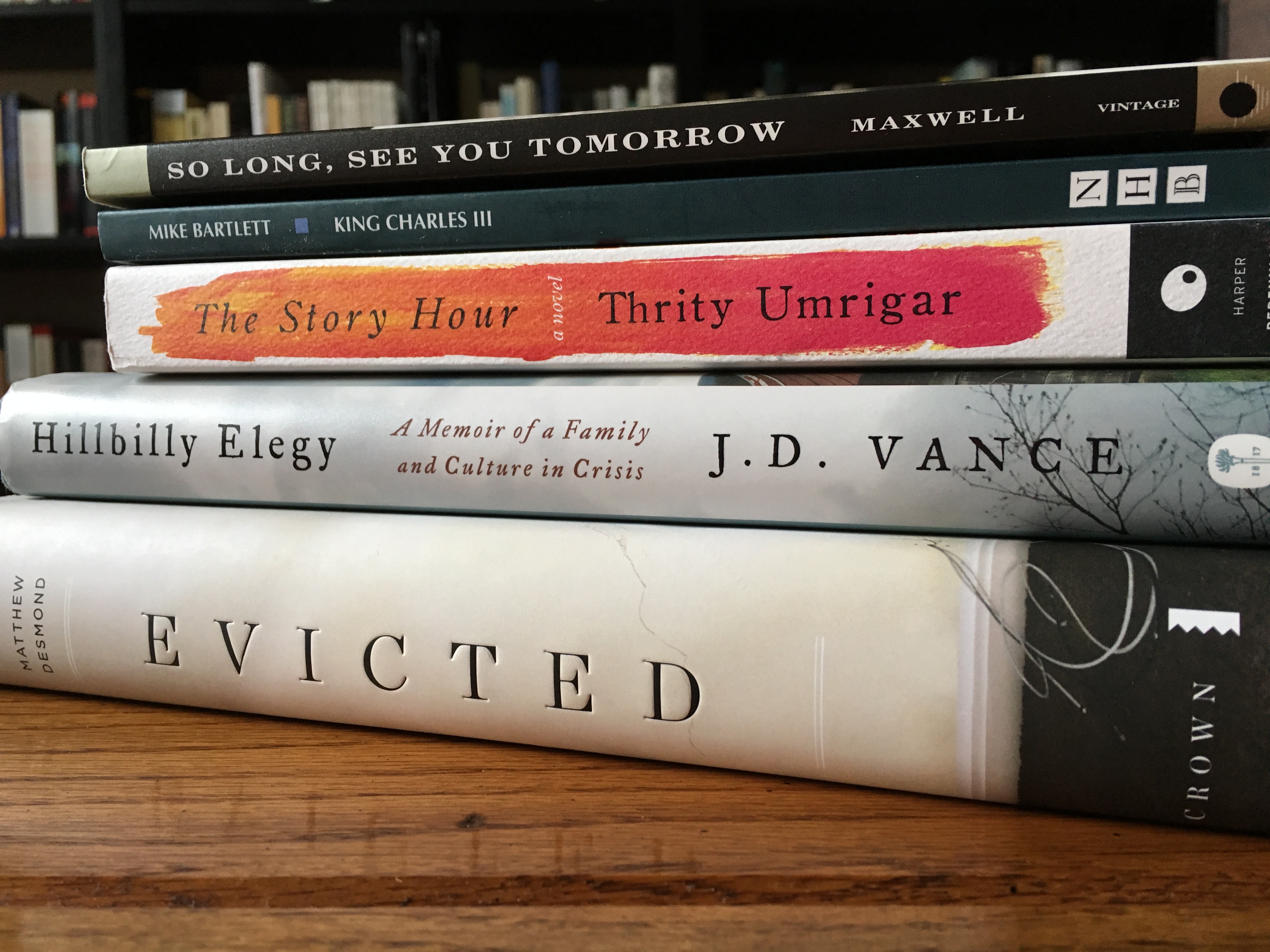
Hillbilly Elegy: A Memoir of a Family and Culture in Crisis (J.D. Vance; 2016. Non-fiction.)
I picked this up after reading after reading Vance’s piece on The Huffington Post.

p. 7
The problems that I saw at the tile warehouse run far deeper than macroeconomic trends and policy. Too many young men immune to hard work. Good jobs impossible to fill for any length of time. And a young man with every reason to work — a wife-to-be to support and a baby on the way — carelessly tossing aside a good job with excellent health insurance. More troublingly, when it was all over, he thought something had been done to him. There is a lack of agency here — a feeling that you have little control over your life and a willingness to blame everyone but yourself. This is distinct from the larger economic landscape of modern America.

p. 9
But I love these people, even those to whom I avoid speaking for my own sanity. And if I leave you with the impression that there are bad people in my life, then I am sorry, both to you and to the people so portrayed. For there are no villains in this story. There’s just a ragtag band of hillbillies struggling to find their way — both for their sake, and by the grace of God, for mine.

Fell, Vol. 1: Feral City (Warren Ellis; 2007. Graphic fiction.)

In defense of book collecting

IMG_5643
From the opening of Michael Robbins’ article “In defense of book collecting” (Chicago Tribune, June 26):

As of this writing there are 1,790 books in my apartment, some couple hundred in my campus office, and an unknown number floating about on loan to various friends and students. This represents a decrease of probably 20 percent from the height of my mania. Over the past few years, I have embarked on culling operations, boxing up hundreds of books and carting them to used bookstores. Spilling off shelves, piled in tottering stacks on every flat surface and a few angular ones, the books are snowing me under.

He had me at “Hello,” of course, but this bit slayed me:

Even after my latest and severest cull, I own three translations of “War and Peace,” a book I read about 150 pages of in high school and never opened again. “Some day!” the sirens sing to the book collector.

In his December 17, 2008 column for the Sun-Times, Neil Steinberg described reading War and Peace aloud to his son:

I am currently reading War and Peace, out loud to my older son, and we’re both loving it, not because it gives us something to brag about, but because it’s great. When Tolstoy describes a horse, it’s like an actual horse canters into the room, twitching and snorting. When Natasha jumps into her mother’s bed to tell the old countess about Prince Andrei, it could be any 16-year-old girl gushing about her dreamboat. It’s real.

When I first shared the link to that piece, I confessed to having acquired three translations of the tome:

war and peace1. Translated by Rosemary Edmonds; acquired in 1991

2. Translated by Anthony Briggs; acquired in February 2007

3. Translated by Richard Pevear and Larissa Volokhonsky; acquired in December 2007

Eight years, a move, and several culling operations later, I still have the Briggs and the Pevear/Volokhonsky, and, as Robbins suggests, the sirens still sing “Some day!’ to this book collector. At nearly seven thousand volumes, my collection has decreased about thirty-five percent since the height of my mania. Our move to the forever home resulted in the greatest cull, to date: It was the one in which the Edmonds translation was released. In the next major cull in 2014, I jettisoned more than ninety percent of the remaining home education materials and all but the treasured volumes in the children’s literature collection. Although I was once interested in YA trends, the genre has lost most of its appeal, which resulted in a mini-cull late last year and will likely result in another in the fall. And some books are now released soon after being read — for example, my “beach books.”

“You live in a library!” the mail carrier admired as he handed me another stack of deliveries. Well, yes. Sort of. It’s actually more of an antilibrary, though, as more than half of its contents are books I haven’t yet read. This once embarrassed me. Now it alternately enlivens and frightens me. From early in Nassim Nicholas Taleb’s The Black Swan: The Impact of the Highly Improbable:

The writer Umberto Eco belongs to that small class of scholars who are encyclopedic, insightful, and nondull. He is the owner of a large personal library (containing thirty thousand books), and separates visitors into two categories: those who react with “Wow! Signore professore dottore Eco, what a library you have! How many of these books have you read?” and the others — a very small minority — who get the point that a private library is not an ego-boosting appendage but a research tool. Read books are far less valuable than unread ones. The library should contain as much of what you do not know as your financial means, mortgage rates, and the currently tight real-estate market allows you to put there. You will accumulate more knowledge and more books as you grow older, and the growing number of unread books on the shelves will look at you menacingly. Indeed, the more you know, the larger the rows of unread books. Let us call this collection of unread books an antilibrary.

All of this book talk reminds me of another bit from Lionel Shriver’s The Mandibles:

The Stackhouses had also banished the busy clunk of books that cluttered all three stories of her parents’ jumbled brick house in Carroll Gardens. Nothing betrayed you as a fuddy-duddy like parallels of shabby spines junking up the walls. Once you’d read a book, why retain it in three dimensions, save as a form of boasting? Now that you could balance the Library of Congress on your fingertip, dragging countless cartons of these spent objects from home to home was like moving with your eggshells.

And that reminds me of our move from Southern California to Chicago just before Christmas 1993. The movers were delayed twice and were rough with our belongings once they arrived in the city. Among other offenses, they tore our mattress, chipped two bookcases and a chest of drawers, and bent the handle of our new refrigerator. When they were finally, finally gone, we began unpacking in the kitchen. In the second box we found, carefully wrapped in paper towel and bubble wrap, the eggshells from the muffins I was making when the movers arrived to pack up our home two weeks earlier.

Some book notes

IMG_7397

About the photo
■ The McCreight was a good beach read (even if I had solved much of its mysteries well before the midpoint and the central mystery almost upon “meeting” the character). I read her debut, Reconstructing Amelia, a couple of years ago. That’s the better book.

This post inspired me to tug the Booth book from the shelves.

This article prompted an impulse purchase.

The Mandibles… How is it possible that each Lionel Shriver novel I read is better than the last? I am made speechless by the humor and horror she wrings from a believably developed economic collapse and the slow apocalypse that follows, so I encourage you to read Jean’s remarks at Necromancy Never Pays. Her post includes a number of quotes from the book, but here is one I pressed into my commonplace book:

p. 15
Since the Stonage, he’d had an ear for it. Everyone else thought that the worst was behind them; order had been gloriously and permanently restored. But for Willing, during his own seminal where-were-you-then occasion at the grand old age of eight, The Day Nothing Went On had been a revelation, and revelations did not un-reveal themselves; they did not fit back into the cupboard. As a consequence of this irreversible epiphany, he had learned to upend expectations. There was nothing astonishing about things not working, about things falling apart. Failure and decay were the world’s natural state. What was astonishing was anything that worked as intended, for any duration whatsoever.

■ My youngest and I were alternately fascinated and horrified by the 2012 article “How Your Cat Is Making You Crazy” (The Atlantic). So, yes, I had to pick up McAuliffe’s book. I placed the order in response to this letter from Jeff Deutsch, director of the Seminary Co-op Bookstores.

If every current member bought one additional book from us this year and then convinced a friend, family member or colleague to do the same, we would double our sales and nearly eliminate our operating deficit. I am asking you to advocate on behalf of this business with the same passion that you would if you were the sole owner.

Consider placing an order, won’t you? You were going to buy a book this week. You know it. I know it. Place the order with the Seminary Co-op Bookstores. Thank you.

Not about the photo
■ Fifteen of the sixty-five books I’ve completed to date have been works of graphic fiction; ten have been plays; and eleven have been non-fiction titles. I had (unspoken) goals of reading at least twenty-six non-fiction books this year and at least four volumes of poetry. Obviously, at eleven and zero, I am not poised to reach them; however, putting the goals in writing may increase the odds that I will, at the very least, try harder.

■ Of the twenty-nine novels I’ve read so far this year, the standouts comprise:

The Shawl (Cynthia Ozick; 1990. Fiction.)
Mr. Penumbra’s 24-Hour Bookstore (Robin Sloan; 2013. Fiction.)
The Sparrow (Mary Doria Russell; 1996. Fiction.)
Heart of Darkness (Joseph Conrad; 1899. Fiction.)
A Good School (Richard Yates; 1978. Fiction.)
The Girls (Emma Cline; 2016. Fiction.)
The Mandibles: A Family, 2029-2047 (Lionel Shriver; 2016. Fiction.)
The Only Ones (Carola Dibbell; 2015. Fiction.)

I wrote about The Sparrow, a reread, here. My experience with Conrad’s slim volume served as a sobering reminder that some books were absolutely wasted on younger versions of me. My recommendation of The Girls (and Helter Skelter) last month was probably lost in the chorus, but don’t miss the thoughtful post at The Sheila Variations.