Weekend. Reading.

FullSizeRender(4)
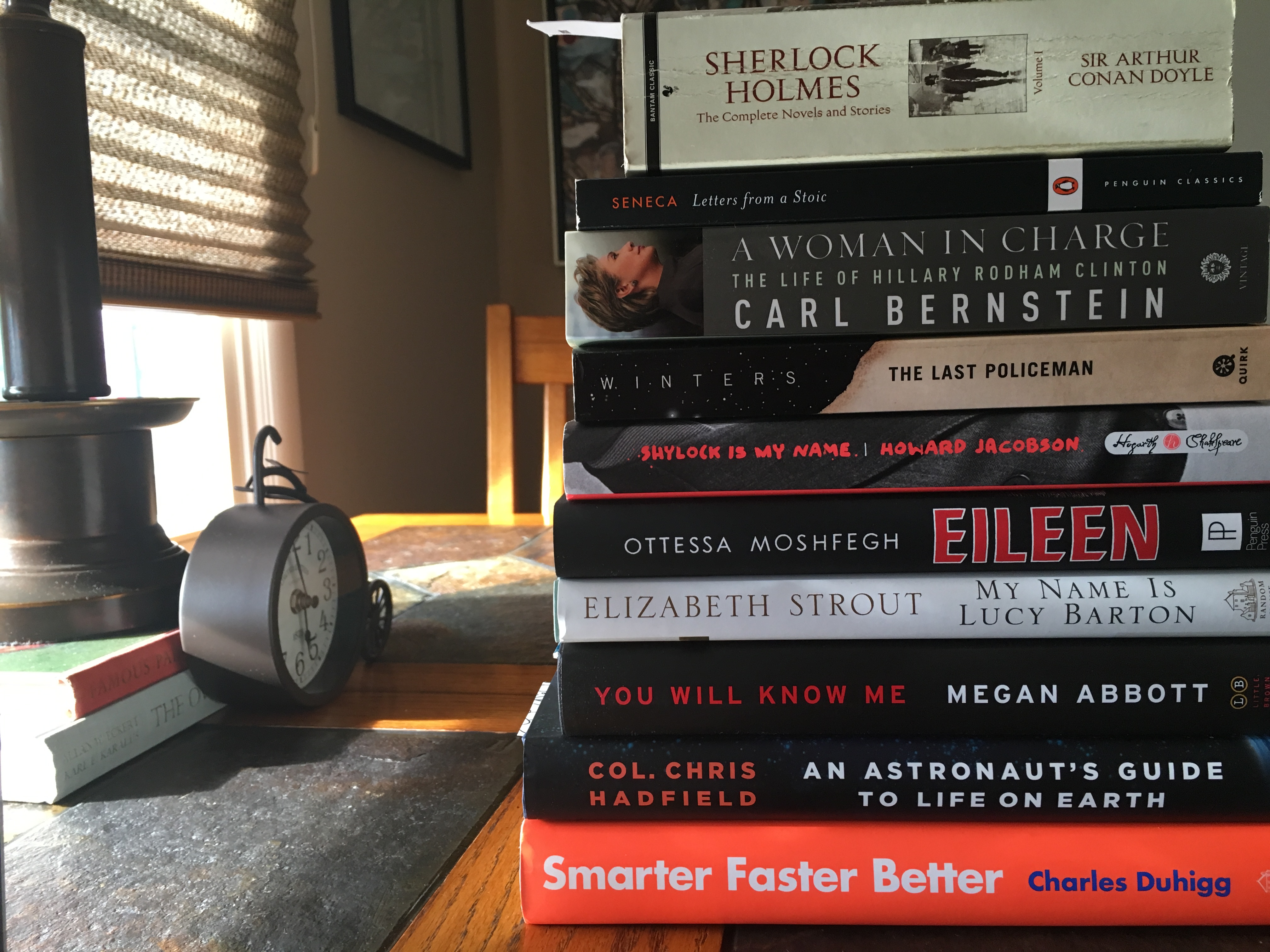
Summer began in earnest this weekend, didn’t it? The wall of heat just beyond our home’s entrances — ugh. Still, we were able to take two ten-mile rides and to sit out in the yards for a time in both the mornings and the evenings. We love to watch our many feathered visitors. With profuse thanks to the air-conditioning gods, we cooked good meals and desserts this weekend, too, and practiced music, studied, finished Season 7 of The X Files, and, of course, read.

After swallowing whole Emma Cline’s The Girls (which is a recommendation, of course), I went in search of my copy of Helter Skelter and finally read it (which is another recommendation — of both the novel and the non-fiction work). Cline nailed the idea of a girl’s search for self-definition in the measuring looks / glances of others, particularly men. One reviewer took the novelist to task for not immersing Evie in the cult’s horror, but to me, that was the point: She was defined by her association, however brief or peripheral.

For the commonplace book:

p. 27
Back then, I was so attuned to attention. I dressed to provoke love, tugging my neckline lower, settling a wistful stare on my face whenever I went out in public that implied many deep and promising thoughts, should anyone happen to glance over. As a child, I had once been part of a charity dog show and paraded around a pretty collie on a leash. How thrilled I’d been at the sanctioned performance: the way I went up to strangers and let them admire the dog, my smile as indulgent and constant as a salesgirl’s, and how vacant I’d felt when it was over, when no one needed me anymore.

I waited to be told what was good about me. I wondered later if this was why there were so many more women than men at the ranch. All that time I had spent readying myself, the articles that taught me life was really just a waiting room until someone noticed you — the boys had spent that time becoming themselves.

p. 99
The possibility of judgment being passed on me supplanted any worries or questions I might have about Russell. At that age, I was, first and foremost, a thing to be judged, and that shifted the power in every interaction onto the other person.

p. 103
There are those survivors of disasters whose accounts begin with the tornado warning or the captain announcing engine failure, but always much earlier in the timeline: an insistence that the noticed a strange quality to the sunlight that morning or excessive static in their sheets. A meaningless fight with a boyfriend. As if the presentiment of catastrophe wove itself into everything that came before.

Did I miss some sign? Some internal twinge?

p. 351
It was a gift. What did I do with it? Life didn’t accumulate as I’d once imagined. […] I paid bills and bought groceries and got my eyes checked while the days crumbled away like debris from a cliff face. Life a continuous backing away from the edge.

And from Helter Skelter:

p. 52
Autopsy reports are abrupt documents. Cold, factual, they can indicate how the victims died, and give clues as to their last hours, but nowhere in them do their subjects emerge, even briefly, as people. Each report is, in its own way, the sum total of a life, yet there are very few glimpses as to how that life was lived. No likes, dislikes, loves, hates, fears, aspirations, or other human emotions; just a final, clinical summing up: “The body is normally developed… The pancreas is grossly unremarkable… The heart weighs 340 grams and is symmetrical…”

Yet the victims had lived, each had a past.

In and on my stacks

FullSizeRender(3)

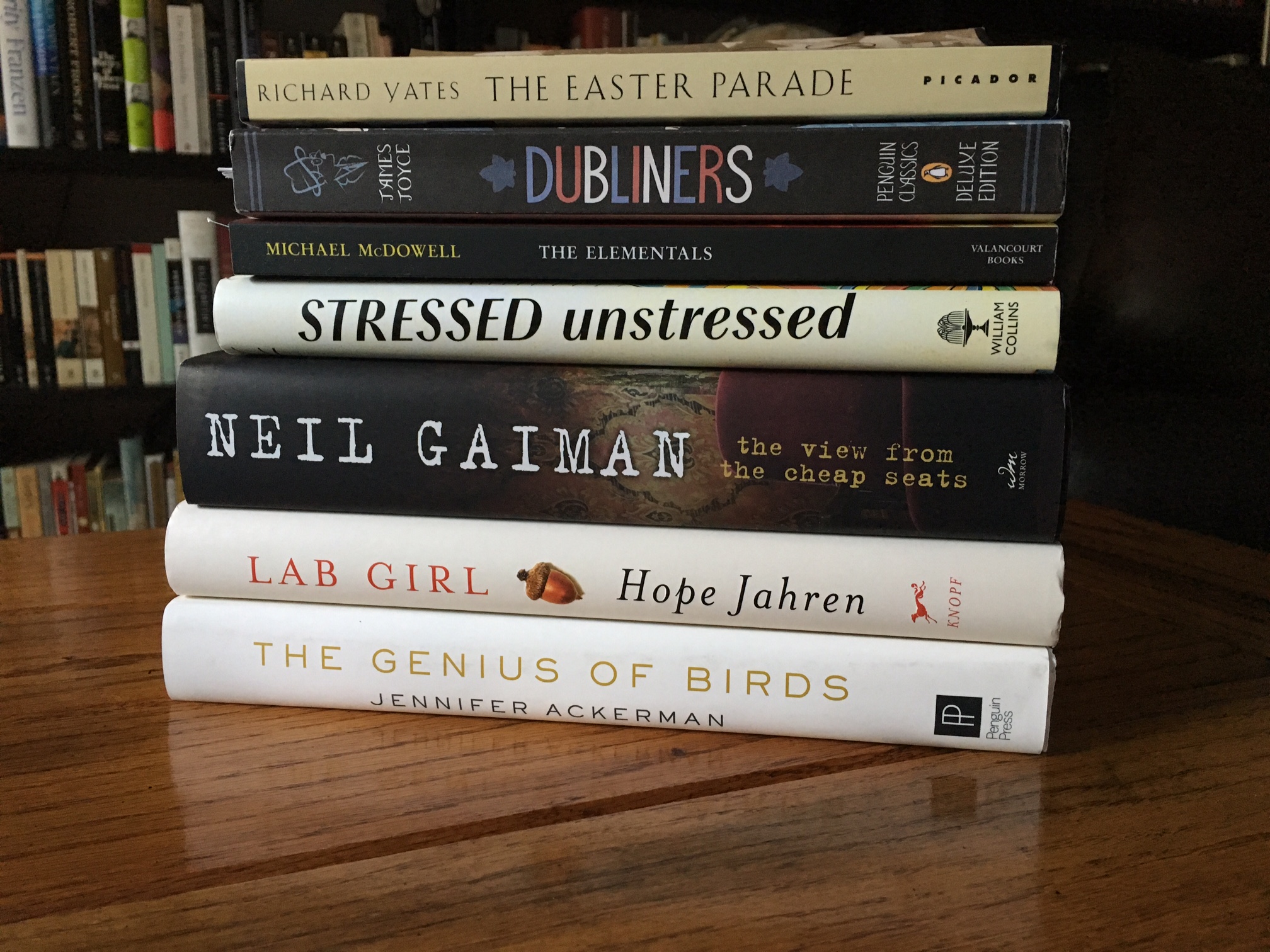
It has been three months since my last bookish post, but I attempt to keep my list current, even when I haven’t enough time to write. With forty-nine books, I am (slightly) exceeding my (modest) goal of two books per week. As I’ve mentioned before, I am a promiscuous reader, loving, leading on, leaving in various states of undress many, many more books than that number would indicate, but I generally include only the cover-to-covers in my list; hence, forty-nine.

Random reading notes:

■ How is it possible that two decades have passed since I first read The Sparrow and breathlessly pressed it on my husband? Twenty years. Well, Russell’s unusual and wonderful novel — with its astronomy-, music-, language-, relationship-, anthropology-, and religion-infused discussions — was the first selection for the summer session of our family book club, and the novel was even better on rereading.

p. 278
Standing in the hallway, John Candotti and Edward Behr could hear half of the conversation taking place inside the Father General’s office quite clearly. It was not necessary to eavesdrop. It was only necessary not to be deaf.

“None of it was published? You are telling me that not one article we sent back was submitted–”

“Maybe we shouldn’t have told him,” John whispered, rubbing the bump on his broken nose.

“He was bound to find out eventually,” said Brother Edward placidly. Anger, he believed, was healthier than depression.

Amen, Brother Edward. Amen.

■ Last year, Roger Rosenblatt’s Kayak Mornings left me cold, but this year, Making Toast, his earlier memoir about loss and grief, seemed to meander less and, therefore, mean more to me.

p. 39
Because I could not understand why she died, I sought to make other things less confusing. I cleaned out junk-closets, gave order to a chaotic shelf of CDs, and cleared an ivy-choked area of the yard.

■ Has anyone else picked up Joe Hill’s The Fireman? It would have been a passable beach read had it not been too long by four hundred pages and had it not suffered so much in (inevitable) comparison to Stephen King’s The Stand. The parallels to his father’s novel were, apparently, intentional:

Two-thirds into writing the book, it suddenly hit me how much The Fireman parallels The Stand. There were some strong threads connecting the two. So, do you run from that? I think it’s more fun to embrace your influences than to try to bury them.

Read the complete interview here. Our family book club’s “reach goal” for last summer was to finish The Stand, a reread for me and for my husband. Only he succeeded, but he does listen to audiobooks while commuting, so he has an advantage over the rest of us. The remaining members have recommitted to finishing by mid-August.

■ I think all of my favorite lines from Cardenio belong to the (wrongfully) much maligned Doris. Early on:

To be honest, I’ve never understood
Why I shouldn’t tell the truth.
I mean the assumption that this is beneficial to the world,
to be nice, to be pleasant,
is just unproven.

[Is she suddenly close to tears?]

Difficult people are always the ones who advance civilization.

And much later:

Well, there’s a mature decision!
What are the odds, Anselmo,
that your second marriage will last as long as your first?

It’s a comment on the excellence of the Shakespeare Project of Chicago that they made this rather tedious work so watchable. For more information about “Shakespeare’s lost work,” visit The Cardenio Project.

■ I have read five more graphic collections since my last post, for a total of ten, to date. While, I am enjoying all of the series, none is a “gateway” volume. If you seek one, though, it’s Brian K. Vaughan’s Y: The Last Man or Jeff Lemire’s Sweet Tooth.

A Good School is, quite possibly, the best book I’ve read this year — which may have been the same thing I said about Richard Yates’ Revolutionary Road eight years ago. In “The Lost World of Richard Yates” (Boston Review, October/November 1999), Stewart O’Nan wrote:

Once the most vaunted of authors–praised by Styron and Vonnegut and Robert Stone as the voice of a generation–he seems now to belong to that august yet sad category, the writer’s writer. Andre Dubus, who was his student at Iowa, revered him, as does Tobias Wolff, and the jackets of Yates’s books are adorned with quotes by the likes of Tennessee Williams and Dorothy Parker, Ann Beattie and Gina Berriault. When authors talk his name pops up as the American writer we wish more people would read, just as Cormac McCarthy’s used to. In the acknowledgments section of his novellas, Women With Men, Richard Ford makes it plain: “I wish to record my debt of gratitude to the stories and novels of Richard Yates, a writer too little appreciated.”

With his insightful and ranging appreciation, O’Nan — also a writer too little appreciated (if you are not familiar with his work, begin with A Prayer for the Dying and Last Night at the Lobster) — all but ensured that Yates would be revisited: Many of Yates’ books are, of course, back in print, and his “painful and sad” first novel received big-screen treatment in 2008. In fact, I finally saw the film last week, which led to the mentally intoned assertion, “The book was better,” and to the shelves, where several Yates titles awaited me. By the way, fans of John Williams’ Stoner will also appreciate A Good School.

From Revolutionary Road:

p. 59-60
And even after politics had palled there had still been the elusive but endlessly absorbing subject of Conformity, or The Suburbs, or Madison Avenue, or American Society Today. “Oh Jesus,” Shep might begin, “you know this character next door to us? Donaldson? The one that’s always out fooling with his power mower and talking about the rat race and the soft sell? Well, listen: did I tell you what he said about his barbecue pit?” And there would follow an anecdote of extreme suburban smugness that left them weak with laughter.

“Oh, I don’t believe it,” April would insist. “Do they really talk that way?”

And Frank would develop the theme. “The point is it wouldn’t be so bad if it weren’t so typical. It isn’t only the Donaldsons—it’s the Cramers too, and the whaddyacallits, the Wingates, and a million others. It’s all the idiots I ride with on the train every day. It’s a disease. Nobody thinks or feels or cares any more; nobody gets excited or believes in anything except their own comfortable God damn mediocrity.”

Milly Campell would writhe in pleasure. “Oh, that’s so true. Isn’t that true, darling?”

They would all agree, and the happy implication was that they alone, the four of them, were painfully alive in a drugged and dying culture.

p. 128-129
“This whole country’s rotten with sentimentality,” Frank said one night, turning ponderously from the window to walk the carpet. “It’s been spreading like a disease for years, for generations, until now everything you touch is flabby with it.”

“Exactly,” she said, enraptured with him.

“I mean isn’t that really what’s the matter, when you get right down to it? I mean even more than the profit motive or the loss of spiritual values or the fear of the bomb or any of those things? Or maybe it’s the result of those things; maybe it’s what happens when all those things start working at once without any real cultural tradition to absorb them. Anyway, whatever it’s the result of, it’s what’s killing the United States. I mean isn’t it? This steady, insistent vulgarizing of every idea and every emotion into some kind of pre-digested intellectual baby food; this optimistic, smiling-through, easy-way-out sentimentality in everybody’s view of life?”

“Yes,” she said. “Yes.”

More book notes will follow.

On the nightstand

Since my last bookish post, I’ve read:

The Invaders (Karolina Waclawiak; 2015. Fiction.)
A Mother’s Reckoning: Living in the Aftermath of Tragedy (Sue Klebold; 2016. Non-fiction.)
In a Dark, Dark Wood (Ruth Ware; 2015. Fiction.)
What She Left Behind (Ellen Marie Wiseman; 2013. Fiction.)
Missoula: Rape and the Justice System in a College Town (Jon Krakauer; 2015. Non-fiction.)
Mr. Penumbra’s 24-Hour Bookstore (Robin Sloan; 2013. Fiction.)
Othello (William Shakespeare; 1603. Drama.)
The Cold Song (Linn Ullmann; 2014. Fiction.)

Notes: I recently concluded a MOOC centered on Othello, which, in addition to supplementary articles and lectures, provided ample motivation to closely reread the play. Although I look forward to seeing the current Chicago Shakespeare Theater production over spring break, my recent encounter with the text reminded me that the play, while meant to be seen and heard, is remarkable reading. The questions on which I reflected included: Is the conclusion inevitable? Is this really a play about race? What are we to make of the women in this play? Are we the audience complicit in Iago’s machinations?

Othello aside, I think I may (finally) be growing too old for unrelentingly sad and/or disturbing novels about dysfunctional families and their communities (e.g., Waclawiak’s tautly written The Destroyers), but Norwegian author Linn Ullmann pulled off something special with The Cold Song, a family drama masquerading as murder mystery. On page 163:

It wasn’t true what they said, that it would gradually become easier to cope with the loss, that time would work in her favor. It had become something of a sport to tell her this and every time they said it she had wanted to lash out, she had wanted to scream, what the hell did they know about time, they hadn’t lost a child, but she couldn’t end it all, she had one more, she couldn’t….

Speaking of murder, In a Dark, Dark Wood was a pleasant way to spend a Saturday afternoon and a pot of coffee. There was nothing pleasant about Krakauer’s Missoula or Klebold’s A Mother’s Reckoning, however. Difficult and heartbreaking, both. On a happier note, I seek admission to the club for readers who loved Mr. Penumbra’s 24-Hour Bookstore. What a charming book.

On the nightstand

A few notes on the books I’ve been reading:

Purge (Sofi Oksanen; 2008. Fiction.)
The sometimes annoying device of toggling time (in this case, the present and the years leading up to during the Soviet occupation of Estonia) and point-of-view is, in this tense novel, effectively employed.

The Shawl (Cynthia Ozick; 1990. Fiction.)

“My niece Stella,” Rosa slowly gave out, “says that in America cats have nine lives, but we — we’re less than cats, so we got three.” She saw that Persky did not follow. She said, “The life after is now. The life before is our real life, at home, where we was born.”

“And during?”

“This was Hitler.”

“Poor Lublin,” Persky said.

“You wasn’t there. From the movies you know it.” She recognized that she had shamed him; she had long ago discovered this power to shame. “After, after, that’s all Stella cares. For me there’s one time only; there’s no after.”

Persky speculated. “You want everything the way it was before.”

“No, no, no,” Rosa said. “It can’t be. I don’t believe in Stella’s cats. Before is a dream. After is joke. Only during stays. And to call it a life is a lie.”

The Book of Jonas (Stephen Dau; 2012. Fiction.)
Unasked, a bookseller pressed this book on me a few years ago, and for some reason, I had thought it was a “feel-good story” about the relationship a soldier and a young person he rescued during a combat mission. This is not that. At. All. To me, the novel read as a meditation on the nature of otherness, on how alone each of us really is. Yes, it concerns war and its senselessness, but it also explores family and loss and grief and isolation, both social and cultural. Highly recommended.

The Bunker, Volume 3 (Joshua Hale Fialkov; 2015. Graphic fiction.)
I have a love-hate relationship with the artwork in this series, but the story has hooked me completely, to the point that I cannot believe I haven’t seen news of its screen, large or small, adaptation.

The Squirrel Mother (Megan Kelso; 2006. Graphic fiction.)
Obstinately and, to this reader, pointlessly obscure.

The Silence of Our Friends (Mark Long; 2012. Graphic fiction.)
Long, whose father was a television reporter during the time of Silence‘s events, draws on childhood recollections to describe the civil unrest in Texas in the 1960s. Well-told story and exceptional artwork.

Deep Work: Rules for Focused Success in a Distracted World (Cal Newport; 2016. Non-fiction.)
That Newport’s suggestions (including “Quit social media”) are obvious goes without saying, but his earnest admonitions may prove helpful to those who are re-evaluating their pursuits.

When Breath Becomes Air (Paul Kalanithi; 2016. Non-fiction.)
For me, Breath is a sentimental companion to Being Mortal, which I read late last year. Moving. Worthwhile. Yet… if you have time for only one, choose Being Mortal. The essence of Breath can be found in Kalanithi’s essay “Before I go” (Stanford Medicine, Spring 2015).

On the nightstand

The Heir Apparent (David Ives; 2011. Drama.)
Although I enjoyed The School for Lies, Ives’ adaptation of Molière’s The Misanthrope, his take on Jean-François Regnard’s Le Légataire universel left me cold. The Heir Apparent, part of the 2015-16 season at the Chicago Shakespeare Theater, is, as Chris Jones reminds readers, a farce. That it’s a farce that should end in half as much time, however, and with far less potty humor was painfully evident in text; it was particularly harrowing in person (as I mentioned here). I actually considered leaving at intermission, in fact. Only the cast’s brilliance prevented me from doing so.

Neighbors (Jan T. Gross; 2001. Non-fiction.)
Our Class (Tadeusz Słobodzianek (adaptation by Ryan Craig); 2009. Drama.)
Earlier this month, I visited the Illinois Holocaust Museum and Education Center. I pulled Neighbors from my shelves that evening, and Gross’ exploration of the senseless horror that occurred in the Polish village of Jedwabne on July 10, 1941, prompted me to read the play inspired by the National Book Award Finalist. Where Neighbors is brisk, relentless, insightful, and disturbing, however, Our Class, which is enslaved by its framing device, fails the material. In fact, had I not read Neighbors, I would have had no real context for events in the play, which culminate in the murder of 1,600 Jews by their friends, schoolmates, and neighbors.

Scored (Lauren McLaughlin; 2011. Fiction.)
A friend mentioned Sesame Credit in our correspondence earlier this month, asking if it didn’t remind me of a YA novel. At the time, I could not locate a conventional news source’s report on China’s “social credit” program, although numerous alarmist links were readily available. I have since read the CNN op-ed “The risks — and benefits — of letting algorithms judge us,” however, and I think she may have been thinking of David Eggers’ The Circle, which is not YA. That said, my search for a related YA title eventually led to Scored, a book that, while competent in its way, yielded few surprises. I did like this, though:

Imani knew that her parents would not have understood. Their grasp of the world was based on an obsolete value system that was probably the root of Imani’s problems. Who else had gifted her with the dusty antique of loyalty, that “disempowering bond”?

Ready Player One (Ernest Kline; 2011. Fiction.)
In which eighties references and geekery abound!

Arcadia (Tom Stoppard; 1993. Drama.)
In an odd scheduling juxtaposition, I saw Marjorie Prime at the Writers Theatre about an hour after leaving the Illinois Holocaust Museum; hence, emotionally speaking, I received a gut-punch followed by a blow to the jaw. Kate Fry and Mary Ann Thebus, who will almost certainly be nominated Jeff Awards, reduced me to tears with their performances in this thought-provoking and timely play, which runs through March 13. Marjorie Prime may well be the last Writers Theatre production in its Books on Vernon location: The new theater space opens in March with Stoppard’s Arcadia. Rosencrantz and Guildenstern Are Dead is one of my favorite works of literature, but I have read no other Stoppard. How delighted I am to have “found” Arcadia. Brilliant. Just brilliant.

By the way, articles in the playbill for Marjorie Prime are responsible for Brian Christian’s The Most Human Human and Nick Bostrom’s Superintelligence moving from my shelves to my nightstand. Other notable titles in my TBR stack include Bertolt Brecht’s The Life of Galileo, the Remy Bumppo production of which will also open in March; Paul Kalanithi’s When Breath Becomes Air; and the third volumes of two graphic series, The Bunker and Letter 44.

The year in books

IMG_6062
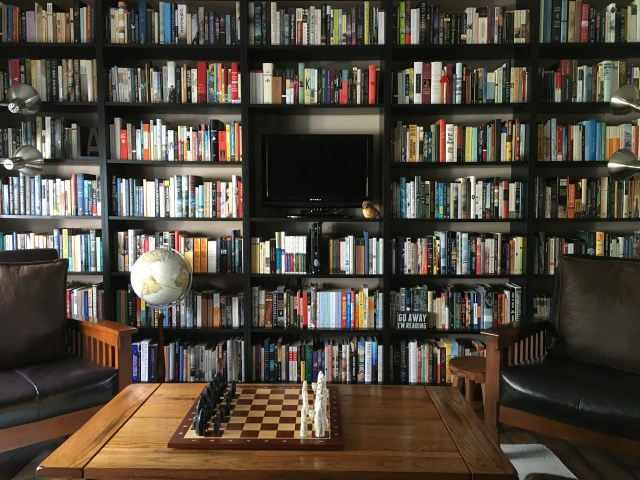
My chief reading goal for 2015 was to read from the shelves of my home library. Although I’ve certainly reduced my, ahem, acquisition habit, I have much room for improvement. Enough said.

I completed 137 books this year. The complete list can be found here. I actually read many, many more (I am an unrepentantly promiscuous reader, bouncing from one book to another, leaving a trail of only just begun, unfinished, and nearly finished books in my wake), but I have listed only books read cover-to-cover. Of those 137 books, 57 were novels (excluding graphic works), nine were plays, 30 were non-fiction titles (again, excluding graphic works), and 41 were graphic works – three of which were non-fiction.

Best Fiction Read in 2015:
Did You Ever Have a Family (Bill Clegg; 2015. 304 pages. Fiction.)
The Other Side of the Mountain (Michel Bernanos; 1967 (2007 edition). 116 pages. Fiction.)
Hermine (Maria Beig; 1984 (2004 translation). 186 pages. Fiction.)
Fates and Furies (Lauren Groff; 2015. 400 pages. Fiction.)
The One and Only Ivan (Katherine Applegate; 2012. 336 pages. Fiction.)
My Wish List (Gregoire Delacourt; 2014. 176 pages. Fiction.)
Passing (Nella Larsen; 1929 (2003). 160 pages. Fiction.)
The Expendable Man (Dorothy B. Hughes; 1963 (2012). 264 pages. Fiction.)

Honorable Mention in Fiction:
The Strange Case of Dr. Jekyll and Mr. Hyde (Robert Louis Stevenson; 1884 (2012). 144 pages. Fiction.)
Private Peaceful (Michael Morpurgo; 2003. 202 pages. Fiction.)
The Water Knife (Paolo Bacigalupi; 2015. 384 pages. Fiction.)
The Subprimes (Karl Taro Greenfeld; 2015. 320 pages. Fiction.)

Best Play Read in 2015:
Marjorie Prime (Jordan Harrison; 2013. Drama.)

Best Non-fiction Read in 2015:
Being Mortal: Medicine and What Matters in the End (Atul Gawande; 2014. 304 pages. Non-fiction.)
Somewhere Towards the End: A Memoir (Diane Athill; 2009. 192 pages. Non-fiction.)

Honorable Mention in Non-fiction:
The Psychopath Test (Jon Ronson; 2011. 288 pages. Non-fiction.)
So You’ve Been Publicly Shamed (Jon Ronson; 2015. 304 pages. Non-fiction.)

Best Graphic Work Read in 2015:
The Collected Essex County (Jeff Lemire; 2009. 512 pages. Graphic Fiction.)

Honorable mention in Graphic Work:
Killing and Dying (Adrian Tomine; 2015. 160 pages. Graphic Fiction.)

Random comments:
Naked Statistics: Stripping the Dread from the Data was certainly a book far afield of my usual choices. This book was really quite terrific, though – informative, accessible, and interesting. Charles Wheelan’s gift is presenting difficult material in a “sticky” manner: Long after I had read Naked Statistics, I remembered concepts and examples.

● Quite simply, Maria Beig’s 1984 novel Hermine is perfect.

From page 154:

Earlier, years earlier, she had tried to tell that kind of story, to explain that kind of experience to other people and herself. In the best cases she had reaped incomprehension for her trouble, more usually disapproval, ridicule most often of all. Inside of her she had a secret chamber for such things. What had happened to her today was already within, and the door shut tight.

● It is said that each of us experiences grief differently. Agreed. No judgment. Let’s just say that I had thought Roger Rosenblatt (Kayak Morning: Reflections on Love, Grief, and Small Boats) and I would have more in common than we actually do.

● I would like to recommend that any reader who has decided graphic works are not for her must read one or both of the following two books:

The Collected Essex County (Jeff Lemire; 2009. 512 pages. Graphic Fiction.)
Killing and Dying (Adrian Tomine; 2015. 160 pages. Graphic Fiction.)

Folks who already appreciate graphic works but missed these two titles are also urged to add them to their library holds.

On the nightstand

Recently finished:

High-Rise (J.G. Ballard; 1975 (2012 reprint). 208 pages. Fiction.)
First published thirty years ago, High-Rise is a slick, smart dystopian parable. Most people are familiar with Ballard’s Empire of the Sun (which was adapted by Spielberg into a film of the same title), but it’s his novels that earned him the adjective “Ballardian.” I liked this brisk work; it felt a bit like Lord of the Flies peopled by suburban adults.

The Martian (Andy Weir; 2014. 384 pages. Fiction.)
I’m not sure I can lend anything original to the general love heaped on Weir’s book. It’s certainly great fun, and we’re looking forward to seeing the movie.

Killing and Dying (Adrian Tomine; 2015. 160 pages. Graphic Fiction.)
If you’re not already a fan of graphic works, I entreat you to set aside any misgivings and/or preconceptions you may have and get a copy of this book now. Yes, this is a well drawn collection; Tomine effortlessly demonstrates what the genre can achieve in capable hands. But more importantly, it is a terrifically told collection, one that elicits involuntary gasps when it reminds us — as the best fiction will — that stories often reveal far greater truths that non-fiction ever could. Tomine demonstrates absolute mastery of the short story form with this work.

The Empty, Volume 1 (Jimmie Robinson; 2015. Graphic Fiction.)
The art was quite beautiful, actually, but the narrative was… “gappy,” for lack of a better word. More, the abrupt resolution makes me wonder if there will even be a Volume 2.

Descender, Volume 1: Tin Stars (Jeff Lemire; 2015. 160 pages. Graphic Fiction.)
Sweet Tooth was my introduction to Lemire, and I greatly admired that series. Descender, which is obviously inspired in part by Iron Giant, Battlestar Galactica, and A.I., is promising.

In progress:

1984 (George Orwell; 1949 (1961 ed.). 328 pages. Fiction.)
A re-read in anticipation of the Steppenwolf production.

Agamemnon (Aeschylus; 458 B.C.E. (1984 ed.). 340 pages. Drama.)
In anticipation of the Court Theatre production.

A Head Full of Ghosts (Paul Tremblay; 2015. 304 pages. Fiction.)
Although I am only 65 pages in, I can already assure you this will be one of my favorite books of the year. What a splendidly well written piece of horror / psychological thriller fiction.

My ideal bookshelf

Three years ago, I pressed My Ideal Bookshelf on anyone who would listen. “If you’re a reader,” I insisted, “you will love this book!” Well, my affection for the book continues unabated, so I’d like to recommend it once again. Your wish list will grow, as will your TBR pile. You will engage in a conversation with each contributor — even if just to exclaim inwardly, Oh! I have that, too! or to furrow your brow, Really? And you will labor over your own “ideal bookshelf.”

DSC_0142

From Ideal Bookshelf:

The books that we choose to keep and display—let alone read—can say a lot about who we are and how we see ourselves. In My Ideal Bookshelf, one hundred leading cultural figures, including writers Chuck Klosterman, Jennifer Egan, and Michael Chabon, musicians Patti Smith and Thurston Moore, chefs and food writers Alice Waters and Mark Bittman, and fashion designers Kate and Laura Mulleavy of Rodarte, reveal the books that matter to them most—books that reflect their obsessions and ambitions and in many cases helped them find their way in the world.

Original paintings by artist Jane Mount showcase the selections, with colorful, hand-lettered book spines and occasional objets d’art from the contributors’ personal bookshelves. The paintings are accompanied by first-person commentary drawn from interviews with editor Thessaly La Force, which touch on everything from the choice of books to becoming a writer to surprising sources of inspiration. This exquisite collection provides rare insight into the creative process and artistic development of today’s most intriguing writers, innovators, and visionaries.