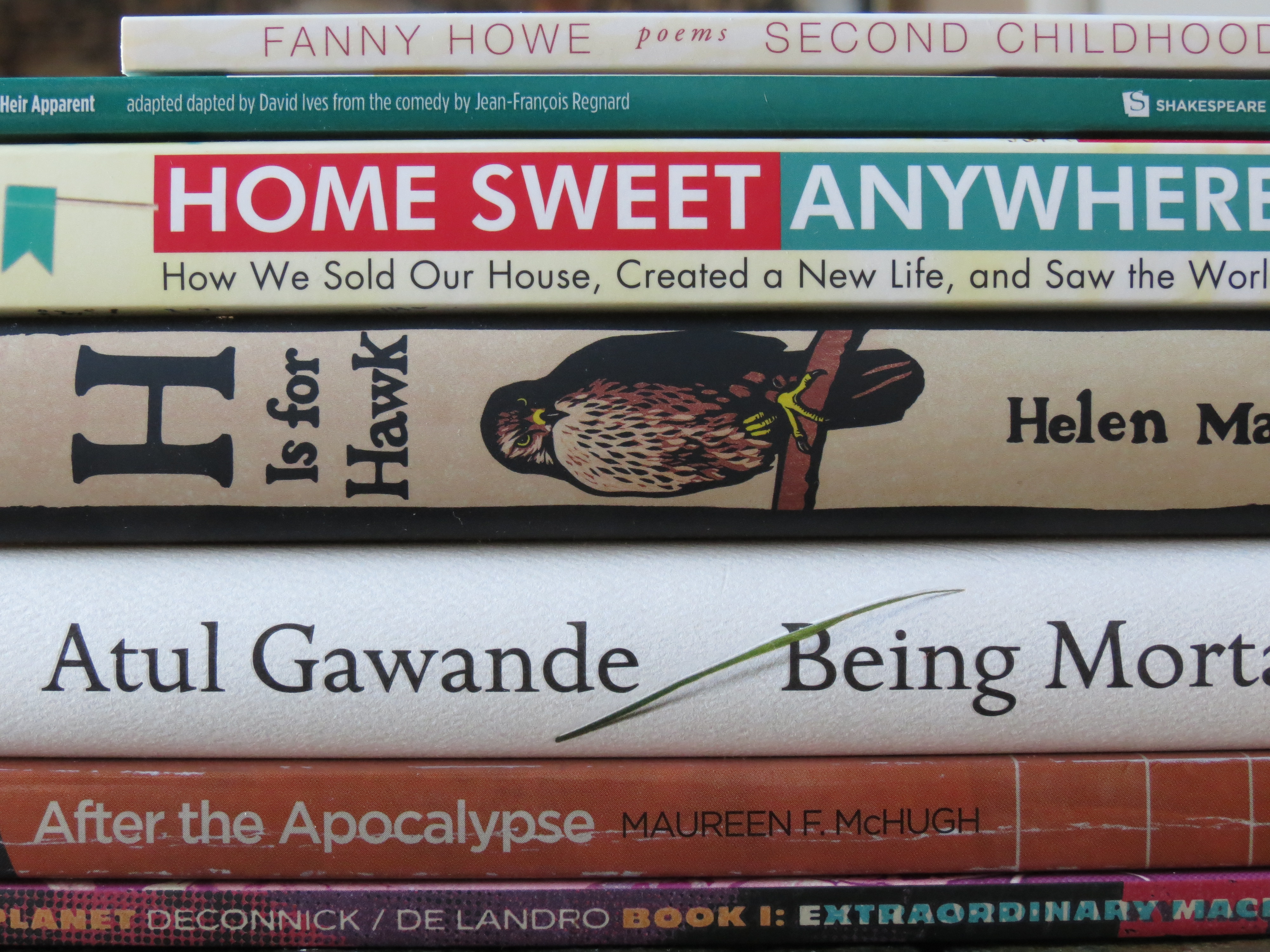
On the nightstand

A few notes on the books I’ve been reading:

Purge (Sofi Oksanen; 2008. Fiction.)
The sometimes annoying device of toggling time (in this case, the present and the years leading up to during the Soviet occupation of Estonia) and point-of-view is, in this tense novel, effectively employed.

The Shawl (Cynthia Ozick; 1990. Fiction.)

“My niece Stella,” Rosa slowly gave out, “says that in America cats have nine lives, but we — we’re less than cats, so we got three.” She saw that Persky did not follow. She said, “The life after is now. The life before is our real life, at home, where we was born.”

“And during?”

“This was Hitler.”

“Poor Lublin,” Persky said.

“You wasn’t there. From the movies you know it.” She recognized that she had shamed him; she had long ago discovered this power to shame. “After, after, that’s all Stella cares. For me there’s one time only; there’s no after.”

Persky speculated. “You want everything the way it was before.”

“No, no, no,” Rosa said. “It can’t be. I don’t believe in Stella’s cats. Before is a dream. After is joke. Only during stays. And to call it a life is a lie.”

The Book of Jonas (Stephen Dau; 2012. Fiction.)
Unasked, a bookseller pressed this book on me a few years ago, and for some reason, I had thought it was a “feel-good story” about the relationship a soldier and a young person he rescued during a combat mission. This is not that. At. All. To me, the novel read as a meditation on the nature of otherness, on how alone each of us really is. Yes, it concerns war and its senselessness, but it also explores family and loss and grief and isolation, both social and cultural. Highly recommended.

The Bunker, Volume 3 (Joshua Hale Fialkov; 2015. Graphic fiction.)
I have a love-hate relationship with the artwork in this series, but the story has hooked me completely, to the point that I cannot believe I haven’t seen news of its screen, large or small, adaptation.

The Squirrel Mother (Megan Kelso; 2006. Graphic fiction.)
Obstinately and, to this reader, pointlessly obscure.

The Silence of Our Friends (Mark Long; 2012. Graphic fiction.)
Long, whose father was a television reporter during the time of Silence‘s events, draws on childhood recollections to describe the civil unrest in Texas in the 1960s. Well-told story and exceptional artwork.

Deep Work: Rules for Focused Success in a Distracted World (Cal Newport; 2016. Non-fiction.)
That Newport’s suggestions (including “Quit social media”) are obvious goes without saying, but his earnest admonitions may prove helpful to those who are re-evaluating their pursuits.

When Breath Becomes Air (Paul Kalanithi; 2016. Non-fiction.)
For me, Breath is a sentimental companion to Being Mortal, which I read late last year. Moving. Worthwhile. Yet… if you have time for only one, choose Being Mortal. The essence of Breath can be found in Kalanithi’s essay “Before I go” (Stanford Medicine, Spring 2015).
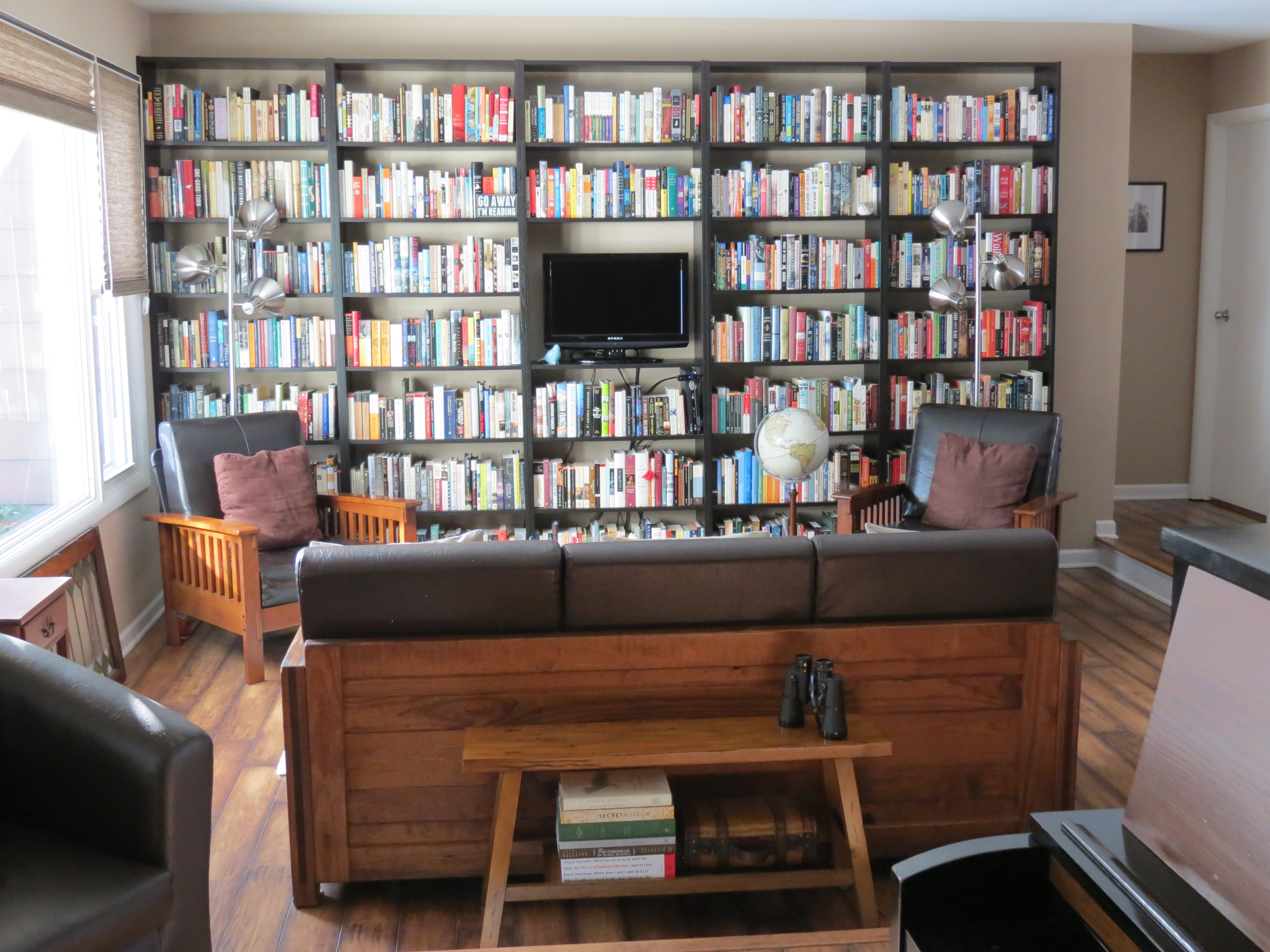
On the nightstand

The Heir Apparent (David Ives; 2011. Drama.)
Although I enjoyed The School for Lies, Ives’ adaptation of Molière’s The Misanthrope, his take on Jean-François Regnard’s Le Légataire universel left me cold. The Heir Apparent, part of the 2015-16 season at the Chicago Shakespeare Theater, is, as Chris Jones reminds readers, a farce. That it’s a farce that should end in half as much time, however, and with far less potty humor was painfully evident in text; it was particularly harrowing in person (as I mentioned here). I actually considered leaving at intermission, in fact. Only the cast’s brilliance prevented me from doing so.

Neighbors (Jan T. Gross; 2001. Non-fiction.)
Our Class (Tadeusz Słobodzianek (adaptation by Ryan Craig); 2009. Drama.)
Earlier this month, I visited the Illinois Holocaust Museum and Education Center. I pulled Neighbors from my shelves that evening, and Gross’ exploration of the senseless horror that occurred in the Polish village of Jedwabne on July 10, 1941, prompted me to read the play inspired by the National Book Award Finalist. Where Neighbors is brisk, relentless, insightful, and disturbing, however, Our Class, which is enslaved by its framing device, fails the material. In fact, had I not read Neighbors, I would have had no real context for events in the play, which culminate in the murder of 1,600 Jews by their friends, schoolmates, and neighbors.

Scored (Lauren McLaughlin; 2011. Fiction.)
A friend mentioned Sesame Credit in our correspondence earlier this month, asking if it didn’t remind me of a YA novel. At the time, I could not locate a conventional news source’s report on China’s “social credit” program, although numerous alarmist links were readily available. I have since read the CNN op-ed “The risks — and benefits — of letting algorithms judge us,” however, and I think she may have been thinking of David Eggers’ The Circle, which is not YA. That said, my search for a related YA title eventually led to Scored, a book that, while competent in its way, yielded few surprises. I did like this, though:

Imani knew that her parents would not have understood. Their grasp of the world was based on an obsolete value system that was probably the root of Imani’s problems. Who else had gifted her with the dusty antique of loyalty, that “disempowering bond”?

Ready Player One (Ernest Kline; 2011. Fiction.)
In which eighties references and geekery abound!

Arcadia (Tom Stoppard; 1993. Drama.)
In an odd scheduling juxtaposition, I saw Marjorie Prime at the Writers Theatre about an hour after leaving the Illinois Holocaust Museum; hence, emotionally speaking, I received a gut-punch followed by a blow to the jaw. Kate Fry and Mary Ann Thebus, who will almost certainly be nominated Jeff Awards, reduced me to tears with their performances in this thought-provoking and timely play, which runs through March 13. Marjorie Prime may well be the last Writers Theatre production in its Books on Vernon location: The new theater space opens in March with Stoppard’s Arcadia. Rosencrantz and Guildenstern Are Dead is one of my favorite works of literature, but I have read no other Stoppard. How delighted I am to have “found” Arcadia. Brilliant. Just brilliant.

By the way, articles in the playbill for Marjorie Prime are responsible for Brian Christian’s The Most Human Human and Nick Bostrom’s Superintelligence moving from my shelves to my nightstand. Other notable titles in my TBR stack include Bertolt Brecht’s The Life of Galileo, the Remy Bumppo production of which will also open in March; Paul Kalanithi’s When Breath Becomes Air; and the third volumes of two graphic series, The Bunker and Letter 44.

The year in books

IMG_6062
My chief reading goal for 2015 was to read from the shelves of my home library. Although I’ve certainly reduced my, ahem, acquisition habit, I have much room for improvement. Enough said.

I completed 137 books this year. The complete list can be found here. I actually read many, many more (I am an unrepentantly promiscuous reader, bouncing from one book to another, leaving a trail of only just begun, unfinished, and nearly finished books in my wake), but I have listed only books read cover-to-cover. Of those 137 books, 57 were novels (excluding graphic works), nine were plays, 30 were non-fiction titles (again, excluding graphic works), and 41 were graphic works – three of which were non-fiction.

Best Fiction Read in 2015:
Did You Ever Have a Family (Bill Clegg; 2015. 304 pages. Fiction.)
The Other Side of the Mountain (Michel Bernanos; 1967 (2007 edition). 116 pages. Fiction.)
Hermine (Maria Beig; 1984 (2004 translation). 186 pages. Fiction.)
Fates and Furies (Lauren Groff; 2015. 400 pages. Fiction.)
The One and Only Ivan (Katherine Applegate; 2012. 336 pages. Fiction.)
My Wish List (Gregoire Delacourt; 2014. 176 pages. Fiction.)
Passing (Nella Larsen; 1929 (2003). 160 pages. Fiction.)
The Expendable Man (Dorothy B. Hughes; 1963 (2012). 264 pages. Fiction.)

Honorable Mention in Fiction:
The Strange Case of Dr. Jekyll and Mr. Hyde (Robert Louis Stevenson; 1884 (2012). 144 pages. Fiction.)
Private Peaceful (Michael Morpurgo; 2003. 202 pages. Fiction.)
The Water Knife (Paolo Bacigalupi; 2015. 384 pages. Fiction.)
The Subprimes (Karl Taro Greenfeld; 2015. 320 pages. Fiction.)

Best Play Read in 2015:
Marjorie Prime (Jordan Harrison; 2013. Drama.)

Best Non-fiction Read in 2015:
Being Mortal: Medicine and What Matters in the End (Atul Gawande; 2014. 304 pages. Non-fiction.)
Somewhere Towards the End: A Memoir (Diane Athill; 2009. 192 pages. Non-fiction.)

Honorable Mention in Non-fiction:
The Psychopath Test (Jon Ronson; 2011. 288 pages. Non-fiction.)
So You’ve Been Publicly Shamed (Jon Ronson; 2015. 304 pages. Non-fiction.)

Best Graphic Work Read in 2015:
The Collected Essex County (Jeff Lemire; 2009. 512 pages. Graphic Fiction.)

Honorable mention in Graphic Work:
Killing and Dying (Adrian Tomine; 2015. 160 pages. Graphic Fiction.)

Random comments:
Naked Statistics: Stripping the Dread from the Data was certainly a book far afield of my usual choices. This book was really quite terrific, though – informative, accessible, and interesting. Charles Wheelan’s gift is presenting difficult material in a “sticky” manner: Long after I had read Naked Statistics, I remembered concepts and examples.

● Quite simply, Maria Beig’s 1984 novel Hermine is perfect.

From page 154:

Earlier, years earlier, she had tried to tell that kind of story, to explain that kind of experience to other people and herself. In the best cases she had reaped incomprehension for her trouble, more usually disapproval, ridicule most often of all. Inside of her she had a secret chamber for such things. What had happened to her today was already within, and the door shut tight.

● It is said that each of us experiences grief differently. Agreed. No judgment. Let’s just say that I had thought Roger Rosenblatt (Kayak Morning: Reflections on Love, Grief, and Small Boats) and I would have more in common than we actually do.

● I would like to recommend that any reader who has decided graphic works are not for her must read one or both of the following two books:

The Collected Essex County (Jeff Lemire; 2009. 512 pages. Graphic Fiction.)
Killing and Dying (Adrian Tomine; 2015. 160 pages. Graphic Fiction.)

Folks who already appreciate graphic works but missed these two titles are also urged to add them to their library holds.

On the nightstand

Recently finished:

High-Rise (J.G. Ballard; 1975 (2012 reprint). 208 pages. Fiction.)
First published thirty years ago, High-Rise is a slick, smart dystopian parable. Most people are familiar with Ballard’s Empire of the Sun (which was adapted by Spielberg into a film of the same title), but it’s his novels that earned him the adjective “Ballardian.” I liked this brisk work; it felt a bit like Lord of the Flies peopled by suburban adults.

The Martian (Andy Weir; 2014. 384 pages. Fiction.)
I’m not sure I can lend anything original to the general love heaped on Weir’s book. It’s certainly great fun, and we’re looking forward to seeing the movie.

Killing and Dying (Adrian Tomine; 2015. 160 pages. Graphic Fiction.)
If you’re not already a fan of graphic works, I entreat you to set aside any misgivings and/or preconceptions you may have and get a copy of this book now. Yes, this is a well drawn collection; Tomine effortlessly demonstrates what the genre can achieve in capable hands. But more importantly, it is a terrifically told collection, one that elicits involuntary gasps when it reminds us — as the best fiction will — that stories often reveal far greater truths that non-fiction ever could. Tomine demonstrates absolute mastery of the short story form with this work.

The Empty, Volume 1 (Jimmie Robinson; 2015. Graphic Fiction.)
The art was quite beautiful, actually, but the narrative was… “gappy,” for lack of a better word. More, the abrupt resolution makes me wonder if there will even be a Volume 2.

Descender, Volume 1: Tin Stars (Jeff Lemire; 2015. 160 pages. Graphic Fiction.)
Sweet Tooth was my introduction to Lemire, and I greatly admired that series. Descender, which is obviously inspired in part by Iron Giant, Battlestar Galactica, and A.I., is promising.

In progress:

1984 (George Orwell; 1949 (1961 ed.). 328 pages. Fiction.)
A re-read in anticipation of the Steppenwolf production.

Agamemnon (Aeschylus; 458 B.C.E. (1984 ed.). 340 pages. Drama.)
In anticipation of the Court Theatre production.

A Head Full of Ghosts (Paul Tremblay; 2015. 304 pages. Fiction.)
Although I am only 65 pages in, I can already assure you this will be one of my favorite books of the year. What a splendidly well written piece of horror / psychological thriller fiction.

My ideal bookshelf

Three years ago, I pressed My Ideal Bookshelf on anyone who would listen. “If you’re a reader,” I insisted, “you will love this book!” Well, my affection for the book continues unabated, so I’d like to recommend it once again. Your wish list will grow, as will your TBR pile. You will engage in a conversation with each contributor — even if just to exclaim inwardly, Oh! I have that, too! or to furrow your brow, Really? And you will labor over your own “ideal bookshelf.”

DSC_0142

From Ideal Bookshelf:

The books that we choose to keep and display—let alone read—can say a lot about who we are and how we see ourselves. In My Ideal Bookshelf, one hundred leading cultural figures, including writers Chuck Klosterman, Jennifer Egan, and Michael Chabon, musicians Patti Smith and Thurston Moore, chefs and food writers Alice Waters and Mark Bittman, and fashion designers Kate and Laura Mulleavy of Rodarte, reveal the books that matter to them most—books that reflect their obsessions and ambitions and in many cases helped them find their way in the world.

Original paintings by artist Jane Mount showcase the selections, with colorful, hand-lettered book spines and occasional objets d’art from the contributors’ personal bookshelves. The paintings are accompanied by first-person commentary drawn from interviews with editor Thessaly La Force, which touch on everything from the choice of books to becoming a writer to surprising sources of inspiration. This exquisite collection provides rare insight into the creative process and artistic development of today’s most intriguing writers, innovators, and visionaries.