“Karma is choice.”

From Sy Montgomery’s The Soul of an Octopus:

p. 190
In casual Western conversation, karma is used interchangeably with destiny, kismet, luck, and fate. Bill had chosen the name while still in the grip of what felt to us all like a star-crossed tragedy of Shakespearean proportions. During the Elizabethan era, most Europeans believed each person’s fate was predetermined, hardwired by the positions of the planets and the stars. Some people still do. But the idea of karma has a deeper, more promising, meaning than that of fate. Karma can help us develop wisdom and compassion. In Hinduism, karma is a path to reaching the state of Brahman, the highest god, the Universal Self, the World Soul. Our karma is something over which, unlike fate, we do have control. “Volition is karma,” the Buddha is reported to have said. Karma is not fate, but, in fact, its opposite: Karma is choice.

I was hooked by page six, when Montgomery reminds readers of the octopus in Jules Verne’s 20,000 Leagues under the Sea. Synchronicity, serendipity, synthesis.

My last entry for August, The Soul of an Octopus was the ninety-fourth book I finished reading so far this year and the twenty-third title in my quest to read at least thirty non-fiction titles in 2018. Last month, I also (finally!) finished The Aeneid, and during the drive down to visit my youngest yesterday, I listened to the remaining lectures in Elizabeth Vandiver’s The Aeneid of Virgil.

Other reading highlights from the past month:

Nomadland: Surviving America in the Twenty-First Century (Jessica Bruder; 2017. Non-fiction.)
As I mentioned here, Janesville, Squeezed, and Nomadland (related entry here) formed a sobering trilogy.

Hope Never Dies: An Obama Biden Mystery (Andrew Shaffer; 2018. Fiction.)
What silly fun this was! My older daughter and I listened to this while walking and running errands.

Things We Lost in the Fire (Mariana Enriquez; 2017. Fiction.)
Wow. Just… wow. From the Amazon blurb: “Written in hypnotic prose that gives grace to the grotesque, Things We Lost in the Fire is a powerful exploration of what happens when our darkest desires are left to roam unchecked, and signals the arrival of an astonishing and necessary voice in contemporary fiction.”

When You Reach Me (Rebecca Stead; 2009. Fiction.)
This beautiful Newbery Award winner reminded why I love to read.

The Kristin Lavransdatter readalong began today, and I have nearly finished this week’s objective: Part 1 of The Wreath (seven chapters). It was easy to become absorbed in this old-fashioned but well-told story.

I will likely finish The Children, a play by Lucy Kirkwood, this holiday weekend and The Third Hotel, a new novel by Laura van den Berg, a little later this week. Another new release, Vox (Christina Dalcher), is also on my nightstand. Derivative, flawed, and strictly plot-driven, it may be done sooner than the atmospheric and disturbing Hotel, which I find I must set aside periodically — not unlike my experience with the brilliant Things We Lost in the Fire. Perhaps I need time to think about the images and ideas the writers have presented; or maybe, more accurately, I need to look away for a bit.

More soon.

“And many consider themselves loners.”

From Jessica Bruder’s Nomadland: Surviving America in the Twenty-First Century (2017):

p. 88
For this community, making an effort to gather in person was no trifling thing. Members spend much of the year scattered across the country. Often they lack the gas money to drive long distances in a straight shot. And many consider themselves loners. Among the hermits, RV Sue has cultivated an especially solitary reputation, pleading with her blog readers not to drop in on her campsites unannounced, explaining that “blogging suits me well because I can interact with all kinds of interesting people without having to actually meet them.” Some of her fans have written about coming across a familiar seventeen-foot Casita during their travels — then realizing who that trailer belonged to and immediately hightailing it in the other direction.

“Being squeezed involves one’s finances, one’s social status, and one’s self-image.”

701004C9-613D-473E-9268-F806FE11C306

Janesville (Amy Goldstein), Nomadland (Jessica Bruder), and Squeezed (Alissa Quart) have formed a fascinating — and sobering — trilogy.

p. 114
Among other things, being middle-class is a matter of having access to certain goods and services. It’s not just the house or the car you can buy. This status is also more granular, reflecting refined varieties of knowledge and information: the middle class knows where to send their children to school, where to get medical treatment, child care, career advice or training, or other kinds of help. Perhaps most importantly, class status is about how you even find out about these things to begin with, which again brings us to “cultural capital.”

When I recall “cultural capital,” I think of my favorite theorist from when I was a graduate student, Pierre Bourdieu. Bourdieu theorized that capital extends beyond economics, encompassing credentials, skills, and tastes. Financial capital is convertible — if you have the latter, you can gain cultural capital through education. Then, if you have the former, you can convert that back into even more economic capital through the right social networks.

Related articles here, here, here, and here.

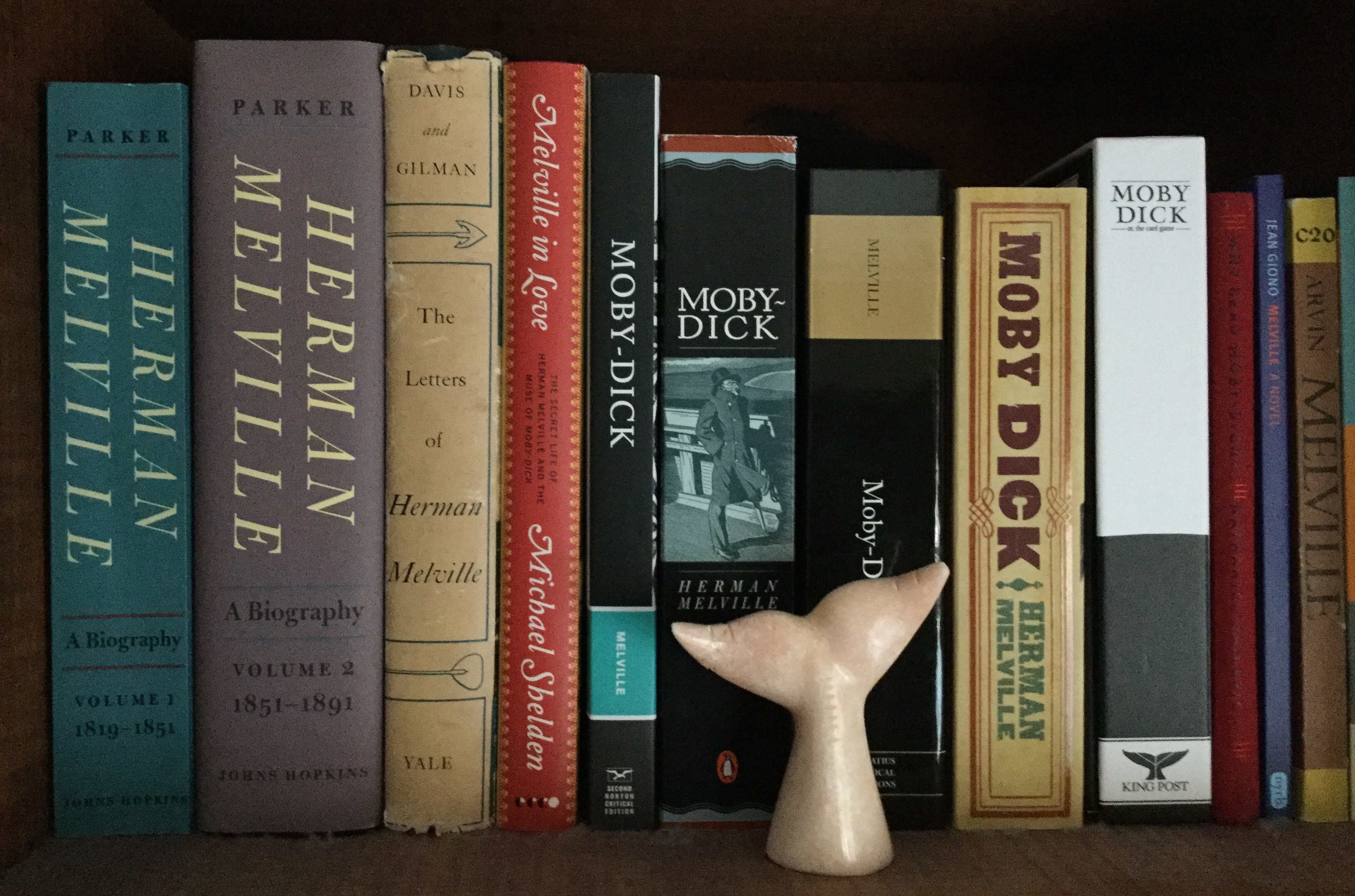
Rereading Moby Dick

Chapter 41: Moby-Dick
Here, then, was this grey-headed, ungodly old man, chasing with curses a Job’s whale round the world, at the head of a crew, too, chiefly made up of mongrel renegades, and castaways, and cannibals — morally enfeebled also, by the incompetence of mere unaided virtue or right-mindedness in Starbuck, the invulnerable jollity of indifference and recklessness in Stubb, and the pervading mediocrity in Flask. Such a crew, so officered, seemed specially picked and packed by some infernal fatality to help him to his monomaniac revenge. How it was that they so aboundingly responded to the old man’s ire — by what evil magic their souls were possessed, that at times his hate seemed almost theirs; the White Whale as much their insufferable foe as his; how all this came to be — what the White Whale was to them, or how to their unconscious understandings, also, in some dim, unsuspected way, he might have seemed the gliding great demon of the seas of life, — all this to explain, would be to dive deeper than Ishmael can go. The subterranean miner that works in us all, how can one tell whither leads his shaft by the ever shifting, muffled sound of his pick?

“Thus ended this voyage beneath the seas.”

AACA22E1-776E-4275-8138-519DC77F7614

Read in anticipation of seeing the Lookingglass Theatre production.

p. 90
“Captain Nemo,” I said to my host who had just stretched out on a divan, “this library would do honor to more than one palace on land, and I am really astounded to think that it travels with you into the ocean depths.”

“Where could one find greater solitude or silence, Professor?” replied Captain Nemo. “Can you boast of greater tranquility in your office at the museum?”

“No, Monsieur, and I must admit that it is very shabby alongside yours. Why, you have six or seven thousand books…”

“Twelve thousand, Monsieur Aronnax. These are my only ties with life on dry land….”

p. 187
“A cannibal can still be an honorable man,” replied Conseil, “just as a glutton can be honest. One doesn’t exclude the other.”

“That’s all very well, Conseil. I’ll even grant you that these cannibals are honorable and that they go about devouring their prisoners honorably. But since I don’t like the idea of being devoured, even honorably, I’ll stay on guard, for the commander of the Nautilus seems to be taking no precautions whatsoever. Now to work.”

Theater of the absurd

We have what are arguably some of the hottest tickets in town.

From Eugène Ionesco’s play Victims of Duty (1953):

CHOUBERT: It’s quite interesting. The Government’s urging all the citizens of the big towns to cultivate detachment. According to this, it’s our last hope of finding an answer to the economic crisis, the confusion of the spirit and the problems of existence.

MADELEINE: We’ve tried everything else, and it hasn’t done any good, but I don’t suppose it’s anyone’s fault.

CHOUBERT: For the time being the Government’s merely recommending this ultimate solution in a friendly manner. They can’t fool us; we know how a recommendation has a way of turning into an order.

MADELEINE: You’re always so anxious to generalize!

CHOUBERT: We know how suggestions suddenly come to look like rules, strict laws.

MADELEINE: Well, my dear, you know the law is necessary, and what’s necessary and indispensable is good, and everything that’s good is nice. And it really is very nice indeed to be a good, law-abiding citizen and do one’s duty and have a clear conscience! …

CHOUBERT: Yes, Madeleine. When one really thinks about it, you’re right. There is something to be said for the law.

MADELEINE: Of course there is.

CHOUBERT: Yes, yes. Renunciation has one important advantage: it’s political and mystical at the same time. It bears fruit on two levels.

The beginning of the end

From page 219 of The Cabin at the End of the World (Paul Tremblay; 2018):

Andrew has taught literature for years, calling his course How the World Ends. The course has occasionally included a literary analysis of the Bible’s Book of Revelation and the Four Horsemen of the Apocalypse riding their red, black, white, and pale horses. Over the years the course syllabus has evolved, but one of the main arguments / discussions he has with his students remains a constant. No matter how bleak or dire, end-of-the-world scenarios appeal to us because we take meaning from the end. Aside from the obvious and well-discussed idea that our narcissism is served when imagining we, out of all the billions who will perish, might survive, Andrew has argued there’s also undeniable allure to witnessing the beginning of the end and perishing along with everyone and everything else. He has impishly said to a classroom, to the scowl of more than a few students, “ Within the kernel of end-times awe and ecstasy is the seed of all organized religions.”

Mid-year reading review

From page 69 of The Hole (Hye-Young Pyun; 2017):

It was impossible to capture the trajectory of life in a map. Without one, there was no way of wrapping your brain around it all, and yet he was skeptical as to whether you could ever represent the world through maps alone.

But it was meaningful. Someone had taken these invisible trajectories that could not be studied with any sort of accuracy and had tried anyway to turn them into a tangible space. He found it boring sometimes for the same reason. A world that could not be understood perfectly, could not be explained unambiguously, and was interpreted differently based on political purposes and conveniences was no different from the world he was already living in. And yet, the one way in which maps were clearly better than life was that they improved with failure. Life itself was merely an accumulation of failures, and those failures never made life better.

The jacket copy suggests that The Hole evokes the work of Shirley Jackson and Stephen King. While I appreciate the assertion, I thought this meditation on the horror of finding blank emptiness at the center of a career, a marriage, a life was more philosophical than the comparisons to psychological thrillers suggests.

This was the book I completed before heading to bed last night, so I have completed sixty-eight books so far this year:

27 novels
10 plays
18 non-fiction titles
13 graphic fiction works
18 works published this year

My complete list can be found here.

Even better on rereading:
Never Let Me Go (Kazuo Ishiguro; 2005. Fiction.)
Childhood’s End (Arthur C. Clarke; 1953. Fiction.)
Daytripper (Fábio Moon and Gabriel Bá; 2011. Graphic fiction.)
Mrs. Caliban (Rachel Ingalls; 1983. Fiction.)

Forgot how wonderful this writer is:
Memento Mori (Muriel Spark; 1959. Fiction.)

For those who loved The Elementals (Michael McDowell; 1981):
The Reapers Are the Angels (Alden Bell; 2010. Fiction.)

A new-ish author who deserves the hype:
Little Fires Everywhere (Celeste Ng; 2017. Fiction.)
Everything I Never Told You (Celeste Ng; 2014. Fiction.)

Fabulous story for a long car trip:
American Kingpin (Nick Bilton; 2017. Non-fiction.)

Honorable mention:
The Idealist: Aaron Swartz and the Rise of Free Culture on the Internet (Justin Peters; 2016. Non-fiction.)

The most engrossing book I’ve read so far this year (not including rereads):
Behold the Dreamers (Imbolo Mbue; 2016. Fiction.)

Honorable mention:
Killers of the Flower Moon (Dan Grann; 2017. Non-fiction.)
An Abbreviated Life (Ariel Leve; 2016. Non-fiction.)
After the Eclipse (Sarah Perry; 2017. Non-fiction.)
The Hole (Hye-young Pyun; 2017. Fiction.)

Backyard birding

Over the last nine days, I have, among other things:

■ followed the progress of the robin family that calls our forsythia bush, “Home”;
■ mowed the lawn three times (!!);
■ seen a play (Suddenly, Last Summer at the Raven);
■ visited the Lincoln Park Zoo;
■ prepared for and undergone one of those screenings doctors recommend for all of us fifty-plus folk;
■ potted a couple of new plants and repotted some older ones;
■ lost a battle against an unidentified and insistent weed in my back garden area;
■ seen a good movie (I, Tonya) and a good documentary (Jane);
■ caught up on the harrowing second season of The Handmaid’s Tale;
■ fretted about how little I have practiced my music; and
■ finished four books:

Sometimes I Lie (Alice Feeney; 2017. Fiction.)
Buried Child (Sam Shepherd; 1978. Drama.)
The Idealist (Justin Peters; 2016. Non-fiction.)
Behold the Dreamers (Imbolo Mbue; 2016. Fiction.)

For the commonplace book, from Act Two of Buried Child:

SHELLY: Can’t we just drive to New Mexico? This is terrible, Vince! I don’t want to stay here. In this house. I thought it was going to be turkey dinners and apple pie and all that kinda stuff.
VINCE: Well I hate to disappoint you!
SHELLY: I’m not disappointed! I’m fuckin’ terrified! I wanna’ go!

Bookish

2D28035B-E908-4730-8912-EC76971FBC7A

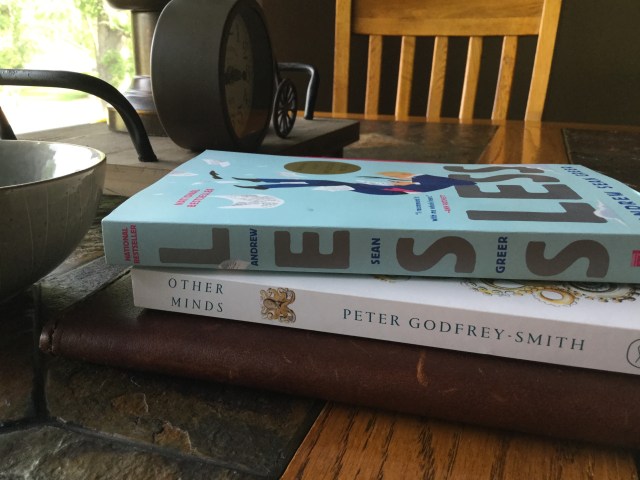
Recent acquisitions.

Last night I finished reading Book 51 of the year, Thi Bui’s illustrated memoir, The Best We Could Do. Because I’m about halfway through The Perfect Mother (Aimee Molloy), a meh recent novel, and Janesville, an excellent non-fiction work, I expect to meet the goal of Robin’s 52 Books in 52 Weeks by Thursday.

On the topic of non-fiction, I’m well positioned to meet one of my own reading goals: to read thirty-six non-fiction tiles in 2018. I’ve read seventeen, so far. In fact, here are my commonplace book entries for the sixteenth, Sarah Perry’s haunting memoir about her mother’s murder, After the Eclipse:

p. 136
As far back as I could remember, reading had been a perfect escape, an alternate universe where none of the problems were mine. When I was upset at home or school, I could always pull out a book, or know that one was waiting for me in the next quiet moment. In first grade, encouraged by my teacher, I began writing stories, and this was even better; I could create whatever escape I wanted, include whatever characters I wanted to spend time with. Writing gave me power.

p. 159
Sometimes, the scary thing about suicide was that it seemed inevitable, the only logical end to everything that had happened.

p. 250
Violence outpaced lab funding everywhere.

Our family book club is tackling The Aeneid this summer. We’ve already listened to the three introductory lectures in Elizabeth Vandiver’s course on the work and have decided to read one of The Aeneid’s twelve books each week, complemented by the appropriate lecture(s). The Girls Rule! Book Club has also tentatively scheduled Madame Bovary (Gustave Flaubert) and The Art of War (Sun Tzu), which may prove a bit ambitious with their commitments, but we’ll see.

The library’s reading program commences later this week, and frankly? My group enjoys some slightly lighter fare in the summer, too, so my assembled a pile of fiction includes Sometimes I Lie (Alice Feeney) and Red Clocks (Leni Zumas) — perfect, I think, for reading lakeside in the early morning between birdwatching and chillaxing.