Following a string of gray days, the sun is winking in and out of view, so it’s time to walk. Today’s other projects include my reading and notes for tomorrow’s meeting on The Magic Mountain, a “You took how many days off?!?” music practice, reading for this, and my current Latin unit.
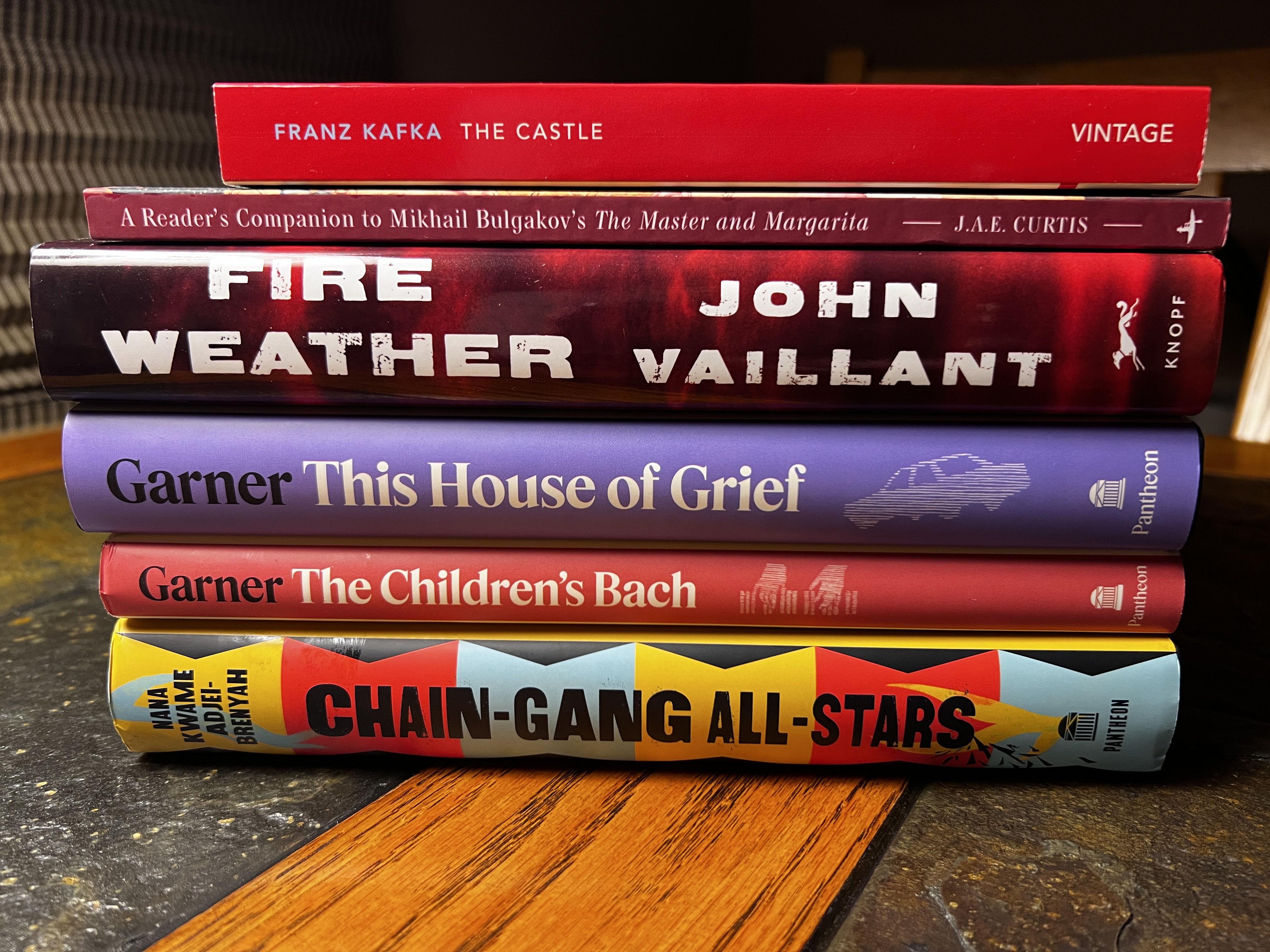
• Practice music with particular emphasis on 113 (Bona Rhythmical Articulation) • Review Latin vocabulary • Read “The Geese” and assemble notes for first of three discussions on Essays of E.B. White • Walk before the light drains from the sky • Look up again tonight • Finish Chain Gang All-Stars (review here)
The graduation concert is behind us, and I have only two more lessons before the holiday break. Practice will continue throughout the holidays, but the respite this season brings is delightful — fewer pieces to cover and more time for “fun stuff,” like the album of Christmas duets for flute and clarinet.
During the winter break, my reading is often a bit more relaxed, too, although I’m thisclose to finishing a few books on my TBR shelf. It may be worth pushing a bit harder than I usually do in December.
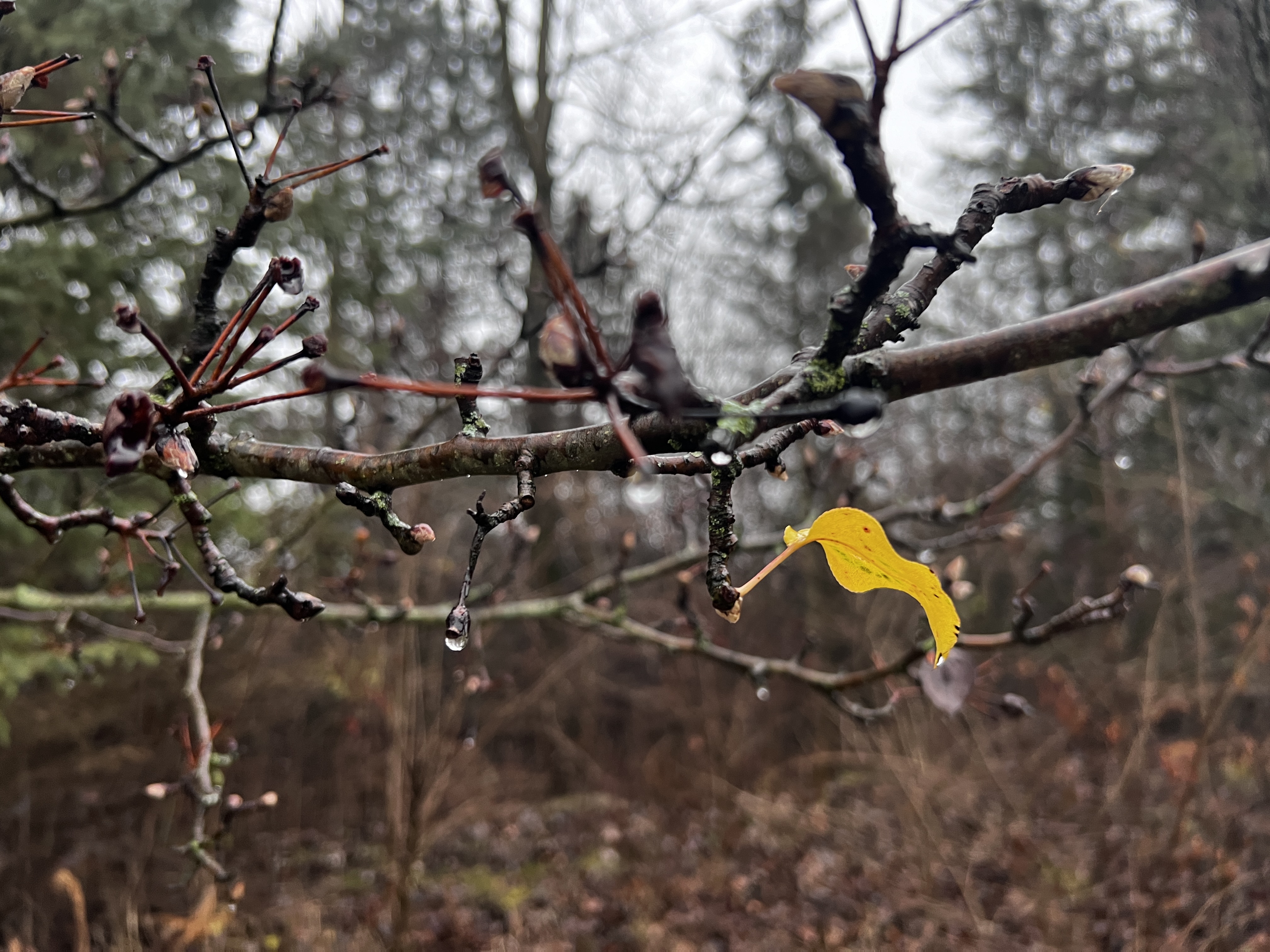
Speaking of which, today was supposed to be an off day, but there we were, putting in a few miles before all of the light drained from the sky. Tomorrow we’re planning to walk in one of the conservation districts.
Since Tuesday evening, we have been fighting some sort of bug, the chief characteristics of which were congestion and lethargy. We have nearly snapped out of it, though, and look forward to resuming our regular walks.
During my sick days, I rediscovered NYPD Blue (Hulu). A fan during its long run, I appreciated returning to this engaging show when I was too weary to read but not enough to sleep. Had I been well, I would have finished Gissing’s The Odd Women, now a task for this weekend.
Next weekend, we will play at the graduation concert. We did manage some quality practice this week and look forward to more this weekend.
🎶 In last week’s lesson, we concluded our work on the Mozart Duetto No.1, K.378, an eleven-page undertaking that began in late June. Because this is the final piece in Selected Duets for Flute, Volume II (Advanced), I have moved on to Johann Christian Schultze’s Sonata for Two Flutes in Album of Flute Duets, revised and annotated by Louis Moyse.
🎶 Somehow I have arrived at page 16 of Robert Cavally’s Melodious and Progressive Studies from Andersen, Gariboldi, Koehler, and Terschak for Flute, Book 2, which means I am working on the second of Köhler’s “moderately difficult pieces as studies for flute” from Op. 33, Book 2. For this adult learner, they are simply difficult, but the work informs my progress in band.
🎶 Not long after I presented the first half of 113 in P. Bona’s rhythmical articulation studies, band rehearsals resumed. With only a few days until our fall concert, however, Bona has moved from the bottom of my daily practice roster back to the (near) top. According to my instructor, only two assignments remain in this book, 116 and 120, the latter of which is five pages long; hence, Bona will remain on the practice roster until at least mid-2024.
🎶 For the last three weeks, I have been working on the third movement of the Stamitz Concerto in G major, Op.29. Unsurprisingly, getting the passage of triplets at measure 45 and the quick measures beginning at 225 under my fingers requires the concentrated repetition in assorted rhythms that many instrumentalists hate but that I really appreciate.
🎶 I first joined the community band for the Spring 2018 concert program. While I felt welcomed and well-supported in what was then a large section, I also felt woefully unready. Four and half years later, when I arrived for the Fall 2022 program, I brought my husband and a significantly stronger skill set. For this weekend’s concert, in addition to a featured flute passage in one piece, I was also assigned the featured piccolo passage in another. What a difference 3,000 hours* can make.
* the (very) approximate number of practice hours between May 2018 and November 2023
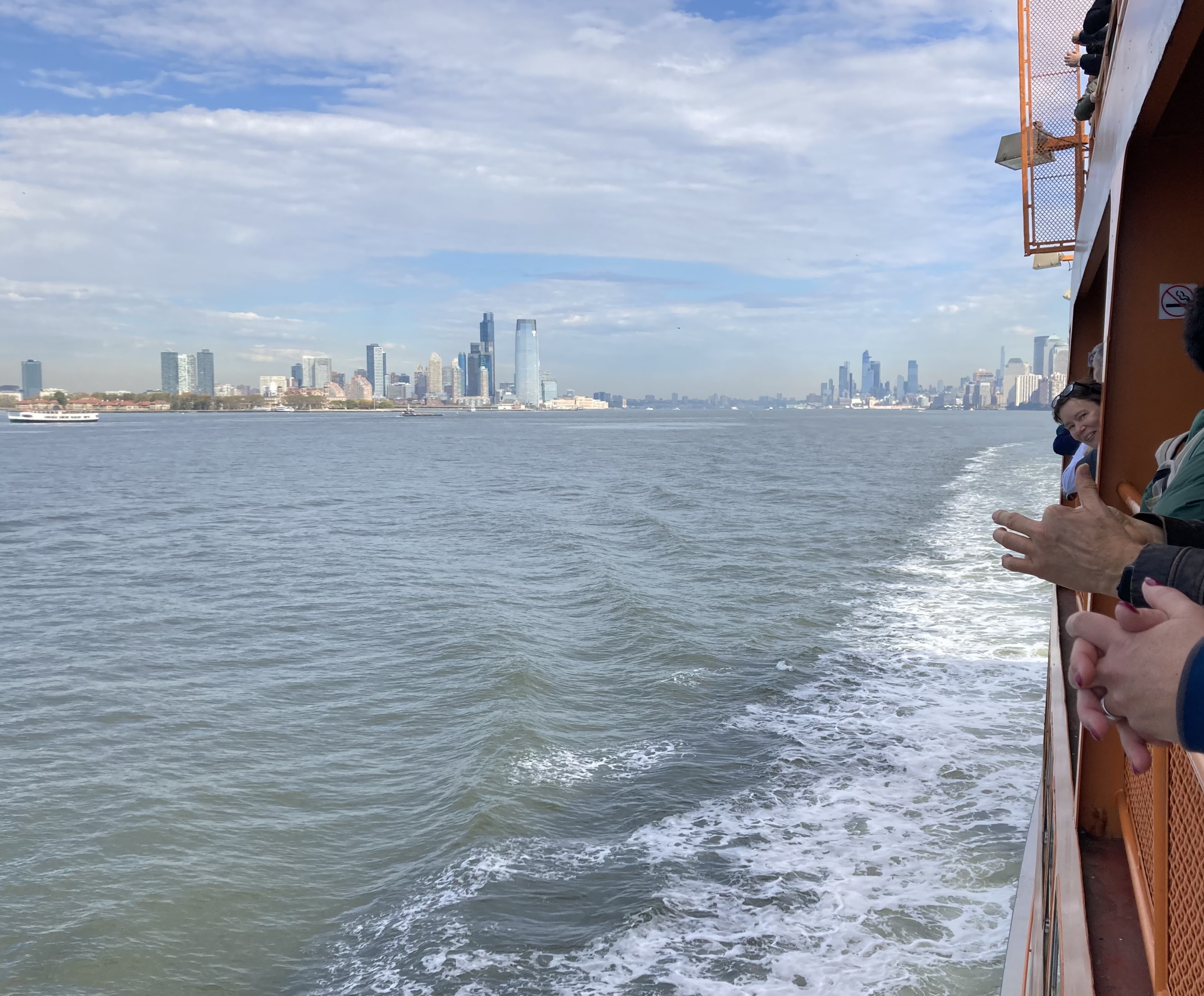
Three weeks have passed since we departed for our NYC adventure. Sparing my seventy-three readers a cliché about time’s passage, I will confine myself to a bemused (virtual) headshake.
Reading: I’m more than halfway through The Woman in White and 195 pages into The Magic Mountain. I had thought I would read ahead in New Grub Street, but this week, I simply kept pace with the APS Together schedule. I hope to finish Our Missing Hearts (terrific review here) over the weekend.
Latin and music: The trip, re-entry, and preparation for the upcoming concert left me a bit short of time and energy for my Latin studies, although my husband did help me drill vocabulary on our trip into Chicago last weekend. (We saw Twelfth Night at the Chicago Shakespeare Theater. Recommended.) The two music lessons since my return from NYC were longer to make up for the lesson lost during vacation (yes, she’s a terrific instructor), and the assignments represent greater challenges, which, coupled with band music, require a continuing commitment to regular (and extended) practice.
Perhaps if I were as strict about Latin as I am about music, I might be reading Ovid by now. Sigh.
Although I had hoped to finish sooner, I only just listened to Lecture 17 of Cervantes’ Don Quixote, an Open Yale Courses program, this morning. (The course comprises twenty-four lectures delivered by Professor Roberto González Echevarría. Absolutely excellent.)
Somehow I finished Nights of Plague in time for a wonderful book discussion last night. I began reading as soon as I finished The Republic earlier this month but was happily sidetracked by an invitation to a reading group tackling Thomas Hardy’s Far from the Madding Crowd; then family came into town for several days. Finishing Orhan Pamuk’s tome really was a feat, then, given how little time I had.
Naturally, although I followed the #FaulknerinAugust discussion, I needed to set aside the book for most of the month, but I am back to a chapter a day in Absalom, Absalom.
I’m also reading Adrienne Brodeur’s Little Monsters.
After only three rehearsals, we have a break from band this coming week, so for the next few music practices, I’m focused primarily on my current étude, the Mozart duet, and the middle of the second movement of the Stamitz concerto. (I spent much less time on this over the last two months than originally planned.)
And though my Latin studies stalled in the second week of the month, after a vocabulary review, I’ve cracked open the next unit.
During my music lesson this week, my teacher corrected an embouchure issue with which I have been struggling in piccolo practice. What a difference! Both my concert flute and alto flute are now en route to the technician for annual cleaning and adjusting, so for the next week or so I’m working with my trusty Yamaha.
Only three meetings remain in the Plato’s Republic reading group. Between the discussion and David Roochnik’s fabulous lectures, I am learning far more than I did forty years ago when I first read this work as a college freshman.
Slowly, surely, I am making my way through my Latin I tutorial. I have reached the point at which I can say that it brings me as much satisfaction as my music studies. (And it is just as difficult.)
Also slowly, surely, I’m accumulating mileage. The air quality and increasing temperatures make exercise difficult, but we take our primary walk early enough to mitigate some of the concerns.
I am a few pages away from finishing a smart and entertaining novel: Babel: Or the Necessity of Violence: An Arcane History of the Oxford Translators’ Revolution by R.F. Kuang. (Review here.) In fact, the last few books I’ve read are worth mentioning:
■ The Fold (Peter Clines; 2015. Fiction.) ■ The Thursday Murder Club (Richard Osman; 2020. Fiction.) ■ The Man Who Died Twice (Richard Osman; 2021. Fiction.) ■ The Bullet That Missed (Richard Osman; 2022. Fiction.) ■ Long Live Latin: The Pleasures of a Useless Language (Nicola Gardini; 2019. Non-fiction.) ■ The Guest (Emma Cline; 2023. Fiction.)
The novels represent my favorite sort of summer reading (engaging, light without being utterly frivolous, sometimes even thought-provoking), and Gardini’s meditation on Latin was perfect. (Review here.)
I’m halfway through My Murder and about 150 pages into Empire of Pain; music practice is going well; and I’m (slowly) developing a routine for studying Latin.
The drought continues, so I’m using weepers on the days permitted for our location to ensure the trees and bushes make it through another summer. The containers and raised beds are doing all right, but the finches have begun to shred the sedum despite my vigilant refilling of the bird bath.
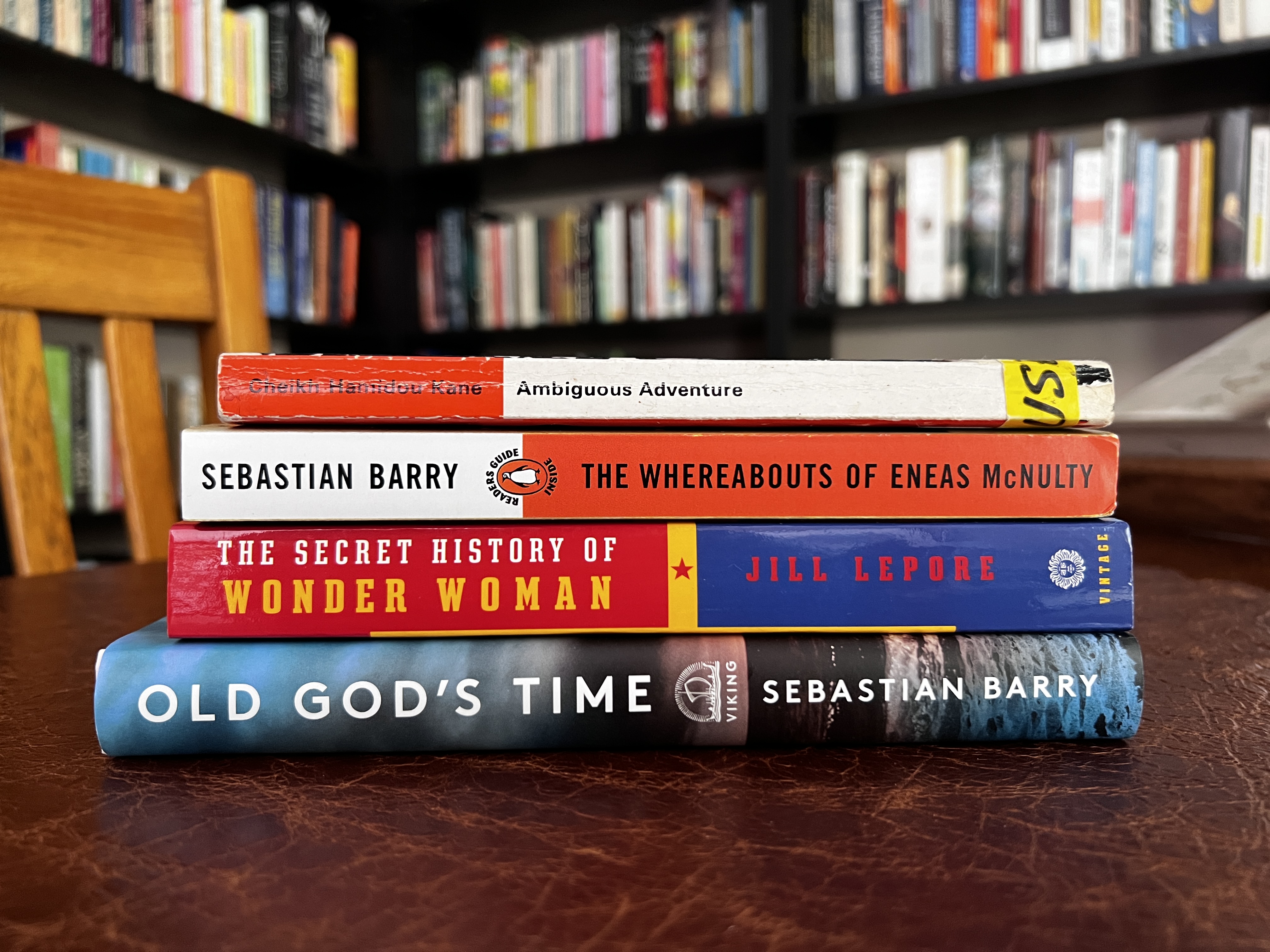
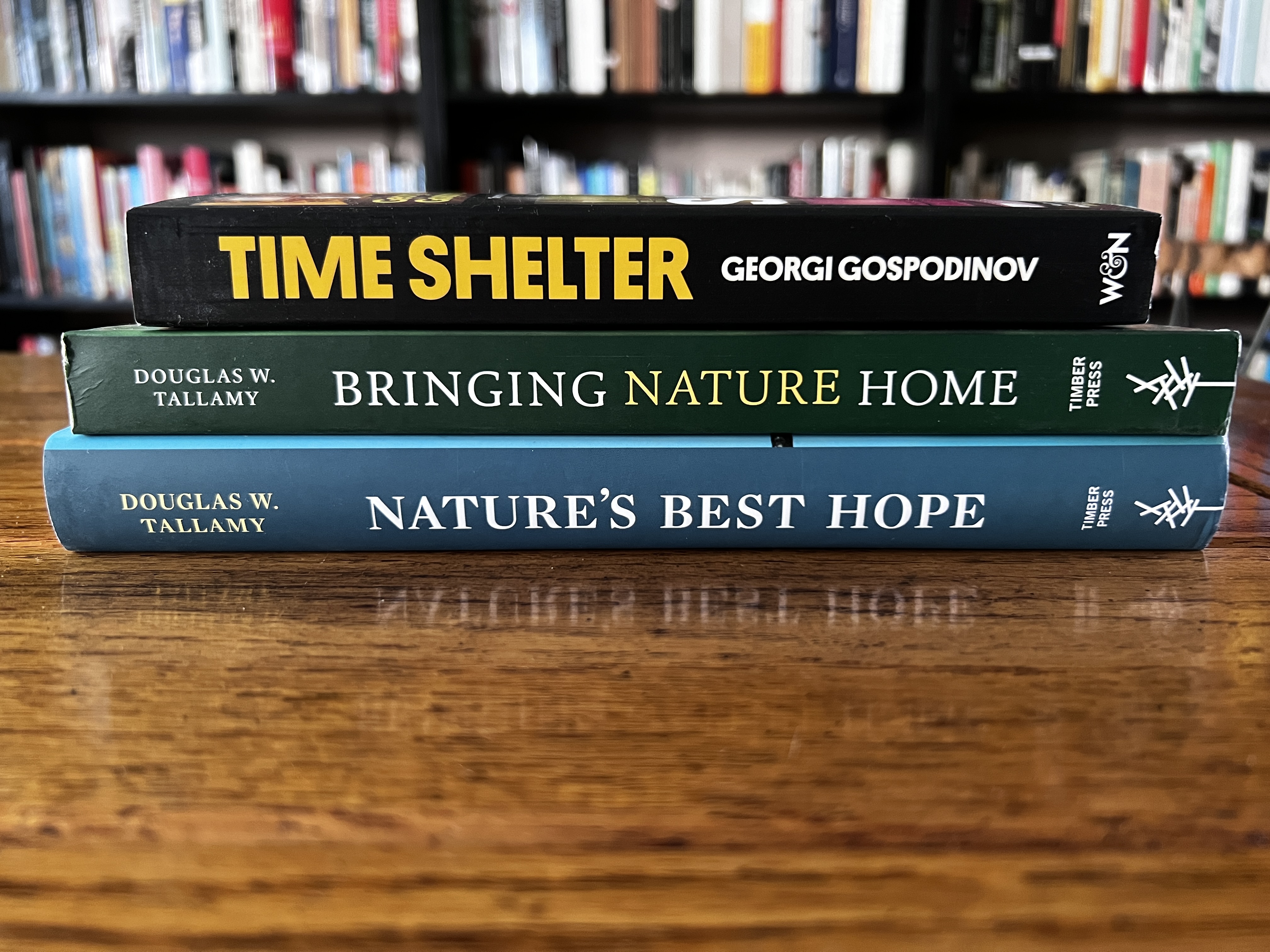
Reading: The TBR shelf has become unwieldy, and it doesn’t even include all of the active titles. Not pictured: Blood Meridian (Cormac McCarthy), Babel (R.F. Kuang), SPQR: A History of Ancient Rome (Mary Beard). In the past, when the stack has become this overwhelming, I’ve simply shelved most of it, figuring (hoping?) that I will return to the books. Eventually. This summer, though, I’m leaning into the “chaos,” letting the shelf remain as it is — in fact, adding to it. Let’s see what I get through before August’s subtle shift of light across my floor.
So far this year, I’ve read fifty-five books, which is a slower pace than the last couple of years. Today I am in the process of finishing Jeremy Denk’s memoir, Every Good Boy Does Fine.
Latin: After a long hiatus, I returned to my Latin studies this week. In January, I submitted my work on CAPVT V with every intention of dovetailing Latin into my spring semester once the assorted classes and groups in which I participated had gotten underway, but the required reading (and writing, in the case of one tutorial) reduced my time for Latin to a few vocabulary review sessions each week. Not ideal. Last night, I submitted my work on CAPVT VI; now all that remains is to read and outline the sixth chapter of SPQR. My goal is to finish CAPVT VII and CAPVT VIII by mid-July. This is a doable rather than rigorous goal.
Other studies: This week was the fourth of eleven meetings for the Catherine Project’s summer reading group on Plato’s Republic. I am pairing my reading with David Roochnik’s lectures (The Great Courses). And I’ve finished seven of the twenty-four lectures in Professor Roberto González Echevarría’s “Cervantes’ Don Quixote” (Open Yale Courses).
Music: In mid-May, following my last music lesson of the spring semester, I did what I usually do: played a bit of hooky from my daily practice schedule, which, naturally, made my return to regular practice alternately embarrassing (Ugh! What’s with my intonation and tone?) and exhilarating (Wow! Listen to how much of that piece I remembered!). I am not participating in the summer recital, so I’ve scheduled one long lesson for June and one for July. (Weekly lessons and community band rehearsals resume in mid-August.) Yes, I am still cutting myself some slack, but I am practicing. By spring semester’s end, we had reached the Rondo and Allegro molto of the Mozart Duetto No.1, K.378, so I’ve been polishing that for this month’s lesson, as well as the Allegro on page 13 of Robert Cavally’s Melodious and Progressive Studies from Andersen, Gariboldi, Koehler, and Terschak for Flute, Book 2. I’ve also begun working on 113 in P. Bona’s rhythmical articulation studies and the second movement of the Stamitz Concerto in G major, Op.29. (Why the second and not the first? Quite simply, the Andante non troppo moderato seemed like a much kinder, gentler place to begin this long project than the Allegro.)
Participating in the community band (and, yes, my teacher’s encouragement) moved me to invest in a piccolo this spring. Because I’ve been working on exercises and short pieces for the piccolo following my flute practice, I have had much less time for the alto flute. I am interested to see what, if any, piccolo work, I am assigned for this fall’s concerts, but I do miss the alto. Working to find a balance….
(For those who are interested in this sort of thing, the concert flute is a handmade Miyazawa 602 with the MX-1 cut headjoint (14K riser), offset G, heavy wall tubing, C# trill key and D# roller; the piccolo is a Hammig 650/3 with a modified wave thin headjoint; and the alto is a Trevor James copper alloy with both the curved and straight headjoints.)
Gardening: We added two more “pollinator pockets,” for a total of four 3×6 raised beds. Four large barrels and numerous other containers also brim with flowers. Maybe we will enjoy this sort of success later in the season? Drought conditions continue here, although the temperatures have been mild. (Hey, would someone dump a cup of iced tea on those who are playing with firecrackers in this weather? Not too bright, folks.)
Health: When I re-retired in February 2020, my goals were to read and study more, practice more, and pay more attention to my health. Check, check, and check. As I think I’ve shared, I’ve lost more than forty pounds since March 2020 — this, thanks to a near-daily walking habit coupled with stretching, some weight work and stationary cycling, and much more mindful meal planning. I still have some work to do, but yard work, the return to long bike rides on the weekend, and kicking up our walking pace is starting to get me there.