
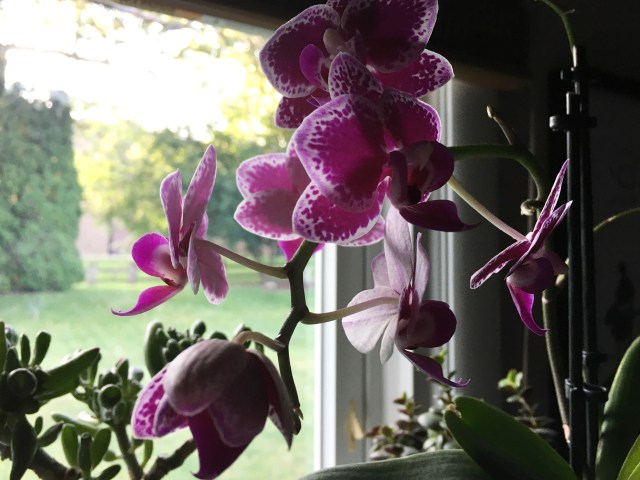
 My miraculous orchid now has seven flowers. (Original entry here.)
“[T]he sole solution of all of the riddles of life and death”

A sixth bloom has emerged, but I will instead share an image of my current stack.
With The Farm I arrived at 135 books read this year; 110 from the shelves.
■ The Return of the Soldier (Rebecca West; 1918. Fiction.)
In May, when I finished Willa Cather’s Alexander’s Bridge (1912), I remarked that it was difficult to believe that was her first novel; it was so assured and true. West’s first novel is even more so — remarkable and memorable.
p. 65
Even though I lay weeping at it on the dead leaves I was sensible of the bitter rapture that attends the discovery of any truth. I felt, indeed, a cold intellectual pride in his refusal to remember his prosperous maturity and his determined dwelling in the time of his first love, for it showed him so much saner than the rest of us, who take life as it comes, loaded with the inessential and the irritating. I was even willing to admit that this choice of what was to him reality out of all the appearances so copiously presented by the world, this adroit discovery of the dropped pearl of beauty, was the act of genius I had always expected from him. But that did not make less agonizing this exclusion from his life.
■ The Bridge of San Luis Rey (Thornton Wilder; 1927. Fiction.)
This was a reread.
p. 138
The art of biography is more difficult than is generally supposed.
■ The Death of Ivan Ilyich (Leo Tolstoy; 1886. Trans. Louise and Aylmer Maude. Fiction.)
This, too, was a reread, my fourth time encountering Tolstoy’s novella. The first was in AP English, thirty-nine years ago. What do typical seventeen-year-olds take away from reading Tolstoy? Oh, I was more than capable of parroting a teacher (or a study guide) on Tolstoy’s biography, the key characters, the basic plot, the essential themes and symbols, but I’m not sure I had actually read The Death of Ivan Ilyich until my third encounter, in my forties.
“Maybe I did not live as I ought to have done,” it suddenly occurred to him. “But how could that be when I did everything properly?” he replied, and immediately dismissed from his mind this, the sole solution of all of the riddles of life and death, as something quite impossible.
■ A Raisin in the Sun (Lorraine Hansberry; 1958. Drama.)
I had planned to read this in Spring 2003 for the “One Book, One Chicago” program. Better late than never.
■ The Farm (Tom Rob Smith; 2014. Fiction.)
A run of so many terrific books rendered this meh novel even more mediocre.
Still blooming

Yes, that’s a fifth flower. I am amazed. And, yes, if those two buds open, at least one, perhaps two more mediocre orchid photos will follow.
■ The Amateurs (Liz Harmer; 2019. Fiction.)
Review here.
■ Postal: Deliverance, Vol. 2 (Brian Edward Hill; 2020. Graphic fiction.)
■ Ascender, Vol. 2: The Dead Sea (Jeff Lemire; 2020. Graphic fiction.)
Hoopla has enabled me to keep up on series that interest me.
■ The Tao of Pooh (Benjamin Hoff; 1982. Non-fiction.)
This is a somewhat different book now than it was when I first read it. The story of the author’s difficulties with the publisher are chronicled on his website.
■ The Pearl (John Steinbeck; 1947. Fiction.)
It seems impossible that I have not read this before, but I could not remember anything more than the horrific conclusion.
p. 25
For it is said that humans are never satisfied, that you give them one thing and they want something more. This is said in disparagement, whereas it is one of the greatest talents the species has and one that has made it superior to animals that are satisfied with what they have.
■ Death in Venice (Thomas Mann; 1912. Trans. Michael Henry Heim; 2004. Fiction.)
Again, how is it possible that I have not read this? The Heim translation is introduced by Michael Cunningham, who writes, in part, “All the writers I respect want to write a book so penetrating and thorough, so compassionate and unrelenting, that it can stand unembarrassed beside the spectacle of life itself. And all writers I respect seem to know (though no one likes to talk about it) that our efforts are doomed from the outset. Life is bigger than literature. We do the best we can. Some of us do better than others.”
How about this for serendipity / synthesis / synchronicity?
p. 84
The cases were kept secret. Within a week, however, there were ten of them, then twenty, thirty, and in different districts to boot. […] The Venetian authorities issued a statement to the effect that health conditions have never been better then took the most essential precautions against the disease. […] But fear of the overall damage that would be done — concern over the recently opened art exhibition in the Public Gardens and the tremendous losses with which the hotels, the shops, the entire, multifaceted tourist trade would be threatened in case of panic and loss of confidence — proved stronger in the city than the love of truth and respect for international covenants: it made the authorities stick stubbornly to their policy of secrecy and denial.
Interesting aside: The word legerdemain is used in the description of one of the pearl dealers in Steinbeck’s short novel. It’s not a common word, so it struck me when I encountered it again in the Heim translation of Mann’s work.
Blooming
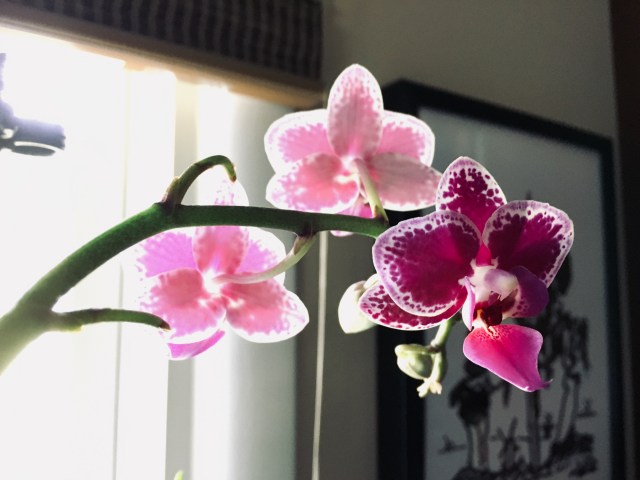 A third bloom! How lucky am I?
In other news…
In about two hours, I will attend my fourth Theater of War production. Warm thanks to the reader who brought this fabulous group to my attention. Today they’re doing The Book of Job Project, using the Stephen Mitchell translation. Maybe I’ll “see” you there?
Also, I finished two more books in June and wanted to add them to the count, which, at the year’s midpoint, stands at 124, with 102 read from the shelves.
■ Circe (Madeline Miller; 2018. Fiction.)
Read with my older daughter as part of our informal summer reading program. Both of us described it as a page-turner and finished it in one day. Related links here and here.
■ The Godmother (Hannelore Cayre; 2019. Fiction.)
Light and quick with a few witty observations. Perhaps it will work better as a movie?
p.16
People say I’m bad tempered, but I think this is hasty. It’s true I’m easily annoyed, because I find people slow and often uninteresting. For example, when they’re banging on about something I couldn’t give a crap about, my face involuntarily takes on an impatient expression which I find hard to hide, and that upsets them. So, they think I’m unfriendly. It’s the reason I don’t really have any friends, just acquaintances.
Two goals met
 With White Fragility, I reached my goal of reading 100 books from the shelves this year. Diangelo’s treatise also put me at a total of 122 books, which exceeds my Goodreads challenge goal of 120 (recently increased from 104). With six months remaining in the year, the suggestion that I raise the goal to 240 did not go unconsidered, but July will be a busy month for me, and I would like to tackle a few reading “projects” later this summer and into autumn. More about that in another post.
Here are the books I’ve read since June 15.
■ The Astonishing Life of Octavian Nothing, Traitor to the Nation, Vol. I: The Pox Party (M.T. Anderson; 2006. Fiction.)
A brutal but deeply moving novel from the author of Feed, a family book club selection from a few years back. Related link here.
■ Citizen: An American Lyric (Claudia Rankine; 2008. Non-fiction.)
Even more powerful when reread.
■ The Blood of Emmett Till (Timothy B. Tyson; 2017. Non-fiction.)
Related links here and here.
■ Plato and a Platypus Walk into a Bar… Understanding Philosophy Through Jokes (Thomas Cathcart and Daniel Klein; 2006. Non-fiction.)
Did I read this when it was first published? All of the jokes are familiar. And maybe that’s the problem.
■ Thick and Other Essays (Tressie McMillan Cottom; 2019. Non-fiction.)
This book grabbed me by the collar, and it still hasn’t set me down and straightened my shirt. Remarkable. If it were feasible, I would press the entire text into my commonplace book.
p. 72
They say the beauty is in the eye of the beholder and that ugly is as ugly does. Both are lies. Ugly is everything done to you in the name of beauty.
Knowing the difference is part of getting free.
■ Make Your Home Among Strangers (Jennine Capó Crucet; 2015. Fiction.)
■ The Mad Scientist’s Daughter (Cassandra Rose Clarke; 2016. Fiction.)
Books that might have appealed to my much younger self still show up in my stacks and occasionally on my shelves. What can I say? A bag of Jax cheese curls or a box of Nabisco sugar wafers will sometimes end up in the pantry, too. Let’s just be grateful I don’t pull out a tube top or my neon green belt, eh?
■ Harry Potter and the Order of the Phoenix (J.K. Rowling; 2003. Fiction.)
Speaking of my younger self, it has been sweetly nostalgic to revisit these books my son and I so enjoyed.
■ Broken Monsters (Lauren Beukes; 2014. Fiction.)
Review here.
■ White Fragility: Why It’s So Hard for White People to Talk About Racism (Robin Diangelo; 2018. Non-fiction.)
Flawed? Or diagnostic?
No ice, please


But not much more.
Before I left last summer, I gave my daughters a beautiful orchid from IKEA. When they came home for the holidays, my older daughter admired my new orchid (a just-in-case-I-forgot-someone-at-work holiday gift). I asked how long the IKEA orchid lasted. Wait, what do you mean it’s still alive? So, yeah, apparently, their orchid had not only grown but sprouted new leaves, new roots, and eventually, buds.
What’s your secret, kid?
“I just water it like the rest of the plants, Mom.”
Wait, what? That’s it?
When I visited in February, I saw this mighty orchid for myself. My daughters have arranged most of their many plants on benches in the sun-filled windows of the Boston-area apartment they share. They’re thriving — my daughters and those plants. Even the orchid.
Hmmm. Just water it, eh? I can no longer remember if it was my aunt or my sister (maybe both?) who told me that orchids get ice-cubed not watered, but does it matter? Why did it never occur to me to research the matter myself? For years, I plied my orchids with ice cubes.
And they died.
Well, my current orchid has never met an ice cube; I just water it like the rest of the plants. When a new leaf emerged, I took a chance and repotted it with some orchid mix from Home Depot. Another leaf. Two roots. Two new stems. A number of buds.
And now… flowers.
Our first visitor since February
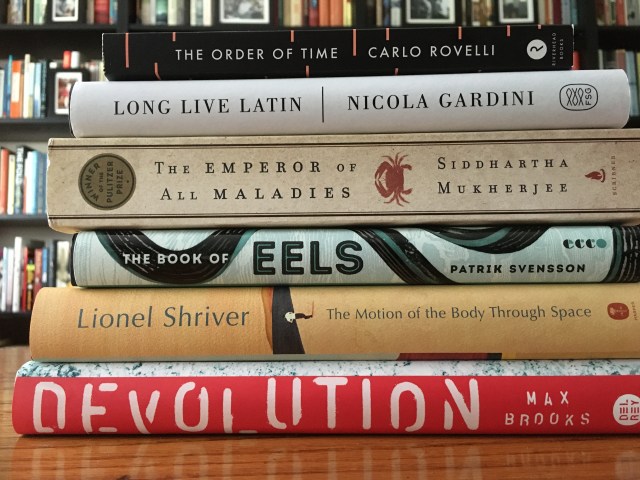
Recent acquisitions.
“Want something different?” he asked before heading out to pick up the replacement.
What I thought: No. No, I do not. I want it to be precisely the same as it was just before it ceased swinging effortlessly from one sink to the other. Make my faucet work or put in its twin. And be quick, darn it; there’s a pandemic going on out there!
What I said: No, thank you. Hey, and how long will that take?
We wore masks. All of the windows were open. I’ve cleaned and cleaned again. I am fervently hoping that’s enough. But, well, I worry.
On the bright side, the shiny new faucet swings from one sink to the other.
And I received some new books.
Shooting into the sun
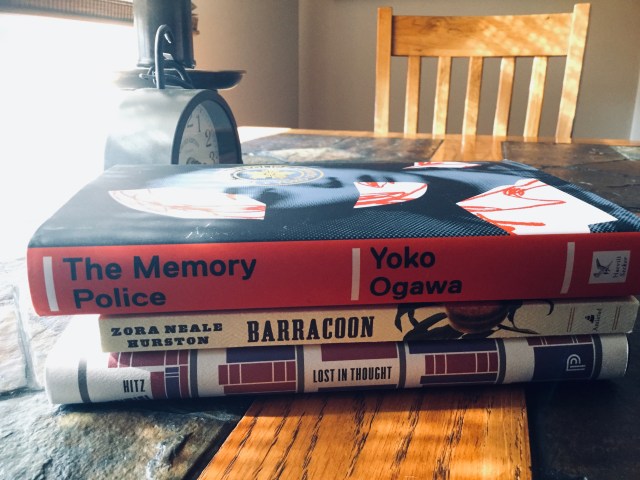
Recent acquisitions.
When I left for my first walk of the day at 5:32 a.m., the thermometer in this window read 58 degrees. Twelve hours later, it reads exactly fifty degrees higher. The light in this spot is so lovely, but in the summer, when the street-facing side of the forever home is bathed in sun, we would be pizza in a brick oven if not for central air conditioning and the beautiful oak that partially shades the front.
According to our arborist, the cold, wet spring was hard on trees, especially oaks, and for the first time in ten springs, that protective oak out front is struggling. We have been relatively lucky, though: Other property owners have experienced catastrophic tree loss since the odd deluge / drought cycles began in 2011. Still, I worry. We lost a maple in the backyard in 2014 to rot stemming from the previous owner’s bad pruning, and shortly after that tree was removed, the backyard oak began showing signs of stress. It was eventually diagnosed with bur oak blight, and, oh, has it been plied with the tree health services since! It finally showed signs of stability last summer, and yesterday the arborist expressed cautious optimism about its chances for survival. He was also encouraged by our ginkgo tree’s miraculous rebirth: Last month, its new leaves suddenly browned and shriveled, but it proved healthy enough to sprout an entirely new set a few weeks later.
I sat down in this clean, well-lighted place to write about the new books I received this afternoon and the one I finished reading this morning, but all of my thoughts are about the trees. I mourned the maple and continue to feel its loss; and I worry about the oaks as much as I do the cats. What explains my attachment?
From Peter Wohlleben’s The Hidden Life of Trees:
But we shouldn’t be concerned about trees purely for material reasons, we should also care about them because of the little puzzles and wonders they present us with. Under the canopy of the trees, daily dramas and moving love stories are played out. Here is the last remaining piece of Nature, right on our doorstep, where adventures are to be experienced and secrets discovered.
Recover and read

Recent acquisitions.
Since my last post, though, I have finished only three books, all of which were read from the shelves:
■ After the Fall (Arthur Miller; 1964. Drama.)
My husband and I recently saw the TimeLine Theatre production of To Master the Art, which centers on Julia Child’s years in France. That McCarthyism figures in both that play and, of course, Miller’s provided one of those moments of readerly intersection I so appreciate.
■ Coraline (Neil Gaiman; 2002. Fiction.)
Has it really been eighteen years since this was published? Review here.
■ Gang Leader for a Day (Sudhir Venkatesh; 2008. Non-fiction.)
Related link with excerpt here.
Still reading
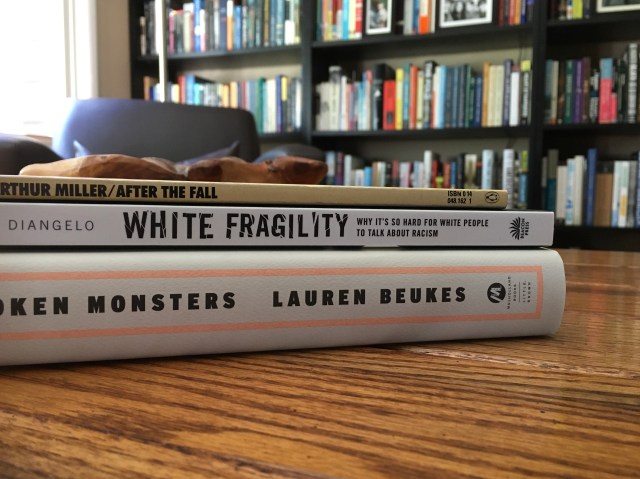
Current stack.
Lists like this, this, and this have sent me to my shelves to reshape my summer reading list.
For a number of reasons, my reading pace has slowed since my last annotated list. I have read five more books, though, for a year-to-date total of 109, 88 of which are RFS. That puts me a dozen books from reaching my goal of one hundred read from shelves.
■ Rodham (Curtis Sittenfeld; 2020. Fiction.) ATY
A sympathetic portrait and engaging what-if. Reviews here and here.
p. 47
I liked being around other people during the day, and I was relieved to be alone late at night; it was the latter that made the former possible. In fact, setting up my nest often made me think if a Wordsworth phrase I’d learned in English class as a high school junior: emotion recollected in tranquility.
p. 165
But as a president, would he be ethically casual, irresponsibly magnanimous, vulnerable to his enemies due to weaknesses he erroneously believed he could conceal or at least be forgiven for?
p.236
I usually liked other human beings and they usually liked me. I liked their specificity, their often unfashionable clothes, their accents and enthusiasms and the things they cared about enough to seek me out and tell me about, and I liked their belief that I could help them in a measurable way. I wanted — I had always wanted this — for their belief to be accurate.
p. 355
So often, people let you down; so often, situations turn out disappointingly. But occasionally someone recognizes, acknowledges, your private and truest self.
■ Harry Potter and the Goblet of Fire (J.K. Rowling; 2000. Fiction.) RFS *
p. 605
Harry, Ron, and Hermione sat up late in the common room once again that night, talking it all over until Harry’s mind was reeling, until he understood what Dumbledore had meant about a head becoming so full of thoughts that it would have been a relief to siphon them off.
■ Saint Joan (George Bernard Shaw; 1923. Drama.) RFS
Recommended here.
SCENE II
THE ARCHBISHOP: A miracle, my friend, is an event which creates faith. That is the purpose and nature of miracles. They may seem very wonderful to the people who witness them, and very simple to those who perform them. That does not matter: if they confirm or create faith they are true miracles.
LA TREMOUILLE: Even when they are frauds, do you mean?
THE ARCHBISHOP: Frauds deceive. An event which creates faith does not deceive: therefore it is not a fraud, but a miracle.
■ Shirley (Susan Scarf Merrell; 2014. Fiction.) RFS
Plucked this from the shelves after reading Sheila O’Malley’s review of the new film. Of course, I was delighted by the serendipity / synthesis / synchronicity at work: I read Jackson’s We Have Always Lived in the Castle last month and watched the film earlier this month.
■ King Lear (William Shakespeare; 1606. Drama.) RFS *
If pressed, I would cast my vote for Lear as the best of the plays. It is certainly the one that awes me more and differently each time I read it. (The first time was thirty-two years ago in a graduate course at Temple University.)
—————————————
ATY Acquired this year
LIB Borrowed from library (including Hoopla and Overdrive)
OTH Other
RFS Read from shelves
* Denotes a reread

