Flooding, dream-hoarding, and reading! Oh, my!

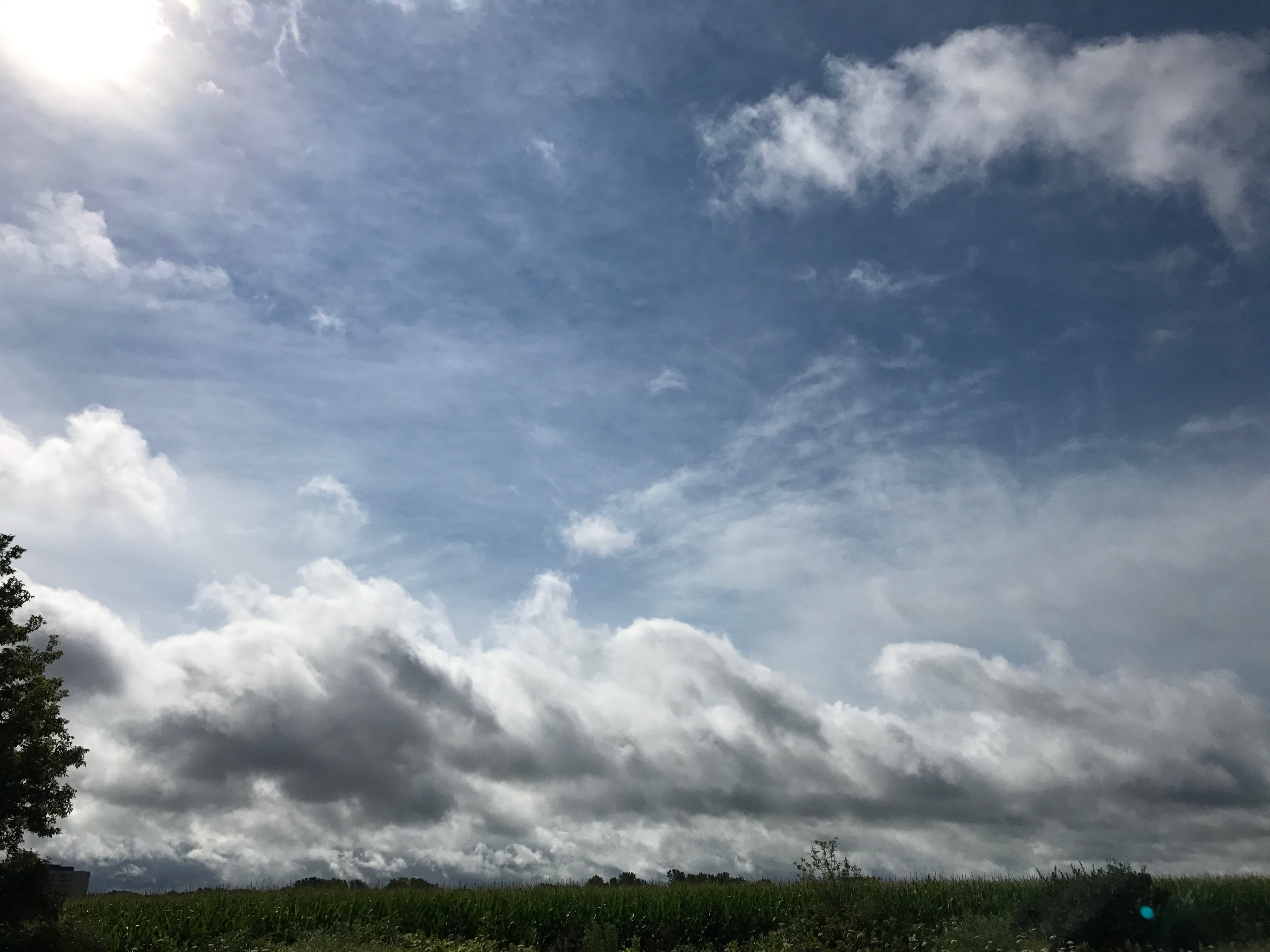
Saturday morning on the trail.

Storms and flooding have overcome parts of our county and most of the neighboring county. After Friday night’s pelting, we expected large puddles on the bike trail Saturday morning, but we peddled through ponds, however temporary. As I’ve learned over the last two weeks, flooding continues and can, in fact, worsen after the rains cease, so the ponds had nearly doubled in size by the time we encountered them on the return trip.

The humidity made a ride seem ill-advised this morning, and by 3 p.m., the storms had returned, so we contented ourselves with exercise videos and the promise of yard work tomorrow morning.

Today begins Week 6 in my quest to read War and Peace in seventeen weeks, but the book is so compelling that I have already finished the reading for Weeks 6 and 7. I have not made as much progress in the “Shakespeare in a Year” project, however: I’ve read through Sonnet 106 but must still (re)read As You Like It. Speaking of the sonnets, I love this from Sonnet 104:

To me, fair friend, you can never be old;
For as you were when first your eye I eyed,
Such seems your beauty still….

It has been a week, but “The Drowned Girl” from Joyce Carol Oates’ new collection, Dis Mem Ber continues to haunt me, and not simply because of its true-crime inspiration. Rather, I remain deeply unsettled by the insightful depiction of students marginalized by “alternate route” admission programs for transfer and / or non-traditional students.

Dream Hoarders (Richard V. Reeves) has also unsettled me (and sent me off to the shelves for Keith Payne’s The Broken Ladder). Reeves’ discussion of internships and other unpaid opportunities for students was particularly uncomfortable: My older daughter works twenty-plus hours per week as an summer intern. Yes, it’s an unpaid internship, but it’s also a priceless opportunity in a competitive (if wildly underpaid) field, where entry-level positions require both education and experience. She and my younger daughter, both undergraduate research assistants, were also asked to continue their projects over the summer, and although one daughter was, quite unexpectedly, offered funding, the other was not. (She did, however, earn a scholarship for achievement in non-major coursework, which had the effect of making the unpaid research seem less… indulgent? privileged? dream-hoarder-like?) Earning an undergraduate research position, especially at a such a large university, where so many capable students vie for so few spots, well, that’s quite an achievement, one that yields the experience, the letters of recommendation, the opportunities to contribute to publications and to present at conferences that make a student a more desirable graduate school applicant and / or jobseeker. So why would any parent say, “No”? And that’s the problem, maintains Reeves. It’s unfair that some students can accept unpaid opportunities while other students cannot. It’s particularly unfair, he continues, that some students have, through their parents’ professional and social networks, access to opportunities, paid and unpaid.

Talk about a challenging read! Here are my commonplace book entries:

p.3
There is one good reason why many Americans feel as if the upper middle class is leaving everyone else behind: They are.

Americans in the top fifth of the income distribution – broadly, households with incomes above the $112,000 mark – are separating from the rest. This separation is economic, visible in bank balances and salaries. But it can also be seen in education, family structure, health and longevity, even in civic and community life. The economic gap is just the most vivid sign of a deepening class divide.

p. 15
The big question is whether we are willing to make some modest sacrifices in order to expand opportunities for others or whether, deep down, we would rather pull up the ladder.

p. 54
The debate over college debt is lively and largely misplaced. It is lively because almost everyone involved in public discourse – scholars, journalists, politicians – went to college and has children who have done or will do so. (Almost every member of Congress has a college degree.) It is misplaced because the real problem in American higher education is not about debt, but distribution and quality. The debt problem is for people from poorer backgrounds who borrow to attend bad colleges.

p. 97
Discrimination on the basis of social class — what we call snobbery in the old country — is largely unacknowledged. Even Americans highly sensitive to the risks of sexism or racism often engage in classism, unaware that they are doing so.

In other bookish news… my younger daughter and I are (re)reading The Odyssey and listening to Elizabeth Vandiver’s wonderful lectures; I am enjoying a flurry of graphic works (more later); and the “twist” in Final Girls (Riley Sager) is no twist. At. All.

In which another week passes

Musicians at the Bristol Renaissance Faire.

We were able to tuck a ten-mile bike ride into each weekend morning, which is such a refreshing way to open a day. With neither plays nor museums on our calendar, we decided to visit the Bristol Renaissance Faire after yesterday’s ride. Because I skipped last year’s trip, I relished stops at favorite vendors like Seventh Sojourn, where I stocked up on scented soaps.

Today after our ride and a little yard work, my daughters headed out for lunch and a hike with a university friend, my husband settled in for a long study session, and I attended to some paperwork, banking, and writing. We still hope to wring a game or two and a family film out of the weekend before it concludes. We’ll see; we’ll see.

Speaking of seeing, I have finally shared the Lord of the Rings movies with my daughters. One thing and then another always kept us from getting around to the films, which may not have been such a bad thing. Apart from Andy Serkis’ brilliant portrayal of Gollum, the trilogy doesn’t really hold up for me, and they weren’t particularly impressed, either. This is heresy, I know, but it all felt so… abrupt and amateurish. In short, the books were better. (But not much.) And speaking of not holding up, while in the dentist’s chair (again!) mid-week, I heard Steve Perry earnestly crooning, “And here, I stand, with o, pen arms…” and thought, not for the first time, Oh, dear! This just does not hold up. So I texted my boyfriend of thirty-five years, husband of thirty-one:

They’re playing “Open Arms” at the dentist.
Our song doesn’t hold up.
LOL.
But I love you anyway.
So eighties. So la, la la, la la, la laaaa.
Guess you can’t dance to NPR, though.
[“Open Arms” was our first dance at our wedding reception.]

To which he sagely replied:

Can’t dance to anything.

In reading news… Today begins Week 5 in my quest to read War and Peace in seventeen weeks. Here are my Week Four commonplace book entries:

p. 448
There was no answer to any of these questions, except one, and that not a logical answer and not at all a reply to them. The answer was: ‘You’ll die and all will end. You’ll die and know all, or cease asking.’ But dying was also dreadful.

p. 451
Your view of life is a regrettable delusion.

I continue to progress in the “Shakespeare in a Year” project, too, making adjustments that suit my interests and scheduling needs. For example, I have read one hundred of the Sonnets and Don Patterson’s related commentary, which is a bit ahead of the plan, but I will read As You Like It this week, which is a tiny bit behind schedule.

In other reading, I finished Chang-Rae Lee’s On Such a Full Sea last night. As others have pointed out, the first-person plural viewpoint contributes to the mythic quality of the narrative, but it also obscures the protagonist a bit, which may frustrate some readers. That said, I think others who share my enthusiasm for Station Eleven (Emily St. John Mandel) will appreciate this beautifully written novel.

p. 215
It’s our common character on display, which is why we invest so much of ourselves — often totally beyond reason — in particular figures and performers, both fictive and of flesh. And when that display is unsettling or notorious, we can collectively wring our hands and wail and then try to assuage the disquiet in our hearts by more coolly interrogating its antecedents, the conditions and causes of its expression, and debate about how we might curb a future recurrence, none of this cynically posed but subtly servicing the final hopeful notion that This Is Not We.

p. 219
But if we calm ourselves and open our eyes and step back far enough, we have to admit that our society, if not fundamentally unwell, has been profoundly wounded.

Joyce Carol Oates’ recent short fiction collection, Dis Mem Ber, was on the porch when I returned from the Faire last night. I couldn’t help myself: I read four of the seven stories before setting it down to finish On Such a Full Sea. Quick, quintessential JCO, particularly the title story. I plan to finish tonight.

Weekending

Purple and yellow prairie flowers.

I took the image above on a walk / hike last Sunday. Has a week already passed since then? What an odd one. Perhaps it was the holiday just as the week was getting underway? Or maybe it was our collectively held breath over the budget negotiations? Or my misguided decision to mow the lawn on the hottest day of 2017? The week passed not unpleasantly but haltingly, in fits and starts. And here we are, at another weekend. Well. Mine will include two bike rides, one play, and several books. How about yours?

Speaking of books, tomorrow begins Week 4 in my quest to read War and Peace in seventeen weeks. Here are some passages for the commonplace book:

p. 178
‘One step beyond that boundary line which resembles the line dividing the living from the dead, lies uncertainty, suffering, and death. And what is there? Who is there? — there beyond that field, that tree, that roof lit up by the sun? No one knows, but one wants to know. You fear and yet long to cross that line, and know that sooner or later it must be crossed and you will have to find out what is there, just as you will inevitably have to learn what lies on the other side of death. But you are strong, healthy, cheerful, and excited, and are surrounded by other such excitedly-animated and health men.’ So thinks, or at any rate, feels, anyone who comes in sight of the enemy, and that feeling gives a particular glamour and glad keenness of impression to everything that takes place at such moments.

p. 207
‘… Go back or I’ll flatten you into a pancake,’ repeated he. This expression evidently pleased him.

p. 299
Her son’s growth towards manhood at each of its stages had seemed as extraordinary to her as if there had never existed the millions of human beings who grew up in the same way.

p. 306
Besides, to tell everything as it really happened it would have been necessary to make an effort to tell only what happened. It is very difficult to tell the truth, and young people are rarely capable of it.

A mid-year review

By June 30, I had completed ninety-one books. My participation in the “Shakespeare in a Year” project accounts for twenty of those titles, and my affection for graphic works, twenty-one. Twenty-four of the ninety-one books I’ve read were published this year, and twenty-four are novels.

My two perennial goals — read at least one non-fiction work every two weeks and read more poetry — usually result in much spluttering and excuse-making, but I have already finished nineteen non-fiction books this year and read ninety of Shakespeare’s 154 sonnets.

Ten mid-year recommendations:

So Long, See You Tomorrow (William Maxwell; 1980. Fiction.)
As much a meditation on loss and grief as it is an exploration of memory and how memory shapes (and haunts and robs from) the present, William Maxwell’s 1980 novel is as perfect a book as A Good School or Revolutionary Road (both by Richard Yates) or Olive Kitteridge (Elizabeth Strout). You’ll find commonplace book entries here.

Evicted: Poverty and Profit in the American City (Matthew Desmond; 2016. Non-fiction.)
This is the sort of book everyone talks about and shares articles about but never reads. I recommend that you actually read it.

Rhinoceros (Eugene Ionesco; 1959. Drama.)
If you only remember this from high school, you haven’t really read it yet. Pull your tattered copy from the shelves and see if it isn’t something more, much more, than you recall.

World of Trouble (Ben H. Winters; 2014. Fiction.)
I’m cheating here because this is the final book in the Last Policeman trilogy, which means, yes, I am actually recommending three books. They’re not heavy, though, and Henry Palace is not simply another quirky detective; he is a character who will roam the rooms of your imagination for a long time.

Before the Fall (Noah Hawley; 2016. Fiction.)
It’s unsurprising that the flow of this “thumping good read” is reminiscent of great television; Hawley is a television writer and producer. Pack this one in your vacation bag. (Commonplace book entries here.)

Briggs Land, Volume 1: State of Grace (Brian Wood; 2017. Graphic fiction.)
I thought I was going to recommend Wood’s The Massive, Volumes 1-5, and then I remembered how strong the opening to his new series is… and how annoyed I was by the resolution of The Massive.

Lincoln in the Bardo (George Saunders; 2017. Fiction.)
Whether or not you ordinarily like audiobooks, you must hear Saunders’ first novel to appreciate how original and remarkable it is. My husband and I listened during trips to and from the University and in and out of Chicago, and we are still talking about this beautiful book. (Related article here.) Neither of us were surprised to learn that it will be a film.

Reclaiming Conversation (Sherry Turkle; 2015. Non-fiction.)
“They decide there should be a rule: A good friend should keep you off your phone when you are together.” (p. 157) Don’t miss this thought-provoking exploration of what has been lost since people turned away from each other to connect via phone.

Fatale (Jean-Paul Manchette; 1977 (2011, English). Fiction.)
In the “slim book you can finish in a day” category, I will shake things up by recommending this dark, odd character study over the other contender, News of the World (Paulette Giles), which doesn’t need my recommendation, anyway, as it has already been touted by everyone and her mother.

American War (Omar El Akkad; 2017. Fiction.)
This is my entry in the “best post-apocalypse / dystopia / it’s a mad, mad world fiction read this year (so far)” category. I know others would choose The Power (Naomi Alderman) or The Book of Joan (Lidia Yuknavitch)… but I think I’m right on this one.

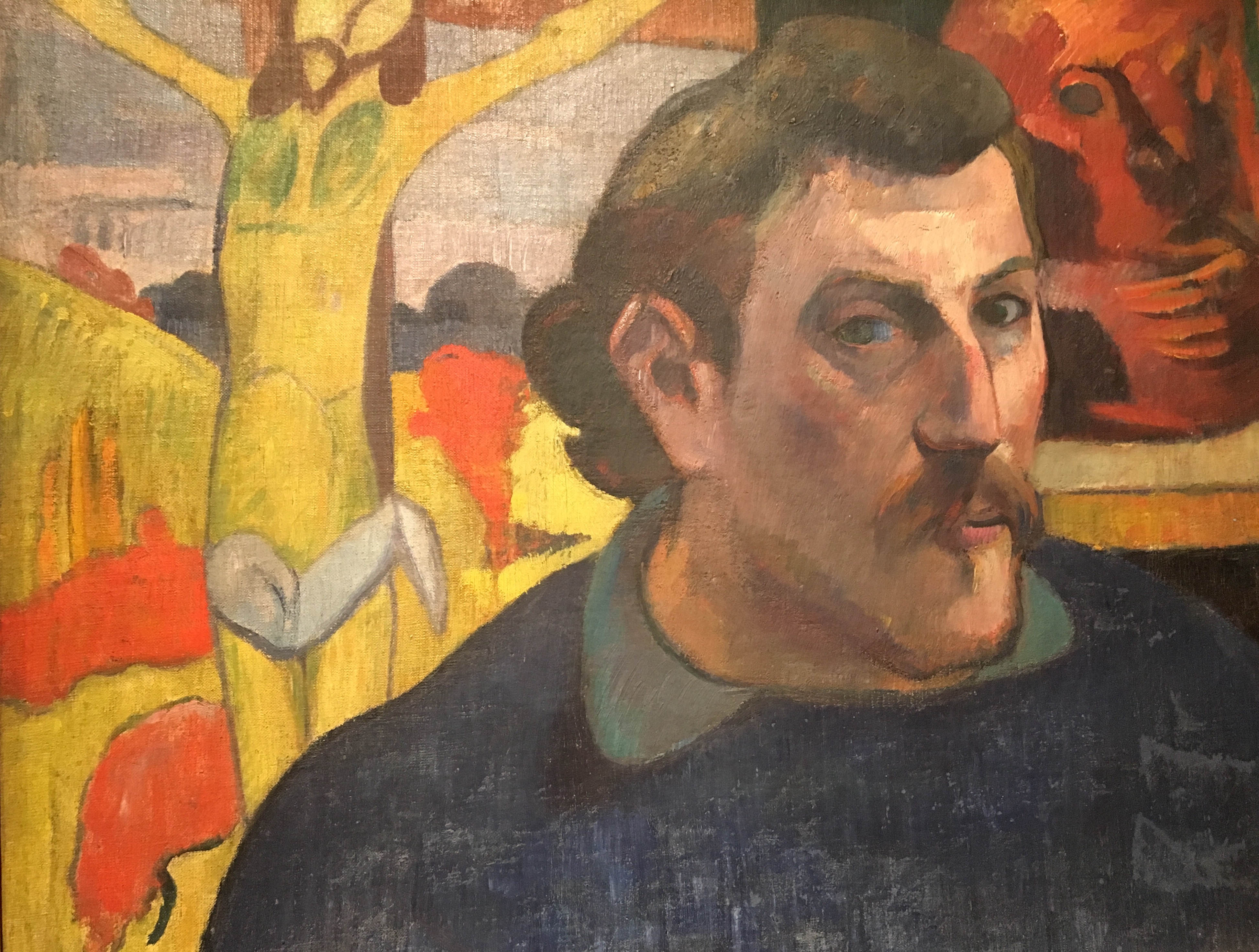
Saturday in the city

Paul Gauguin’s “Portrait of the Artist with the Yellow Christ” (1890-91).

I captured the image above at the Art Institute’s “Gauguin: Artist as Alchemist” exhibition. Afterward, we dined at Petterino’s, then headed to the Goodman for Ah, Wilderness! (Reviews here and here.)