

My daughter took this photo.
My daughter took this photo.
The following was originally written more than a decade ago in response to a post on a homeschooling board; it was then reshaped and published to my old site. The original poster asked about managing her child’s attitude toward schoolwork. She was having difficulty finishing lessons each week and felt they were falling behind. This repost (with minor edits) is provided at A.K.’s request.
It all begins with me.
Most of the time when things “break bad” here (and they do; not often, but they do), it’s more about me than about anyone else. When the work is taking forever to complete, when the quality is less than expected, when enthusiasm has waned, etc., I don’t need to look much further than the example I’ve been setting. Have I been on-task? Have I been doing my job(s) with attention to detail? Have I conveyed my love of the subject and of the family-centered learning project? Or have I been dealing with our accountant in a series of longwinded telephone calls? Spending twenty extra minutes on the treadmill? Checking email or blogging? Planning activities for next week, month, or year when we haven’t completed the activities for this week, month, or year? (Actually, I gave up that last bit during year one of this adventure. One of the first hard lessons I learned about home education is that my time is best spent not on elaborate lesson plans (no matter how ingenious, inventive, or inspiring to other hs-ing mothers), thumbing through catalogues, drafting curriculum wishlists, or bouncing from one resource to another but on the simple task of focusing on the moment we’re in. It has saved me years of angst and wasted time, talent, and treasure, that lesson has.)
Don’t misunderstand. I think that it’s important that we parent-educators tend to our needs, but I also think it’s critical that we do it on our own time. (For me, that’s in the wee, small hours of the morn’ or the late evening hours after they head to bed or, sometimes, during the day on “free” days (one benefit of year-round studies).) When I forget this self-mandate (e.g., when I take a call during lesson time or blog while the kids are laboring over math sheets), I send the following mixed message: Leading the family-centered learning project is my first and most important job — except when I want to do something else. Make that mistake too many times, and it’s really no wonder when the youngest dallies over a sheet she previously needed only thirty minutes to complete for three, four times longer than that; no wonder that they’re feeling recalcitrant, unmotivated; no wonder our interactions are laced with discontent.
Lest you or someone else click away in anger, note that this is not a criticism of any sort. I don’t know how you approach your work. You asked how to reach your child’s heart, though; I can only tell you how I reach my own children’s hearts and minds:
With as much consistency as possible, I model the behavior and standards I want the kids to maintain.
And I’ve been doing that since we began this adventure.
By necessity, this means I haven’t adopted then abandoned multiple approaches to parenting or learning. It means that I decided on a fairly certain course early on, a course chosen to match my personality and goals well.
And I’ve stuck with it.
There is an unmistakable rhythm to our days, a dance of daily routines and rituals that guide this family’s life, and everyone sways to the silent music
…because it has been playing since they they arrived.
Sure, there’s spontaneity. And fun. Lots of it. Surprise. Humor. Laughter. But that’s the harmony. The melody is one of clearly stated goals and plenty of examples of how to achieve them.
We parent-educators love to point out that the benefit of homeschooling is that we can tailor the curriculum and our approach to our students’ needs. I suspect, however, that there is a point at which this becomes too much of a good thing. Clearly, when an elementary school student fails to understand that his or her job is to play and learn and study and grow (and to do so without a big fuss), he or she needs less “heart talk” and more “stern talk” — mixed with a healthy dose of the teacher modeling the same level of commitment to task.
What is “stern talk”? It might look something like this: Quite simply, education is the law here; as in, parents must provide their children with an education. If my child isn’t learning (barring some sort of organic issue), we are not complying with the law. If I am doing my part (check), that leaves you, the child. You must do your part. In this house, that means that the following activities must be completed on a daily (weekly, monthly, annual) basis. Until we’re in compliance, we will skip the following activities: [insert favorite programs, extracurriculars here].
I’m going to circle back to my original premise: It all begins with the parent-educator. Anger and sadness are one response to a recalcitrant student. Humor is another approach. But, in the end, unwavering purposefulness may be the best choice, and that’s hard to achieve if we haven’t done the hard work of laying out our own courses. As I said, this is not a criticism but an observation based on my teaching and parenting experiences: Things work best when I work best.


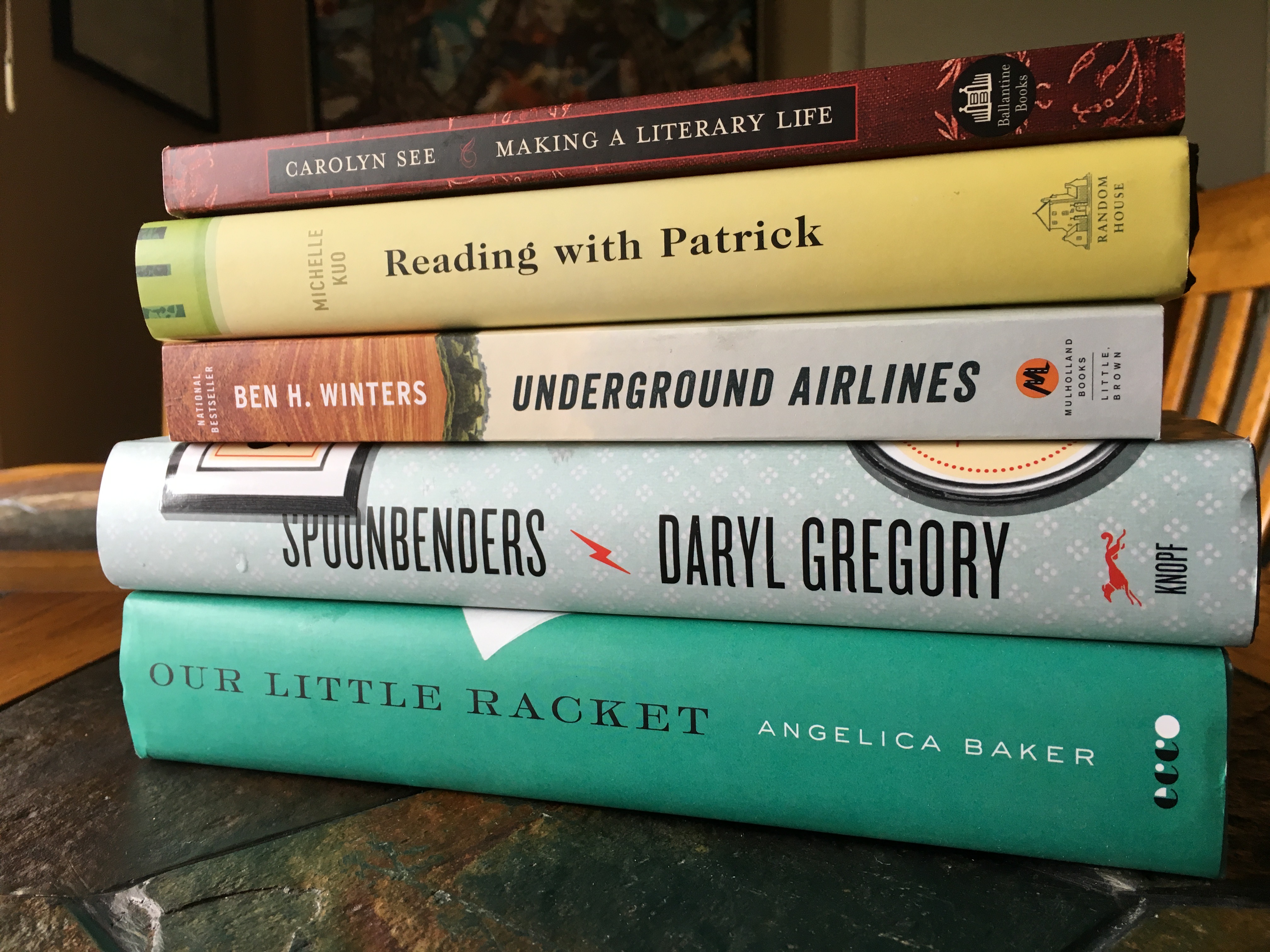
A stack of books (still) in progress.
 Before pouring my first mug of coffee this morning, I caught a glimpse of a female ruby-throated hummingbird visiting the hanging plants in the front yard. I had time to whisper, “Hummingbird!” twice, to alert my daughters, before she darted away. Ordinarily, the hummingbirds are attracted to the plant pictured above. It hangs near a window in the back of the house and appeals to many backyard visitors, including spicebush swallowtail butterflies.
Did you watch?
My youngest fashioned pinhole projectors from recyclables, and we safely viewed the phenomena between lunch and shopping. Yesterday’s errand list filled a page, but we didn’t want to miss the event. I had purchased glasses for all of us from Celestron but, erring on the side of (extreme) caution, we contented ourselves with “science in a cereal box.” Pretty cool.
Not so cool? How (very, very) swiftly the last fifteen weeks passed: My daughters are preparing for their return to university, and I am wondering how my heart can feel as if it is both bursting with proud excitement and breaking into ten thousand shards.







From Anna Botsford Comstock’s Handbook of Nature Study:
In my belief, there are two and only two occupations for Saturday [or Sunday] afternoon or forenoon for a teacher. One is to be out-of-doors and the other is to lie in bed, and the first is best. Out in this, God’s beautiful world, there is everything waiting to heal lacerated nerves, to strengthen tired muscles, to please and content the soul that is torn to shreds with duty and care.
 When my younger daughter and I embarked on our plan to (re)read The Odyssey before she returns to campus later this month, we agreed to tackle five or six of the epic’s books per week. We soon became so engrossed, however, that we finished weeks ahead of our schedule. We read the much-admired Fagles translation, and it was fine. An ardent Stephen Mitchell fan, I would have preferred his translation, but it is, inexplicably, unavailable in audiobook. I read the Fagles translation to the accompaniment of none other than Sir Ian McKellen, yet I pined for Alfred Molina reading Mitchell.
Here are my commonplace book entries:
Book Seven
I’m just a mortal man.
Whom do you know most saddled down with sorrow?
They are the ones I’d equal, grief for grief.
And I could tell a tale of still more hardship,
all I’ve suffered, thanks to the gods’ will.
But despite my misery, let me finish dinner.
The belly’s a shameless dog, there’s nothing worse.
Always insisting, pressing, it never lets us forget —
destroyed as I am, my heart racked with sadness,
sick with anguish, still it keeps demanding,
‘Eat, drink!’ It blots out all the memory
of my pain, commanding, ‘Fill me up!’
Book Eight
With a dark glance
wily Odysseus shot back, “Indecent talk, my friend.
You, you’re a reckless fool – I see that. So,
the gods don’t hand out all their gifts at once,
not build and brains and flowing speech to all….”
Book Eighteen
[N]otorious for his belly, a ravenous, bottomless pit
for food and drink….
Book Twenty
So surrender to sleep at last. What a misery,
keeping watch through the night, wide awake –
you’ll soon come up from under all your troubles.
It’s wildly optimistic of us, but now we are hoping to read The Scarlet Letter (Nathaniel Hawthorne) before she leaves. Also filed under “W” (for “Wildly Optimistic”) is the copy of Persuasion in the haphazard stack pictured above. Last month, when a flurry of news items appeared about the Jane Austen bicentenary, I determined that it would be the Austen novel I would most enjoy revisiting.
Today begins Week 8 in my quest to read War and Peace in seventeen weeks (or less), but the book continues to engage, and I have already finished the reading for both this week and next. Here are commonplace book entries for Weeks 6 through 9:
Book Two, Part Three, Chapter 7
At that meeting he was struck for the first time by the endless variety of men’s minds, which prevents a truth from ever presenting itself identically to two persons.
Book Two, Part Five, Chapter 1
It was too dreadful to be under the burden of these insoluble problems, so he abandoned himself to any distraction in order to forget them. He frequented every kind of society, drank much, bought pictures, engaged in building, and above all – read.
He read, and read everything that came to hand. On coming home, while his valets were still taking off his things, he picked up a book and began to read.
Book Two, Part Five, Chapter 9
She could not follow the opera nor even listen to the music, she saw only the painted cardboard and the queerly dressed men and women who moved, spoke, and sang so strangely in that brilliant light. She knew what it was all meant to represent, but it was so pretentiously false and unnatural that she first felt ashamed for the actors and then amused at them. She looked at the faces of the audience, seeking in them the same sense of ridicule and perplexity she herself experienced, but they all seemed attentive to what was happening on the stage, and expressed delight which to Natasha seemed feigned. ‘I suppose it has to be like this!’ she thought.
Book Three, Part One, Chapter 1
There are two sides to the life of every man, his individual life which is the more free the more abstract its interests, and his elemental swarm-life in which he inevitably obeys laws laid down for him.
I have made some progress in the “Shakespeare in a Year” project, too. Last weekend, I reread As You Like It and Twelfth Night. How fascinating to encounter Rosalind and Viola again, one right after the other.
From Act II, Scene 7, of As You Like It:
Thou seest we are not all alone unhappy:
This wide and universal theatre
Presents more woeful pageants than the scene
Wherein we play in.
Yesterday, I finished Troilus and Cressida, which, like Titus Andronicus, was new to me. Unlike Titus, though, Troilus was a chore to read. An uneven, clunky play, it provided little readerly joy beyond the unanticipated tie-in to the discussions we’ve been having about The Iliad and The Odyssey.
I have not yet decided when and where to squeeze Sir Thomas More into my schedule, nor have I decided what to do about Hamlet, a play I’ve read and seen more (many more) than a few times. Earlier in the project, I chose Howard Jacobson’s Shylock Is My Name over rereading The Merchant of Venice, and I am considering a similar substitution for Hamlet. The novel Hamlet, Prince of Denmark (A. J. Hartley and David Hewson) is the chief contender, although… I wonder if I could count Withnail and I (Bruce Robinson). Hmmm….
Other bookish bits: I discussed our Moby Dick reread here. Perhaps if I begin posting my commonplace book entries, those of you who have maintained a “No way!” stance on the the White Whale may be persuaded to try it. The Broken Ladder is my follow-up to Dream Hoarders (related entry here), and the other books are either recently acquired or awaiting reshelving.


 Nerdishly