


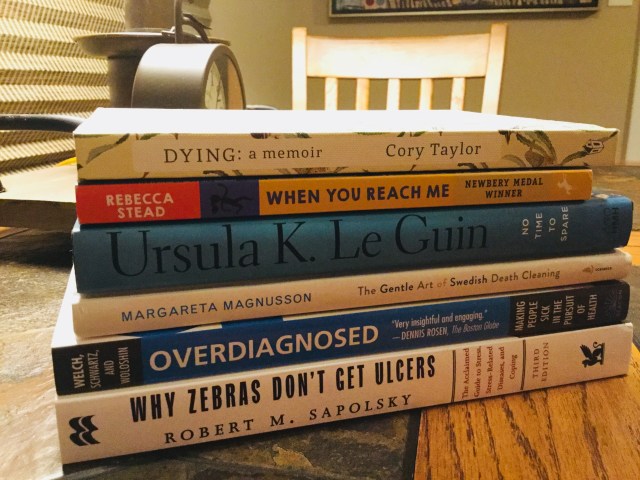
No, I haven’t broken my resolution already. These are a preorder and the last few holiday-gift-card purchases.
So, as I reported last week, I finished 157 books in 2017. It’s less about the number and more about the experience, though, and this year was enhanced by my participation in the “Shakespeare in a Year” project, Robin‘s War and Peace read-along, and a slew of terrific non-fiction. In short, 2017 will be a tough act to follow.
While mulling over my reading goals for this year, I stumbled upon a post in which a virtual friend mentioned that turning sixty has made her keenly aware of how finite her reading life is; she chooses books even more carefully now. Her wise insight now informs my own reading choices. I also came up with a short list of reading resolutions for 2018:
1. Read from the shelves.
2. Complete a close reading of Moby Dick.
Yes, I have already read it. More than once. It’s worth it.
3. Reread at least one Vonnegut novel.
I appreciated rereads these past two years but wonder how much of his oeuvre “holds up.”
4. Finish reading several books abandoned in 2017 (or *gulp* earlier).
Six Four (Hideo Yokoyama), Will in the World (Stephen Greenblatt), and Providence of a Sparrow (Chris Chester) come immediately to mind. Yeah, I may have been a shamelessly promiscuous reader in the past, but these are good books that don’t deserve such treatment.
5. Read at least thirty non-fiction titles.
Twenty-six has been my goal in the past. I beat it in 2017, so now I’ve raised the bar.
❧
My first book of the year was Never Let Me Go (Kazuo Ishiguro), a family book club selection and a reread for me. Tonight I will finish An Enemy of the People (Henrik Ibsen) — a selection made in anticipation of seeing Traitor (based on this play) later this winter break and An Enemy of the People over spring break. Arthur C. Clarke’s Childhood’s End is up next (another family book club selection).


In her paean to birding, Rare Encounters with Ordinary Birds, Lyanda Lynn Haupt writes:
There is a game birders play on New Year’s Day called “Bird of the Year.” The very first bird you see on the first day of the new year is your theme bird for the next 365 days. It might seem a curious custom, but people who watch birds regularly are always contriving ways to keep themselves interested. This is one of those ways. You are given the possibility of creating something extraordinary — a Year of the Osprey, Year of the Pileated Woodpecker, Year of the Trumpeter Swan. This game is an inspiration to place yourself in natural circumstances that will yield a heavenly bird, blessing your year, your perspective, your imagination, your spirit. New year, new bird.
After her breathless anticipation, Haupt is confronted with… an European Starling, or “sky-rat.”
The Year of the European Starling. Inauspicious, yes, but not without its charms, according to Haupt.
As I have on the past fourteen or so New Year’s Eves, I ensured that all of the feeders were topped off and that corn and nuts were scattered for the squirrels last night. (There are, of course, no squirrel-proof feeders, but I have learned that feed scattered away from the feeders will (mostly) keep those furry nuisances away from the birds and the more expensive seed.) Last year, I espied a black-capped chickadee in the oak out back. This year, I lifted the window-hanging while still curled in bed and saw a female Northern Cardinal at one of the feeders.


Since my mid-year review, I have read sixty-six books, for a total of 157 this year. An unrepentantly promiscuous reader, I could easily add thirty more titles to my annual list — books left in various stages of “undress” — but, as always, I have included only cover-to-covers.
— 53 plays (37 by Shakespeare)
— 45 novels (not including graphic works)
— 23 non-fiction works (29, including graphic works)
— 5 poetry titles
— 31 graphic works (6 of which were non-fiction titles)
A few fun facts:
▪ My participation in the “Shakespeare in a Year” project accounts for forty of those titles and may also explain the thirty-four-book increase over last year’s 123.
▪ “Shakespeare in a Year” was not the only challenge I undertook in 2017. This was also the year I (finally!) read War and Peace.
▪ I exceeded my two perennial goals — Read at least one non-fiction work every two weeks and Read more poetry — by finishing twenty-nine non-fiction books (six of which were graphic works, including the three volumes of John Lewis’ remarkable memoir, March) and reading each of Shakespeare’s 154 sonnets, as well as Venus and Adonis and The Rape of Lucrece.
▪ I read three fewer graphic works than last year and twelve fewer novels.
▪ Forty-one of the books I read were published this year. (Last year, I read forty-six books published in 2016.)
Other notes: This year, I reread a number of books that were as good if not better than they were when I first (or, in some cases, last) read them. (I have not included Shakespeare’s plays in this discussion.) To me, Reread generally equals Highly recommended, so consider these well worth your time:
■ The Handmaid’s Tale (Margaret Atwood; 1986. Fiction.)
■ Rhinoceros (Eugene Ionesco; 1959. Drama.)
■ Rosencrantz and Guildenstern Are Dead (Tom Stoppard; 1966. Drama.)
■ The Odyssey (Homer. (Trans. Robert Fagles; 1996.) Poetry.)
■ Fun Home (Alison Bechdel; 2006. Graphic memoir.)
■ Cat’s Cradle (Kurt Vonnegut; 1963. Fiction.)
Finally, the following are the books I’d like to recommend — again, in several cases:
■ So Long, See You Tomorrow (William Maxwell; 1980. Fiction.)
As much a meditation on loss and grief as it is an exploration of memory and how memory shapes (and haunts and robs from) the present, William Maxwell’s 1980 novel is as perfect a book as A Good School or Revolutionary Road (both by Richard Yates) or Olive Kitteridge (Elizabeth Strout). You’ll find commonplace book entries here.
■ World of Trouble (Ben H. Winters; 2014. Fiction.)
I’m cheating here because this is the final book in the Last Policeman trilogy, which means, yes, I am actually recommending three books. They’re not heavy, though, and Henry Palace is not simply another quirky detective; he is a character who will roam the rooms of your imagination for a long time.
■ Before the Fall (Noah Hawley; 2016. Fiction.)
It’s unsurprising that the flow of this “thumping good read” is reminiscent of great television; Hawley is a television writer and producer. (Commonplace book entries here.) My “Honorable Mention” recommendation would be Fierce Kingdom (Gin Phillips; 2017). This beautifully written and almost recklessly fast-paced thriller is destined for big-screen treatment. (Commonplace book entries here.) Pack either or both of these in your vacation bag.
■ Lincoln in the Bardo (George Saunders; 2017. Fiction.)
Whether or not you ordinarily like audiobooks, you must hear Saunders’ first novel to appreciate how original and remarkable it is. My husband and I listened during trips to and from the University and in and out of Chicago, and we are still talking about this beautiful book. (Related article here.) Neither of us were surprised to learn that it will be a film.
■ Fatale (Jean-Paul Manchette; 1977 (2011, English). Fiction.)
In the “slim book you can finish in a day” category, I shook things up earlier this year by recommending this dark, odd character study over the other contender, News of the World (Paulette Giles), which didn’t need my recommendation, anyway, as it was touted by everyone and her mother.
■ American War (Omar El Akkad; 2017. Fiction.)
This is my entry in the “best post-apocalypse / dystopia / it’s a mad, mad world fiction read this year” category. Others chose The Power (Naomi Alderman) or The Book of Joan (Lidia Yuknavitch)… but I think I’m right on this one.
■ A Whole Life (Robert Seethaler; 2014. Fiction.)
In 2015, I noted that Maria Beig’s novel Hermine: An Animal Life (translated from the German by Jaimy Gordon) is perfect, so comparing my experience of A Whole Life (translated from the German by Charlotte Collins) to Hermine is the highest praise I can offer this beautiful and deceptively simple novel. See also this review from The Irish Times, which draws parallels to Stoner (John Williams) and So Long, See You Tomorrow (William Maxwell), two books that would, like Hermine, easily earn a spot in my “Essential Bookcase.”
■ Evicted: Poverty and Profit in the American City (Matthew Desmond; 2016. Non-fiction.)
This is the sort of book everyone talks about and shares articles about but never reads. I recommend that you actually read it.
■ Reclaiming Conversation (Sherry Turkle; 2015. Non-fiction.)
“They decide there should be a rule: A good friend should keep you off your phone when you are together.” (p. 157) Don’t miss this thought-provoking exploration of what has been lost since people turned away from each other to connect via phone.
■ The Road to Jonestown: Jim Jones and the Peoples Temple (Jeff Guinn; 2017. Non-fiction.)
This well-researched account fascinates and saddens: If it were all so inevitable, how did no one prevent the tragedy?
■ Briggs Land, Volume 1: State of Grace (Brian Wood; 2017. Graphic fiction.)
I thought I was going to recommend Wood’s The Massive, Volumes 1-5, and then I remembered how strong the opening to his new series is… and how annoyed I was by the resolution of The Massive.
Wishing you good company, great books, and your favorite warm beverage!
 Nerdishly
