Post-eclipse

IMG_2499Before pouring my first mug of coffee this morning, I caught a glimpse of a female ruby-throated hummingbird visiting the hanging plants in the front yard. I had time to whisper, “Hummingbird!” twice, to alert my daughters, before she darted away. Ordinarily, the hummingbirds are attracted to the plant pictured above. It hangs near a window in the back of the house and appeals to many backyard visitors, including spicebush swallowtail butterflies.

Did you watch?
My youngest fashioned pinhole projectors from recyclables, and we safely viewed the phenomena between lunch and shopping. Yesterday’s errand list filled a page, but we didn’t want to miss the event. I had purchased glasses for all of us from Celestron but, erring on the side of (extreme) caution, we contented ourselves with “science in a cereal box.” Pretty cool.

Not so cool? How (very, very) swiftly the last fifteen weeks passed: My daughters are preparing for their return to university, and I am wondering how my heart can feel as if it is both bursting with proud excitement and breaking into ten thousand shards.

Sunday in the park


From Anna Botsford Comstock’s Handbook of Nature Study:

In my belief, there are two and only two occupations for Saturday [or Sunday] afternoon or forenoon for a teacher. One is to be out-of-doors and the other is to lie in bed, and the first is best. Out in this, God’s beautiful world, there is everything waiting to heal lacerated nerves, to strengthen tired muscles, to please and content the soul that is torn to shreds with duty and care.

Reading notes

IMG_2498When my younger daughter and I embarked on our plan to (re)read The Odyssey before she returns to campus later this month, we agreed to tackle five or six of the epic’s books per week. We soon became so engrossed, however, that we finished weeks ahead of our schedule. We read the much-admired Fagles translation, and it was fine. An ardent Stephen Mitchell fan, I would have preferred his translation, but it is, inexplicably, unavailable in audiobook. I read the Fagles translation to the accompaniment of none other than Sir Ian McKellen, yet I pined for Alfred Molina reading Mitchell.

Here are my commonplace book entries:

Book Seven
I’m just a mortal man.
Whom do you know most saddled down with sorrow?
They are the ones I’d equal, grief for grief.
And I could tell a tale of still more hardship,
all I’ve suffered, thanks to the gods’ will.
But despite my misery, let me finish dinner.
The belly’s a shameless dog, there’s nothing worse.
Always insisting, pressing, it never lets us forget —
destroyed as I am, my heart racked with sadness,
sick with anguish, still it keeps demanding,
‘Eat, drink!’ It blots out all the memory
of my pain, commanding, ‘Fill me up!’

Book Eight
With a dark glance
wily Odysseus shot back, “Indecent talk, my friend.
You, you’re a reckless fool – I see that. So,
the gods don’t hand out all their gifts at once,
not build and brains and flowing speech to all….”

Book Eighteen
[N]otorious for his belly, a ravenous, bottomless pit
for food and drink….

Book Twenty
So surrender to sleep at last. What a misery,
keeping watch through the night, wide awake –
you’ll soon come up from under all your troubles.

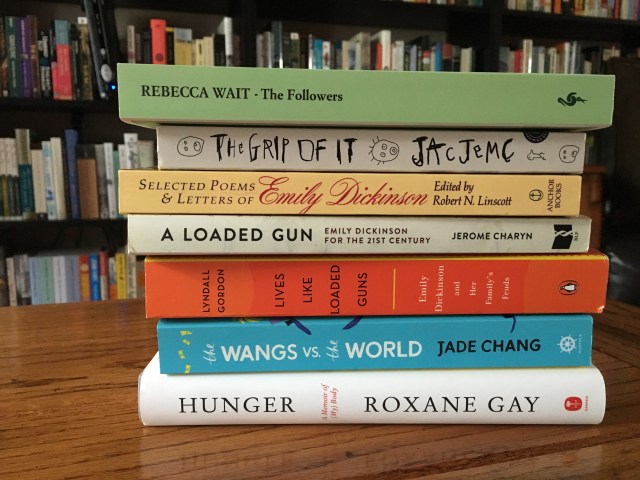
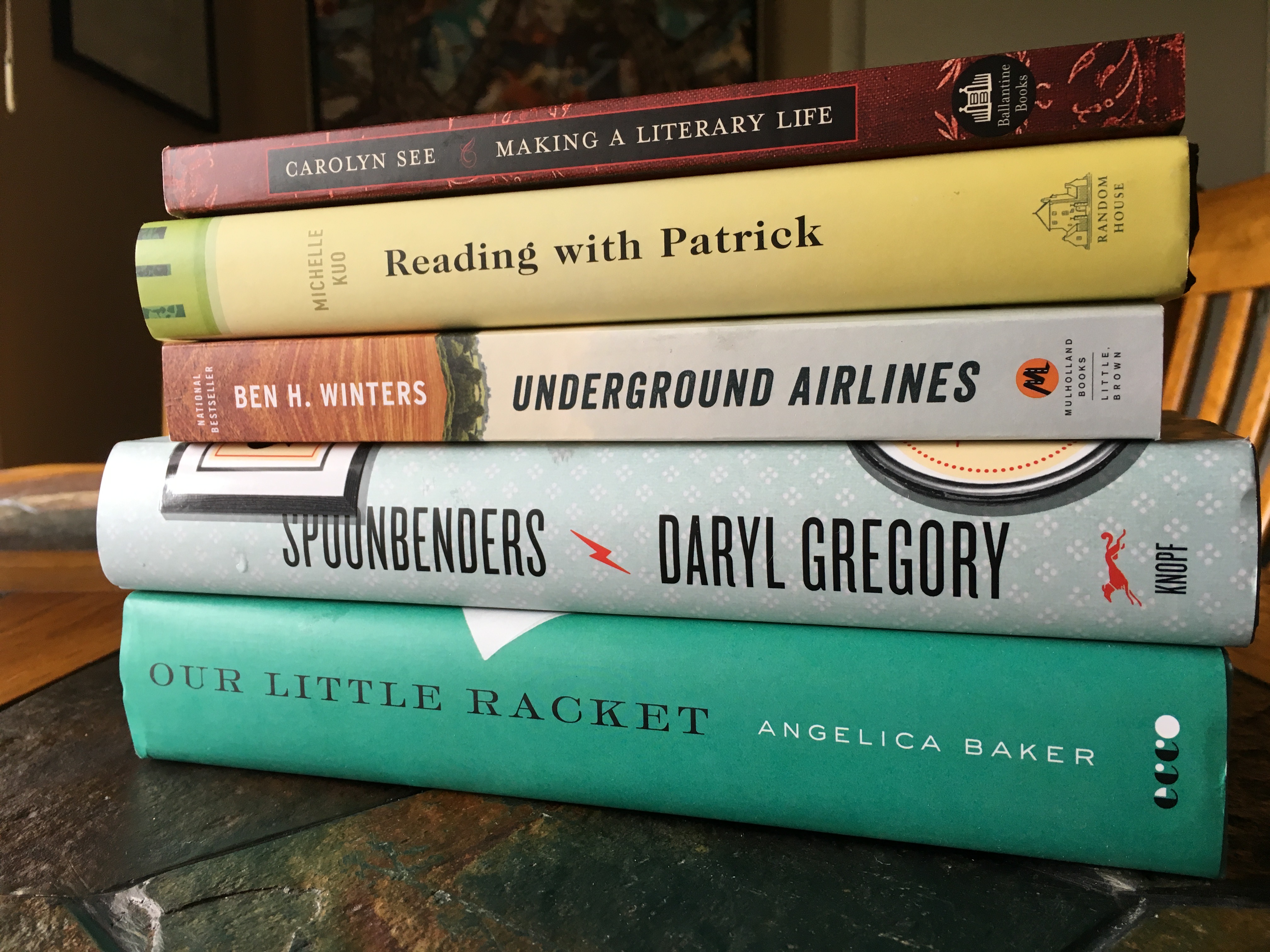
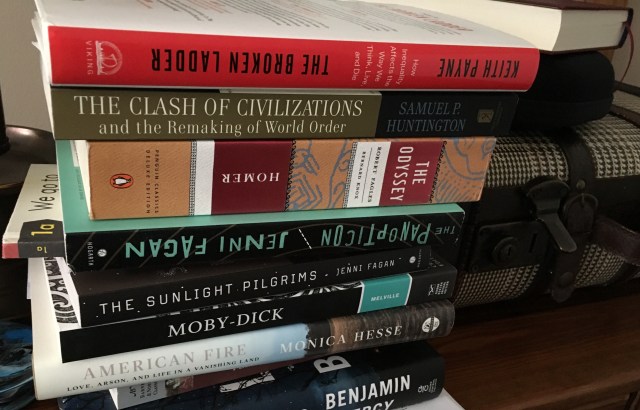
It’s wildly optimistic of us, but now we are hoping to read The Scarlet Letter (Nathaniel Hawthorne) before she leaves. Also filed under “W” (for “Wildly Optimistic”) is the copy of Persuasion in the haphazard stack pictured above. Last month, when a flurry of news items appeared about the Jane Austen bicentenary, I determined that it would be the Austen novel I would most enjoy revisiting.

Today begins Week 8 in my quest to read War and Peace in seventeen weeks (or less), but the book continues to engage, and I have already finished the reading for both this week and next. Here are commonplace book entries for Weeks 6 through 9:

Book Two, Part Three, Chapter 7
At that meeting he was struck for the first time by the endless variety of men’s minds, which prevents a truth from ever presenting itself identically to two persons.

Book Two, Part Five, Chapter 1
It was too dreadful to be under the burden of these insoluble problems, so he abandoned himself to any distraction in order to forget them. He frequented every kind of society, drank much, bought pictures, engaged in building, and above all – read.

He read, and read everything that came to hand. On coming home, while his valets were still taking off his things, he picked up a book and began to read.

Book Two, Part Five, Chapter 9
She could not follow the opera nor even listen to the music, she saw only the painted cardboard and the queerly dressed men and women who moved, spoke, and sang so strangely in that brilliant light. She knew what it was all meant to represent, but it was so pretentiously false and unnatural that she first felt ashamed for the actors and then amused at them. She looked at the faces of the audience, seeking in them the same sense of ridicule and perplexity she herself experienced, but they all seemed attentive to what was happening on the stage, and expressed delight which to Natasha seemed feigned. ‘I suppose it has to be like this!’ she thought.

Book Three, Part One, Chapter 1
There are two sides to the life of every man, his individual life which is the more free the more abstract its interests, and his elemental swarm-life in which he inevitably obeys laws laid down for him.

I have made some progress in the “Shakespeare in a Year” project, too. Last weekend, I reread As You Like It and Twelfth Night. How fascinating to encounter Rosalind and Viola again, one right after the other.

From Act II, Scene 7, of As You Like It:

Thou seest we are not all alone unhappy:
This wide and universal theatre
Presents more woeful pageants than the scene
Wherein we play in.

Yesterday, I finished Troilus and Cressida, which, like Titus Andronicus, was new to me. Unlike Titus, though, Troilus was a chore to read. An uneven, clunky play, it provided little readerly joy beyond the unanticipated tie-in to the discussions we’ve been having about The Iliad and The Odyssey.

I have not yet decided when and where to squeeze Sir Thomas More into my schedule, nor have I decided what to do about Hamlet, a play I’ve read and seen more (many more) than a few times. Earlier in the project, I chose Howard Jacobson’s Shylock Is My Name over rereading The Merchant of Venice, and I am considering a similar substitution for Hamlet. The novel Hamlet, Prince of Denmark (A. J. Hartley and David Hewson) is the chief contender, although… I wonder if I could count Withnail and I (Bruce Robinson). Hmmm….

Other bookish bits: I discussed our Moby Dick reread here. Perhaps if I begin posting my commonplace book entries, those of you who have maintained a “No way!” stance on the the White Whale may be persuaded to try it. The Broken Ladder is my follow-up to Dream Hoarders (related entry here), and the other books are either recently acquired or awaiting reshelving.
 

This and that

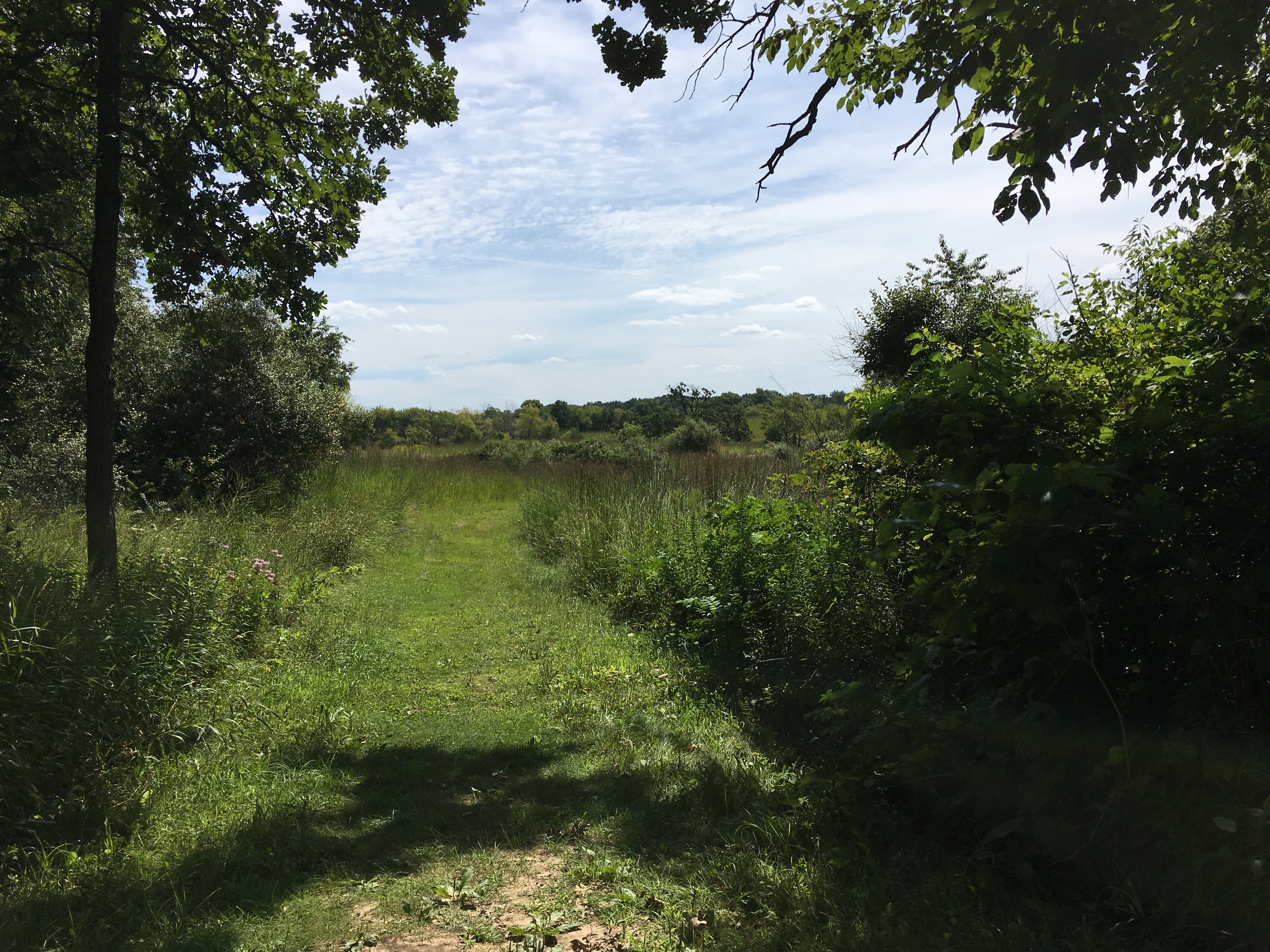
The temperatures have been so unlike-August that we decided to give the bikes a rest this weekend and head to a new-to-us conservation area for a hike and a geocaching adventure. What a terrific morning! We logged our seventeenth cache (the seventh of fifteen required for a challenge in which we’re participating).

Earlier this week, we celebrated Herman Melville’s 198th birthday by seeing Moby Dick at the Lookingglass. We first saw this gorgeous production in 2015, when Christopher Donahue dazzled as Ahab. Jamie Abelson offers a more restrained portrayal of the monomaniac, but we appreciated his interpretation. Moby Dick runs through September 3. If possible, do not miss this one.

Speaking of missing theatrical events, only one other patron joined us for the National Theatre Live broadcast of Angels in America Part One: Millennium on July 20; we had the theater all to ourselves a week later for Part Two: Perestroika. Sure, the length of these productions — approximately eight hours including intervals over two evenings — is wildly indulgent, and the Fandango tickets were outrageously priced. But wow. What terrific performances, particularly Andrew Garfield as Prior Walter and Denise Gough as Harper Pitt. If Angels is rebroadcast, consider it a good use of your time and treasure.

Other items in the “recently seen” category: I finally saw the last episode and a half of The Handmaid’s Tale. Brilliant. This is one of those rare occasions on which I will assert that the screen adaptation is as good as, if not better than, the book. I also saw and enjoyed Dawn of the Planet of the Apes and 10 Cloverfield Lane, fun, summer-evening films.

Bookish bits next time.

Flooding, dream-hoarding, and reading! Oh, my!

Saturday morning on the trail.

Storms and flooding have overcome parts of our county and most of the neighboring county. After Friday night’s pelting, we expected large puddles on the bike trail Saturday morning, but we peddled through ponds, however temporary. As I’ve learned over the last two weeks, flooding continues and can, in fact, worsen after the rains cease, so the ponds had nearly doubled in size by the time we encountered them on the return trip.

The humidity made a ride seem ill-advised this morning, and by 3 p.m., the storms had returned, so we contented ourselves with exercise videos and the promise of yard work tomorrow morning.

Today begins Week 6 in my quest to read War and Peace in seventeen weeks, but the book is so compelling that I have already finished the reading for Weeks 6 and 7. I have not made as much progress in the “Shakespeare in a Year” project, however: I’ve read through Sonnet 106 but must still (re)read As You Like It. Speaking of the sonnets, I love this from Sonnet 104:

To me, fair friend, you can never be old;
For as you were when first your eye I eyed,
Such seems your beauty still….

It has been a week, but “The Drowned Girl” from Joyce Carol Oates’ new collection, Dis Mem Ber continues to haunt me, and not simply because of its true-crime inspiration. Rather, I remain deeply unsettled by the insightful depiction of students marginalized by “alternate route” admission programs for transfer and / or non-traditional students.

Dream Hoarders (Richard V. Reeves) has also unsettled me (and sent me off to the shelves for Keith Payne’s The Broken Ladder). Reeves’ discussion of internships and other unpaid opportunities for students was particularly uncomfortable: My older daughter works twenty-plus hours per week as an summer intern. Yes, it’s an unpaid internship, but it’s also a priceless opportunity in a competitive (if wildly underpaid) field, where entry-level positions require both education and experience. She and my younger daughter, both undergraduate research assistants, were also asked to continue their projects over the summer, and although one daughter was, quite unexpectedly, offered funding, the other was not. (She did, however, earn a scholarship for achievement in non-major coursework, which had the effect of making the unpaid research seem less… indulgent? privileged? dream-hoarder-like?) Earning an undergraduate research position, especially at a such a large university, where so many capable students vie for so few spots, well, that’s quite an achievement, one that yields the experience, the letters of recommendation, the opportunities to contribute to publications and to present at conferences that make a student a more desirable graduate school applicant and / or jobseeker. So why would any parent say, “No”? And that’s the problem, maintains Reeves. It’s unfair that some students can accept unpaid opportunities while other students cannot. It’s particularly unfair, he continues, that some students have, through their parents’ professional and social networks, access to opportunities, paid and unpaid.

Talk about a challenging read! Here are my commonplace book entries:

p.3
There is one good reason why many Americans feel as if the upper middle class is leaving everyone else behind: They are.

Americans in the top fifth of the income distribution – broadly, households with incomes above the $112,000 mark – are separating from the rest. This separation is economic, visible in bank balances and salaries. But it can also be seen in education, family structure, health and longevity, even in civic and community life. The economic gap is just the most vivid sign of a deepening class divide.

p. 15
The big question is whether we are willing to make some modest sacrifices in order to expand opportunities for others or whether, deep down, we would rather pull up the ladder.

p. 54
The debate over college debt is lively and largely misplaced. It is lively because almost everyone involved in public discourse – scholars, journalists, politicians – went to college and has children who have done or will do so. (Almost every member of Congress has a college degree.) It is misplaced because the real problem in American higher education is not about debt, but distribution and quality. The debt problem is for people from poorer backgrounds who borrow to attend bad colleges.

p. 97
Discrimination on the basis of social class — what we call snobbery in the old country — is largely unacknowledged. Even Americans highly sensitive to the risks of sexism or racism often engage in classism, unaware that they are doing so.

In other bookish news… my younger daughter and I are (re)reading The Odyssey and listening to Elizabeth Vandiver’s wonderful lectures; I am enjoying a flurry of graphic works (more later); and the “twist” in Final Girls (Riley Sager) is no twist. At. All.

In which another week passes

Musicians at the Bristol Renaissance Faire.

We were able to tuck a ten-mile bike ride into each weekend morning, which is such a refreshing way to open a day. With neither plays nor museums on our calendar, we decided to visit the Bristol Renaissance Faire after yesterday’s ride. Because I skipped last year’s trip, I relished stops at favorite vendors like Seventh Sojourn, where I stocked up on scented soaps.

Today after our ride and a little yard work, my daughters headed out for lunch and a hike with a university friend, my husband settled in for a long study session, and I attended to some paperwork, banking, and writing. We still hope to wring a game or two and a family film out of the weekend before it concludes. We’ll see; we’ll see.

Speaking of seeing, I have finally shared the Lord of the Rings movies with my daughters. One thing and then another always kept us from getting around to the films, which may not have been such a bad thing. Apart from Andy Serkis’ brilliant portrayal of Gollum, the trilogy doesn’t really hold up for me, and they weren’t particularly impressed, either. This is heresy, I know, but it all felt so… abrupt and amateurish. In short, the books were better. (But not much.) And speaking of not holding up, while in the dentist’s chair (again!) mid-week, I heard Steve Perry earnestly crooning, “And here, I stand, with o, pen arms…” and thought, not for the first time, Oh, dear! This just does not hold up. So I texted my boyfriend of thirty-five years, husband of thirty-one:

They’re playing “Open Arms” at the dentist.
Our song doesn’t hold up.
LOL.
But I love you anyway.
So eighties. So la, la la, la la, la laaaa.
Guess you can’t dance to NPR, though.
[“Open Arms” was our first dance at our wedding reception.]

To which he sagely replied:

Can’t dance to anything.

In reading news… Today begins Week 5 in my quest to read War and Peace in seventeen weeks. Here are my Week Four commonplace book entries:

p. 448
There was no answer to any of these questions, except one, and that not a logical answer and not at all a reply to them. The answer was: ‘You’ll die and all will end. You’ll die and know all, or cease asking.’ But dying was also dreadful.

p. 451
Your view of life is a regrettable delusion.

I continue to progress in the “Shakespeare in a Year” project, too, making adjustments that suit my interests and scheduling needs. For example, I have read one hundred of the Sonnets and Don Patterson’s related commentary, which is a bit ahead of the plan, but I will read As You Like It this week, which is a tiny bit behind schedule.

In other reading, I finished Chang-Rae Lee’s On Such a Full Sea last night. As others have pointed out, the first-person plural viewpoint contributes to the mythic quality of the narrative, but it also obscures the protagonist a bit, which may frustrate some readers. That said, I think others who share my enthusiasm for Station Eleven (Emily St. John Mandel) will appreciate this beautifully written novel.

p. 215
It’s our common character on display, which is why we invest so much of ourselves — often totally beyond reason — in particular figures and performers, both fictive and of flesh. And when that display is unsettling or notorious, we can collectively wring our hands and wail and then try to assuage the disquiet in our hearts by more coolly interrogating its antecedents, the conditions and causes of its expression, and debate about how we might curb a future recurrence, none of this cynically posed but subtly servicing the final hopeful notion that This Is Not We.

p. 219
But if we calm ourselves and open our eyes and step back far enough, we have to admit that our society, if not fundamentally unwell, has been profoundly wounded.

Joyce Carol Oates’ recent short fiction collection, Dis Mem Ber, was on the porch when I returned from the Faire last night. I couldn’t help myself: I read four of the seven stories before setting it down to finish On Such a Full Sea. Quick, quintessential JCO, particularly the title story. I plan to finish tonight.

Weekending

Purple and yellow prairie flowers.

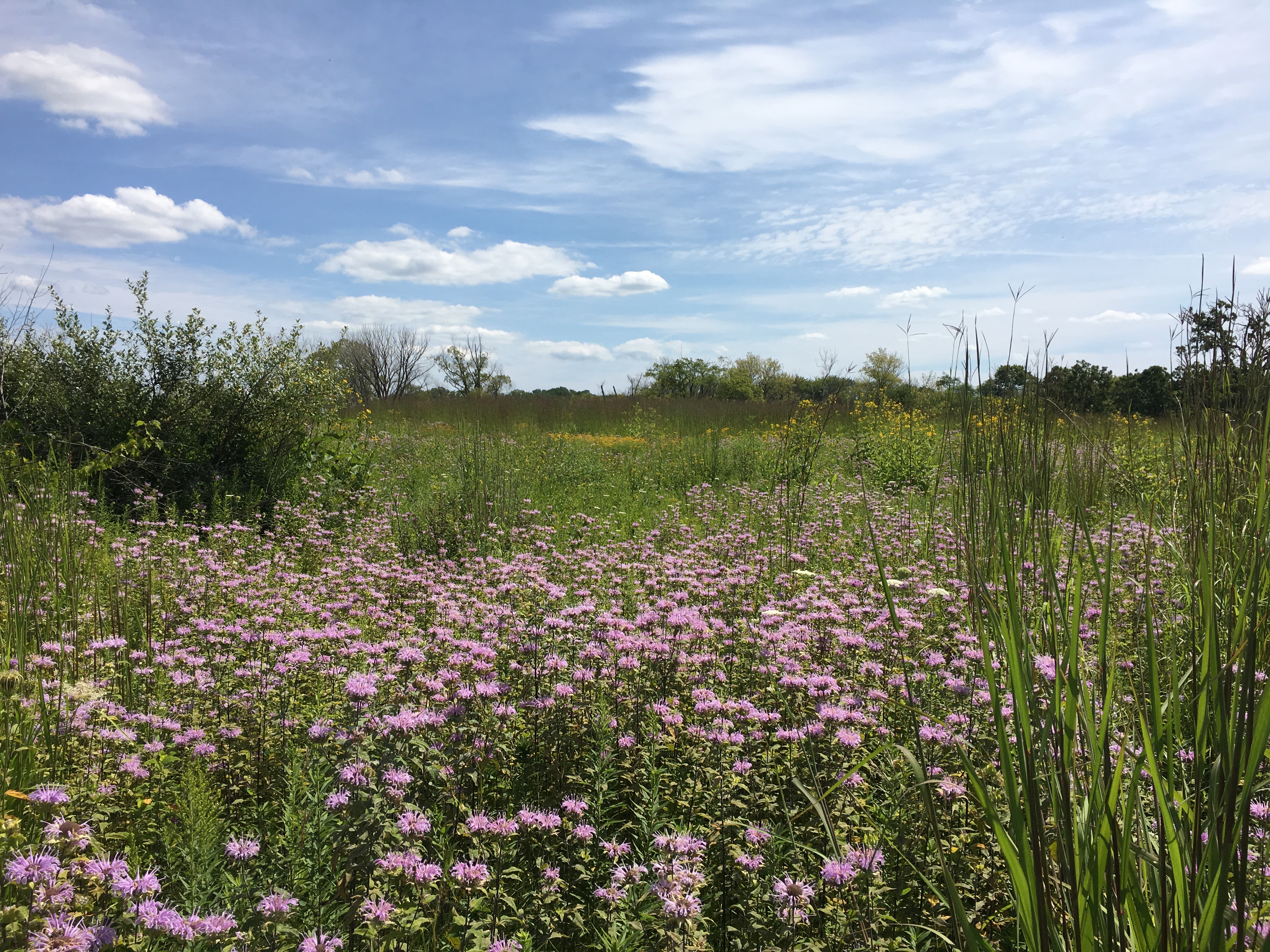
I took the image above on a walk / hike last Sunday. Has a week already passed since then? What an odd one. Perhaps it was the holiday just as the week was getting underway? Or maybe it was our collectively held breath over the budget negotiations? Or my misguided decision to mow the lawn on the hottest day of 2017? The week passed not unpleasantly but haltingly, in fits and starts. And here we are, at another weekend. Well. Mine will include two bike rides, one play, and several books. How about yours?

Speaking of books, tomorrow begins Week 4 in my quest to read War and Peace in seventeen weeks. Here are some passages for the commonplace book:

p. 178
‘One step beyond that boundary line which resembles the line dividing the living from the dead, lies uncertainty, suffering, and death. And what is there? Who is there? — there beyond that field, that tree, that roof lit up by the sun? No one knows, but one wants to know. You fear and yet long to cross that line, and know that sooner or later it must be crossed and you will have to find out what is there, just as you will inevitably have to learn what lies on the other side of death. But you are strong, healthy, cheerful, and excited, and are surrounded by other such excitedly-animated and health men.’ So thinks, or at any rate, feels, anyone who comes in sight of the enemy, and that feeling gives a particular glamour and glad keenness of impression to everything that takes place at such moments.

p. 207
‘… Go back or I’ll flatten you into a pancake,’ repeated he. This expression evidently pleased him.

p. 299
Her son’s growth towards manhood at each of its stages had seemed as extraordinary to her as if there had never existed the millions of human beings who grew up in the same way.

p. 306
Besides, to tell everything as it really happened it would have been necessary to make an effort to tell only what happened. It is very difficult to tell the truth, and young people are rarely capable of it.