Shakespeare in a Year

Four shelves of Shakespeare.

Four shelves of Shakespeare.

Now knee-deep in this project, I feel confident discussing my progress. So. Using this plan, a number of readers are attempting to read all of Shakespeare’s works in 2017. At this writing, I have completed the Sonnets through 18, Venus and Adonis through line 432, and the following plays:

The Taming of the Shrew
The Two Gentlemen of Verona
Henry VI, Part 1
Henry VI, Part 2
Henry VI, Part 3
Richard III

Because the Shakespeare Project of Chicago presented King John (a play for our time, to be sure) in January, I have also read that. Why am I off schedule? Early voting for the consolidated primary begins next week. This, coupled with my other pursuits, requires that I work ahead to keep up.

To complement my reading, I chose Tony Tanner’s Prefaces to Shakespeare. Garber, Bloom, and Van Doren were well exercised during our home education years, so it was time to turn to another resource. That said, I may supplement with a rerun of the Saccio lectures. For the sonnets, I am using Don Paterson’s Reading Shakespeare’s Sonnets and the app that features the filmed performances coupled with Paterson’s comments. (By the way, I purchased the Tanner seven years ago. It has given all of the stockpiled companions around the house hope: “Maybe she will read me next!” Heh, heh, heh.)

The plays
Going forward, I will try to be more methodical about my notes. As I recall, my remarks about Taming centered on how I would direct the final act as if Kate were complicit in the wager. I’ve written about my experience of Gentlemen a few times, including here; my reread was swift. The Henry VI plays were not tedious for me (some find them so) because I read them last year to prepare for the Chicago Shakespeare Theater’s Tug of War. (Foreign Fire and Civil Strife covered three plays each: Edward III, Henry V, and Henry VI, Part 1; and Henry VI, Parts 2 and 3, and Richard III. Yes, three plays, one meal, two snacks per event. It. Was. Awesome.) The “read a synopsis or retelling / watch a(t least one) production / listen to an unabridged recording with text in hand / dig into additional resources” approach works well for me, and this go-around, I watched The Hollow Crown, Cycle 2, and read the plays while listening to the Arkangel productions. Margaret interests me greatly; what a role that would be!

Richard III more naturally follows the Henry VI plays than Titus Andronicus (the next play on the plan), so I reread Richard III first. In addition to the CST production in the fall, we saw the Gift Theatre production of Richard III at the Steppenwolf last year. Wow. What a mesmerizing performance. Yes, he rose from his wheelchair and encircled Anne with his walker. Brilliant. (Review here.) Over the weekend, I also watched Benedict Cumberbatch as Richard in The Hollow Crown, Cycle 2. Maybe it was Richard III overload (or Benedict Cumberbatch overload, for that matter), but his Richard lacked the dark wit that usually makes the character such a delicious role.

Speaking of delicious, ahem… ‘gainst my wont, I have begun reading Titus Andronicus, one of the few plays I have not already read and studied, before seeing a production. Amazon Video had nothing, nor was there anything on our shelves, so I await word on my library holds. Spoiler alert: As many folks know, Titus Andronicus is a horror show of a play. Even if you choose to reconcile the violence as purposeful camp, it’s still rough going, especially if, like me, you use the Arkangel recording to complement your reading. You’ve been warned.

The sonnets
It is a reflection of my limitations, obviously, and not the poet’s, but the sonnets, with one exception, hold little appeal for me. The exception is Sonnet 74, which was sent to me with the note:

Below is Shakespeare’s Sonnet 74, where the poet addresses his beloved, advising that his spirit will live on after his death in what he leaves behind (his poem) and his spirit in his beloved’s heart. Bold emphasis is mine.

But be contented: when that fell arrest
Without all bail shall carry me away,
My life hath in this line some interest,
Which for memorial still with thee shall stay.
When thou reviewest this, thou dost review
The very part was consecrate to thee:
The earth can have but earth, which is his due;
My spirit is thine, the better part of me:
So then thou hast but lost the dregs of life,
The prey of worms, my body being dead,
The coward conquest of a wretch’s knife,
Too base of thee to be remembered.
The worth of that is that which it contains,
And that is this, and this with thee remains.

This reminds me to make the following commonplace book entry from King John:

CARDINAL PANDULPH
You hold too heinous a respect of grief.

CONSTANCE
He talks to me that never had a son.

KING PHILIP
You are as fond of grief as of your child.

CONSTANCE
Grief fills the room up of my absent child,
Lies in his bed, walks up and down with me,
Puts on his pretty looks, repeats his words,
Remembers me of all his gracious parts,
Stuffs out his vacant garments with his form;
Then, have I reason to be fond of grief?
Fare you well: had you such a loss as I,
I could give better comfort than you do.

Yes, I have mentally SCREAMED this:

[S]He talks to me that never had a son.

And this:

Fare you well: had you such a loss as I,
I could give better comfort than you do.

Once I finish Titus Andronicus, I will use the rest of this week’s Shakespeare time to read through Sonnet 27.

The long poems
Which leaves Venus and Adonis. While tame by today’s standards, this is certainly naughty Shakespeare. Chuckle. According to my husband, this poem merits my eyebrow face — when my eyebrows rise so high, they all but disappear. My reading / listening, though, has been a powerful reminder that so much of human narrative — perhaps especially Shakespeare — is meant to be heard. I blame the Q Brothers for this, but my imagination’s ear *totally* heard an ad-rap-tation of the poem! My goal, in addition to Sonnets 19 through 27, is to read through Line 576 this week.

A walk in the woods

Image taken February 4, 2017.

Image taken February 4, 2017.

My husband and I take at least one long walk-hike together each weekend. When pressed for time, we wander the neighborhood, but we prefer to head to one of the parks or conservation areas. (And our middle-aged feet and knees certainly prefer the trails to the sidewalks.)

From Anna Botsford Comstock’s Handbook of Nature Study:

In my belief, there are two and only two occupations for Saturday afternoon or forenoon for a teacher. One is to be out-of-doors and the other is to lie in bed, and the first is best. Out in this, God’s beautiful world, there is everything waiting to heal lacerated nerves, to strengthen tired muscles, to please and content the soul that is torn to shreds with duty and care.

Winter at the sites we most enjoy can be stark, but even in the gray hardness, cold beauty is evident. That said, it is difficult for this trail to compete with its autumn afternoon finery.

Same trail on October 2, 2015.

Same trail on October 2, 2015.

IMG_5201[1]

Who tells your story?

img_1366The Book of Joseph, a biographical play based on correspondence collected in Every Day Lasts a Year, runs through March 5 at the Chicago Shakespeare Theater.

From Stuart Sherman’s “A Scholar’s Perspective: Here?”:

The story told in The Book of Joseph is simple, true, and fraught with loss. In Kraków, Poland, 1939, Joseph Hollander — Jewish, enterprising, and alert to the approaching storm of hate and death — arranges a swift departure to safer places for himself and his large, loved family: mother, sisters, in-laws, nieces. But they decline to leave, calmly convinced that (to echo a novel published three years earlier an ocean away) it can’t happen here. Only Joseph knows it can. They stay; he leaves, intent on securing their escape somewhere down the line.

Then there’s a second story, without which we would have far less access to the first. Baltimore, Maryland, 1986: in the wake of Joseph’s death, his adoring grown son Richard finds a briefcase full of letters postmarked from Poland, stamped with swastikas, dating from the early 1940s, written by the Hollanders, under deepening duress, to the their cherished, distant son, now dwelling precariously in America and still trying like hell to get them out.

Entwining these two stories, from the middle and the end of the twentieth century, The Book of Joseph documents the Hollander family’s wholeness and its sunderings.

Our family shares a great enthusiasm for talk, talk, talking about what we read, see, do, think. This, coupled with my mental quilting — stitching this experience to that book to this film to that exhibition, and so on — is how I learn (and how I learn how much remains to be learned). So, on the long drive from Chicago, my husband and I discussed The Book of Joseph. The second act, which, I pointed out, propelled the material from quite good to must-see, focuses on who will tell the — “Who lives? Who dies? Who tells your story?” I offered. My husband acknowledged the Hamilton reference. The Book of Joseph is a Holocaust story, but it is a family story first. What parts of their narrative will survive? Who will remain to tell their story? How will it be told? Will it be told?

This play deserves a wide and appreciative audience. Reviews here and here, and I heartily agree with Chris Jones: Sean Fortunato, gives “the performance of his professional life” as Joseph Hollander.

Speaking of mental quilting, by the way, before I saw her name, I recognized Amy Carle’s face: She read the female lead in The Hill You Die On. Her Neve roams the rooms of my imagination still. (I’ve republished my entry from that evening here.)

The Hill You Die On

The following was published on my original site on November 15, 2011.

Last night was the reading of Sheila O’Malley’s play, The Hill You Die On.

No traces of the play that had closed the night before were apparent in the small theater space where the reading was held. All that remained was bare, black, blank.

Expectant.

Two chairs and two stands on a platform. Another chair and stand off to the side.

The audience entered, greeted, rustled, embraced, connected, acknowledged, made room for, settled.

Introductions.

And then a relationship unfolded.

And I was reminded all over again that what happens to each of us is both unique and universal. The story is ours alone, but it has all been told before, hasn’t it? The coming together. And apart. The tenderness and sorrow. The beginning and the inevitable conclusion.

If you have heeded my recommendations over the years, if you have bookmarked The Sheila Variations or added the site to your feed or done whatever you need to do to ensure that you’re keeping up with her, you already know that she can, vernacularly speaking, write her ass off. The Hill You Die On is simply further evidence of her gifts.

Humor punctuates the first half of the play; Sheila’s dialogue reminds us that laughter comes easily early in a relationship. Wit has a different sound when it ends, though, doesn’t it, and she captures that, too. Most importantly, she captures the truth of it all – the honesty that is both tender and devastating.

A quiet moment all but undid me: Jack explains to Neve why he reads obituaries. Over the past year, I’ve perfected the art of the silent sob, so I don’t think I distracted anyone with my reaction to that beautifully written, perfectly delivered scene.

And the conclusion… well, I don’t think I was alone in my response to that.

Jeff Christian portrayed Jack. As I have mentioned, Jeff was the artistic director for the Shakespeare Project of Chicago (SPC), which played an important role in fostering my son’s (and my own, for that matter) love of Shakespeare. I had a moment after the play to tell Jeff how much I appreciated not only his wonderful performance but also his work with the Project. Damned if he didn’t ask me which plays we had seen. The Winter’s Tale, which we saw in February 2005, immediately came to mind, as did The Merchant of Venice from the 2003-2004 season, but for the life of me I could not remember Two Gentlemen of Verona, from that same season. “Uhhh….” It came to me as we were driving home. Of course. Well, we introverts don’t score high on small talk, do we? (More, let’s face it: Two Gentleman of Verona is not exactly one of Shakespeare’s great ones.) Still, once I learned that he was going to play Jack, I determined that he must know how important his work with SPC had been to us – and that meant talking to him. So I tried.

And Amy Carle portrayed, no, became Neve. Had I simply read the character, I would have loved her, but Amy Carle’s performance ensured that Neve will roam the rooms of my imagination for a long time. Beautifully, beautifully done.

The reading was followed by a discussion with Sheila and the director, Mitchell Fain (who also deserves a shout-out, as does the person who read the stage directions, which required impeccable timing – and he had it; regrettably, I don’t have his name). If all that I’ve already written hasn’t persuaded you that the play was absolutely terrific, then this confession may: Following many articulate audience responses to everything from scene changes to cultural references to character, I spoke. Pretty animatedly, in fact. Ayup. Deeply moved and likely inspired by the play’s frank language, I attempted to describe what, to me, was Jack’s emotionally brutish behavior during the “scorched earth” argument and in the penultimate scene.

And I did so in the most unflattering terms.

A slang word was involved.

Twice.

It will haunt me for weeks. [Note: Five and half years later, it haunts me.]

Couple that episode with my sincere but inept conversation with Jeff, and, well, there you go. The introvert’s worst nightmare.

Don’t worry, though. I’ll get over it.

Heh, heh, heh.

Sheila, thank you. Your characters, their relationship, your way with words, the wisdom and humor you revealed, the truths you told — all of it moved me, made me think, made me feel, made me hope to understand. Thank you. And congratulations!

More book notes

img_9809
■ Wednesday is comics day. This week, my pull list comprised Saga #42 and Revival #46.

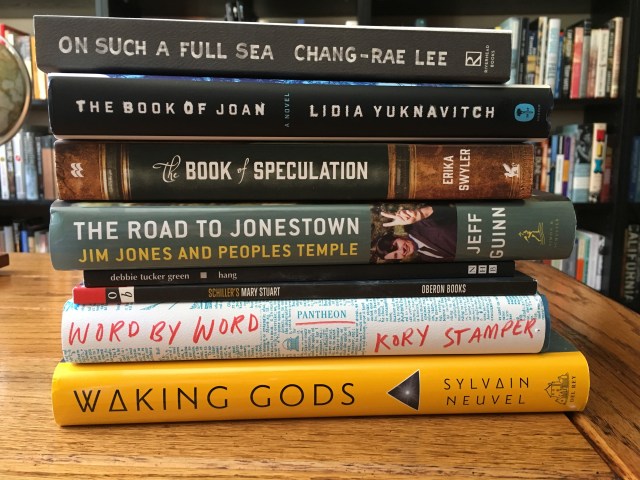
■ Crouch’s Dark Matter entertained three of us late last year, so I chose Pines for an easy, escapist read.

■ Move Evicted to the top of your TBR pile. Now. Really. I’ll wait. From my commonplace book:

p. 256
The Hinkstons expected more of their landlord for the money they were paying her. Rent was their biggest expense by far, and they wanted a decent and functional home in return. They wanted things to be fixed when they broke. But if Sherrena wasn’t going to repair her own property, neither were they. The house failed the tenants, and the tenants failed the house.

p. 257
Substandard housing was a blow to your psychological health: not only because things like dampness, mold, and overcrowding could bring about depression but also because of what living in awful conditions told you about yourself.

p. 285
Poverty could pile on; living it often meant steering through gnarled thickets of interconnected misfortunes and trying not to go crazy. There were moments of calm, but life on balance was facing one crisis after another.

p. 291
The home is the wellspring of personhood.

■ We will see the world premiere of The Book of Joseph at the Chicago Shakespeare Theater next month. The play adapts the correspondence collected in Every Day Lasts a Year.

■ Our family book club chose The Handmaid’s Tale for our winter selection. We listened to the audiobook for a bit during each of our drives in and out of Chicago and on the way back to campus. (Claire Danes does exceptional work with the narration.) My husband completed the audiobook, my daughters are reading the rest in between classes and research, and I finished by rereading my thirty-one-year-old hardback. Since I first read Tale, it has been a looming part of the landscape of my imagination, yet I was unprepared for how much more horrifying it seems now — now that I am the mother of adult daughters, now that the world appears to have gone a bit mad.

p. 181
No mother is ever, completely, a child’s idea of what a mother should be, and I suppose it works the other way around as well. But despite everything, we didn’t do too badly by one another, we did as well as most.

I wish she were here, so I could tell her I finally know this.

■ I picked up Bird Watching from a bargain table at the university bookstore. I want to adore McCartney’s playfulness, but I do not.

■ Maybe I should have declined the invitation because I knew I would not be able to give the “Shakespeare in a Year” project my complete attention until this weekend, but I am confident I will be completely caught up by Groundhog’s Day.

Reading notes

img_1162■ As much a meditation on loss and grief as it is an exploration of memory and how memory shapes (and haunts and robs from) the present, William Maxwell’s 1980 novel So Long, See You Tomorrow is as perfect a book as A Good School or Revolutionary Road (both by Richard Yates) or Olive Kittredge (Elizabeth Strout).

p. 9
What I didn’t say, across the few feet that separated our two beds, was that I couldn’t understand how it had happened to us. It seemed like a mistake. And mistakes ought to be rectified, only this one couldn’t be. Between the way things used to be and the the way they were now was a void that couldn’t be crossed. I had to find an explanation other than the real one, which was that we were no more immune to misfortune that anybody else, and the idea that kept recurring to me, perhaps because of that pacing the floor with my father, was that I had inadvertently walked through a door I shouldn’t have gone through and couldn’t get back to the place I hadn’t meant to leave.

p. 27
What we, or at any rate I, refer to confidently as memory — meaning a moment, a scene, a fact that has been subjected to a fixative and thereby rescued from oblivion — is really a form of storytelling that goes on continually in the mind and often changes with the telling. Too many conflicting emotional interests are involved for life ever to be wholly acceptable, and possibly it is the work of the storyteller to rearrange things so that they conform to this end. In any case, in talking about the past we lie with every breath we draw.

p. 113
In the face of a deprivation so great, what is the use of asking him to go on being the boy he was. He might as well start life over again as some other boy instead.

■ So thoroughly did my family enjoy the Chicago Shakespeare Theater production of King Charles III (reviews here and here) that I decided to read the play.

The Shakespeare Project of Chicago is hosted by libraries, and the library at which we saw King John is engaged in a “One Book, One Community” program for which The Story Hour (Thrity Umrigar) is the selection. It interested me enough to order a copy.

■ I wanted to add another passage from J.D. Vance’s Hillbilly Elegy to the commonplace book before shelving it:

p. 228
For kids like me, the part of the brain that deals with stress and conflict is always activated — the switch flipped indefinitely. We are constantly ready to fight or flee, because there is constant exposure to the bear, whether that bear is an alcoholic dad or an unhinged mom. We become hardwired for conflict. And that wiring remains, even when there’s no more conflict to be had.

■ As I mentioned last week, Elegy segues neatly into Evicted (Matthew Desmond). Fifty pages in, what I’ve noticed so far is that Desmond seems evenhanded in his depiction of the tenants and their landlords.

“Space is freaking awesome!”

img_1078

img_1085

img_1100

img_1093

img_1076The above are images I took during our recent visit to the Adler Planetarium. What I love about the last one is that I can see my daughters through the display.

After the museum, we saw A Disappearing Number at the TimeLine Theatre. Yes, a play about math. What did you expect? My site is called “Nerdishly.” My youngest recently secured a spot with a high energy physics research group that is working on the ATLAS experiment, so insert a muted nerdgirl “Squeeeeee!” when Anish Jethmalani’s character, Aninda, announced that he was a physicist lecturing at CERN. The script is not a seamless one, but this production is so fabulous that one forgives the weaknesses in the text. Highly recommended.