

Shelved for now.
Shelved for now.

… with a sort of heady excitement: ‘There are only the pursued, the pursuing, the busy and the tired.’”
One of my favorite books has reached its centennial: “100 years later, ‘The Great Gatsby’ still speaks to the troubled dream of America.”

Portrait Bust of a Woman; Mid-2nd century, Roman.
My photo, taken at the Art Institute of Chicago.
Women beyond a certain age are largely unseen, I know, but beneath that cloak of invisibility, I have been self-conscious about my appearance for several months. My husband and daughters have assured and reassured me that all is well, but I didn’t begin to believe it until yesterday, when the surgeon smilingly beheld her work and declared that I am healing much more quickly (and much less traumatically) than most can expect; more, I will look as if much of this had never happened — and soon.
Since late August, it has sometimes felt as if my calendar comprised only medical appointments followed by return visits coupled with lab work accompanied by consultations, as if my days demanded many, too many, health-related accommodations. This is a drama-filled and -fueled interpretation of what were largely commonplace issues associated with aging, and when I couldn’t talk (or shame) myself out of feeling sorry for me, I walked. It helped (even when it hurt — hence, the orthopedist, the orthotics) — as did reading, finding the Jerry Orbach seasons of Law & Order on Hulu, looking at art, and listening to music, including pop treasures like this.
Today through rain-streaked windows, I can see wet-feathered birds visiting our feeders while I, dry and warm in my favorite chair, read from a stack that includes Shakespeare’s Henry V and The Tempest and Cormac McCarthy’s Blood Meridian. And according to the forecast, I should be able to walk for a bit before class tonight. I’ll wear my cloak of invisibility with confidence.

Today I’m reading Canto 20 of Dante’s Paradiso, some poetry, and Frindle (Andrew Clements; 1996), a favorite from when my children were young.
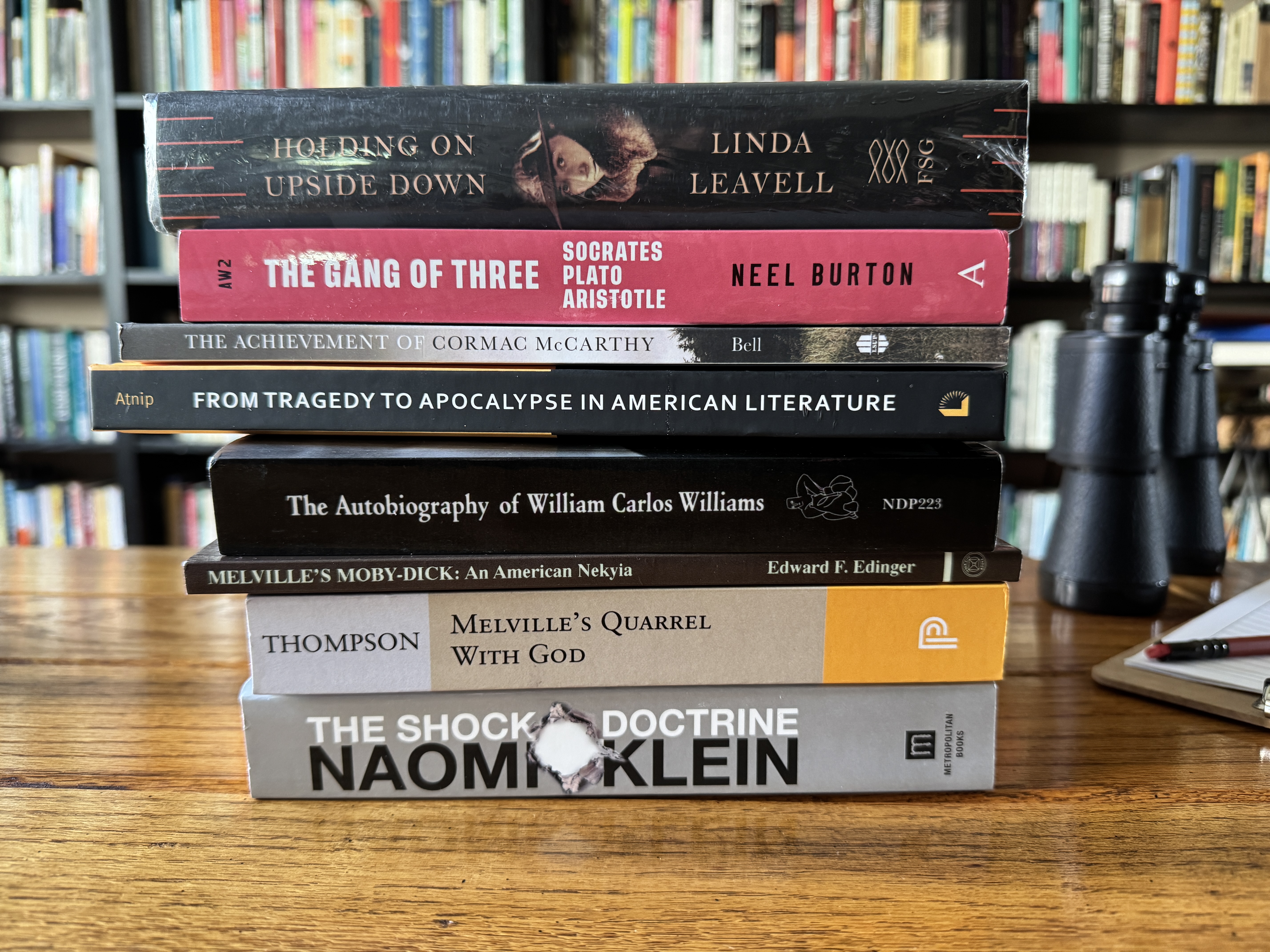
Shelved for now.
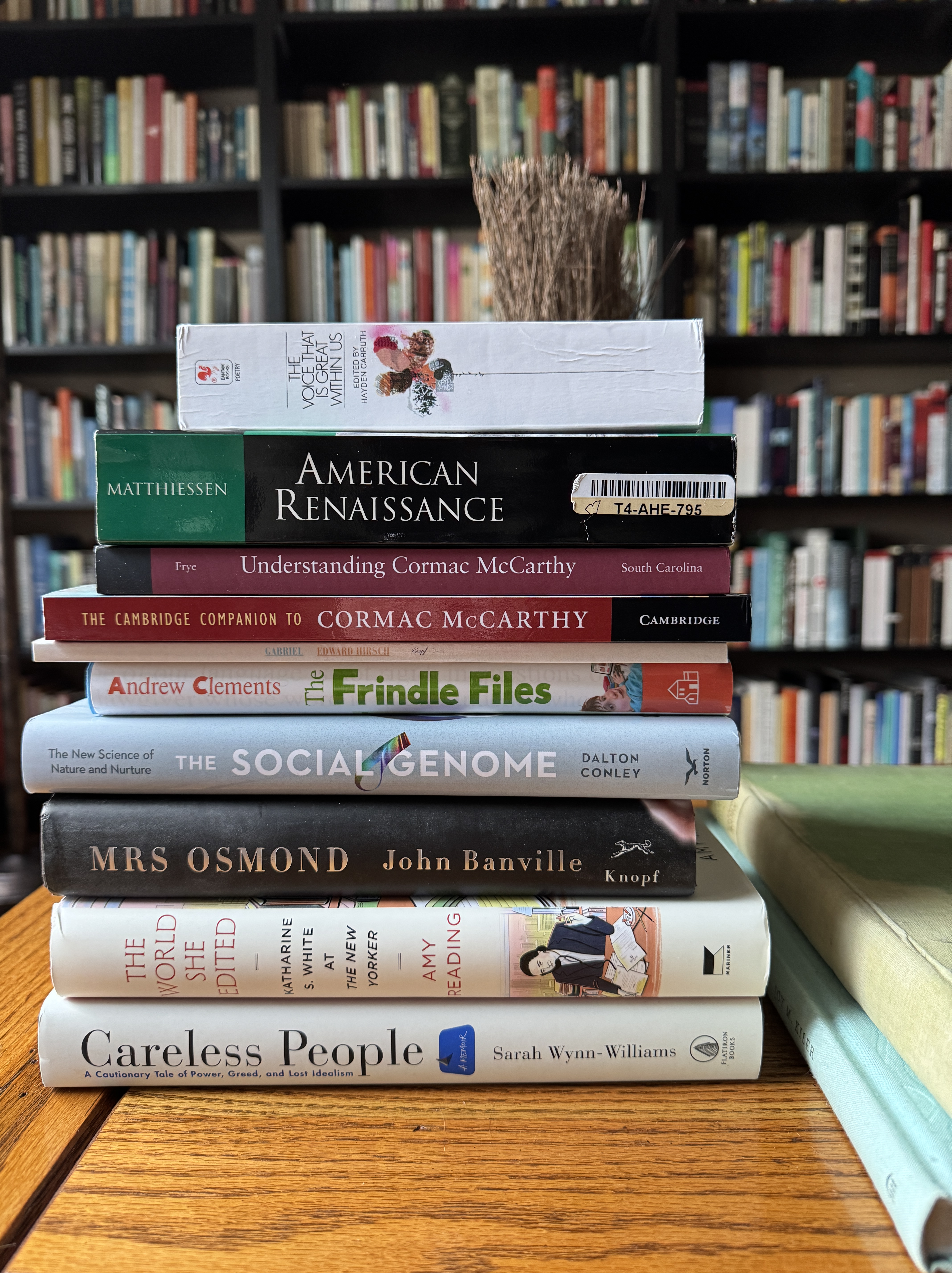
Lately: Reading. Planning a short spring break. Getting back into a music practice groove. Walking.

The sandhill cranes are returning; they soared overhead on my walks yesterday and today. Sun and warmer temperatures. Some new books, purchases and gifts.

New books.
This week I read Prodigal Summer (Barbara Kingsolver; 2000), this month’s SciFri Book Club selection. Although it began compellingly, by the midpoint it had grown wearingly didactic. Still, moments delighted me, including one in which Deanna, an introvert and solitary forest ranger, meets the colleague who brings her supplies. He expresses surprise that she doesn’t want a television, doesn’t listen to the radio. A big news event could occur, he chides, “and you wouldn’t know it for a month.” She asks what would be different because he knew that same news. Nothing, it turns out. She replies, “Why I like my life, Jerry. I watch birds. They do something different every fifteen minutes.” These days, I share some of that sensibility.
Related: In Doppleganger: A Trip into the Mirror World (2023), which I finished reading over the weekend, Naomi Klein mentions Iris Murdoch’s ideas about “unselfing.” At The Marginalian, I learned more. In The Sovereignty of Good, Murdoch writes:
Beauty is the convenient and traditional name of something which art and nature share, and which gives a fairly clear sense to the idea of quality of experience and change of consciousness. I am looking out of my window in an anxious and resentful state of mind, oblivious of my surroundings, brooding perhaps on some damage done to my prestige. Then suddenly I observe a hovering kestrel. In a moment everything is altered. The brooding self with its hurt vanity has disappeared. There is nothing now but kestrel. And when I return to thinking of the other matter it seems less important. And of course this is something which we may also do deliberately: give attention to nature in order to clear our minds of selfish care.
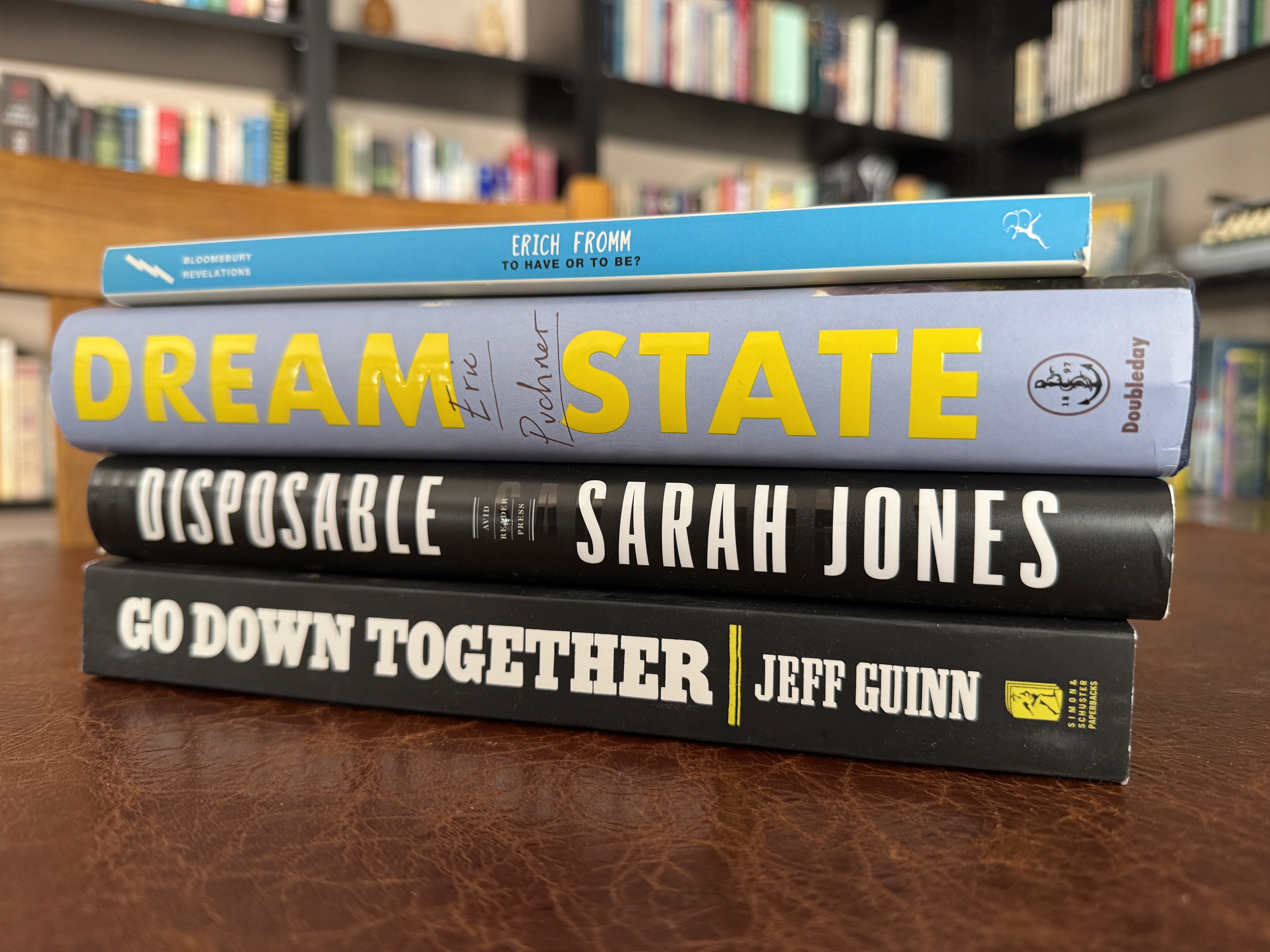
A few new books.
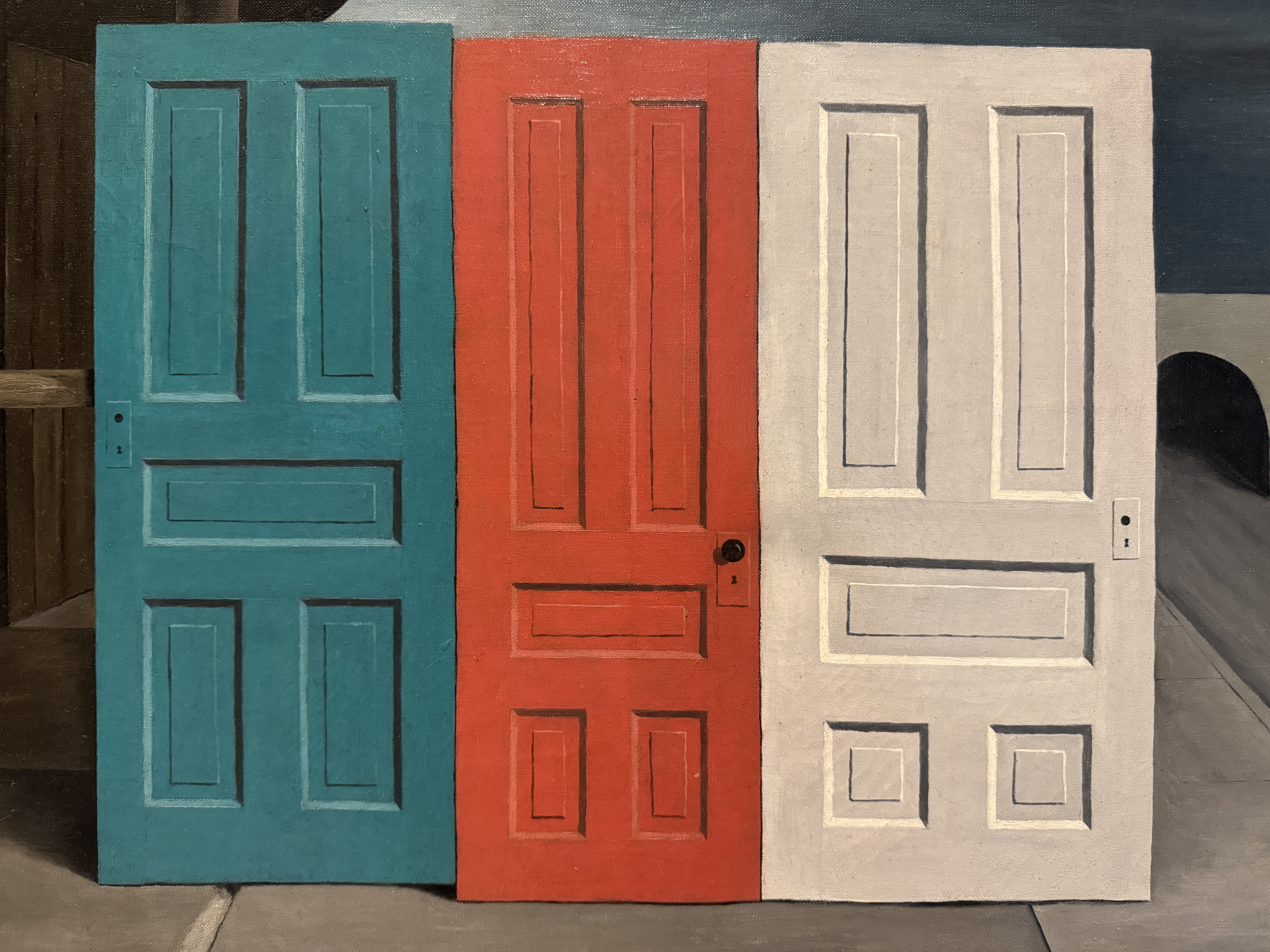
My image of Gertrude Abercrombie’s “Doors (3 Demolition)” (1957).
Over the weekend we saw the Court’s excellent production of A Raisin in the Sun (review here), having visited our favorite noodle stop and the Smart Museum of Art beforehand. (The Smart is still celebrating its fiftieth anniversary, so if you’re in the area and have never visited this tiny treasure, get there.)
After a week of single-digit temperatures, the weather has granted us a return to more comfortable walking weather. (Recurring public service announcement: Wear sunscreen.) In addition to logging more miles, I’ve gotten back to music practice, preparing to resume lessons in mid-March. (The doctor advised against playing for at least two weeks post-surgery; it was only a few days the first time. May there be no third time.)
Generally, very little can prevent me from reading, so that has continued uninterrupted. Not long after announcing I had begun The Heaven and Earth Grocery Store, though, I read this article and became absorbed by Barbara Kingsolver’s Demon Copperhead (2022). Come for the social commentary; stay for one of the most beguiling narrators since perhaps his narrative brother, David Copperfield. (Speaking of the Dickens novel, I will reread it for a UChicago course later this year.) I’ve since returned to the McBride, a delight, and will likely finish it today or tomorrow. Late last week, I attended a virtual talk with Amy Tan; naturally her book about backyard birding made its way from my shelves to the table beside my favorite reading chair. And as I’ve mentioned, with my youngest, I’ve been reading books by Brazilian writers, most recently, Captains of the Sands (Jorge Amado; 1937). Since some have likened it to Lord of the Flies (William Golding; 1954), we have decided to reread that when we finish Captains. (In a neat intersection of interests, I discovered Yellowjackets this month, which most assuredly owes a debt to Golding — and to Lost, a small-screen family favorite.)
All that remains is to get back to my Latin studies, which, now that I feel more myself, seems probable this week.
I typed and erased at least three sentences to conclude this entry and then remembered that Jeanne at Necromancy Never Pays had already pointed me to the right words:
How to Be Eaten did turn out to be the right book at the right time. It fit in with something I read by Amanda Marcotte, author of Troll Nation and writer for Salon, who advises that resistance can consist of simply “continuing to exist, by thriving as the person you were born to be, and by holding one another for strength and comfort in adversity.”
Until next time, then, continue to exist. Thrive as the person you were born to be. Hold one another for strength and comfort in adversity.
 Nerdishly