The beginning of the end

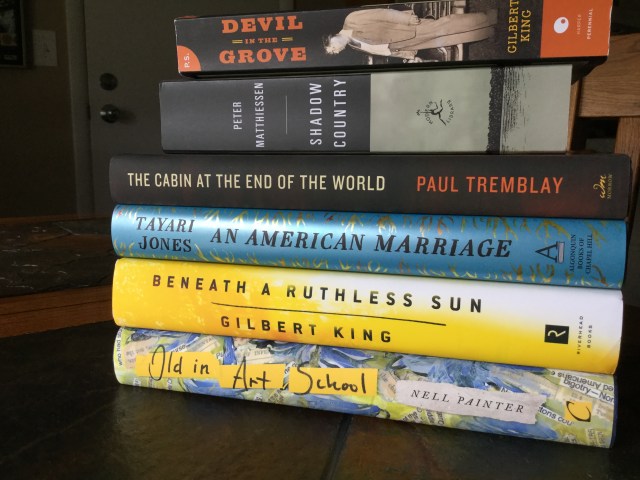
From page 219 of The Cabin at the End of the World (Paul Tremblay; 2018):

Andrew has taught literature for years, calling his course How the World Ends. The course has occasionally included a literary analysis of the Bible’s Book of Revelation and the Four Horsemen of the Apocalypse riding their red, black, white, and pale horses. Over the years the course syllabus has evolved, but one of the main arguments / discussions he has with his students remains a constant. No matter how bleak or dire, end-of-the-world scenarios appeal to us because we take meaning from the end. Aside from the obvious and well-discussed idea that our narcissism is served when imagining we, out of all the billions who will perish, might survive, Andrew has argued there’s also undeniable allure to witnessing the beginning of the end and perishing along with everyone and everything else. He has impishly said to a classroom, to the scowl of more than a few students, “ Within the kernel of end-times awe and ecstasy is the seed of all organized religions.”

Mid-year reading review

From page 69 of The Hole (Hye-Young Pyun; 2017):

It was impossible to capture the trajectory of life in a map. Without one, there was no way of wrapping your brain around it all, and yet he was skeptical as to whether you could ever represent the world through maps alone.

But it was meaningful. Someone had taken these invisible trajectories that could not be studied with any sort of accuracy and had tried anyway to turn them into a tangible space. He found it boring sometimes for the same reason. A world that could not be understood perfectly, could not be explained unambiguously, and was interpreted differently based on political purposes and conveniences was no different from the world he was already living in. And yet, the one way in which maps were clearly better than life was that they improved with failure. Life itself was merely an accumulation of failures, and those failures never made life better.

The jacket copy suggests that The Hole evokes the work of Shirley Jackson and Stephen King. While I appreciate the assertion, I thought this meditation on the horror of finding blank emptiness at the center of a career, a marriage, a life was more philosophical than the comparisons to psychological thrillers suggests.

This was the book I completed before heading to bed last night, so I have completed sixty-eight books so far this year:

27 novels
10 plays
18 non-fiction titles
13 graphic fiction works
18 works published this year

My complete list can be found here.

Even better on rereading:
Never Let Me Go (Kazuo Ishiguro; 2005. Fiction.)
Childhood’s End (Arthur C. Clarke; 1953. Fiction.)
Daytripper (Fábio Moon and Gabriel Bá; 2011. Graphic fiction.)
Mrs. Caliban (Rachel Ingalls; 1983. Fiction.)

Forgot how wonderful this writer is:
Memento Mori (Muriel Spark; 1959. Fiction.)

For those who loved The Elementals (Michael McDowell; 1981):
The Reapers Are the Angels (Alden Bell; 2010. Fiction.)

A new-ish author who deserves the hype:
Little Fires Everywhere (Celeste Ng; 2017. Fiction.)
Everything I Never Told You (Celeste Ng; 2014. Fiction.)

Fabulous story for a long car trip:
American Kingpin (Nick Bilton; 2017. Non-fiction.)

Honorable mention:
The Idealist: Aaron Swartz and the Rise of Free Culture on the Internet (Justin Peters; 2016. Non-fiction.)

The most engrossing book I’ve read so far this year (not including rereads):
Behold the Dreamers (Imbolo Mbue; 2016. Fiction.)

Honorable mention:
Killers of the Flower Moon (Dan Grann; 2017. Non-fiction.)
An Abbreviated Life (Ariel Leve; 2016. Non-fiction.)
After the Eclipse (Sarah Perry; 2017. Non-fiction.)
The Hole (Hye-young Pyun; 2017. Fiction.)

Two weeks

Before they struck out on their own…

How the time passed:

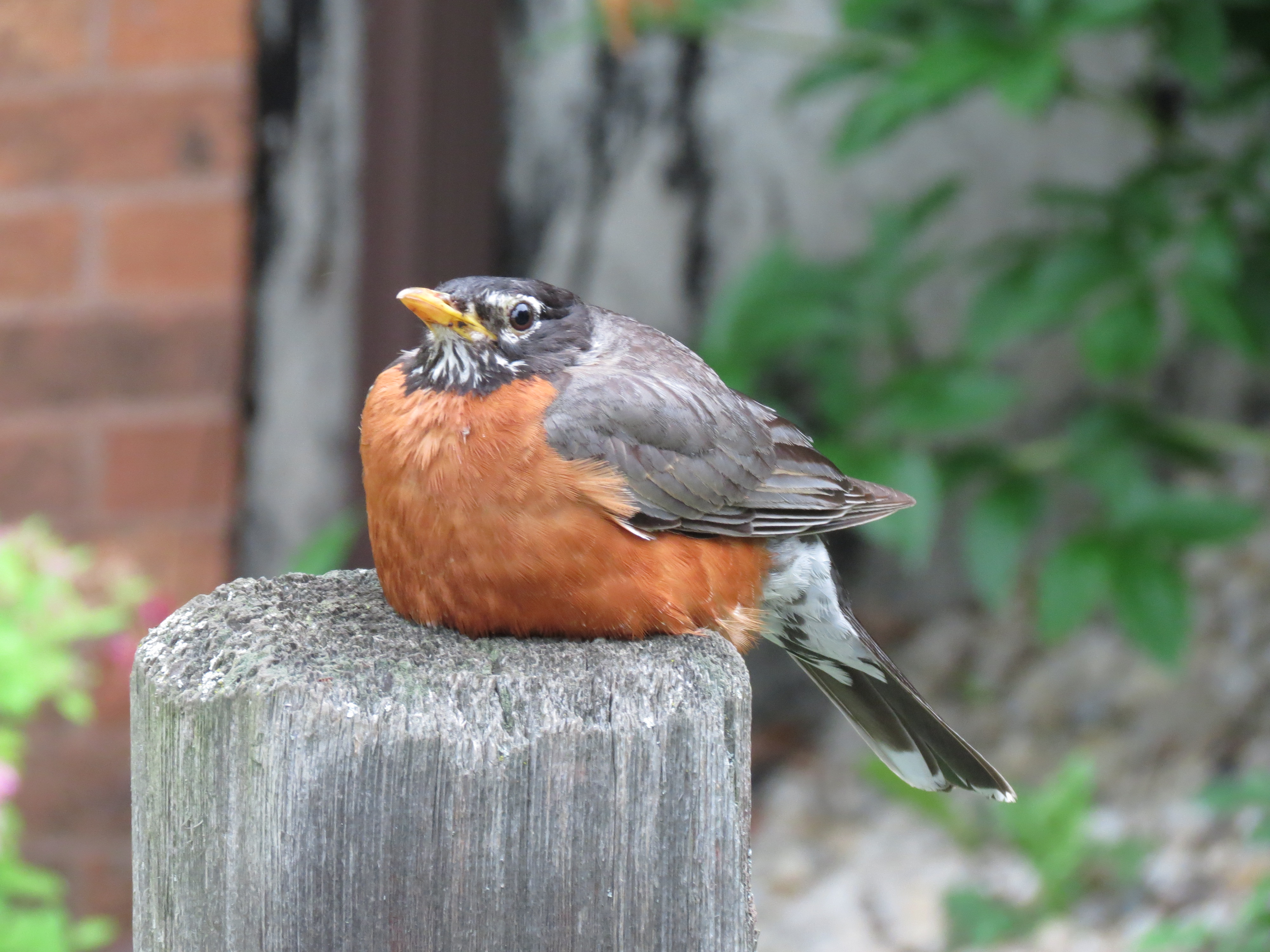
■ two fledged robins and numerous other juveniles, including cardinals, sparrows, red-bellied woodpeckers, blue jays, and goldfinches;
■ one play (Buried Child at Writers Theatre);
■ two museum adventures: the Field and the Shedd;
■ one documentary (Won’t You Be My Neighbor?);
■ fifteen hours of music practice;
■ one music lesson;
■ one American Red Cross course (Adult and Pediatric First Aid/CPR/AED);
■ four “dates” with the lawnmower, edger, and trimmer;
■ three trips to the car dealership (Bleah!);
■ two hours of volunteer work;
■ two episodes of The Handmaid’s Tale;
■ the first week of my current MOOC (music theory); and
■ six books:

Macbeth (William Shakespeare; 1606. Drama.)
Royal City, Vol. 2: Sonic Youth (Jeff Lemire; 2017. Graphic non-fiction.)
Sorry to Disrupt the Peace (Patty Yumi Cottrell; 2017. Fiction.)
Macbeth (Hogarth Shakespeare) (Jo Nesbø; 2018. Fiction.)
Hamlet (William Shakespeare; 1602. Drama.)
The Lying Game (Ruth Ware; 2017. Fiction.)

As well as all of the even more commonplace activities (e.g., errands, chores, walks, games) that this parttime educator’s summer months comprise. Apart from car shopping and the excessive heat warnings, the season has been quite kind to me, so far. How has your summer been?

Next up: mid-year reading review.

Backyard birding

Over the last nine days, I have, among other things:

■ followed the progress of the robin family that calls our forsythia bush, “Home”;
■ mowed the lawn three times (!!);
■ seen a play (Suddenly, Last Summer at the Raven);
■ visited the Lincoln Park Zoo;
■ prepared for and undergone one of those screenings doctors recommend for all of us fifty-plus folk;
■ potted a couple of new plants and repotted some older ones;
■ lost a battle against an unidentified and insistent weed in my back garden area;
■ seen a good movie (I, Tonya) and a good documentary (Jane);
■ caught up on the harrowing second season of The Handmaid’s Tale;
■ fretted about how little I have practiced my music; and
■ finished four books:

Sometimes I Lie (Alice Feeney; 2017. Fiction.)
Buried Child (Sam Shepherd; 1978. Drama.)
The Idealist (Justin Peters; 2016. Non-fiction.)
Behold the Dreamers (Imbolo Mbue; 2016. Fiction.)

For the commonplace book, from Act Two of Buried Child:

SHELLY: Can’t we just drive to New Mexico? This is terrible, Vince! I don’t want to stay here. In this house. I thought it was going to be turkey dinners and apple pie and all that kinda stuff.
VINCE: Well I hate to disappoint you!
SHELLY: I’m not disappointed! I’m fuckin’ terrified! I wanna’ go!

More bookishness

B44B243C-E871-4B34-9FF2-326FCDCB0586

More acquisitions

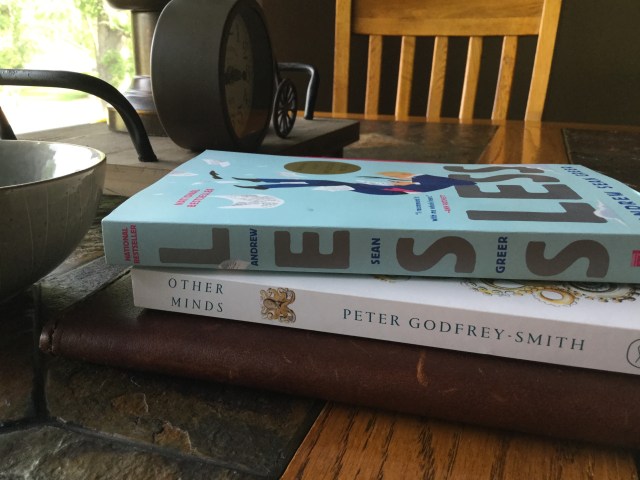
As it turns out, Thi Bui’s illustrated memoir, The Best We Could Do, was Book 52 of the year for me, so I actually met the goal of Robin’s 52 Books in 52 Weeks on May 27. Woot! Since then, I’ve read:

The Perfect Mother (Aimee Molloy; 2018. Fiction.)
Red Clocks (Leni Zumas; 2018. Fiction.)
Daytripper (Fábio Moon and Gabriel Bá; 2011. Graphic fiction.)
Mrs. Caliban (Rachel Ingalls; 1983. Fiction.)

As I mentioned previously, Molloy’s novel was just meh, but, boy, was Red Clocks terrific, as were Daytripper and Mrs. Caliban, both of which were rereads. In fact, I first read Ingalls’ slim novel more than thirty years ago and thought it was a revelation then. Now, with the benefit of years and experience, I recognize it as quite possibly perfect.

p. 107
“Have you heard of a doctor who didn’t try to shoot you full of drugs? I’m not sick. I’m bereaved. That means I’ve got to keep all my strength to get through. And if I’m full of drugs, my resistance is going to be destroyed, isn’t it?”

In anticipation of seeing the play, I’m about to reread Tennessee Williams’ Suddenly, Last Summer. I will also read Book III of The Aeneid this week. It’s hard to say which of the many books in my TBR stack and scrawled in my book journal will win the coveted spot in my knapsack, though.


Bookish

2D28035B-E908-4730-8912-EC76971FBC7A

Recent acquisitions.

Last night I finished reading Book 51 of the year, Thi Bui’s illustrated memoir, The Best We Could Do. Because I’m about halfway through The Perfect Mother (Aimee Molloy), a meh recent novel, and Janesville, an excellent non-fiction work, I expect to meet the goal of Robin’s 52 Books in 52 Weeks by Thursday.

On the topic of non-fiction, I’m well positioned to meet one of my own reading goals: to read thirty-six non-fiction tiles in 2018. I’ve read seventeen, so far. In fact, here are my commonplace book entries for the sixteenth, Sarah Perry’s haunting memoir about her mother’s murder, After the Eclipse:

p. 136
As far back as I could remember, reading had been a perfect escape, an alternate universe where none of the problems were mine. When I was upset at home or school, I could always pull out a book, or know that one was waiting for me in the next quiet moment. In first grade, encouraged by my teacher, I began writing stories, and this was even better; I could create whatever escape I wanted, include whatever characters I wanted to spend time with. Writing gave me power.

p. 159
Sometimes, the scary thing about suicide was that it seemed inevitable, the only logical end to everything that had happened.

p. 250
Violence outpaced lab funding everywhere.

Our family book club is tackling The Aeneid this summer. We’ve already listened to the three introductory lectures in Elizabeth Vandiver’s course on the work and have decided to read one of The Aeneid’s twelve books each week, complemented by the appropriate lecture(s). The Girls Rule! Book Club has also tentatively scheduled Madame Bovary (Gustave Flaubert) and The Art of War (Sun Tzu), which may prove a bit ambitious with their commitments, but we’ll see.

The library’s reading program commences later this week, and frankly? My group enjoys some slightly lighter fare in the summer, too, so my assembled a pile of fiction includes Sometimes I Lie (Alice Feeney) and Red Clocks (Leni Zumas) — perfect, I think, for reading lakeside in the early morning between birdwatching and chillaxing.

Quotable


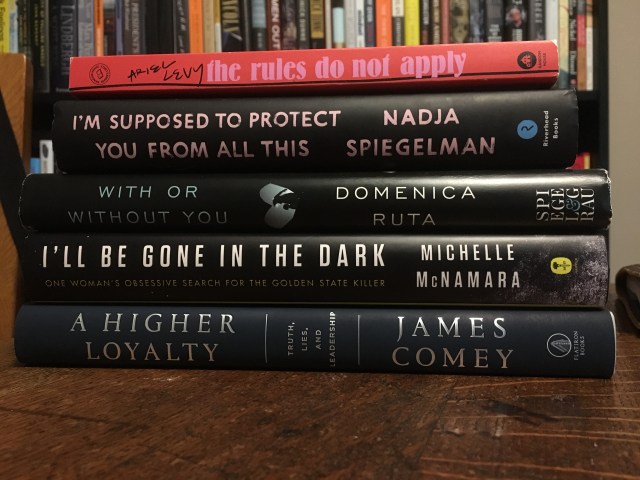
With or Without You (Domenica Ruta; 2013. Non-fiction.)
p. 23
Pride like this is both tyrannical and tragic, for the chief function of pride is to usher in the fall.

My parents had sufficient raw materials to achieve a level of fame in a small town, but not much more than that.

p. 119
It made sense to me. There are some things that we have to forget about in order to get through the day.

I’m Supposed to Protect You from All This (Nadja Spiegelman; 2016. Non-fiction.)
p. 87
According to neuroscientists, when we stir up a long-term memory, it floats in our consciousness, unstable, for a window of approximately three hours. During this time, the memory is malleable. The present infiltrates the past. We add details to fill in the gaps. Then the brain re-encodes the memory as if it were new, writing over the old one. As it sinks back down into the depths of our minds, we are not even aware of what we have gained or lost, or why.

p. 235
It had happened to me once, the unexpected resurgence of a difficult childhood memory. It had made me feel I was losing my hold on reality. It terrified me, already, that I was composed of a past that was so lonely, that was made up of memories and narratives no one else in my family could agree upon. It was too much that it might be unknowable to myself as well. I wondered often how many other memories lurked within me, dark and alien as cancers.

I’ll Be Gone in the Dark (Michelle McNamara; 2018. Non-fiction.)
p. 199
In their reserve and in virtually every other way, detectives differ from show-biz folks. Detectives listen. They’re getting a read. Entertainers get a read only to gauge their influence on a room. Detectives deal in concrete tasks. I once spent an hour listening to an actress analyze a three-line text that hurt her feelings. Eventually I’ll see the cracks in a detective’s veneer, but in the beginning their company is an unexpected relief, like fleeing a moodily lit cast party loud with competitive chatter and joining a meeting of determined Eagle Scouts awaiting their next challenge. I wasn’t a native in the land of the literal-minded, but I enjoyed my time there.

A Higher Loyalty (James Comey; 2018. Non-fiction.)
p. 118
I had never met President Obama before and was struck by two things: how much thinner he appeared in person and his ability to focus.

p. 121
On the way out the door, I told Kathy Ruemmler how surprised I was by the interesting discussion, telling her, “I can’t believe someone with such a supple mind actually got elected president.”

p. 123
Though it was a small moment, what struck me about President Obama’s remark is that it displayed a sense of humor, insight, and an ability to connect with an audience, which I would later come to appreciate in a president even more. These are all qualities that are indispensable in good leaders. A sense of humor in particular strikes me as an important indicator – or “tell” – about someone’s ego. Having a balance of confidence and humility is essential to effective leadership. Laughing in a genuine way requires a certain level of confidence, because we all look a little silly laughing: that makes us vulnerable, a state insecure people fear. And laughing is also frequently an appreciation of others, who have said something that is funny. That is, you didn’t say it, and by laughing you acknowledge the other, something else insecure people can’t do.

The Rules Do Not Apply (Ariel Levy; 2017. Non-fiction.)
p. 4
My lined notebooks were the only place I could say as much as I wanted, whenever I wanted. To this day I feel comforted and relieved of loneliness, no matter how foreign my surroundings, if I have a pad and a pen.

p. 5
(When we expressed subdued versions of our outrage to our elders, their responses invariably included the phrase “paying your dues.” It was not a phrase we cared for.)

p. 154
How did people do this? People who’d lost children who had existed – not for minutes but days, decades? Children who had voices, who had opened their eyes. Children with names. Did these people wake up every morning until the day they died and beg Mother Nature to return what she had given and then taken away?