
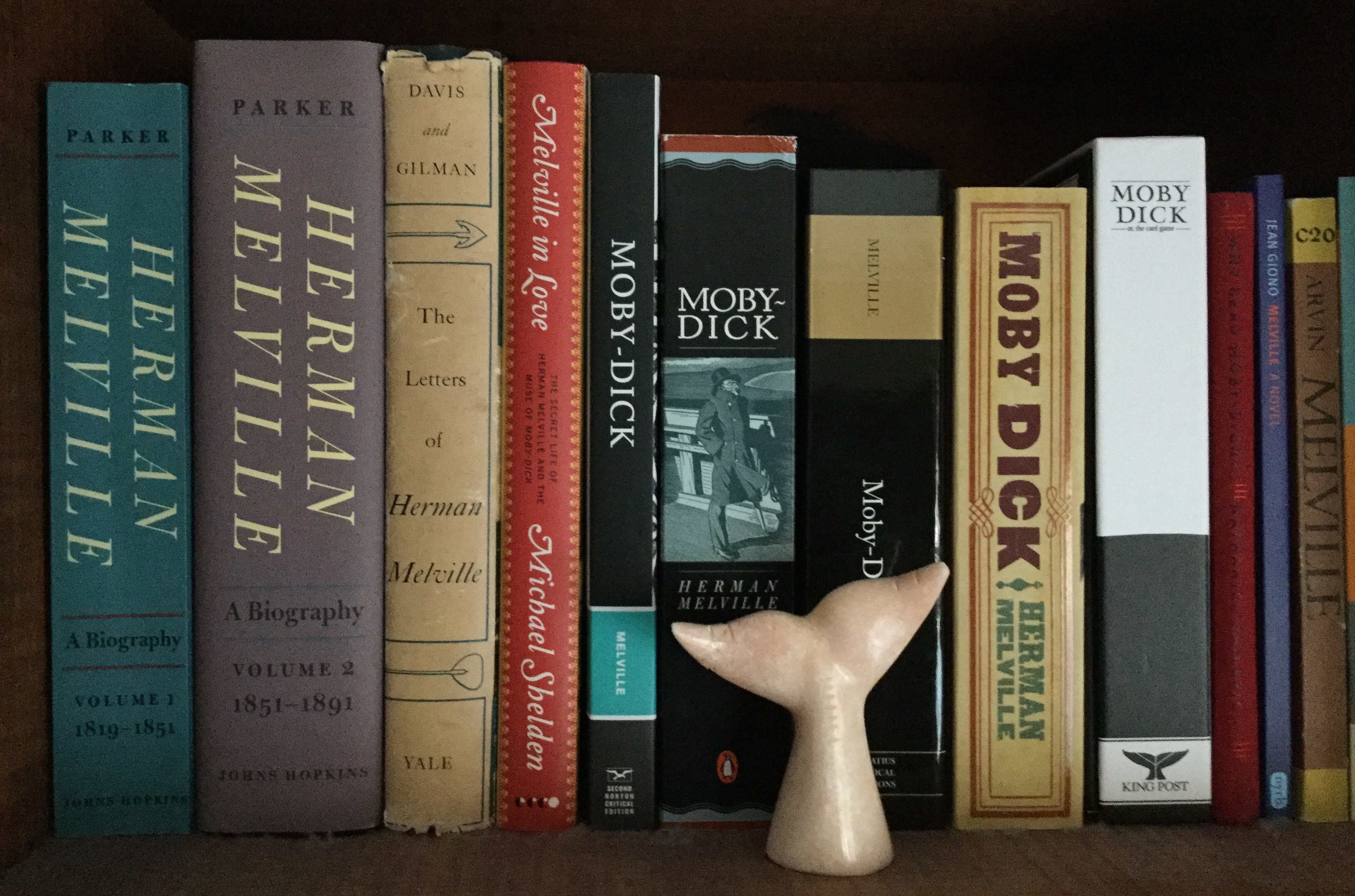
 Chapter 41: Moby-Dick
Here, then, was this grey-headed, ungodly old man, chasing with curses a Job’s whale round the world, at the head of a crew, too, chiefly made up of mongrel renegades, and castaways, and cannibals — morally enfeebled also, by the incompetence of mere unaided virtue or right-mindedness in Starbuck, the invulnerable jollity of indifference and recklessness in Stubb, and the pervading mediocrity in Flask. Such a crew, so officered, seemed specially picked and packed by some infernal fatality to help him to his monomaniac revenge. How it was that they so aboundingly responded to the old man’s ire — by what evil magic their souls were possessed, that at times his hate seemed almost theirs; the White Whale as much their insufferable foe as his; how all this came to be — what the White Whale was to them, or how to their unconscious understandings, also, in some dim, unsuspected way, he might have seemed the gliding great demon of the seas of life, — all this to explain, would be to dive deeper than Ishmael can go. The subterranean miner that works in us all, how can one tell whither leads his shaft by the ever shifting, muffled sound of his pick?
Category Archives: books
“Thus ended this voyage beneath the seas.”

Read in anticipation of seeing the Lookingglass Theatre production.
“Captain Nemo,” I said to my host who had just stretched out on a divan, “this library would do honor to more than one palace on land, and I am really astounded to think that it travels with you into the ocean depths.”
“Where could one find greater solitude or silence, Professor?” replied Captain Nemo. “Can you boast of greater tranquility in your office at the museum?”
“No, Monsieur, and I must admit that it is very shabby alongside yours. Why, you have six or seven thousand books…”
“Twelve thousand, Monsieur Aronnax. These are my only ties with life on dry land….”
p. 187
“A cannibal can still be an honorable man,” replied Conseil, “just as a glutton can be honest. One doesn’t exclude the other.”
“That’s all very well, Conseil. I’ll even grant you that these cannibals are honorable and that they go about devouring their prisoners honorably. But since I don’t like the idea of being devoured, even honorably, I’ll stay on guard, for the commander of the Nautilus seems to be taking no precautions whatsoever. Now to work.”
Connoisseurs of summer light

The light has changed a great deal in the two months since this photo was taken.
From one of my favorite Mary Schmich columns (Chicago Tribune, August 1, 2008):
If you merely count the days from summer’s official start in June until its finale in September, August 1 doesn’t even mark the summer midpoint. But it does mark the high point, which means the beginning of the end.
The light shifts, softens. The shadows on the leaves and the living room floor make you wonder: When exactly did the wane start?
People in other places may not wonder, but Chicagoans are connoisseurs of summer light. We spot the changes as surely as a foodie detects the difference between fennel and star-anise.
Yes, the light has shifted and softened, but the unofficial conclusion of my summer has been heralded by more than that: My older daughter will conclude her work at the therapeutic riding facility this week, then submit the last of the paperwork required to begin her new job in a nearby school district. My younger daughter will give a talk on her research at [insert name of national laboratory here] later this week, then move back home — only to begin packing for her return to university.
The Girls Rule! School will enjoy a short and joyous reunion in the interval between her arrival home and her sister’s first day on the new job, but the season is most certainly waning: My flute teacher held her summer recital this weekend, and the beach closes for the season next weekend. Leaves are dropping from the beleaguered but rallying oak out back, and acorns are abundant on the others. Subscription tickets have been mailed, and many single tickets are now on sale. On the to-do list, “Bring winter coats to cleaner before Labor Day” is underscored. Twice.
With back-to-school (which has always seemed more a new year than January 1) only weeks away, then, it feels right to assess my progress on this year’s reading goals.
Since my mid-year review, I’ve read another fifteen books — five novels, one play, seven works of graphic fiction, and two non-fiction titles — for a total of eighty-three books read, to date. Books XI and XII and Lectures 9 through 12 remain in my quest to read The Aeneid and finish Elizabeth Vandiver’s The Aeneid of Virgil. About two and half hours remain in my audiobook of Hope Never Dies (Andrew Shaffer; 2018), and about one hundred pages remain in Jessica Bruder’s Nomadland (2017). Despite having a number of books in various states of unread, I’ve gamely begun Squeezed (Alissa Quart; 2018 — review here) because I must return it to the library later this month — right around the time I help move my youngest back to university and resume my academic-year position.
One of my reading resolutions for this year is to finish at least thirty non-fiction titles. In May, I misstated this as thirty-six, but when I revisited the original post this morning, I was delighted to realize that I am within ten books of the goal. Admittedly, I have made less progress on Resolutions 1 (Read from the shelves) and 4 (Finish reading several books abandoned in 2017 (or *gulp* earlier)), but I remain upbeat about rereading at least one Vonnegut novel (Resolution 3; probably Sirens of Titan and likely for Banned Books Week) and completing a close reading of Moby Dick (Resolution 2).
By next Sunday, I hope to post my (tentative) autumn reading plans.
Recent acquisitions
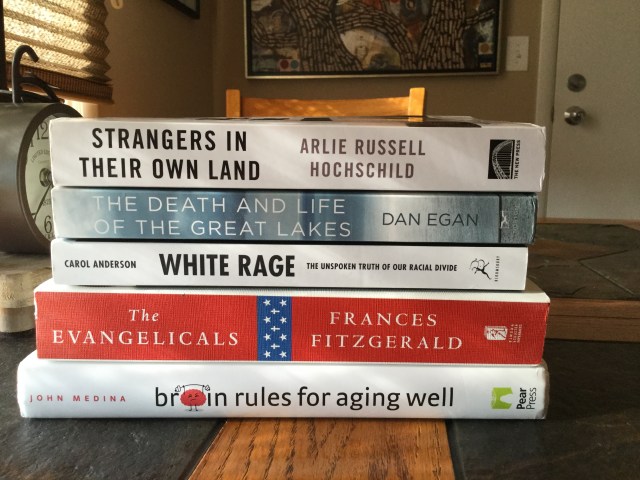 Another month fled past without much in the way of posts, but given the drafts I’ve accumulated, I suspect you’ll hear more from me in August and September.
Books

Some recent acquisitions… already had a copy of Verne,
which I read nearly seventeen years ago. This is the Anthony Bonner translation,
with an introduction by Ray Bradbury.
Theater of the absurd
We have what are arguably some of the hottest tickets in town.
From Eugène Ionesco’s play Victims of Duty (1953):
CHOUBERT: It’s quite interesting. The Government’s urging all the citizens of the big towns to cultivate detachment. According to this, it’s our last hope of finding an answer to the economic crisis, the confusion of the spirit and the problems of existence.
MADELEINE: We’ve tried everything else, and it hasn’t done any good, but I don’t suppose it’s anyone’s fault.
CHOUBERT: For the time being the Government’s merely recommending this ultimate solution in a friendly manner. They can’t fool us; we know how a recommendation has a way of turning into an order.
MADELEINE: You’re always so anxious to generalize!
CHOUBERT: We know how suggestions suddenly come to look like rules, strict laws.
MADELEINE: Well, my dear, you know the law is necessary, and what’s necessary and indispensable is good, and everything that’s good is nice. And it really is very nice indeed to be a good, law-abiding citizen and do one’s duty and have a clear conscience! …
CHOUBERT: Yes, Madeleine. When one really thinks about it, you’re right. There is something to be said for the law.
MADELEINE: Of course there is.
CHOUBERT: Yes, yes. Renunciation has one important advantage: it’s political and mystical at the same time. It bears fruit on two levels.
The beginning of the end
From page 219 of The Cabin at the End of the World (Paul Tremblay; 2018):
Andrew has taught literature for years, calling his course How the World Ends. The course has occasionally included a literary analysis of the Bible’s Book of Revelation and the Four Horsemen of the Apocalypse riding their red, black, white, and pale horses. Over the years the course syllabus has evolved, but one of the main arguments / discussions he has with his students remains a constant. No matter how bleak or dire, end-of-the-world scenarios appeal to us because we take meaning from the end. Aside from the obvious and well-discussed idea that our narcissism is served when imagining we, out of all the billions who will perish, might survive, Andrew has argued there’s also undeniable allure to witnessing the beginning of the end and perishing along with everyone and everything else. He has impishly said to a classroom, to the scowl of more than a few students, “ Within the kernel of end-times awe and ecstasy is the seed of all organized religions.”
Recent acquisitions

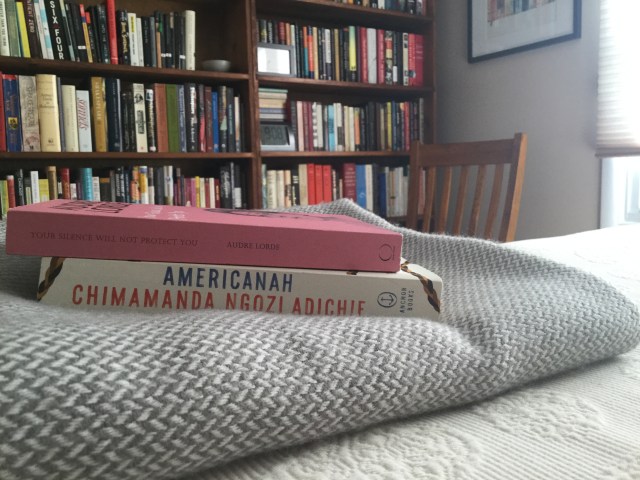
New books
Mid-year reading review
From page 69 of The Hole (Hye-Young Pyun; 2017):
It was impossible to capture the trajectory of life in a map. Without one, there was no way of wrapping your brain around it all, and yet he was skeptical as to whether you could ever represent the world through maps alone.
But it was meaningful. Someone had taken these invisible trajectories that could not be studied with any sort of accuracy and had tried anyway to turn them into a tangible space. He found it boring sometimes for the same reason. A world that could not be understood perfectly, could not be explained unambiguously, and was interpreted differently based on political purposes and conveniences was no different from the world he was already living in. And yet, the one way in which maps were clearly better than life was that they improved with failure. Life itself was merely an accumulation of failures, and those failures never made life better.
The jacket copy suggests that The Hole evokes the work of Shirley Jackson and Stephen King. While I appreciate the assertion, I thought this meditation on the horror of finding blank emptiness at the center of a career, a marriage, a life was more philosophical than the comparisons to psychological thrillers suggests.
This was the book I completed before heading to bed last night, so I have completed sixty-eight books so far this year:
27 novels
10 plays
18 non-fiction titles
13 graphic fiction works
18 works published this year
My complete list can be found here.
Even better on rereading:
■ Never Let Me Go (Kazuo Ishiguro; 2005. Fiction.)
■ Childhood’s End (Arthur C. Clarke; 1953. Fiction.)
■ Daytripper (Fábio Moon and Gabriel Bá; 2011. Graphic fiction.)
■ Mrs. Caliban (Rachel Ingalls; 1983. Fiction.)
Forgot how wonderful this writer is:
■ Memento Mori (Muriel Spark; 1959. Fiction.)
For those who loved The Elementals (Michael McDowell; 1981):
■ The Reapers Are the Angels (Alden Bell; 2010. Fiction.)
A new-ish author who deserves the hype:
■ Little Fires Everywhere (Celeste Ng; 2017. Fiction.)
■ Everything I Never Told You (Celeste Ng; 2014. Fiction.)
Fabulous story for a long car trip:
■ American Kingpin (Nick Bilton; 2017. Non-fiction.)
Honorable mention:
■ The Idealist: Aaron Swartz and the Rise of Free Culture on the Internet (Justin Peters; 2016. Non-fiction.)
The most engrossing book I’ve read so far this year (not including rereads):
■ Behold the Dreamers (Imbolo Mbue; 2016. Fiction.)
Honorable mention:
■ Killers of the Flower Moon (Dan Grann; 2017. Non-fiction.)
■ An Abbreviated Life (Ariel Leve; 2016. Non-fiction.)
■ After the Eclipse (Sarah Perry; 2017. Non-fiction.)
■ The Hole (Hye-young Pyun; 2017. Fiction.)

