War and Peace in seventeen weeks and other reading notes

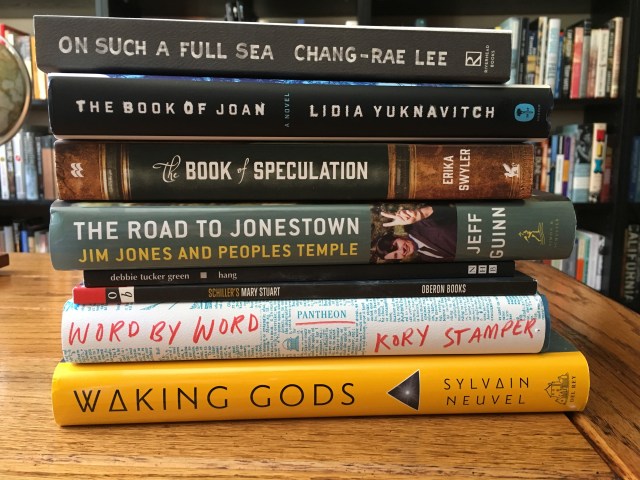
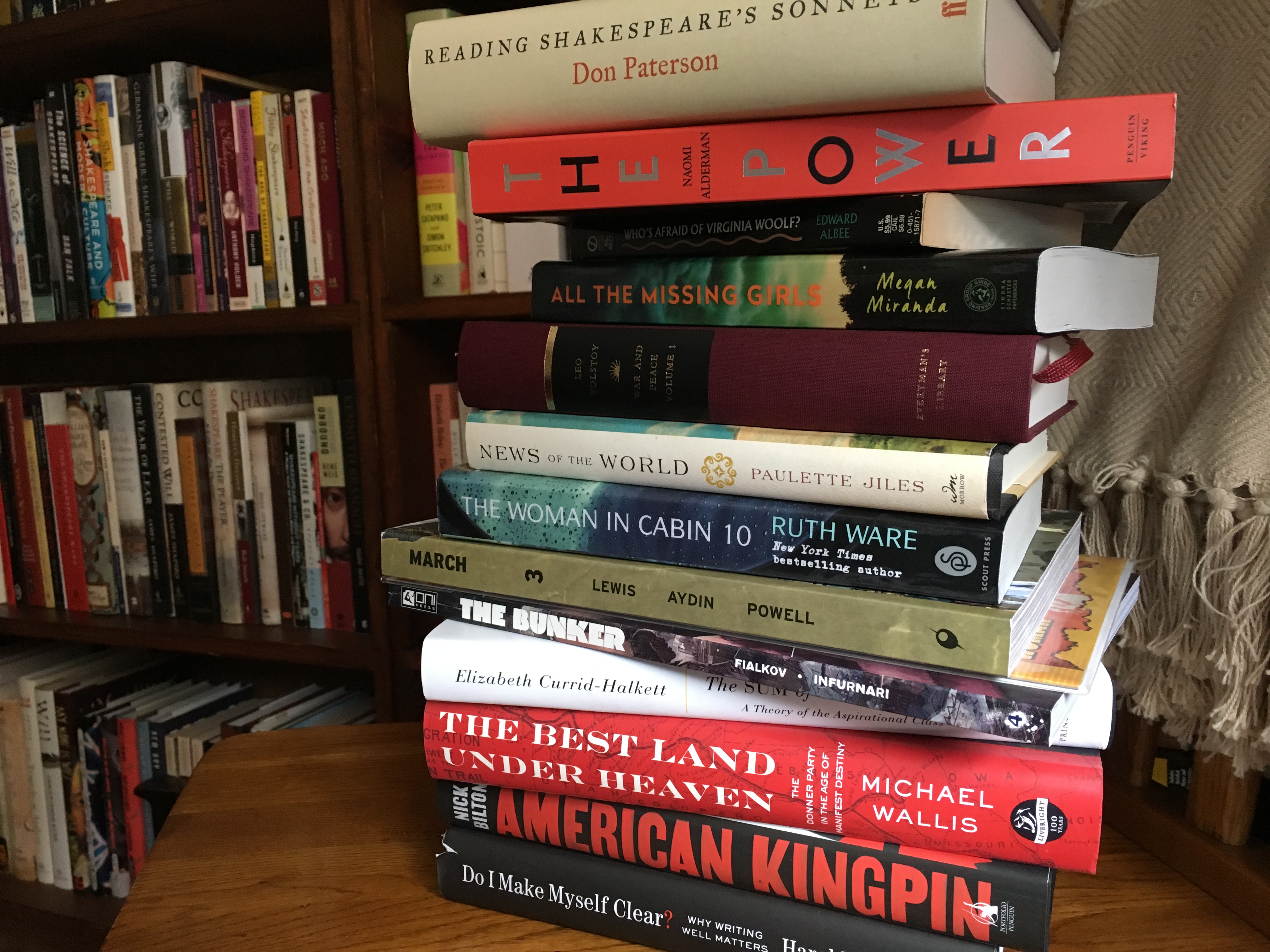
As I’ve shared, War and Peace has always been one of those books I hope to get to… Some day! Well, Robin has developed a plan that all but ensures I will finish the tome by late October. Volume 1 of the three-volume Everyman’s Library edition (Maude translation) is in the middle of the stack pictured above, which means, yes, I now own yet another copy of War and Peace… well, two more, if you count the audiobook to which I am listening (at twice the recorded speed) while reading. For the commonplace book:

p. 4
Prince Vasili always spoke languidly, like an actor repeating a stale part.

p. 29
“If no one fought except on his own conviction, there would be no wars, “ he said.

“And that would be splendid,” said Pierre.

p. 71
They wept because they were friends, and because they were kind-hearted, and because they – friends from childhood – had to think about such a base thing as money, and because their youth was over…. But those tears were pleasant to them both.

I am still at work on the “Shakespeare in a Year” project. In anticipation of seeing the National Theatre Live broadcast, I put Julius Caesar before Henry V; otherwise, I am on or ahead of schedule. The Sonnets remain a slog, although, at Sonnet 82, I am actually ahead of schedule. Perhaps there is no poetry in me? But, then, how I do love the plays!

From Julius Caesar, Act IV, Scene iii:

“All this”? Ay, more. Fret till your proud heart break.
Go show your slaves how choleric you are
And make your bondmen tremble. Must I budge?
Must I observe you? Must I stand and crouch
Under your testy humor? By the gods,
You shall digest the venom of your spleen,
Though it do split you. For from this day forth,
I’ll use you for my mirth, yea, for my laughter,
When you are waspish.

For submitting the first log in the summer reading program, each patron receives a book. My husband gave me his turn, so I ended up with two beach reads: The Woman in Cabin 10 and All the Missing Girls, both of which were the light, quick respites I needed while recovering from a dental emergency. (All is well now.)

As did nearly everyone else, I found News of the World (Paulette Jiles) delightful. I actually began reading it via audiobook on the trip downstate to bring my daughters home for the summer. (We need two cars to move them in and out.) The narrator remained in my ear even when I turned to the book, and upon finishing, I promptly insisted that my husband choose it as his next audiobook. For the commonplace book:

p. 121
Maybe life is just carrying news. Surviving to carry the news. Maybe we have just one message, and it is delivered to us when we are born and we are never sure what it says; it may have nothing to do with us personally but it must be carried by hand through a life, all the way, and at the end handed over, sealed.

p. 201

Life was not safe and nothing could make it so, neither fashionable dresses nor bank accounts.

Reading on devices troubles me, but it was the only way I could immediately access Dream Hoarders: How the American Upper Middle Class Is Leaving Everyone Else in the Dust, Why That Is a Problem, and What to Do about It (Richard V. Reeves) when I first became interested. At the halfway point, here are my commonplace entries:

p.3
There is one good reason why many Americans feel as if the upper middle class is leaving everyone else behind: They are.

Americans in the top fifth of the income distribution – broadly, households with incomes above the $112,000 mark – are separating from the rest. This separation is economic, visible in bank balances and salaries. But it can also be seen in education, family structure, health and longevity, even in civic and community life. The economic gap is just the most vivid sign of a deepening class divide.

p. 15
The big question is whether we are willing to make some modest sacrifices in order to expand opportunities for others or whether, deep down, we would rather pull up the ladder.

p. 54
The debate over college debt is lively and largely misplaced. It is lively because almost everyone involved in public discourse – scholars, journalists, politicians – went to college and has children who have done or will do so. (Almost every member of Congress has a college degree.) It is misplaced because the real problem in American higher education is not about debt, but distribution and quality. The debt problem is for people from poorer backgrounds who borrow to attend bad colleges.

Other notes: I reread Who’s Afraid of Virginia Woolf? in anticipation of the National Theatre Live broadcast. So much to press into the commonplace book, but this is destined to become a family favorite: “Martha, in my mind you’re buried in cement right up to the neck. No, up to the nose, it’s much quieter.” The Power promised more than the fragmented writing could deliver. March is one of those books that demonstrate just how important and powerful the graphic work genre is. I think I will need to reread the first three volumes of Bunker to make any sense of what is happening now. So much time passes between releases! The three four books on the bottom represent my TBRN (to be read next) pile. We’ll have to see if that plays out.
Geocaches, books, and whatnot

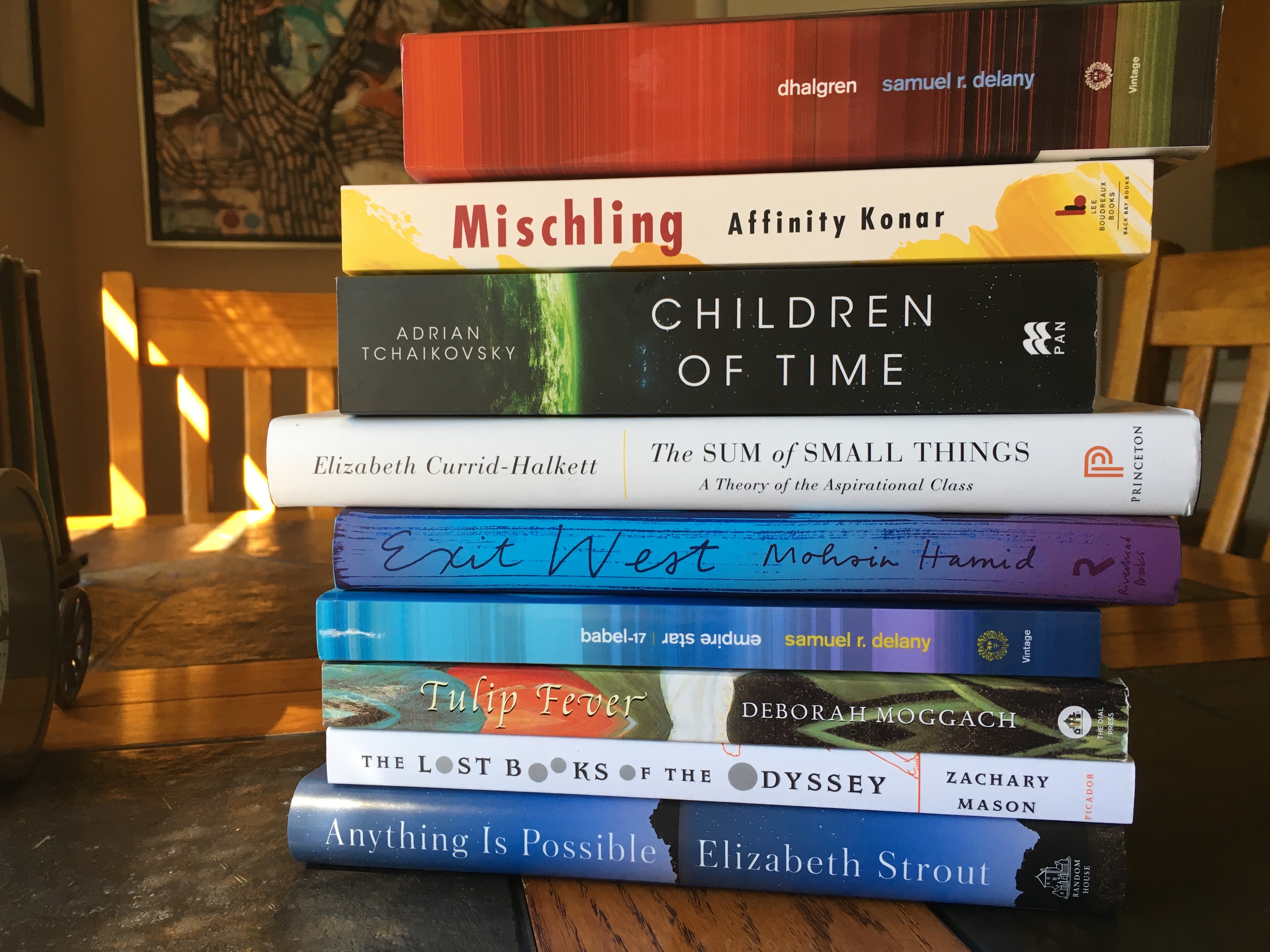
Image taken this past Sunday.

During the first of our two trips downstate last week, we found our fifteenth cache. Small and craftily hidden on campus, it is one that we had been unable to locate in February and March. We must be gaining some skills, eh? Maybe. With our sixteenth find this Sunday, we achieved the sixth of fifteen required caches for the challenge in which we’re participating. Although it is still quite cool here, I suspect it will soon become warmer and buggier than we typically appreciate during our walks in the woods. By Memorial Day, we may need to set aside the challenge until autumn. We’ll see, though.

In the week since my last post, I (re)read eight books:

Fatale (Jean-Paul Manchette; 1977 (2011, English). Fiction.)
Tenth of December (George Saunders; 2013. Fiction.)
The Complete Idiot’s Guide to Geocaching, (2012. Non-fiction.)
Briggs Land, Volume 1: State of Grace (Brian Wood; 2017. Graphic fiction.)
Those Who Wish Me Dead (Michael Koryta; 2014. Fiction.)
Henry IV, Part 1 (William Shakespeare; 1597. Drama.)
The Rape of Lucrece (William Shakespeare; 1594. Poetry.)
Henry IV, Part 2 (William Shakespeare; 1597. Drama.)

Graphic novel readers, add Briggs Land to your TBR stack. Short story lovers? Have you met Saunders? He reminds me of Vonnegut in all the best ways. Try “The Semplica-Girl Diaries.” It it works for you, put Tenth of December on your nightstand. (Lincoln in the Bardo should already be there.)

The spring semester of my music lessons concluded last week. As I have done for the past two summers, I will take one lesson during each of the summer months and resume weekly lessons after Labor Day. For my solo piece, I am moving from Sadko’s “Song of India” to Bach’s Arioso from Cantata BWV 156. My older daughter, who is taking organ lessons at the University, and I will also be working on Michael Conway’s “Elegy for Flute and Organ.”

In other news, a female Eastern Towhee spent the day in my yard late last week, so I had a new addition to my backyard list. I haven’t seen the grosbeaks, orioles, or hummingbirds yet, but it is getting to be that time of year again: I have begun assembling my garden containers, and my husband and I redefined a corner of our backyard, adding a border and new plants. I repainted all of the outdoor furniture and repositioned the bird feeders. As soon as the evening temperatures increase a bit more, I will finish planting and install a new, wasp-resistant hummingbird feeder. Welcome to my house, butterflies and birds!

Coming up: My daughters will soon conclude their spring semester. Once they return home, our first two theater adventures will be Harvey at the Court and Relativity at Northlight.

Weekend, rainy and cold

■ The weather did not prevent us from finding our thirteenth and fourteenth geocaches, both of which are part of a fifteen-cache tour we’re on. (We are a third of the way through, with five logged.) After a one-month hiatus, it was a great deal of fun to continue with this pursuit.

■ Two notes on my last entry: I finished Reclaiming Conversation (Sherry Turkle) yesterday and am now eyeing Fatale (Jean-Patrick Manchette) and News of the World (Paulette Jiles). And on the topic of Moby Dick, the librarian featured in this ALA magazine article has a dream job, no?

The Handmaid’s Tale is superlative television. Drop everything. Watch it now.

Book notes

Monster (Walter Dean Myers; 1999. Fiction.)
Before his incarceration, sixteen-year-old Steven Harmon was a high school student who particularly enjoyed his film course. In prison, to recover his sense of self, he keeps a diary in the form of a movie script. While watching They Call Us Monsters, I wondered how familiar Ben Lear was with this contemporary young adult classic.

Birds Life Art (Kyo Maclear; 2017. Non-fiction.)
This lovely and meditative volume yielded the following commonplace book entries:

p. 26
My husband is far too loyal and drowsy to doubt me. If I embark on a fantastically ill-conceived journey, I know he will be the guy throwing paper streamers in the air and hooting, “Farewell! Farewell!”

This is what we do. We cheer each other on in our misadventures.

p. 48
Smallness did not dismay me. Big nature travel — with its extreme odysseys and summit-fixated explorers — just seemed so, well, grandiose. The drive to go bigger and farther just one more instance of the overreaching at the heart of Western culture.

I like smallness. I like the perverse audacity of someone aiming tiny.

p. 86
I was a bookish child and grew to be a bookish adult. Books gave me pleasure, but they also gave me permission to isolate myself, to turn away from the world when it bothered or frightened me. Books allowed me to hide from demands, from the day, from family and the immediate world. They provided solace and amusement in the deep night and served as surrogates for friendship when I was far away from home.

Lincoln in the Bardo (George Saunders; 2017. Fiction.)
Whether or not you ordinarily like audiobooks, you must hear Saunders’ first novel to appreciate how original and remarkable it is. My husband and I listened during trips to and from the University and in and out of Chicago, and we are still talking about this beautiful book. (Related article here.) Neither of us were surprised to learn that it will be a film; nor were we really surprised by this bit of synchronicity.

The Art of Practicing (Madeline Bruser; 1999. Non-fiction.)
Much of the advice seemed, well, obvious. Stretch. Be mindful. Work but not painfully. Focus. Do what you love. And so on.

Other notes…
■ After a few fits and starts, I am poised to finish Sherry Turkle’s Reclaiming Conversation this week. A thought-provoking exploration of what has been lost since people have turned away from each other to connect via phone, this book suffered the fate many of mine do: It was tossed aside, unfinished, when I, a promiscuous reader if e’er there were one, picked up another. And another. And another. And so on. (It’s embarrassing how grateful the books seem when I return to them. Have they no respect for themselves? Chuckle.) Here are two short commonplace book entries:

p. 54

The desire for the edited life crosses generations, but the young consider it their birthright.

p. 147
They decide there should be a rule: A good friend should keep you off your phone when you are together.

■ My husband and I have been rereading Moby Dick; or, The Whale. It began as a desperate bid to sleep through the night but has evolved into a project that provides discussion fodder and new in-jokes. (“Queequeg, my fine friend, does this sort of thing often happen?”) We long ago fell into the habit of leaving a muted radio set to WGN or WBEZ playing as we slumbered. Late last year, though, when frequent awakenings began to affect the quality of our rest, we realized — after changing pillows, thermostats, sheets, and alarms — that the newscasts punctuating our favorite features (and later, the topics to which our favorite features had inevitably turned) were the disturbance. What to do? Ah, an audiobook! Each night, we pick up where we left off, in an endless loop — which is really much more delightful than it sounds. We were already fans of Moby Dick, but William Hootkins’ narration makes us wonder why it is not even more widely read. I am revisiting the text itself, too, (re)marking favorite passages and making new notes. From the opening of Chapter XLIX: The Hyena:

There are certain queer times and occasions in this strange mixed affair we call life when a man takes this whole universe for a vast practical joke, though the wit thereof he but dimly discerns, and more than suspects that the joke is at nobody’s expense but his own. However, nothing dispirits, and nothing seems worth while disputing. He bolts down all events, all creeds, and beliefs, and persuasions, all hard things visible and invisible, never mind how knobby; as an ostrich of potent digestion gobbles down bullets and gun flints. And as for small difficulties and worryings, prospects of sudden disaster, peril of life and limb; all these, and death itself, seem to him only sly, good-natured hits, and jolly punches in the side bestowed by the unseen and unaccountable old joker. That odd sort of wayward mood I am speaking of, comes over a man only in some time of extreme tribulation; it comes in the very midst of his earnestness, so that what just before might have seemed to him a thing most momentous, now seems but a part of the general joke.

■ My “Shakespeare in a Year” project is going well, although I somehow fell a bit behind with the sonnets. As National Poetry Month draws to a close, though, I will finish Sonnets 49 through 54. May brings The Merchant of Venice and Henry IV, Parts 1 and 2, Sonnets 55 through 66 and The Rape of Lucrece. (I wonder if Jacobson’s Shylock Is My Name, a book I wantonly set aside last summer, will show me the same embarrassing gratitude Turkle’s Reclaiming Conversation has when I return to it next month to complement my reread of Merchant?)

■ Speaking of National Poetry Month, I will close with the conclusion to one of my favorite poems, Tom Hennen’s “The Life of a Day“:

[…] For some reason
we like to see days pass, even though most of us
claim we don’t want to reach our last one for a
long time. We examine each day before us with
barely a glance and say, no, this isn’t one I’ve been
looking for, and wait in a bored sort of way for
the next, when, we are convinced, our lives will
start for real. Meanwhile, this day is going by per-
fectly well-adjusted, as some days are, with the
right amounts of sunlight and shade, and a light
breeze scented with a perfume made from the
mixture of fallen apples, corn stubble, dry oak
leaves, and the faint odor of last night’s meander-
ing skunk.

Reading notes

Here are some passages for the commonplace book:

From Before the Fall (Noah Hawley; 2016. Fiction.):

p. 95
The machine he believed himself to be broke down. and Gus found himself immersed in an experience he had witnessed for years in his job with the NTSB, but never truly understood. Grief. Death was not an intellectual conceit. It was an existential black hole, an animal riddle, both problem and solution, and the grief it inspired could not be fixed or bypassed like a faulty relay, but only endured.

p. 101
Convergence. It’s one of those things that feels meaningful, but isn’t. At least he doesn’t think it is. How could it be? A batter in Boston fouling pitches into the stands while a small plan struggles through low coastal fog. How many millions of other activities begin and end at the same time? How many other “facts” converge in just the right way, creating symbolic connectivity?

p. 251
He breaks off, thinking, aware that he is not giving them what they wanted, but concerned that their questions are too important to answer in the moment, to define in passing, simply to meet some kind of arbitrary deadline. What was the experience like? Why did it happen? What does it mean going forward? These are the subjects for books. They are questions you meditate for years — to find the right words, to identify all the critical factors, both subjective and objective.

It’s unsurprising that the flow of this “thumping good read” reminds me of great television; Hawley is a television writer and producer.

From The Last One (Alexandra Oliva; 2016. Fiction.):

p. 58
This adventure I asked for, it’s not what I was expecting, not what I wanted. I thought I would feel empowered, but I’m only exhausted.

p. 90
For all her love of animals, for all her work with animals, she feels little remorse. She is comfortable in her knowledge that humans are omnivores and that securing reliable sources of protein is what allowed the species to evolve its current intelligence. She will not kill to kill, but she will kill to eat, and she sees little difference between the eyes of a dead fish and a live one.

Some reviews mentioned that the book erred in revealing its “twist” in the opening pages. They miss the point. Completely. A central conceit of a “reality” survival show is that the audience has information the participants do not. Here, the reader has knowledge the protagonist does not, so The Last One delivers its gut-punch not in a twist but rather in Mae’s eventual comprehension that what she had thought was the fakery of television is actual her new reality.

From The Hard Problem (Tom Stoppard; 2015. Drama.):

From Scene Five:
Hilary (roused) Being wrong about human behaviour half the time is our guiding star, Leo! It’s what’s telling us the study of the mind is not a science. We’re dealing in mind stuff that doesn’t show up in a scan — accountability, duty freewill, language, all the stuff that makes behaviour unpredictable.

We saw Stoppard’s latest play at the Court Theatre this past weekend. If you’re in the area, both it and TimeLine Theatre’s A Disappearing Number are must-see theater. Both run through April 9.

In other reading…
Election Day (April 4) was a long slog made bearable by Lucinda Rosenfeld’s Class, a book light enough that I could regularly look away but meaty enough that I didn’t feel like I had consumed the mental equivalent of Yodels.

Brian Wood’s The Massive is a pretty terrific post-apocalyptic tale. My daughters, both artists and readers of graphic fiction, say that I should remark on the art when I talk about graphic fiction. It’s generally all about the story for me, but in these volumes, I realized that I do know when a different artist takes over. In a medium dependent on image, why would one change artists partway through the story? Different styles change the narrative in subtle ways. Is that the point? Or is it simpler than that? Is one artist available when one issue or arc is being prepared for publication but unavailable for another? Well, in any event, Danijel Zezelj’s work in the “Sahara” arc was particularly powerful.

For my “Shakespeare in a Year” project, I have read through Sonnet 45 and Line 936 of Venus and Adonis, the latter of which I find the more satisfying endeavor. (No pun, Shakespearean or otherwise, intended.) Don Paterson’s commentary, however, quite nearly makes slogging through the sonnets worth it. Irreverent and insightful and highly recommended.

Since my last bookish post, I’ve also (re)read Richard II, a favorite of mine…

Let’s talk of graves, of worms, and epitaphs;
Make dust our paper and with rainy eyes
Write sorrow on the bosom of the earth,
Let’s choose executors and talk of wills….

… and Romeo and Juliet. Is it old(er) age that makes me increasingly immune to this story’s appeal? I must have muttered, “Overwrought,” two dozen or more times while reading and listening. Mercutio, though. What an invention! I think it was Bloom who posited that the Mercutio passages presage the verbal antics of Hamlet. I can believe it.

In advance of seeing the CST’s Tug of War: Foreign Fire last year, I read Edward III, which occurs in the reading plan between Richard III and The Comedy of Errors. I simply have not been able to bring myself to reread it. Since this admission does not appear to have gotten me booted from the group, I plan to move on to A Midsummer Night’s Dream this coming weekend.

A related aside: Over spring break I shared with my daughters my proposal for the CST’s 2017-18 season: Richard II with Scott Parkinson as the deposed king, Coriolanus with Timothy Edward Kane as the (to my mind) underappreciated noble, and Titus Andronicus with Larry Yando in the lead. You heard it here first, folks.

By the numbers

The 2.75-mile trail along which we logged five geocaches.

3
Number of weeks, more or less, since my last post.

10
Number of days in our daughters’ spring break, during which they studied, researched, and recharged at home.

5
Number of geocaches we logged during their break. What a delight to share this new pursuit with them!

2
Number of trips into Chicago during spring break: one for the Lyric Opera’s Eugene Onegin (review here) and one for Love’s Labor’s Lost at the Chicago Shakespeare Theater (review here).

88
Number of hours I will have worked (early voting and Election Day) for the Consolidated Primary and the Consolidated Election. The turnout was much larger in October and November, which is both normal (Presidential Election) and puzzling (when you consider that local elections have an immediate impact on a voter’s life).

3
Number of weeks I’ve completed in my latest MOOC. (Three to go.) This one concerns reading in the digital age and has sent me to the shelves for my copies of The Shallows (Nicholas Carr) and The Gutenberg Elegies (Sven Birkerts).

44
Number of books I’ve already read this year. This is shaping up to be the first “Big (Reading) Year” I’ve posted since adopting a “reading slowly” approach. I haven’t moved away from that; rather, I simply have even more time to read. Book notes to follow.

Pursuits

Site of our seventh geocache.

In the week since I last posted, I

■ saw Captain Fantastic — and loved it;
■ caught up on all of my comics, including the final issue of Revival (which was lame);
■ realized that Season Five of The Americans begins this week and set my DVR (Woot!);
■ counted the days until my daughters return home for break (Woot! again); and
■ thrice-dreamed that I was mowing the lawn. It cannot be time for that already, can it?

This weekend, I read and then saw Harold Pinter’s No Man’s Land. National Theatre Live’s rebroadcast of the production featuring Patrick Stewart and Ian McKellen as Hirst and Spooner, respectively, earned two enthusiastic thumbs up from us.

From early in Act I:

HIRST: Tonight… my friend… you find me in the last lap of a race… I had long forgotten to run.

Pause.

SPOONER: A metaphor. Things are looking up.

Later in the act:

FOSTER: We protect this gentleman against corruption, against men of craft, against men of evil, we could destroy you without a glance, we take care of this gentleman, we do it out of love.

And from the play’s conclusion:

SPOONER: No. You are in no man’s land. Which never moves, which never changes, which never grows older, but which remains forever, icy and silent.

Silence.

HIRST: I’ll drink to that.

If I were a drinker, I’d toast our seventh geocache find. Yes, we made two entries in our log this weekend, one of which occurred before a leisurely walk/hike in a new-to-us park. We arrived at geocaching long after its surge in popularity, but we are thoroughly enjoying this mini-adventure.

If I were a drinker, I’d also toast my new flute. On the recommendation of my teacher, I’ve graduated from a perfectly delightful student instrument to a bold, responsive intermediate instrument that was designed to surpass a player’s needs through college studies. It’s a treasure.

My flute lessons began two years and five months ago, when my daughters, now juniors, began college. My current studies center on Rubank Advanced Method: Flute, Vol. 1. and Pares Scales. I am also preparing the solo “Song of India” from Rimsky-Korsakov’s opera Sadko. Hadyn’s “Serenade,” which is the fortieth of Louis Moyse’s Forty Little Pieces in Progressive Order, preceded this and is technically more difficult, but working on expression in “Song of India” has been developmentally appropriate for me, and I will be sorry to set aside this beautiful piece. Speaking of Forty Little Pieces, although I’ve already presented the most difficult, we continue to pepper my list of open assignments with the remaining songs. For this week’s lesson, I have prepared No. 33.

As an adult student and a retiree, I bring two things to this pursuit most of my teacher’s other students do not have: experience and time. Experienced learners tend to question, clarify, synthesize, and study — a lot. All of this requires time. During my first year of lessons, I once confessed to having only thirty minutes each day to practice before that week’s meeting. Usually, I made time for at least three fifteen-minute practice sessions daily; often, four. “Forty-five minutes?” my teacher responded, wistfully. “I’m happy to hear that students [in Rubank Elementary Method: Flute] have done fifteen minutes a day.” These days, I’m deeply chagrined when I haven’t put in at least four twenty-minute sessions daily, and I aim for six or more.

Of course, younger students rarely struggle, as I most certainly do, with velocity, and they have fewer problems “translating” unfamiliar music. Generally, too, they will travel further and do more with their music, including performances, than an adult learner will be able to do. Still, this is a worthwhile pursuit, and I am grateful for the opportunity.

Coming up: My progress on the “Shakespeare in Year” project; what else I’ve been reading; and more.