Today I am finishing my reread of Faulkner’s As I Lay Dying for the Roundtable course “Fictions of the Self in American Literature,” among other assignments for assorted courses and seminars. Before my Sunday afternoon runs away from me, though, I should also walk in the cold sun and practice my music.
In spite of the days atop days of poor air quality and too little rain, the pockets have flourished and continue to attract pollinators. We’ve decided to add three more raised beds and two “prairie lawn” patches.
In other news…
Earlier this year, when I registered for a partial semester of lessons in order to have time to address a health concern, I was already experiencing ambivalence about my flute adventure: I love the instrument and the pursuit, but the program no longer met my interests and needs, and practice had become a self-defeating slog. My teacher’s recent retirement represented an opportunity to rethink my expectations, though, and after a four-month break, I scheduled a trial lesson with a teacher whose approach in nearly every way differs from my previous instruction. Focused on (re)building my foundation, we’re using Marcel Moyse’s 24 Little Melodic Studies and On Sonority, Art, and Technique, as well as Taffanel and Gaubert (particularly Exercise 4 to prepare for Michel Debost’s scale game). Encouraged to bring a solo piece I had never presented, I sorted through my library of music before impulsively choosing a simple but lovely arrangement of Holst’s “Jupiter, the Bringer of Jollity” I had heard on Tomplay. The challenge for these first few lessons is simply creating a great sound with excellent support, so why not skip the usual suspects for now? What a great piece for improving phrasing and expression. (You may better know it as the patriotic hymn “I Vow to Thee, My Country.”)
Speaking of pursuits… It’s been nearly a month, but “On the nightstand” in the sidebar has been updated to reflect my current studies.
Portrait Bust of a Woman; Mid-2nd century, Roman. My photo, taken at the Art Institute of Chicago.
Women beyond a certain age are largely unseen, I know, but beneath that cloak of invisibility, I have been self-conscious about my appearance for several months. My husband and daughters have assured and reassured me that all is well, but I didn’t begin to believe it until yesterday, when the surgeon smilingly beheld her work and declared that I am healing much more quickly (and much less traumatically) than most can expect; more, I will look as if much of this had never happened — and soon.
Since late August, it has sometimes felt as if my calendar comprised only medical appointments followed by return visits coupled with lab work accompanied by consultations, as if my days demanded many, too many, health-related accommodations. This is a drama-filled and -fueled interpretation of what were largely commonplace issues associated with aging, and when I couldn’t talk (or shame) myself out of feeling sorry for me, I walked. It helped (even when it hurt — hence, the orthopedist, the orthotics) — as did reading, finding the Jerry Orbach seasons of Law & Order on Hulu, looking at art, and listening to music, including pop treasures like this.
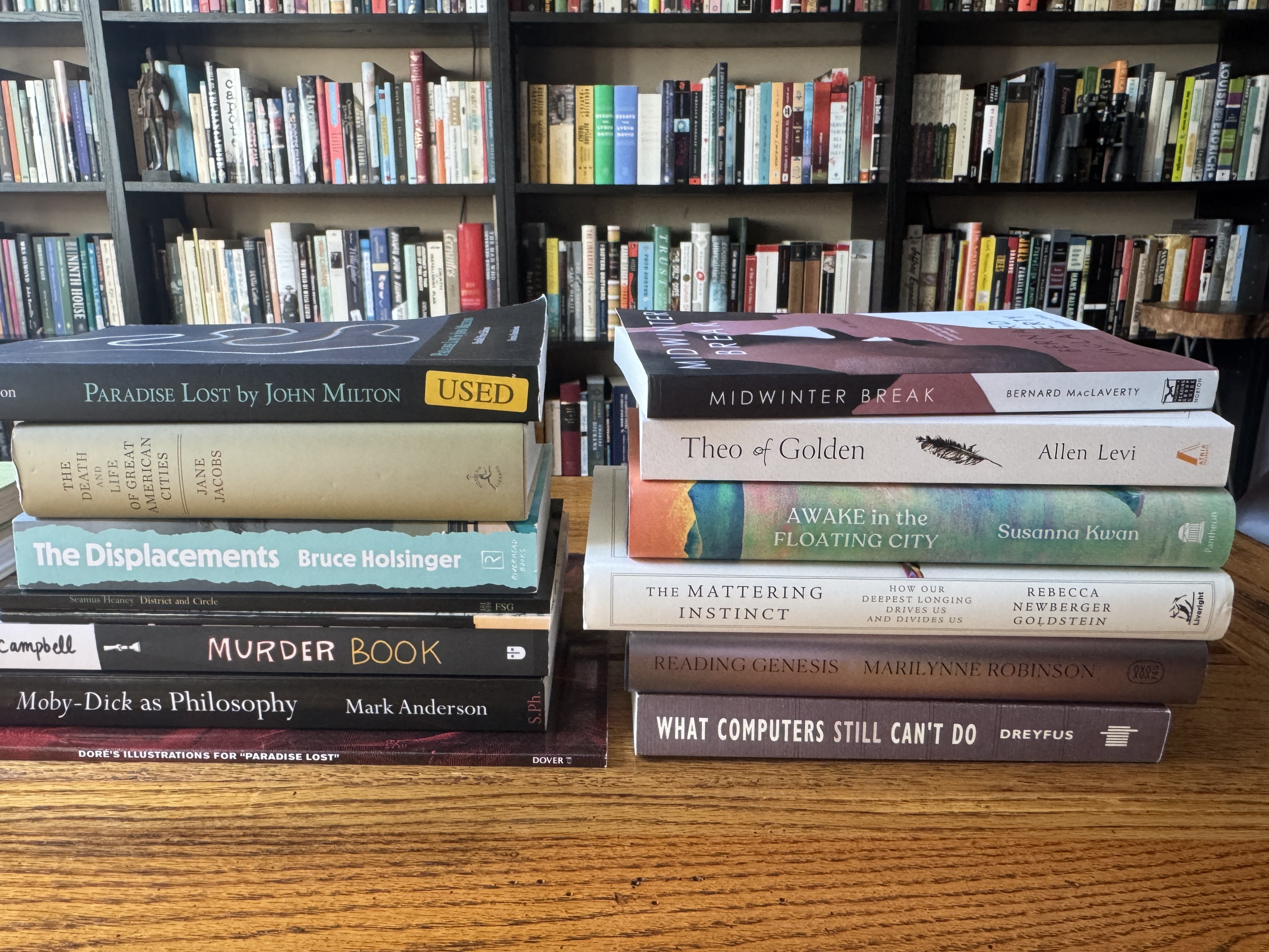
Today through rain-streaked windows, I can see wet-feathered birds visiting our feeders while I, dry and warm in my favorite chair, read from a stack that includes Shakespeare’s Henry V and The Tempest and Cormac McCarthy’s Blood Meridian. And according to the forecast, I should be able to walk for a bit before class tonight. I’ll wear my cloak of invisibility with confidence.
After a week of single-digit temperatures, the weather has granted us a return to more comfortable walking weather. (Recurring public service announcement: Wear sunscreen.) In addition to logging more miles, I’ve gotten back to music practice, preparing to resume lessons in mid-March. (The doctor advised against playing for at least two weeks post-surgery; it was only a few days the first time. May there be no third time.)
Generally, very little can prevent me from reading, so that has continued uninterrupted. Not long after announcing I had begun The Heaven and Earth Grocery Store, though, I read this article and became absorbed by Barbara Kingsolver’s Demon Copperhead (2022). Come for the social commentary; stay for one of the most beguiling narrators since perhaps his narrative brother, David Copperfield. (Speaking of the Dickens novel, I will reread it for a UChicago course later this year.) I’ve since returned to the McBride, a delight, and will likely finish it today or tomorrow. Late last week, I attended a virtual talk with Amy Tan; naturally her book about backyard birding made its way from my shelves to the table beside my favorite reading chair. And as I’ve mentioned, with my youngest, I’ve been reading books by Brazilian writers, most recently, Captains of the Sands (Jorge Amado; 1937). Since some have likened it to Lord of the Flies (William Golding; 1954), we have decided to reread that when we finish Captains. (In a neat intersection of interests, I discovered Yellowjackets this month, which most assuredly owes a debt to Golding — and to Lost, a small-screen family favorite.)
All that remains is to get back to my Latin studies, which, now that I feel more myself, seems probable this week.
How to Be Eaten did turn out to be the right book at the right time. It fit in with something I read by Amanda Marcotte, author of Troll Nation and writer for Salon, who advises that resistance can consist of simply “continuing to exist, by thriving as the person you were born to be, and by holding one another for strength and comfort in adversity.”
Until next time, then, continue to exist. Thrive as the person you were born to be. Hold one another for strength and comfort in adversity.
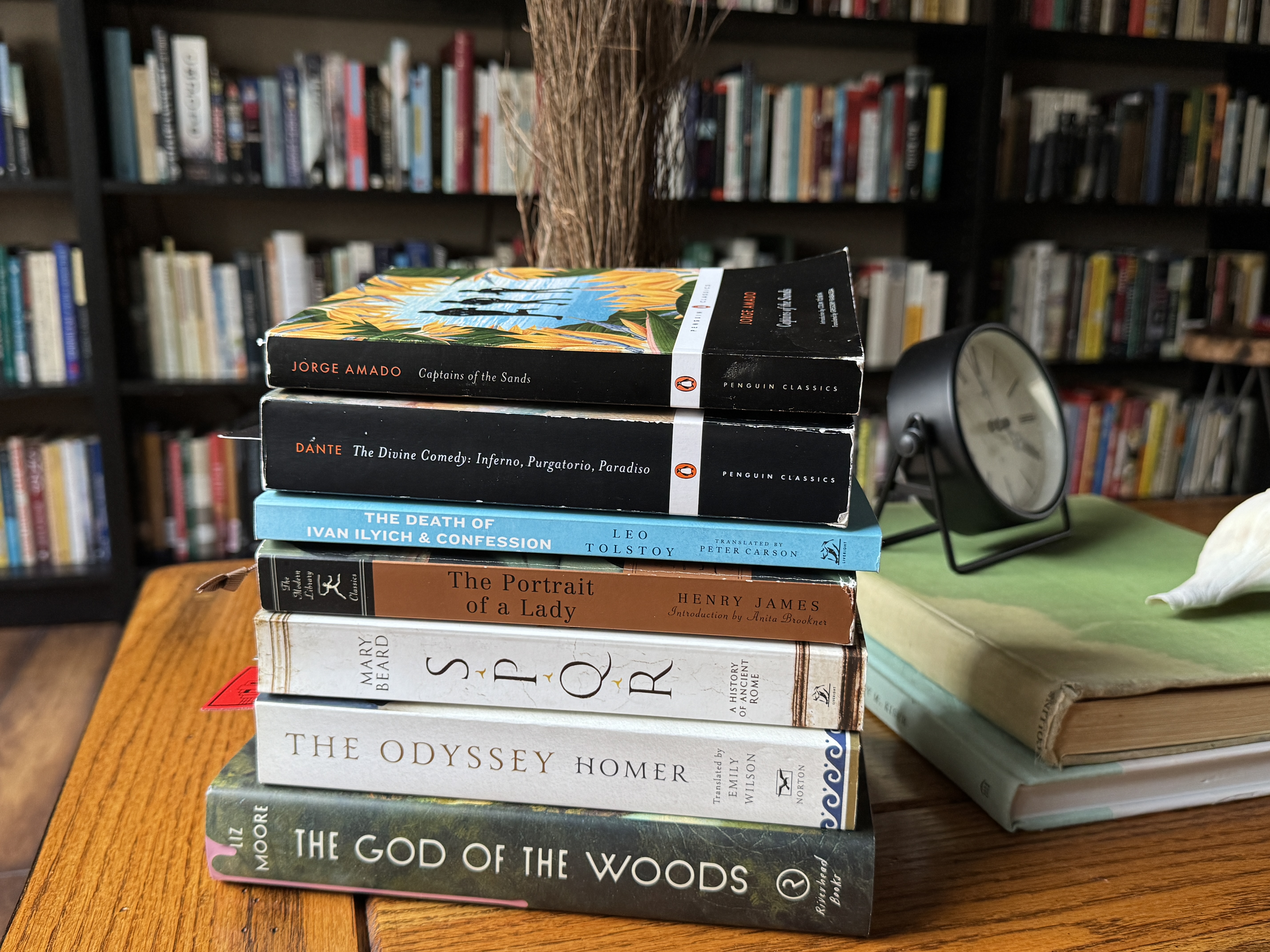
These have been my companions over the last week or so of recuperation. Although I’m not sure I thought the Moore was as amazing as many reviewers did, it was a solid bit of entertainment. Most of the other books are familiar from my sidebar, but the Tolstoy is new… I joined Story Club with George Saunders, an absolute delight. And the Amado is part of the Brazilian literature mini-project on which my youngest and I have embarked.
Today, though, inspired by a talk I attended this week, I’m beginning The Heaven and Earth Grocery Store.
Not pictured is Pinter’s Betrayal, which I read in anticipation of this.
It was already eighty when I was ready to head out this morning, and heat index values of between 110 and 115 are expected in my area, so, yes, I bailed on the workout and used the time for paperwork and tasks decidedly more fun than walking in the unforgiving sun (e.g., shelving new books).
Speaking of the sun, in the sixties and seventies, I was a Coppertone kid raised on the Jersey Shore. Consider this a random but important public service announcement from someone who knows: Get your skin checked annually. If the dermatologist recommends that spots be biopsied and/or treated, have them biopsied and/or treated. Early identification of potential problems leads to better outcomes. Finally, wear sunscreen and a hat. No, really. Do it.
■ Macbeth (William Shakespeare; 1606. Drama.) In advance of watching Joel Coen’s film. Related story/review here.
■ Six Characters in Search of an Author (Luigi Pirandello (Trans. Edward Storer; 1921. Drama.) Cannot recall the precise path that led me to Scallydandling about the books, but I can say that I enjoy poking about in her video lists. Six Characters was her January drama selection.
■ Late Migrations: A Memoir of Love and Loss (Margaret Renkl; 2019. Non-fiction.) For the commonplace book:
p. 7 But the shadow side of love is always loss, and grief is only love’s twin.
p.17 Holding a useless camera, I suddenly realize that something extraordinary is happening right before me, a great serpent slowly on the move and all the songbirds aware of its presence and calling to each other and telling each other to beware. The miracle isn’t happening in the sky at all. It’s happening in the damp weeds of an ordinary backyard, among last year’s moldering leaves and the fragrant soil turned up by moles.
p. 73 […B]ut the flip side of ignorance is astonishment, and I am good at astonishment.
p. 155 When I didn’t die, however, and then didn’t die some more, I came one day to understand: I wasn’t dying; I was grieving. I wasn’t dying. Not yet.
p. 186 Human beings are creatures made for joy. Against all evidence, we tell ourselves that grief and loneliness and despair are tragedies, unwelcome variations from the pleasure and calm and safety that in the right way of the world would form the firm ground of our being. In the fairy tale we tell ourselves, darkness holds nothing resembling a gift.
What we feel always contains its own truth, but it is not the only truth, and darkness almost always harbors some bit of goodness tucked out of sight, waiting for an unexpected light to shine, to reveal it in its deepest hiding place.
With the month closing and only nine books on my list, I’d say this year has begun at a far more leisurely pace than last year (twenty-five books). That said, I’m reading quite a bit. With 100 Days of Dante, I’ve nearly climbed Mount Purgatory. With book groups, I’m reading Anna Karenina, Moby-Dick, and Debt (see sidebar). I’ve just begun A Clockwork Orange, the February Cardiff BookTalk selection. And my husband and I have embarked on a read-the-bible-in-a-year schedule. (It pains me to confess that I haven’t read the complete bible. Do you have a recommendation for a “bible as literature” resource? We’ll take it.)
I began listening to State of Terror (Louise Penny and Hillary Rodham Clinton) on the drive to and from Michigan last week — not Chief Inspector Gamache but certainly entertaining. While away, I also tried to finish Noah Hawley’s latest novel, Anthem (review here), but no luck. Unlike S. Kirk Walsh, I’m finding it a bit… tedious.
Before heading out on my mini-vacation, I gave a Zoom* performance for an audience of one, playing the Rondeau, Polonaise, and Badinerie from Suite No. 2 in B Minor, BWV 1067. Was it flawless? Nope. But while I was away, my teacher wrote, in part, “Really, really excellent work on the Bach! So pleased and proud that you put your all into it and did such a great job.” Yes, I’m still grinning. My new solo piece is Howard Ferguson’s Three Sketches for Flute and Piano. I’m also working on the ninth of 18 Studies for Flute by Joachim Anderson, Op. 41, in Robert Cavally’s Melodious and Progressive Studies from Andersen, Gariboldi, Koehler, and Terschak for Flute, Book 1, and “From Duetto No. IV” (W.F. Bach) in Selected Duets for Flute, Volume II (Advanced). My practice schedule remains much as it was in the fall.
Our walking schedule, however, does not: The snow and ice (to say nothing of the extreme cold of days like yesterday) make early morning walks in the neighborhood untenable, so we’ve been using workouts on DVDs, after which, I hop on the exercise bike while my husband gets ready for work. We have the equipment needed to walk the conservation district paths, though, so we head there on the weekends during which the weather cooperates.
* Given the continuing uncertainty surrounding the virus, I requested that we return to the virtual format until at least February.
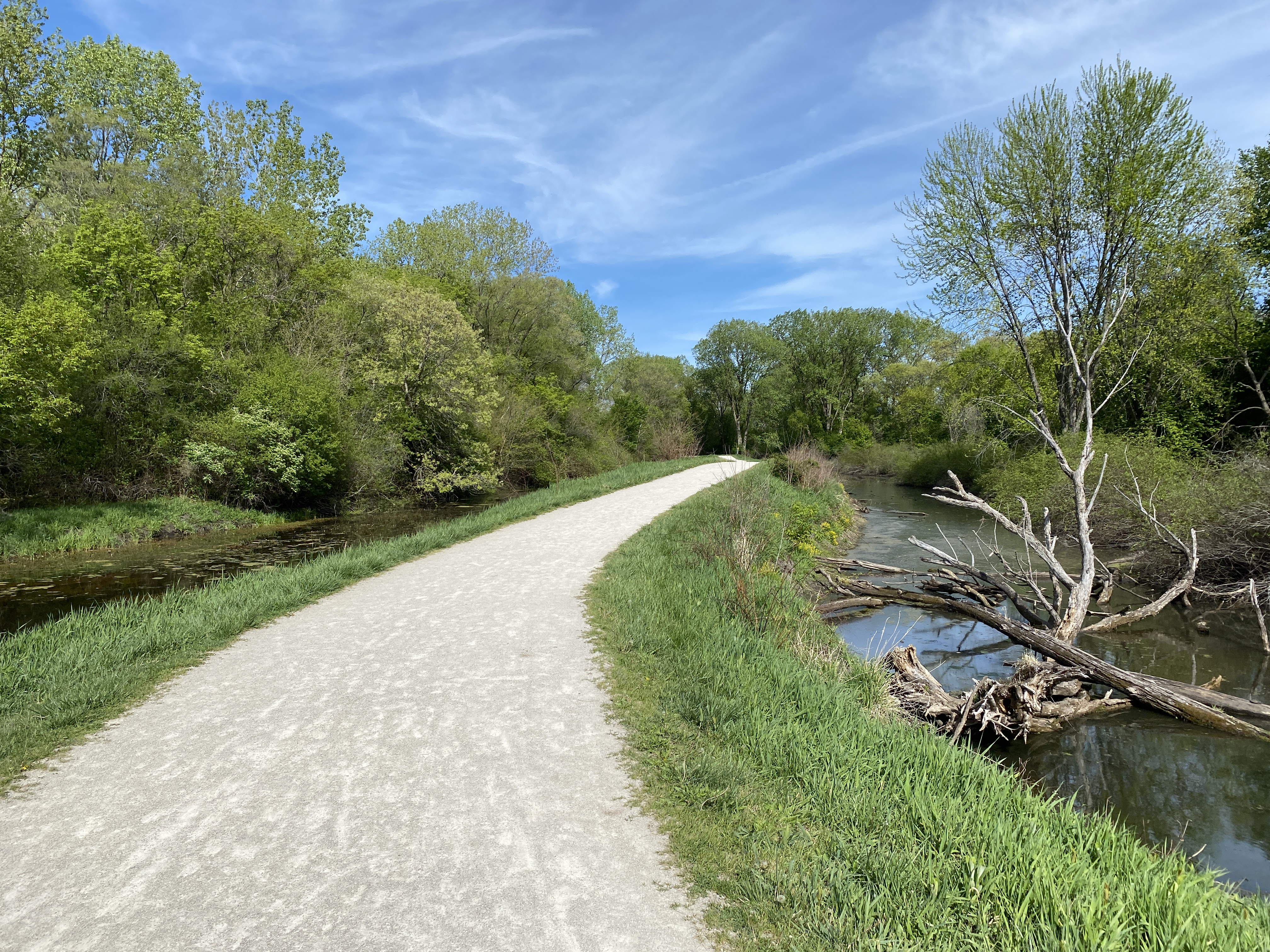
Portions of our neighborhood were developed with older residents in mind, and the reasonably well maintained sidewalks and paths make daily walks as easy as after-lunch naps. While my husband and I regularly walk three miles in the neighborhood before he begins work each weekday, though, we prefer to get out to a conservation area or state park on the weekends. The image above was taken last Sunday.
The weekend has arrived, and, boy, do I need it. I am going to follow my cat’s example: a warm blanket, a few naps, and maybe a few episodes of Westworld, Season 2. (Yes, I’m behind.)
It’s not that I’m never sick, but I have been pretty fortunate. Sure, five years ago, I spent much of the late summer and early fall battling an upper respiratory infection, and, yes, I’ve had a couple of colds since then, but mostly it seems that I am able to vanquish the occasional illness quickly.
On Friday, November 9, though, I succumbed to a clinging, cold-like bug. Fever, chills, and fatigue nearly caused me to miss a play on Saturday night. (Afterward, we mused that it was, in fact, quite missable, something we’ve said about only one other play in eight years.) Coughing and exhaustion forced me to call out of work on Thursday, November 15, but apart from post-nasal drip and a lingering cough, I felt much better on Thanksgiving. On Black Friday, however, I awoke to “stomach flu” and an impressive fever. (It may have been the guacamole; no one else had any.) When that subsided twenty-four hours later, I needed to focus on post-holiday travel and the blizzard. Given how physically weak I was, my husband and I decided that I would drive my youngest back to university and remain overnight, and he would stay home to keep up with the snow clearing — which would have been great decisions, had my daughter and I discovered the leak in the new air mattress before 2 a.m. Monday. Heh, heh, heh. “Boy, will I sleep well tonight!” I announced when I returned home. Nope. Another night of broken sleep.
So… I spent the remainder of this past week catnapping and getting to bed early to put the kibosh on a lingering, low-level fatigue. It’s my fervent hope that one or two more nights will do the trick. It has, after all, been more than three weeks; I’d like to be done now, please.
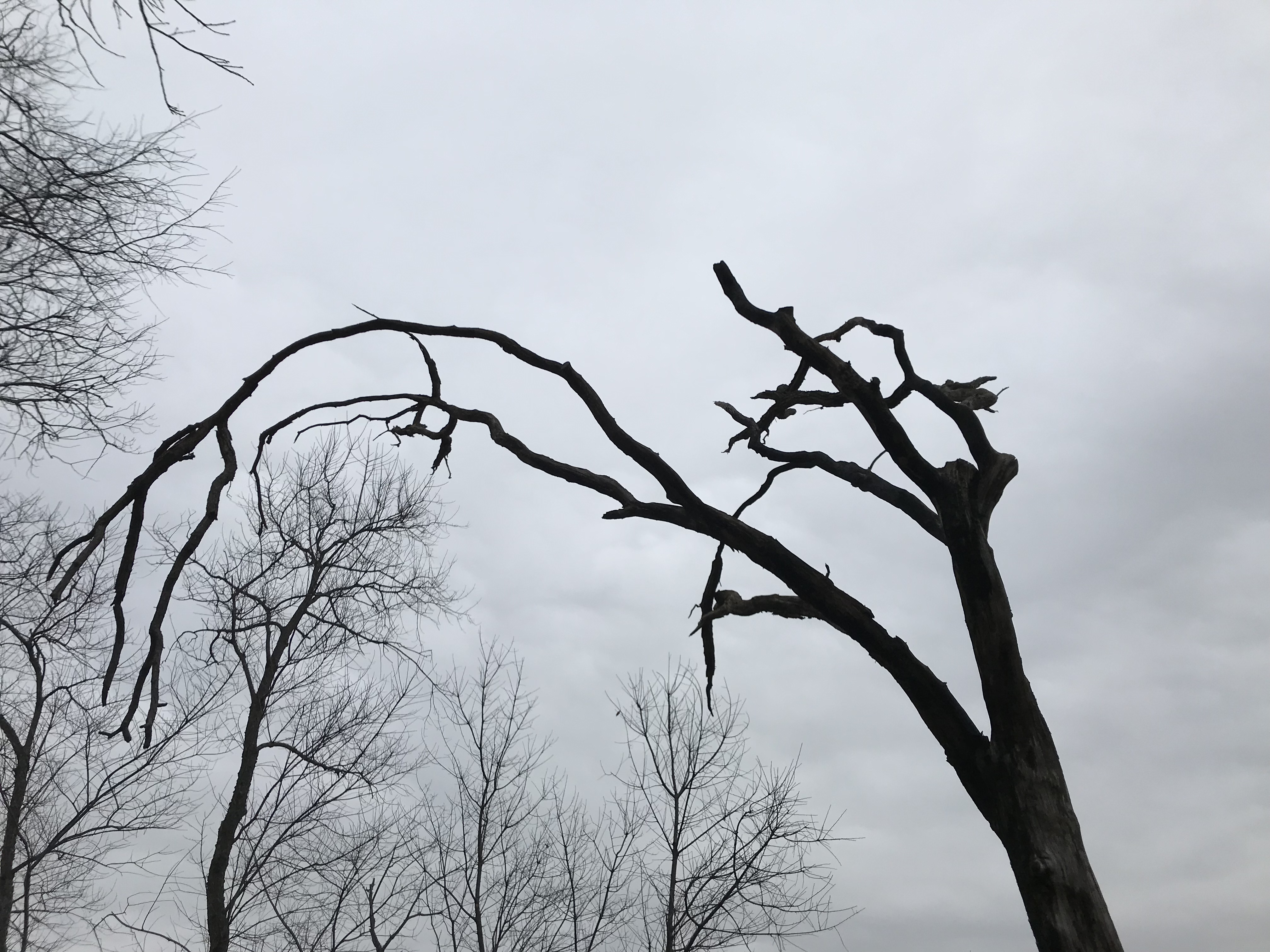
The gloomy weather doesn’t do much to improve my energy level, either. The photo above was taken on a family walk Thanksgiving morning. I’m certain it has looked like that nearly every day since.





 The weekend has arrived, and, boy, do I need it. I am going to follow my cat’s example: a warm blanket, a few naps, and maybe a few episodes of Westworld, Season 2. (Yes, I’m behind.)
 It’s not that I’m never sick, but I have been pretty fortunate. Sure, five years ago, I spent much of the late summer and early fall battling an upper respiratory infection, and, yes, I’ve had a couple of colds since then, but mostly it seems that I am able to vanquish the occasional illness quickly.
 Nerdishly