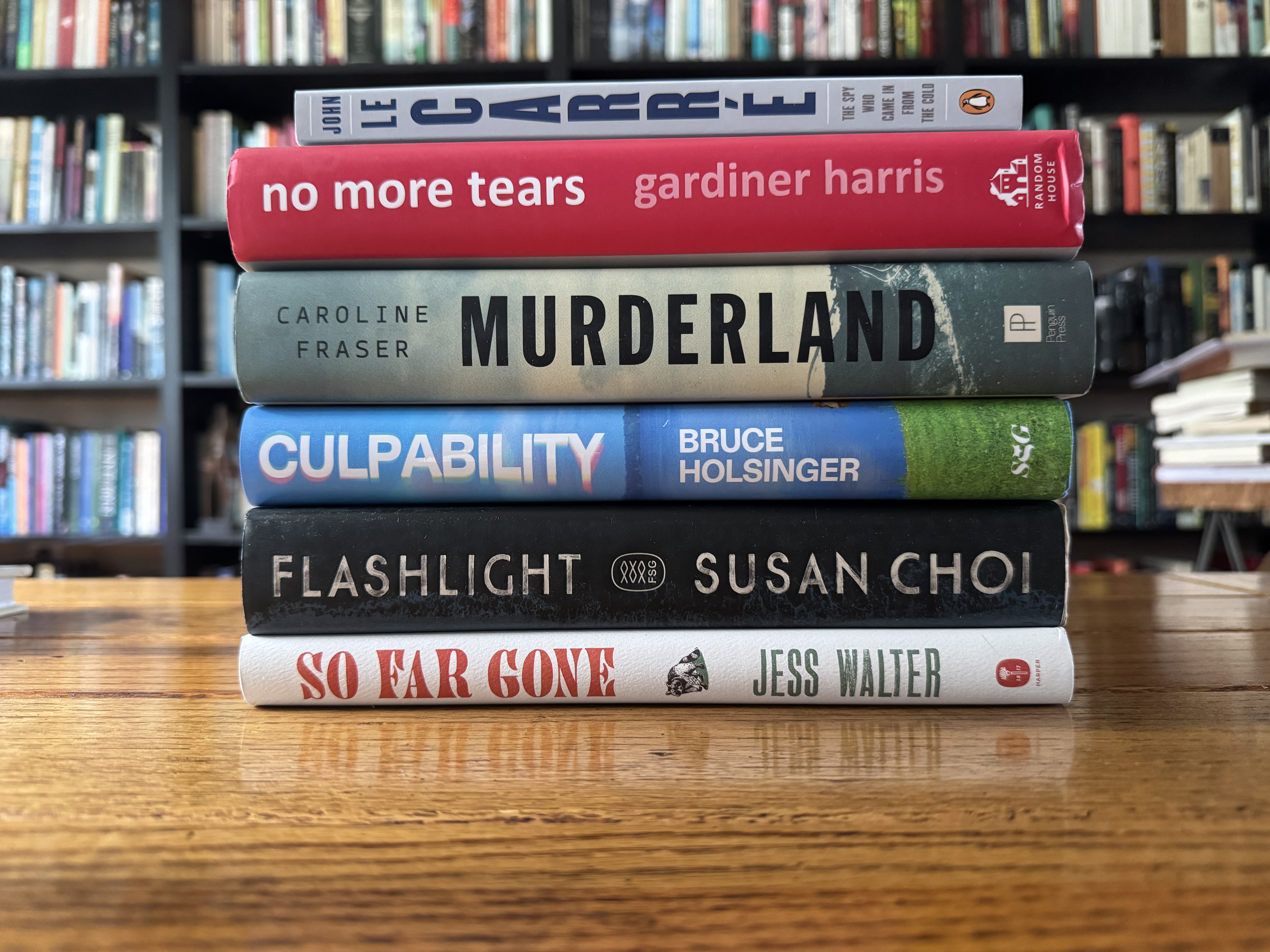
These recent acquisitions were shelved because my current stack is so tall that my youngest gently joked about it throughout her recent visit. She was not wrong. I also shelved The Remains of the Day (Kazuo Ishiguro; 1989), which I (re)read with Commonplace Philosophy (this book was even more beautiful three-plus decades later), and the subtle, haunting Under the Eye of the Big Bird (Hiromi Kamakami; 2025 — review here). I’ve shelved Stephen Fry’s Troy (2021) for now because I am working though Aristotle’s Nicomachean Ethics and secondary sources for study group and David Copperfield (Charles Dickens; 1850) for a UChicago Graham School course, plus Latin and music practice. The currently reading stack now looks a wee bit more manageable.
More than forty years ago, my college mentor recommended Testament (1983) in one or another of the several classes and seminars I took with him. When I was home a couple of weekends later, my mother channel-surfed in lieu of conversation, and William Devane’s face flickered across the screen. “Can we watch this for a bit?”
It wasn’t a long movie, over in a quiet horror and a sob.
I remember it as my first genuine glimpse into the lives of adults, of families. (And this is, of course, the gift of good books, films, artworks, music, etc. — that they help us understand what is real and true in ways in which what is real and true has not yet done, perhaps cannot do.)
The film, which was brilliantly cast with gifted actors (Jane Alexander, Devane, a young Luke Haas) who actually look like a typical nuclear family in a California hamlet, opens twenty-four hours before a nuclear attack. In Thornton Wilder’s Our Town, Emily cries out in Act III, “I can’t. I can’t go on. It goes too fast. We don’t have time to look at one another. I didn’t realize. So all that was going on and we never noticed.” This not-looking, not-noticing is, of course, the essence of Testament‘s extended first act: that the father challenges the son to make the hill but pedals ahead, that the youngest would prefer to be a rat in the school production of The Pied Piper of Hamelin (a wish denied that serves as heartbreaking foreshadow), that the mother fails to awaken in time to exercise, that the husband and wife make love rather than continue a painful discussion, and so on. Piano practice. Breakfast. Clutter. School. Work. Answering machines. Unfinished projects. Unspoken fears. Unmet expectations. Pain and beauty, the extraordinary and the commonplace. Life. And no one really notices. The rhythms and grace notes that underscore everyday life grow too subtle, pass unmarked, end uncelebrated.
And then the world winks out, a few lights at a time. We can wish that we remember everything, and how we survived, the mother tells her son as the movie concludes.
But is being the last woman standing on the cusp of the end of the world what a little girl conjures when she dreams about growing up?
Watching Testament decades later, with my oldest child, later with his sisters, perceptive and sensitive filmgoers all, I was challenged — again — to examine the course and content of my life. If it were all over tomorrow, would today have been enough?
Literature or art or music or conversation that makes. us. think. (like Testament, for example) hurts, doesn’t it? It forces us to re-examine ourselves and our lives in ways that may… that will disappoint us. Reconciling who we are with who we thought we might be is hard, painful work.
Thinking about Testament nearly always reminds me of Ray Bradbury’s short story “The Last Night of the World.”
“We haven’t been too bad, have we?”
“No, nor enormously good. I suppose that’s the trouble — we haven’t been very much of anything except us, while a big part of the world was being lots of quite awful things.”
Rereading the story as if it were in conversation with Testament makes me wonder if Bradbury misstepped. While we must be something more than not too bad, I’m not certain that being ourselves is such an unworthy goal — being our best selves, that is, and by doing so inspiring in those we love and those we meet the desire to be, in turn, their best selves. So that even if a big part of the world is being lots of quite awful things, we are not allowing the everyday to pass unnoticed and uncelebrated.
Speaking of works in conversation, Testament is on my mind because I am about to reread The Road as part of a deep-dive into Cormac McCarthy’s work. When I watched the film adapted from McCarthy’s dystopian novel, I concluded that Testament is far and away the more emotionally wrenching film, perhaps because quiet horror is more insidious and thought-provoking than graphic depictions of man’s inhumanity to man, and because the beginning of the end of all things is infinitely sadder and more painful than the near-end of all things.
Don’t you agree?
The above was adapted from a post that first appeared on my previous site more than twenty years ago.
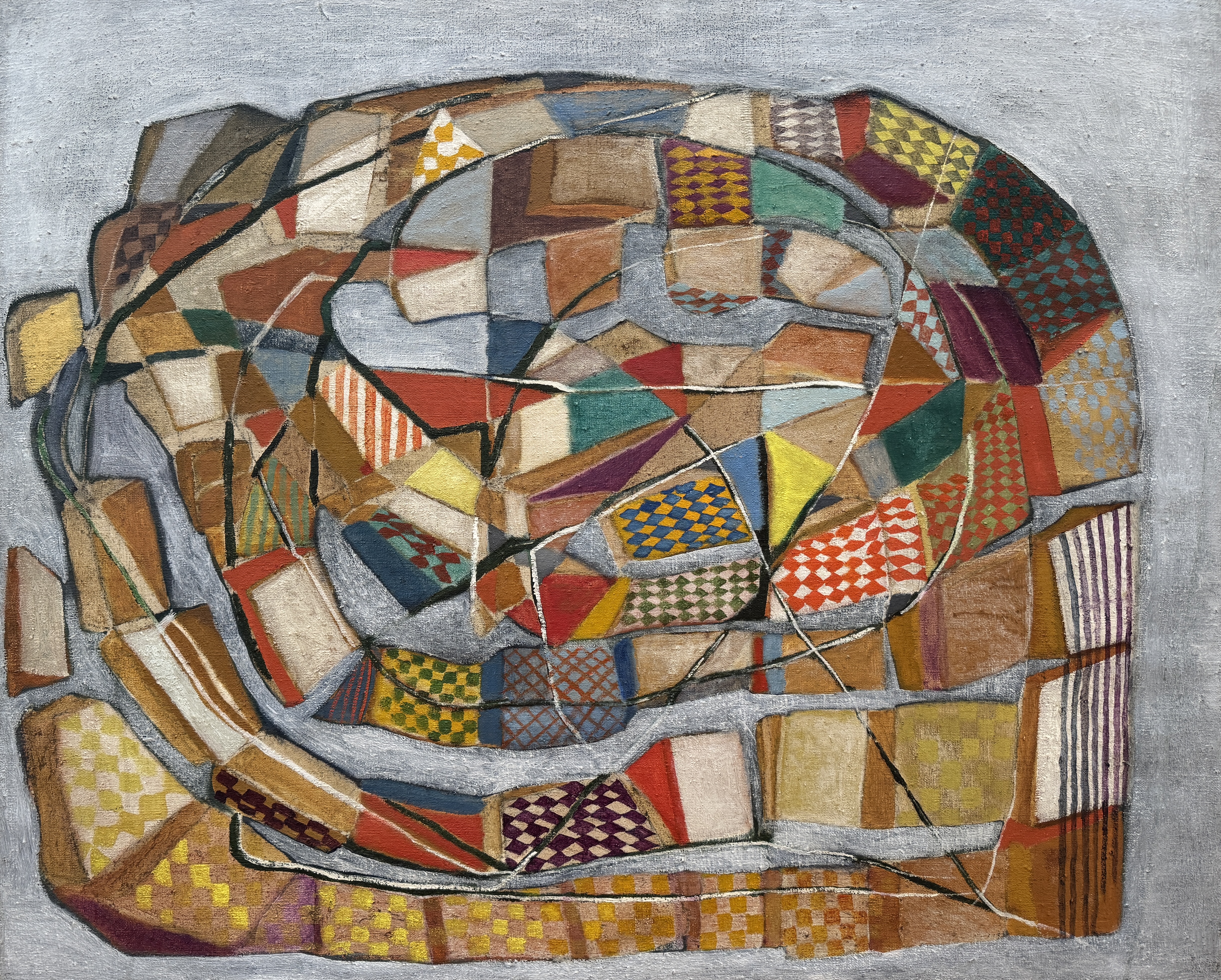
On Friday morning at the Art Institute, I encountered the painting above, “Composition” (1936-37) by Maria Helena Viera da Silva. The plaque beside it attributes the following quote to the artist:
“I paint my amazement, which at the same time is delight, fear and laughter. I do not want to exclude anything from this amazement. I want to paint pictures with many things, with all the contradictions.”
When I returned from my walk, I shelved most of these and then reviewed my notes on Book II of Aristotle’s Nicomachean Ethics for this morning’s study group. This afternoon I finished Cormac McCarthy’s No Country for Old Men (2005).
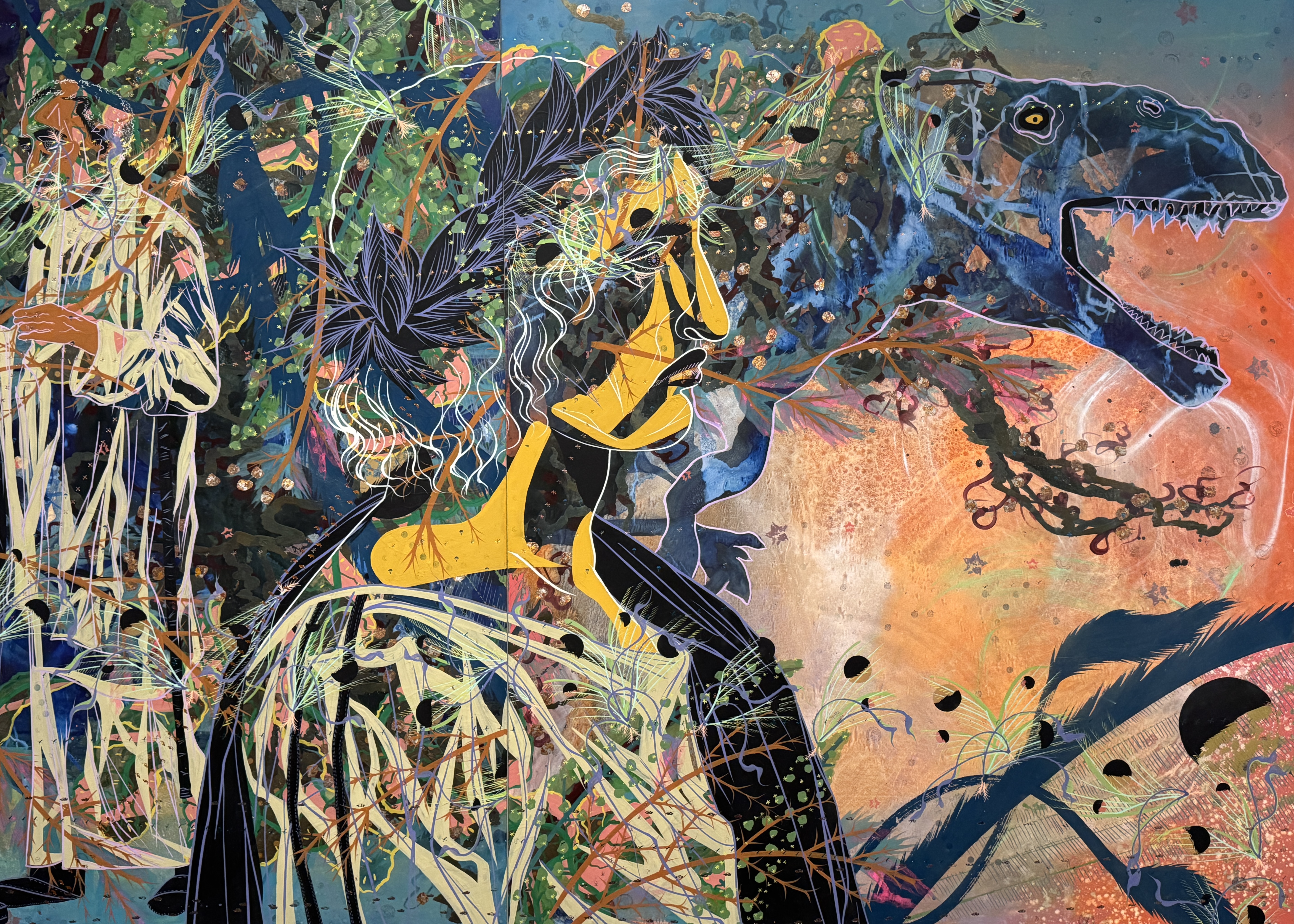
What Sin Is Purged Here in the Circle Where We Are Standing? (2023)
Tammy Nguyen’s painting was not on view the last time I visited the Toledo Art Museum — at least I’m pretty certain it wasn’t. But even if it were, this was the visit during which it demanded my attention. Here’s a link to more about this startling and compelling work.
At the Smart Museum yesterday, I experienced a similar sense of discovery when I encountered Patrick Nagatani’s Beware Artist. We were in the area for the Sunday matinee of An Iliad at the Court, which is drop-everything-and-get-your-tickets theater. We had seen Timothy Edward Kane in this role three times before — live in the 2013 production and in the 2020 production at the Institute for the Study of Ancient Cultures Museum (formerly, the Oriental Institute) and streaming during the pandemic. Mesmerizing as he was then, he is even more spectacular in this iteration of The Poet. The post-show discussion with Kendall Sharpe of the University of Chicago Graham School and Charlie Newell, former artistic director of the theater, was time spent well, too. We returned for the evening performance, which featured Kane’s understudy, Jason Huysman. To me, the role of The Poet is not necessarily to be interpreted as Homer but rather as one of many singers of the Iliad, so it was a gift to hear another vocalist, to encounter the material in a different way. While both actors impart the heroic, the beautiful, and the doomed, however, Kane is, as Newell suggested in his remarks, a demigod, and like Achilles, his work towers above that of other men, his shield illuminates worlds, and his voice stops hearts.
After sleeping in this morning, we walked, then finished all of the yard work in time to watch the Vera C. Rubin Observatory “First Look Event.” Sharing the link with my sister and nephew, I wrote, Humans may be warriors and conquerors, but we are storytellers and stargazers, too.
While walking along the Huron River last weekend, we found ourselves in one of those places that would probably prove a bit dodgy once the sun set but that in the late afternoon simply provided an image of nature and infrastructure in uneasy harmony. Much of the view from Amtrak’s Wolverine arrests my attention in the same way — the detritus of industry overlaid with fleeting glimpses of wildflowers and birds. I drove this time, but I think I will take the train again later this summer.
Today after chores, a long walk, main meal, and a short nap, I am settling into my favorite chair with the latest issue of The Atlantic to read Elizabeth Bruenig’s “Witness.” Beside me are Aristotle’s Nicomachean Ethics and Rosalind Rosenburg’s biography of Pauli Murray, Jane Crow. A long and dangerously hot weekend is forecast. Stay hydrated. Seek shade. And keep your cool.







 Nerdishly