
It has been three months since my last bookish post, but I attempt to keep my list current, even when I haven’t enough time to write. With forty-nine books, I am (slightly) exceeding my (modest) goal of two books per week. As I’ve mentioned before, I am a promiscuous reader, loving, leading on, leaving in various states of undress many, many more books than that number would indicate, but I generally include only the cover-to-covers in my list; hence, forty-nine.
Random reading notes:
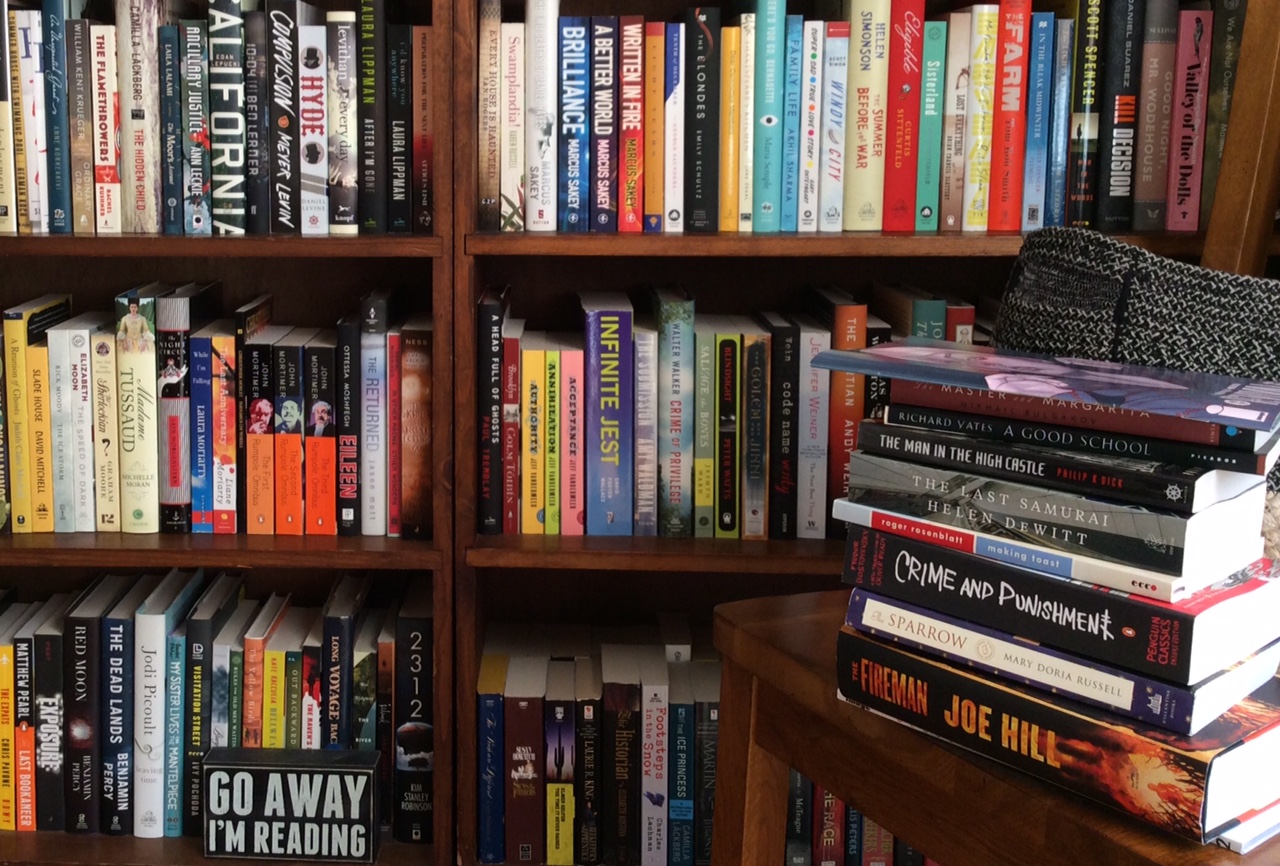
■ How is it possible that two decades have passed since I first read The Sparrow and breathlessly pressed it on my husband? Twenty years. Well, Russell’s unusual and wonderful novel — with its astronomy-, music-, language-, relationship-, anthropology-, and religion-infused discussions — was the first selection for the summer session of our family book club, and the novel was even better on rereading.
p. 278
Standing in the hallway, John Candotti and Edward Behr could hear half of the conversation taking place inside the Father General’s office quite clearly. It was not necessary to eavesdrop. It was only necessary not to be deaf.
“None of it was published? You are telling me that not one article we sent back was submitted–”
“Maybe we shouldn’t have told him,” John whispered, rubbing the bump on his broken nose.
“He was bound to find out eventually,” said Brother Edward placidly. Anger, he believed, was healthier than depression.
Amen, Brother Edward. Amen.
■ Last year, Roger Rosenblatt’s Kayak Mornings left me cold, but this year, Making Toast, his earlier memoir about loss and grief, seemed to meander less and, therefore, mean more to me.
p. 39
Because I could not understand why she died, I sought to make other things less confusing. I cleaned out junk-closets, gave order to a chaotic shelf of CDs, and cleared an ivy-choked area of the yard.
■ Has anyone else picked up Joe Hill’s The Fireman? It would have been a passable beach read had it not been too long by four hundred pages and had it not suffered so much in (inevitable) comparison to Stephen King’s The Stand. The parallels to his father’s novel were, apparently, intentional:
Two-thirds into writing the book, it suddenly hit me how much The Fireman parallels The Stand. There were some strong threads connecting the two. So, do you run from that? I think it’s more fun to embrace your influences than to try to bury them.
Read the complete interview here. Our family book club’s “reach goal” for last summer was to finish The Stand, a reread for me and for my husband. Only he succeeded, but he does listen to audiobooks while commuting, so he has an advantage over the rest of us. The remaining members have recommitted to finishing by mid-August.
■ I think all of my favorite lines from Cardenio belong to the (wrongfully) much maligned Doris. Early on:
To be honest, I’ve never understood
Why I shouldn’t tell the truth.
I mean the assumption that this is beneficial to the world,
to be nice, to be pleasant,
is just unproven.
[Is she suddenly close to tears?]
Difficult people are always the ones who advance civilization.
And much later:
Well, there’s a mature decision!
What are the odds, Anselmo,
that your second marriage will last as long as your first?
It’s a comment on the excellence of the Shakespeare Project of Chicago that they made this rather tedious work so watchable. For more information about “Shakespeare’s lost work,” visit The Cardenio Project.
■ I have read five more graphic collections since my last post, for a total of ten, to date. While, I am enjoying all of the series, none is a “gateway” volume. If you seek one, though, it’s Brian K. Vaughan’s Y: The Last Man or Jeff Lemire’s Sweet Tooth.
■ A Good School is, quite possibly, the best book I’ve read this year — which may have been the same thing I said about Richard Yates’ Revolutionary Road eight years ago. In “The Lost World of Richard Yates” (Boston Review, October/November 1999), Stewart O’Nan wrote:
Once the most vaunted of authors–praised by Styron and Vonnegut and Robert Stone as the voice of a generation–he seems now to belong to that august yet sad category, the writer’s writer. Andre Dubus, who was his student at Iowa, revered him, as does Tobias Wolff, and the jackets of Yates’s books are adorned with quotes by the likes of Tennessee Williams and Dorothy Parker, Ann Beattie and Gina Berriault. When authors talk his name pops up as the American writer we wish more people would read, just as Cormac McCarthy’s used to. In the acknowledgments section of his novellas, Women With Men, Richard Ford makes it plain: “I wish to record my debt of gratitude to the stories and novels of Richard Yates, a writer too little appreciated.”
With his insightful and ranging appreciation, O’Nan — also a writer too little appreciated (if you are not familiar with his work, begin with A Prayer for the Dying and Last Night at the Lobster) — all but ensured that Yates would be revisited: Many of Yates’ books are, of course, back in print, and his “painful and sad” first novel received big-screen treatment in 2008. In fact, I finally saw the film last week, which led to the mentally intoned assertion, “The book was better,” and to the shelves, where several Yates titles awaited me. By the way, fans of John Williams’ Stoner will also appreciate A Good School.
From Revolutionary Road:
p. 59-60
And even after politics had palled there had still been the elusive but endlessly absorbing subject of Conformity, or The Suburbs, or Madison Avenue, or American Society Today. “Oh Jesus,” Shep might begin, “you know this character next door to us? Donaldson? The one that’s always out fooling with his power mower and talking about the rat race and the soft sell? Well, listen: did I tell you what he said about his barbecue pit?” And there would follow an anecdote of extreme suburban smugness that left them weak with laughter.
“Oh, I don’t believe it,” April would insist. “Do they really talk that way?”
And Frank would develop the theme. “The point is it wouldn’t be so bad if it weren’t so typical. It isn’t only the Donaldsons—it’s the Cramers too, and the whaddyacallits, the Wingates, and a million others. It’s all the idiots I ride with on the train every day. It’s a disease. Nobody thinks or feels or cares any more; nobody gets excited or believes in anything except their own comfortable God damn mediocrity.”
Milly Campell would writhe in pleasure. “Oh, that’s so true. Isn’t that true, darling?”
They would all agree, and the happy implication was that they alone, the four of them, were painfully alive in a drugged and dying culture.
p. 128-129
“This whole country’s rotten with sentimentality,” Frank said one night, turning ponderously from the window to walk the carpet. “It’s been spreading like a disease for years, for generations, until now everything you touch is flabby with it.”
“Exactly,” she said, enraptured with him.
“I mean isn’t that really what’s the matter, when you get right down to it? I mean even more than the profit motive or the loss of spiritual values or the fear of the bomb or any of those things? Or maybe it’s the result of those things; maybe it’s what happens when all those things start working at once without any real cultural tradition to absorb them. Anyway, whatever it’s the result of, it’s what’s killing the United States. I mean isn’t it? This steady, insistent vulgarizing of every idea and every emotion into some kind of pre-digested intellectual baby food; this optimistic, smiling-through, easy-way-out sentimentality in everybody’s view of life?”
“Yes,” she said. “Yes.”
More book notes will follow.




 Nerdishly