An annotated reading list

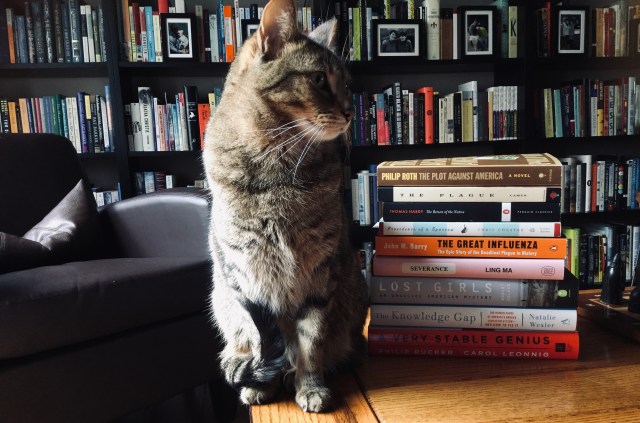
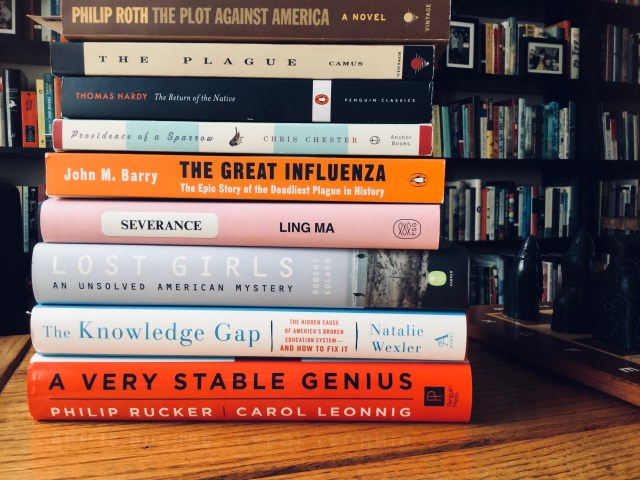
0497D280-6518-4F0A-8431-D80CBBD7F138Since my last list, I have read fifteen books, which means that I have completed Robin’s “Read 52 Books in 52 Weeks” challenge. But let’s keep going, eh?

Autobiography of a Face (Lucy Grealy; 1994. Non-fiction.) RFS
p. 7
The cruelty of children is immense, almost startling its precision. The kids at the parties were fairly young and, surrounded by adults, they rarely make cruel remarks outright. But their open, uncensored stares were more painful than the deliberate taunts of my peers at school, where insecurities drove everything and everyone like some looming, evil presence in a haunted machine. But in those backyards, where the grass was mown so short and sharp it would have hurt to walk on it, there was only the fact of me, my face, my ugliness.

The Plot Against America (Philip Roth; 2004. Fiction.) RFS
I had thought this would be a reread but then realized I had confused it with American Pastoral. The book is practically perfect, so although the first episode of the new HBO series was solid, it’s unlikely that I will continue watching.

p. 114
Turned wrong way round, the relentless unforeseen was what we schoolchildren studied as “history,” harmless history, where everything unexpected in its own time is chronicled on the page as inevitable. The terror of the unforeseen is what the science of history hides, turning a disaster into an epic.

p. 300
Whether outright government-sanctioned persecution was inevitable, nobody could say for sure, but the fear of persecution was such that not even a practical man grounded in his everyday tasks, a person who tried his best to contain the uncertainty and the anxiety and the anger and operate according to the dictates of reason, could hope to preserve his equilibrium any longer.

p. 316
To have enslaved America with this hocus-pocus! To have captured the mind of the world’s greatest nation without uttering a single word of truth! Oh, the pleasure we must be affording the most malevolent man on earth!

Aimless Love (Billy Collins; 2013. Poetry.) RFS
Billy Collins is a treasure.

My Dark Vanessa (Kate Elizabeth Russell; 2020. Fiction.) ATY
Read in two sittings. Timely and disturbing. Related links here and here.

Severance (Ming La; 2018. Fiction.) RFS
Prescient and gorgeously written. I cannot recommend it enough. Mr. Nerdishly agrees, wryly adding, “It’s also scary as hell.” Review here.

Trees, Vol. 3 (Warren Ellis; 2020. Graphic fiction.) LIB
Strong addition to the series.

Oblivion Song, Vol. 4 (Robert Kirkman; 2020. Graphic fiction.) LIB
Less so.

Say Nothing: A True Story of Murder and Memory in Northern Ireland (Patrick Radden Keene; 2019. Non-fiction.) RFS
Related links here and here.

Catch and Kill (Ronan Farrow; 2019. Non-fiction.) RFS
This reminded me of my experience reading Bad Blood: I could not put it down; hours disappeared. A review and an article about the related podcast.

The Old Man and the Sea (Ernest Hemingway; 1952. Fiction.) ATY
This is another of those books that I have reread as an adult and realized, “Wow, that was clearly wasted on my teenaged self.”

No one should be alone in their old age, he thought. But it is unavoidable.

Postal: Deliverance, Vol. 1 (Brian Edward Hill; 2019. Graphic fiction.) LIB
The owner of the comic book store we patronize has fruitfully recommended several series to me, so it’s odd that he didn’t mention that Postal, a series on my shortlist, had continued. Well, it was a treat to discover the first volume on Hoopla.

The Nose (Nikolai Gogol; 1835. Fiction.) RFS
We saw some of William Kentridge’s The Nose Series at the Milwaukee Art Museum, but a search of the museum’s website yields only a tax document mentioning that the prints were there. Weird. Well, in any event, I now plan to watch the Kentridge production of the Shostakovich opera via Met On Demand.

But nothing lasts long in this world, and so even joy is weaker one minute than the last, and by the third it has become something fainter still, until finally it fades imperceptibly back into the more usual state of one’s mind, just as a ripple on water, born from the drop of a pebble, will gradually merge back into the smooth surface of the lake.

The Book of M (Peng Shepherd; 2018. Fiction.) RFS
Too long by one hundred pages, and, boy, is the chapter for each narrator device one of the most overused in contemporary fiction, or what? Add to that the fact that I grew impatient with the fantastical elements by the final third, and you have the recipe for a Meh rating.

The Lion in Winter (James Goldman; 1966. Drama.) RFS
Reread one of my favorites because this is a season that requires such indulgences.

Act II, Scene 1
Eleanor: I adored you.
Henry: Never.
Eleanor: I still do.
Henry: Of all the lies, that one is the most terrible.
Eleanor: I know: that’s why I saved it up for now.
(They throw themselves into each other’s arms.) Oh, Henry, we have mangled everything we’ve touched.

The Dream-Quest of Vellitt Boe (Kij Johnson; 2016. Fiction.) RFS
My ticket stub from Chicago Shakespeare Theater’s 2016 production of Tug of War: Friendly Fire marked page 41. My best guess, then, is that I began this unusual book four years ago and set it aside. Written as a feminist counterpoint to H.P. Lovecraft’s The Dream-Quest of Unknown Kadath, this short novel is certainly not my usual fare, but I returned to the beginning and gave it another shot. Still not my cuppa, but, hey, I finished it this time. Related article here.

—————————————
ATY Acquired this year
LIB Borrowed from library (including Hoopla and Overdrive)
OTH Other
RFS Read from shelves
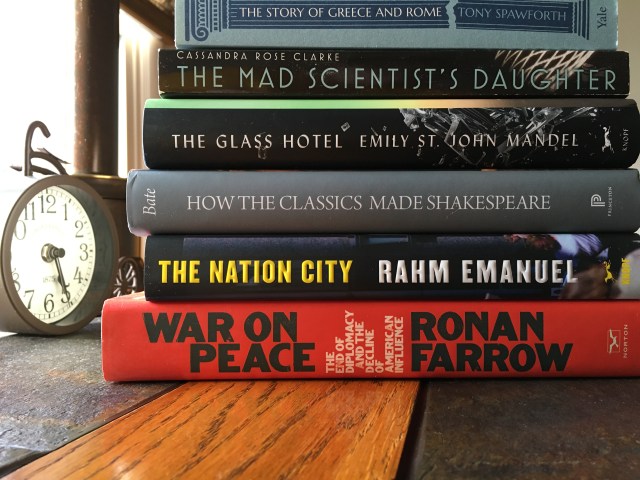
Full of care

BD531F06-100A-4A40-BC0D-60F5578EC8AE

On the road into the conservation area.

Landing in the hospital for a preventable accident is one of the last things anyone wants — ever, I suppose, but especially right now. So we are careful, so much more careful. Careful with the knives. Careful on the steps into the living room and garage. Careful at the stove. Careful in the shower. Careful with the yard tools. Careful behind the wheel.

Careful. Careful.

My husband’s car had been no further than the grocery store for two weeks. It really needs a run, he told me last Thursday. It’s not a thoroughbred horse, I replied, tempering the retort with, But why don’t we drive to a nearby conservation area and back?

To be hurt is the last thing anyone wants — ever, I think, but especially right now. So I am careful. Careful about sarcasm. Careful about criticism. Careful about sharing the news. Careful, so much more careful, with my words. Not so careful that I am a stranger to myself, of course, or to him, but careful enough to cushion the blow a soft apocalypse could deliver.

This will be nice, I added. The park will be beautiful.

We took his reliable and decidedly ordinary sedan to the drive-through car wash. My husband parks beneath an oak, and it is spring. Rain or not, the car needed a wash. Then we took it not for a run so much as a sedate stroll on nearly empty roads beneath heavy clouds.

Careful. Careful!

We had already worked out, and my husband had several meetings scheduled for the afternoon. Hiking the kames on last autumn’s slippery leaves? Not on this finally healing knee. And you don’t want to miss any of your commitments. We saw a few walkers on the backside of the area, but part of that trail abuts the creek, which in spring and summer frequently overruns its banks. A stumble. A cold. No, we must be…

Careful.

The park was beautiful if gloomy and gray. On the way out, we stopped to watch a pair of sandhill cranes, and on the way home we stopped at a store. We were armed with gloves and sanitizer and wipes. Fine, but we must be quick. And careful.

When we returned home, he carried the bags into the garage and wiped down the contents. Did we really need toilet paper? Gently, not critically.

They haven’t had any in weeks, and you can’t be too…

Careful.

He’s right; I know.

After showering, we put away the groceries and made lunch. (Careful by the stove.) After we called our daughters, he dialed into the first of many meetings, and I washed the dishes. (Careful with the knives.)

As the soapy water drained from the sink, I heard the chorus of murmurs that signals a meeting has begun in earnest. He moved down the hall, and I poured a mug of coffee and carried it into the living room. (Careful on the step.) As I looked out the rain-splattered window, a cardinal couple alighted on the platform feeder. Careful. A sharp-shinned hawk has been spending a lot of time in and near our yard. The male passed a seed to the female, and I thought, Be careful with one another.

An annotated reading list

27987404-51E0-4E06-97EB-E783C463D15C

Talk about serendipity, synthesis, and synchronicity…
Not long after I finished reading Mary Beard’s slim volume, Women & Power, I visited the MFA, where the Head of Medusa (Arnold Böcklin, 1894) held my gaze.

I’ve finished fourteen books since my last list.

The Truants (Kate Weinberg; 2019. Fiction.) LIB
A quick, entertaining read. I particularly relished the idea of Agatha Christie as a subject of academic inquiry.

Women and Power (Mary Beard; 2017. Non-fiction.) RFS
Mary Beard is a genius. Related link here.

Men Explain Things to Me (Rebecca Solnit; 2017. Non-fiction.) RFS
Related link: “Before there was mansplaining, there was Rebecca Solnit’s 2008 critique of male arrogance. Reprinted here with a new introduction.”

p. 10
Dude, if you’re reading this, you’re a carbuncle on the face of humanity and an obstacle to civilization. Feel the shame.

p. 62
Gay men and lesbians have already opened up the question of what qualities and roles are male and female in ways that can be liberating for straight people. When they marry, the meaning of marriage is likewise opened up. No hierarchical tradition underlies their union. Some people have greeted this with joy.

The Prime of Miss Jean Brodie (Muriel Spark; 1961. Fiction.) RFS
Muriel Spark was a genius, too.

The Lady from the Sea (Henrik Ibsen; 1888. Drama.) RFS
Read in anticipation of seeing the Court Theatre production.

Five Days at Memorial (Sheri Fink; 2013. Non-fiction.) RFS
Related link here.

The Taming of the Shrew (William Shakespeare; 1592. Drama.) RFS
Reread in anticipation of seeing the Royal Shakespeare Company at Chicago Shakespeare.

Zeitoun (Dave Eggers; 2009. Non-fiction.) RFS
This was the perfect companion to Fink’s Five Days at Memorial and Patricia Smith’s Blood Dazzler earlier this year.

As You Like It (William Shakespeare; 1599. Drama.) RFS
Read in anticipation of seeing the Chicago Shakespeare production.

Act III, Scene V
But, mistress, know yourself: down on your knees,
And thank heaven, fasting, for a good man’s love:
For I must tell you friendly in your ear,
Sell when you can: you are not for all markets:
Cry the man mercy; love him; take his offer:
Foul is most foul, being foul to be a scoffer.

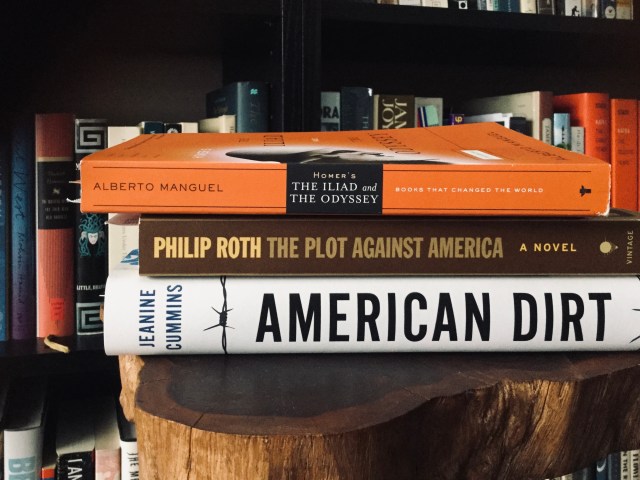
American Dirt (Jeanine Cummins; 2020. Fiction.) ATY
From the NYT review by Parul Sehgal:

But does the book’s shallowness paradoxically explain the excitement surrounding it? The tortured sentences aside, “American Dirt” is enviably easy to read. It is determinedly apolitical. The deep roots of these forced migrations are never interrogated; the American reader can read without fear of uncomfortable self-reproach. It asks only for us to accept that “these people are people,” while giving us the saintly to root for and the barbarous to deplore — and then congratulating us for caring.

It certainly was “enviably easy to read.”

p. 50
What a waste of time it had all been. Lydia feels annoyed that her niece won’t get to see the music box she purchased for her special day. How expensive it was! She realizes, even as this thought occurs to her, how bizarre and awful it is, but she can’t stop it from crashing in. She doesn’t rebuke herself for thinking it; she does herself the small kindness of forgiving her malfunctioning logic.

p. 276
He’s a philosopher, she thinks. He’s rough, but he means what he says, and his openness is a provocation. Despite everything, he likes being alive. Lydia doesn’t know whether that’s true for herself. For mothers, the question is immaterial anyway. Her survival is a matter of instinct rather than desire.

Homer’s The Iliad and The Odyssey (Alberto Manguel; 2007. Non-fiction.) RFS
We’ve had our tickets to the Court’s sold-out, site-specific remount of An Iliad since September. It was more than worth the wait and the price.

p. 2
We don’t know anything about Homer. It is otherwise with Homer’s books. In a very real sense, the Iliad and the Odyssey are familiar to us prior to opening the first page. Even before we begin to follow the changing moods of Achilles or admire the wit and courage of Ulysses, we have learned to expect that somewhere in these stories of war in time and travel in space we will be told the experience of every human struggle and every human displacement. Two of our oldest metaphors tell us that all life is a battle and that all life is a journey; whether the Iliad and the Odyssey drew on this knowledge or whether this knowledge was drawn from the Iliad and the Odyssey is, in the final count, unimportant, since a book and its readers are both mirrors that reflect one another endlessly.

p. 88
A book’s influence is never straightforward. Common readers, unrestricted by the rigours of academe, allow their books to dialogue with one another, to exchange meanings and metaphors, to enrich and annotate each other. In the reader’s mind, books become intertwined and intermingled, so that we no longer know whether a certain adventure belongs to Arsilaous or to Aquiles, or where Homer ends Ulysses’ adventures and the author of Sinbad takes them up again.

p. 226
The scene of war, says Homer, is never only that of war: it is never only that of men acting out in the present the events of the day. It is always the scene of the past as well, a display of what men secretly once were, revealed now in their ultimate moments. Confronted with the imminence of violent death, war also confronts them with the memory of days of peace, of the happiness that life can, and should, grant us. War is both things: the experience of an awful presence and the ghost of a beloved past.

The Iliad (Gareth Hinds; 2019. Graphic fiction.) RFS
I did not appreciate this volume as much as Hinds’ graphic retelling of The Odyssey, which I read last year.

Why We Can’t Sleep (Ada Calhoun; 2020. Non-fiction.) LIB
p. 221
Could we even see our newfound midlife invisibility as a source of power? In Harry Potter’s world, one of the most prized magical tools is an invisibility cloak. There are great advantages to being underestimated. Two of the best reporters I know are women in their fifties. They look so friendly and non-threatening, if you notice them at all. They can lurk in any room without usually wary people remembering to keep their guard up. Then they write devastating whistleblowing articles. The world ignores middle-aged women at its peril.

Vinegar Girl (Anne Tyler; 2016. Fiction.) RFS
Read as a companion to my Shrew reread. This was also “enviably easy to read,” and that’s not a criticism.

—————————————
ATY Acquired this year
LIB Borrowed from library
OTH Other
RFS Read from shelves

“We will miss you. Greatly.”

31AC60F0-BBC3-4B95-8F6E-35FBA4255AC9

The close of one of my students’ farewell notes.

By the time I landed a tutoring gig at a nearby elementary school, I no longer needed the distraction I thought a part-time job might provide. I began looking for “a little something to keep me busy” in November 2016 because the two months following my daughters’ departure for university were… okay but difficult. I told myself that a part-time job would be just the thing. Apart from the election judge assignments, though, I didn’t find anything that met my requirements — a predictable schedule, no weekend hours, and work that I would be delighted to discuss with others — until August 2017. By then, I had already determined how to happily, productively, and meaningfully spend retirement sans any boss but myself, but given the effort I had invested in the search, I read the offer as a sign and accepted.

That was two and a half years ago, and I could, as they say, write a book. By last May, though, I was more than done collecting the material. I planned to advise the program director over the summer, but I spent June helping my daughters plan their relocation, and I spent July and August in Massachusetts. Could I have cobbled together twenty minutes to type up a resignation letter and fifteen to make a phone call? Yeah, but for some reason I didn’t, and two days after I returned to Illinois, I returned to work.

Then, one Friday in September, as I was hurrying to finish some yard work before getting ready to head to school, I injured my knee in a fall that resulted in nearly two weeks off. Three years earlier, not long after my daughters headed to university, I experienced a similarly incapacitating injury to the same knee. It took about six months to heal then, which means I have not yet lost hope over the pain and periodic instability I continue to experience from the more recent injury. Besides, the orthopedist assures me all will be well. Eventually. Still, if the job offer was a sign, it was hard not to read my fall as one, too.

I prepared a letter of resignation to submit in mid-October with the intent of providing up to two months’ notice if they needed that much time to find my replacement. But this happened. And then that. And I didn’t want to add to the director’s list of concerns, so I stayed.

And I stayed.

And I stayed.

Until I realized that I could not stay any longer. Because this and then that had happened in the fall, a substitute had joined the program, and she was interested in a permanent position. Leaving would be… difficult but okay.

So I left.

Before I did, though, I said goodbye. Sure, they will likely forget about me by next Thursday. But last week, they wanted me to know that they would miss me.

Greatly.

Well.

Right back at you.

Currently reading

AF09B3D1-8B2E-4234-888B-E207299136CBOn this gray, cold morning, all I really want to do is sip coffee, watch the birds in my yard (right now, three beautiful crows, my bird of the year), and read. Alas, I am covering the vacation of the gal who took over my tutoring gig, so I must rouse myself, don something more appropriate than these comfortable flannel pants and my favorite old sweater, and prepare the sort of nutritious lunch that will keep me going until 6 p.m. Sigh.