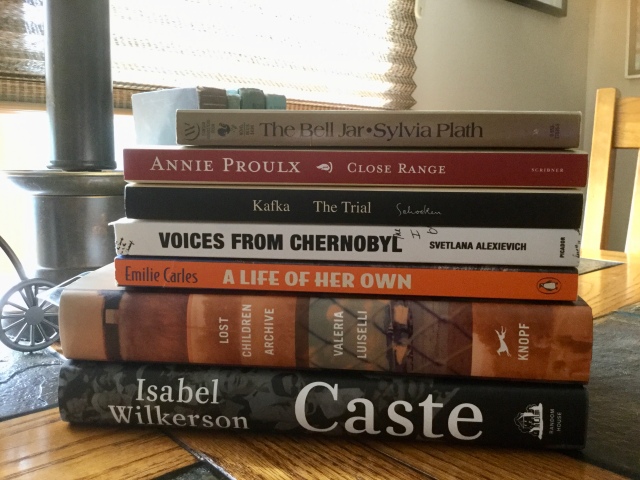
An annotated reading list

27987404-51E0-4E06-97EB-E783C463D15C

Talk about serendipity, synthesis, and synchronicity…
Not long after I finished reading Mary Beard’s slim volume, Women & Power, I visited the MFA, where the Head of Medusa (Arnold Böcklin, 1894) held my gaze.

I’ve finished fourteen books since my last list.

The Truants (Kate Weinberg; 2019. Fiction.) LIB
A quick, entertaining read. I particularly relished the idea of Agatha Christie as a subject of academic inquiry.

Women and Power (Mary Beard; 2017. Non-fiction.) RFS
Mary Beard is a genius. Related link here.

Men Explain Things to Me (Rebecca Solnit; 2017. Non-fiction.) RFS
Related link: “Before there was mansplaining, there was Rebecca Solnit’s 2008 critique of male arrogance. Reprinted here with a new introduction.”

p. 10
Dude, if you’re reading this, you’re a carbuncle on the face of humanity and an obstacle to civilization. Feel the shame.

p. 62
Gay men and lesbians have already opened up the question of what qualities and roles are male and female in ways that can be liberating for straight people. When they marry, the meaning of marriage is likewise opened up. No hierarchical tradition underlies their union. Some people have greeted this with joy.

The Prime of Miss Jean Brodie (Muriel Spark; 1961. Fiction.) RFS
Muriel Spark was a genius, too.

The Lady from the Sea (Henrik Ibsen; 1888. Drama.) RFS
Read in anticipation of seeing the Court Theatre production.

Five Days at Memorial (Sheri Fink; 2013. Non-fiction.) RFS
Related link here.

The Taming of the Shrew (William Shakespeare; 1592. Drama.) RFS
Reread in anticipation of seeing the Royal Shakespeare Company at Chicago Shakespeare.

Zeitoun (Dave Eggers; 2009. Non-fiction.) RFS
This was the perfect companion to Fink’s Five Days at Memorial and Patricia Smith’s Blood Dazzler earlier this year.

As You Like It (William Shakespeare; 1599. Drama.) RFS
Read in anticipation of seeing the Chicago Shakespeare production.

Act III, Scene V
But, mistress, know yourself: down on your knees,
And thank heaven, fasting, for a good man’s love:
For I must tell you friendly in your ear,
Sell when you can: you are not for all markets:
Cry the man mercy; love him; take his offer:
Foul is most foul, being foul to be a scoffer.

American Dirt (Jeanine Cummins; 2020. Fiction.) ATY
From the NYT review by Parul Sehgal:

But does the book’s shallowness paradoxically explain the excitement surrounding it? The tortured sentences aside, “American Dirt” is enviably easy to read. It is determinedly apolitical. The deep roots of these forced migrations are never interrogated; the American reader can read without fear of uncomfortable self-reproach. It asks only for us to accept that “these people are people,” while giving us the saintly to root for and the barbarous to deplore — and then congratulating us for caring.

It certainly was “enviably easy to read.”

p. 50
What a waste of time it had all been. Lydia feels annoyed that her niece won’t get to see the music box she purchased for her special day. How expensive it was! She realizes, even as this thought occurs to her, how bizarre and awful it is, but she can’t stop it from crashing in. She doesn’t rebuke herself for thinking it; she does herself the small kindness of forgiving her malfunctioning logic.

p. 276
He’s a philosopher, she thinks. He’s rough, but he means what he says, and his openness is a provocation. Despite everything, he likes being alive. Lydia doesn’t know whether that’s true for herself. For mothers, the question is immaterial anyway. Her survival is a matter of instinct rather than desire.

Homer’s The Iliad and The Odyssey (Alberto Manguel; 2007. Non-fiction.) RFS
We’ve had our tickets to the Court’s sold-out, site-specific remount of An Iliad since September. It was more than worth the wait and the price.

p. 2
We don’t know anything about Homer. It is otherwise with Homer’s books. In a very real sense, the Iliad and the Odyssey are familiar to us prior to opening the first page. Even before we begin to follow the changing moods of Achilles or admire the wit and courage of Ulysses, we have learned to expect that somewhere in these stories of war in time and travel in space we will be told the experience of every human struggle and every human displacement. Two of our oldest metaphors tell us that all life is a battle and that all life is a journey; whether the Iliad and the Odyssey drew on this knowledge or whether this knowledge was drawn from the Iliad and the Odyssey is, in the final count, unimportant, since a book and its readers are both mirrors that reflect one another endlessly.

p. 88
A book’s influence is never straightforward. Common readers, unrestricted by the rigours of academe, allow their books to dialogue with one another, to exchange meanings and metaphors, to enrich and annotate each other. In the reader’s mind, books become intertwined and intermingled, so that we no longer know whether a certain adventure belongs to Arsilaous or to Aquiles, or where Homer ends Ulysses’ adventures and the author of Sinbad takes them up again.

p. 226
The scene of war, says Homer, is never only that of war: it is never only that of men acting out in the present the events of the day. It is always the scene of the past as well, a display of what men secretly once were, revealed now in their ultimate moments. Confronted with the imminence of violent death, war also confronts them with the memory of days of peace, of the happiness that life can, and should, grant us. War is both things: the experience of an awful presence and the ghost of a beloved past.

The Iliad (Gareth Hinds; 2019. Graphic fiction.) RFS
I did not appreciate this volume as much as Hinds’ graphic retelling of The Odyssey, which I read last year.

Why We Can’t Sleep (Ada Calhoun; 2020. Non-fiction.) LIB
p. 221
Could we even see our newfound midlife invisibility as a source of power? In Harry Potter’s world, one of the most prized magical tools is an invisibility cloak. There are great advantages to being underestimated. Two of the best reporters I know are women in their fifties. They look so friendly and non-threatening, if you notice them at all. They can lurk in any room without usually wary people remembering to keep their guard up. Then they write devastating whistleblowing articles. The world ignores middle-aged women at its peril.

Vinegar Girl (Anne Tyler; 2016. Fiction.) RFS
Read as a companion to my Shrew reread. This was also “enviably easy to read,” and that’s not a criticism.

—————————————
ATY Acquired this year
LIB Borrowed from library
OTH Other
RFS Read from shelves

“We will miss you. Greatly.”

31AC60F0-BBC3-4B95-8F6E-35FBA4255AC9

The close of one of my students’ farewell notes.

By the time I landed a tutoring gig at a nearby elementary school, I no longer needed the distraction I thought a part-time job might provide. I began looking for “a little something to keep me busy” in November 2016 because the two months following my daughters’ departure for university were… okay but difficult. I told myself that a part-time job would be just the thing. Apart from the election judge assignments, though, I didn’t find anything that met my requirements — a predictable schedule, no weekend hours, and work that I would be delighted to discuss with others — until August 2017. By then, I had already determined how to happily, productively, and meaningfully spend retirement sans any boss but myself, but given the effort I had invested in the search, I read the offer as a sign and accepted.

That was two and a half years ago, and I could, as they say, write a book. By last May, though, I was more than done collecting the material. I planned to advise the program director over the summer, but I spent June helping my daughters plan their relocation, and I spent July and August in Massachusetts. Could I have cobbled together twenty minutes to type up a resignation letter and fifteen to make a phone call? Yeah, but for some reason I didn’t, and two days after I returned to Illinois, I returned to work.

Then, one Friday in September, as I was hurrying to finish some yard work before getting ready to head to school, I injured my knee in a fall that resulted in nearly two weeks off. Three years earlier, not long after my daughters headed to university, I experienced a similarly incapacitating injury to the same knee. It took about six months to heal then, which means I have not yet lost hope over the pain and periodic instability I continue to experience from the more recent injury. Besides, the orthopedist assures me all will be well. Eventually. Still, if the job offer was a sign, it was hard not to read my fall as one, too.

I prepared a letter of resignation to submit in mid-October with the intent of providing up to two months’ notice if they needed that much time to find my replacement. But this happened. And then that. And I didn’t want to add to the director’s list of concerns, so I stayed.

And I stayed.

And I stayed.

Until I realized that I could not stay any longer. Because this and then that had happened in the fall, a substitute had joined the program, and she was interested in a permanent position. Leaving would be… difficult but okay.

So I left.

Before I did, though, I said goodbye. Sure, they will likely forget about me by next Thursday. But last week, they wanted me to know that they would miss me.

Greatly.

Well.

Right back at you.

Currently reading

AF09B3D1-8B2E-4234-888B-E207299136CBOn this gray, cold morning, all I really want to do is sip coffee, watch the birds in my yard (right now, three beautiful crows, my bird of the year), and read. Alas, I am covering the vacation of the gal who took over my tutoring gig, so I must rouse myself, don something more appropriate than these comfortable flannel pants and my favorite old sweater, and prepare the sort of nutritious lunch that will keep me going until 6 p.m. Sigh.

Or, The Whale

0670BA96-7902-46F6-BC58-296F127C1433On Monday, in addition to Robert Salmon’s South Sea Whale Fishing II (1831), the Barry Moser-illustrated Moby Dick put me in a “Hast seen?” mood.

0ADBC582-F26E-4B14-BE81-28FCD6BBA4D6On Wednesday, I watched the activity in the penguin exhibit on the main level of the New England Aquarium through the skeleton of a North American right whale.

Museum of Fine Arts

DEE96846-902E-4245-8849-C3611B299A15
09DD52A1-AB81-4CC2-8FE5-C3BC95284709
66B93AB8-D67A-4C7C-9F42-6CC7A088590F
5C927527-7CDA-4383-B43F-C737E00A70C7
AFAF0C77-1244-4456-A76C-8C00B4E8289A
51A7E010-2846-4152-9634-AD181FB273B0A few more photos captured on my recent trip to the Museum of Fine Arts, Boston.

Morning Sunlight on the Snow, Éragny-sur-Epte; Camille Pissarro, 1895
Seacoast at Trouville; Claude Monet, 1881
Seascape II; Hyman Bloom, 1974
Endlessly Repeating Twentieth Century Modernism; Josiah McElheny, 2007
■ Olmec mask; 900–600 BC
South Sea Whale Fishing II; Robert Salmon, 1831

Matters of Life and Death

FEB7973D-5774-4947-B229-B47B2D518963
961FABF8-9246-492C-B8CC-5BAB09882A0D
7CA4E07F-0279-49A4-A7E6-B8C059886691
642516BE-C23C-4BCB-897D-384BE8B973AC
1E5274AE-9DC7-41E7-A40F-31B71CCDADEA The above are some of the images I captured today at Hyman Bloom: Matters of Life and Death, an exhibit I first saw last summer.

Boxer in His Corner, 1930
Old Woman Climbing, undated
■ Detail from The Bride, 1943-45
■ Detail from The Bride, 1941
■ Detail from Rocks and Autumn Leaves, 1949-51

An annotated reading list

BEBAC6F2-0CFC-499C-9EEF-C9AC33C715B4Once upon a time ago, I would cobble together a monthly (or so) review of books I’d been reading with notes, quotes, and / or links. I thought I’d do that today to get back into the posting groove. So far, I’ve read twenty-three books this year, fifteen of which are from my shelves and eleven of which are non-fiction titles. I’m off to a promising start, eh?

Highlights of the Collections of the Oriental Institute (Jean M. Evans; 2017. Non-fiction.) RFS
We revisited the Oriental Institute in December in anticipation of seeing An Iliad there next month.

The Mousetrap (Agatha Christie; 1952. Drama.) RFS
Read in advance of seeing the Court Theatre production.

Trust Exercise (Susan Choi; 2019. Fiction.) RFS
Interesting review here.

Rutherford and Sons (Githa Sowerby; 1912. Drama.) RFS
Read before seeing the TimeLine Theatre production.

Richard III (William Shakespeare; 1592. Drama.) RFS
Reread before seeing the Shakespeare Project of Chicago production.

In the Heart of the Sea (Nathan Philbrick; 2000. Non-fiction.) RFS
In a weird twist, I watched the movie before reading this terrific book. My interest was, of course, fueled by my Moby-Dick reread late last year.

Dear America (Jose Antonio Vargas; 2018. Non-fiction.) RFS
Related link here.

A Long Way Gone (Ishmael Beah; 2007. Non-fiction.) RFS
Arrived at this book a bit later than most. Here’s a related link.

Frogcatchers (Jeff Lemire; 2018. Graphic fiction.) LIB
Another of Lemire’s meditations on death, regret, and letting go.

On Tyranny (Timothy Snyder; 2017. Non-fiction.) RFS
Again, arrived at this later than most. I began marking passages for the commonplace book and soon realized I’d copy the entire text. Review here.

Tomten Tales (Astrid Lindgren; 2017 ed. (1960 and 1966). Juvenile fiction.) LIB
Small gnome ornaments topped the holiday gift bags I distributed this year. In a lovely note, my music teacher thanked me for, among other things, “the adorable tomten.” In pursuit of a definition, I stumbled on this delightful children’s book.

An Astronaut’s Guide to Life on Earth (Chris Hadfield; 2013. Non-fiction.) RFS
My younger daughter (insistently) recommended this.

p. 267
If you start thinking that only your biggest and shiniest moments count, you’re setting yourself up to feel like a failure most of the time. Personally, I’d rather feel good most of the time, so to me everything counts: the small moments, the medium ones, the successes that make the papers and also the ones that no one knows about but me. The challenge is avoiding being derailed by the big, shiny moments that turn other people’s heads. You have to figure out for yourself how to enjoy and celebrate them, and then move on.

Between the World and Me (Ta-Nehisi Coates; 2015. Non-fiction.) RFS
p. 51
Poetry aims for an economy of truth — loose and useless words must be discarded, and I found that these loose and useless words were not separate from loose and useless thoughts. Poetry was not simply the transcription of notions — beautiful writing rarely is. I wanted to learn to write, which was ultimately, still, as my mother had taught me, a confrontation with my own innocence, my own rationalizations. Poetry was the processing of my thoughts until the slag of justification fell away and I was left with the cold steel truths of life.

Keep It Moving (Twyla Tharp; 2019. Non-fiction.) LIB
Meh.

The Passengers (John Marrs; 2019. Fiction.) ATY
Flawed and a bit predictable but an altogether entertaining way to pass a Sunday evening.

Digital Minimalism (Cal Newport; 2019. Non-fiction.) RFS
This book is partially responsible for the gap in entries here.

We Should All Be Feminists (Chimamanda Ngozi Adichie; 2014. Non-fiction.) LIB
p. 18
Today, we live in a vastly different world. The person more qualified to lead is not the physically stronger person. It is the more intelligent, the more knowledgeable, the more creative, more innovative. And there are no hormones for those attributes. A man is as likely as a woman to be intelligent, innovative, creative. We have evolved. But our ideas of gender have not evolved very much.

Daughter of Time (Josephine Tey; 1951. Fiction.) RFS
I reread this after rereading Richard III.

p. 33
It was shocking how little history remained with one after a good education.

p. 196
“No, that doesn’t matter at all. Most people’s first books are their best anyway; it’s the one they wanted most to write….”

Blood Dazzler (Patricia Smith; 2009. Poetry.) LIB
Excerpts here.

Invisible Women: Data Bias in a World Designed for Men (Carolyn Criado Perez; 2019. Non-fiction.) RFS
Wow. Wow. Wow. This will certainly top my list of memorable reads this year. Related link here.

The Whisper Man (Alex North; 2019. Fiction.) ATY
Another meh.

The Warehouse (Rob Hart; 2019. Fiction.) LIB
Although I’m weary of the narrative device of alternating voices, it worked in this near-future dystopian novel.

Emma (Jane Austen; 1815. Fiction.) RFS
Austen’s prose sparkles; her wit pierces. But I wonder if I am too old to appreciate Emma. I reread the novel before seeing the new Chicago Shakespeare musical.

—————————————
ATY Acquired this year
LIB Borrowed from library
RFS Read from shelves


Flute adventures

A717A32E-A118-44E5-879C-3F7F5F49BD8F

It’s impossible to explain the brain tic that made the Rimsky-Korsokov completely readable, while my repeated errors in 34 finally reduced me to writing it out during a particularly grueling practice session. (Yes, I probably should have erased it once I had “mastered” the passage, but that is, after all, how this sausage finally got made.)

With ornament exercises 34 and 35 (which, coupled with 33 in December, kicked my amateur musician’s capacious ass), I completed the Rubank Advanced Method: Flute, Volume II, at last night’s lesson. That’s kind of a big deal. Even my no-nonsense teacher took a moment to appreciate the accomplishment.

In addition to scale and tone exercises and P. Bona’s rhythmical articulation studies, I am now working in Robert Cavally’s Melodious and Progressive Studies from Andersen, Gariboldi, Koehler, and Terschak for Flute, Book 1. And in addition to my solo piece (currently Handel’s Flute sonata in G major (HWV 363b)), I prepare my part of a new (reasonably short) duet each week.

My current daily practice schedule:

— 20 minutes: long tones and scales
— 20 minutes: Melodious and Progressive Studies
— 20 minutes: duet
— 15 minutes: rhythmical articulation
— 15 minutes: solo

Later this month, band rehearsals begin: twice weekly plus sectionals. At that point, I think I’m looking at another increase in practice time:

— 20 minutes: long tones and scales
— 20 minutes: Melodious and Progressive Studies
— 20 minutes: duet
— 15 minutes: rhythmical articulation
— 20 minutes: solo
— 20 minutes: band music or other

I’ve already met with musicians in my section and reviewed the selections from last semester. The music is fun but not too challenging — perfect for someone who wants to (re)learn how to play well with others before tackling the challenges of say, the first and second flute part of “Variations on a Korean Folk Song” or Shostakovich’s “Festive Overture.” * Preparation for duets with my husband, who has recently taken up the clarinet, and some exploration (e.g., sight reading exercises and revisiting the pieces in my repertoire, such as it is) will comprise “other.”

———————————————————————

* Which is what I was assigned when I joined the community band of the local college two years ago this month. The group is lovely, and the flute players I sat between were not only solid musicians but kind, patient teachers. Still… The music would represent a challenge to me now. Then? It was almost impossible. “Play what you can,” everyone says, but I felt as if I had missed a key step in my development as a musician. In high school, you usually do some learning and growing in concert band before you earn a spot in wind ensemble, you know? So I have joined the adult equivalent of concert band.