
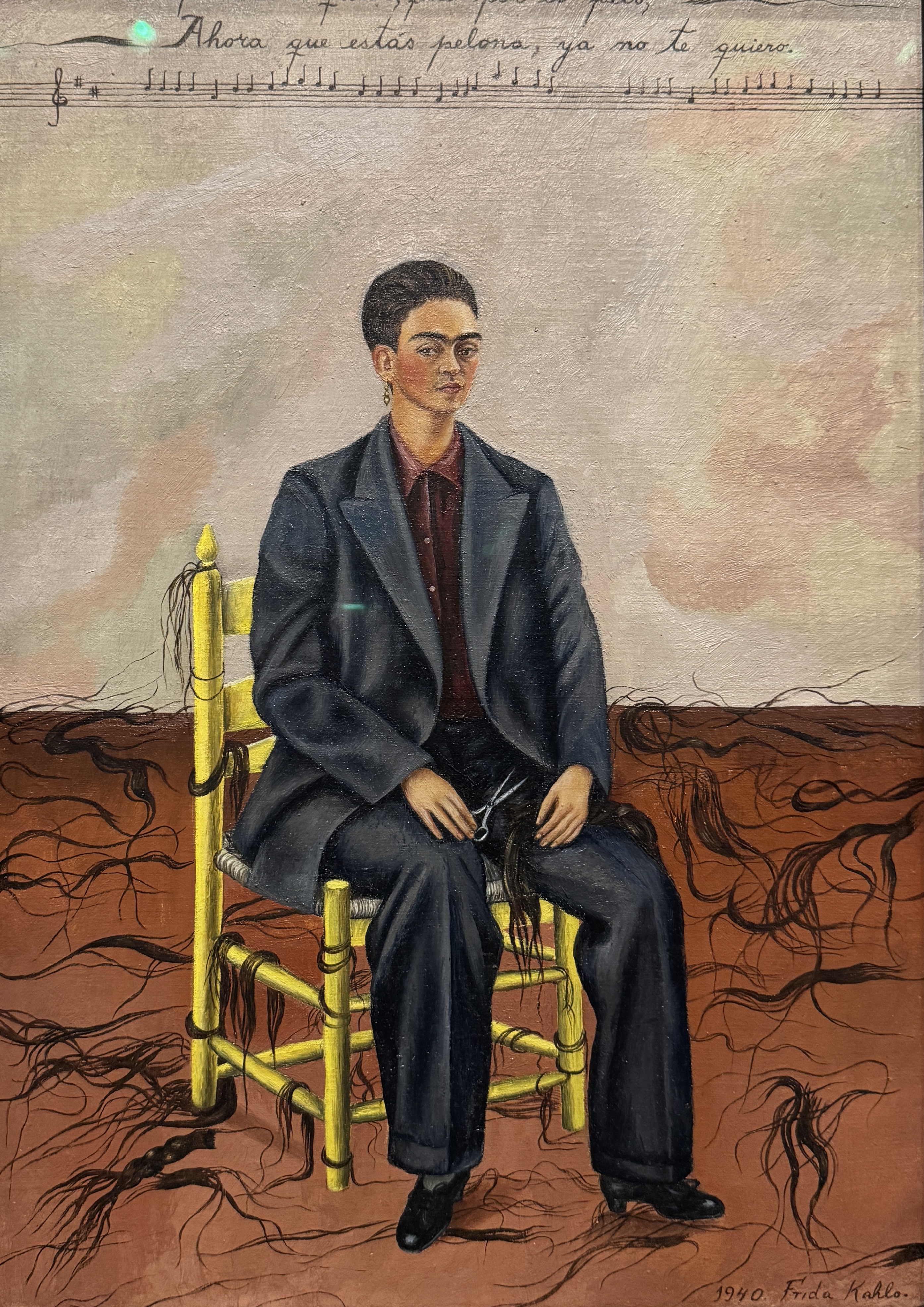


Yesterday we visited the Art Institute for “Frida Kahlo’s Month in Paris: A Friendship with Mary Reynolds” (where I captured the images above) and the Driehaus for “Materialities.” In the evening, we saw Henry Johnson at Victory Gardens Theater.
Yesterday we visited the Art Institute for “Frida Kahlo’s Month in Paris: A Friendship with Mary Reynolds” (where I captured the images above) and the Driehaus for “Materialities.” In the evening, we saw Henry Johnson at Victory Gardens Theater.

I’m particularly looking forward to Daniel Mendelsohn’s translation of The Odyssey. Related article here.

Shelved for now.

… with a sort of heady excitement: ‘There are only the pursued, the pursuing, the busy and the tired.’”
One of my favorite books has reached its centennial: “100 years later, ‘The Great Gatsby’ still speaks to the troubled dream of America.”

My photo of Desert Forms (Hughie Lee-Smith; 1957).
In March, during a visit to the Art Institute, I saw this painting in a way I think of as “again for the first time.” The plaque indicates that the artist “often situated enigmatic people in bleak landscapes,” a reflection of Lee-Smith’s experience as an African American. Earlier that month, I had reread “The Love Song of J. Alfred Prufrock” (T.S. Eliot; 1915), and the painting evoked in me the same sense of depthless anxiety and loss the poem did:
Do I dare
Disturb the universe?
In a minute there is time
For decisions and revisions which a minute will reverse.
For I have known them all already, known them all….


A few more of my images of “Art in Bloom” at the Milwaukee Art Museum.

Visited the Milwaukee Art Museum for Art in Bloom.

Portrait Bust of a Woman; Mid-2nd century, Roman.
My photo, taken at the Art Institute of Chicago.
Women beyond a certain age are largely unseen, I know, but beneath that cloak of invisibility, I have been self-conscious about my appearance for several months. My husband and daughters have assured and reassured me that all is well, but I didn’t begin to believe it until yesterday, when the surgeon smilingly beheld her work and declared that I am healing much more quickly (and much less traumatically) than most can expect; more, I will look as if much of this had never happened — and soon.
Since late August, it has sometimes felt as if my calendar comprised only medical appointments followed by return visits coupled with lab work accompanied by consultations, as if my days demanded many, too many, health-related accommodations. This is a drama-filled and -fueled interpretation of what were largely commonplace issues associated with aging, and when I couldn’t talk (or shame) myself out of feeling sorry for me, I walked. It helped (even when it hurt — hence, the orthopedist, the orthotics) — as did reading, finding the Jerry Orbach seasons of Law & Order on Hulu, looking at art, and listening to music, including pop treasures like this.
Today through rain-streaked windows, I can see wet-feathered birds visiting our feeders while I, dry and warm in my favorite chair, read from a stack that includes Shakespeare’s Henry V and The Tempest and Cormac McCarthy’s Blood Meridian. And according to the forecast, I should be able to walk for a bit before class tonight. I’ll wear my cloak of invisibility with confidence.

Today I’m reading Canto 20 of Dante’s Paradiso, some poetry, and Frindle (Andrew Clements; 1996), a favorite from when my children were young.
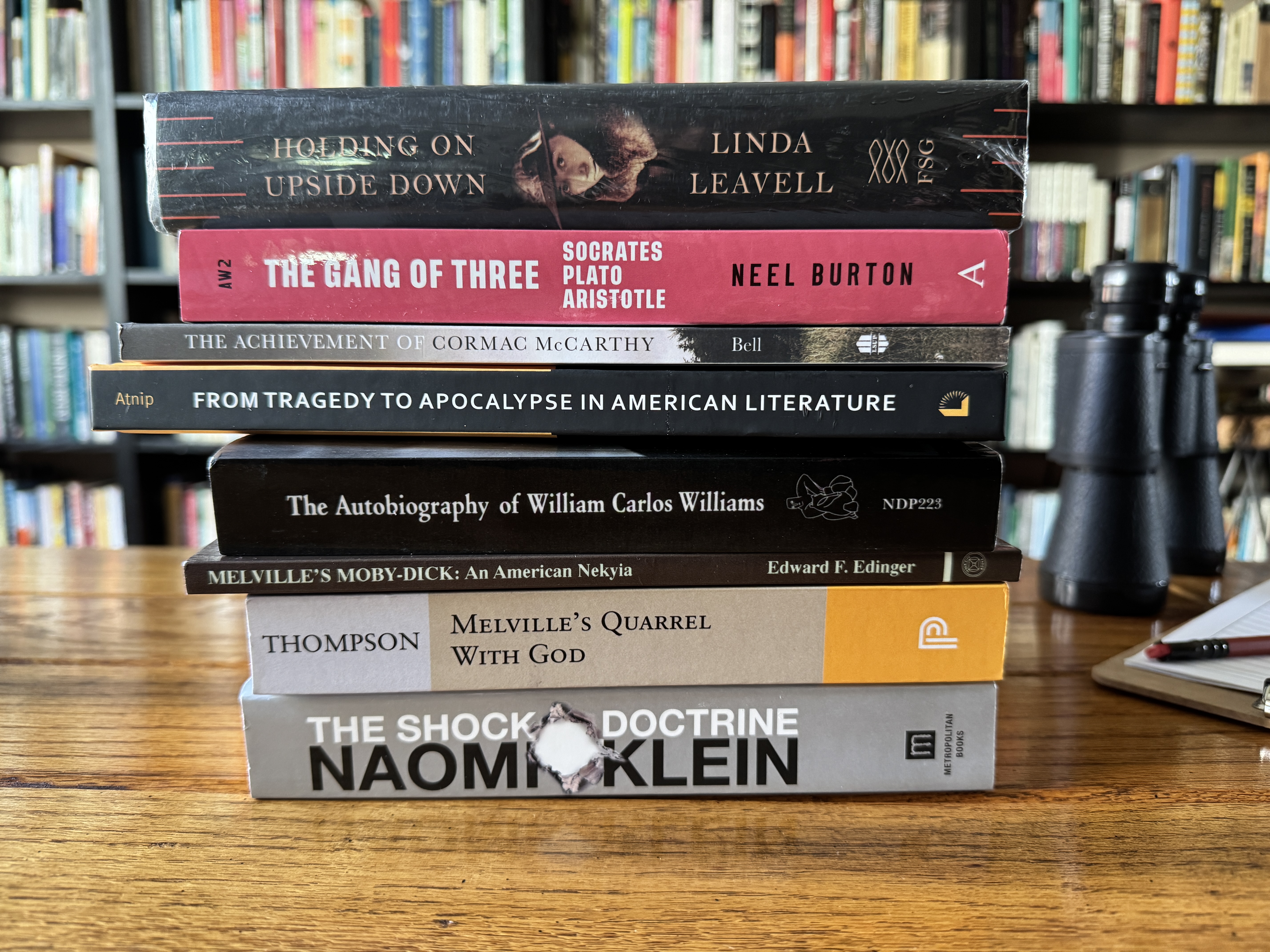
Shelved for now.
 Nerdishly