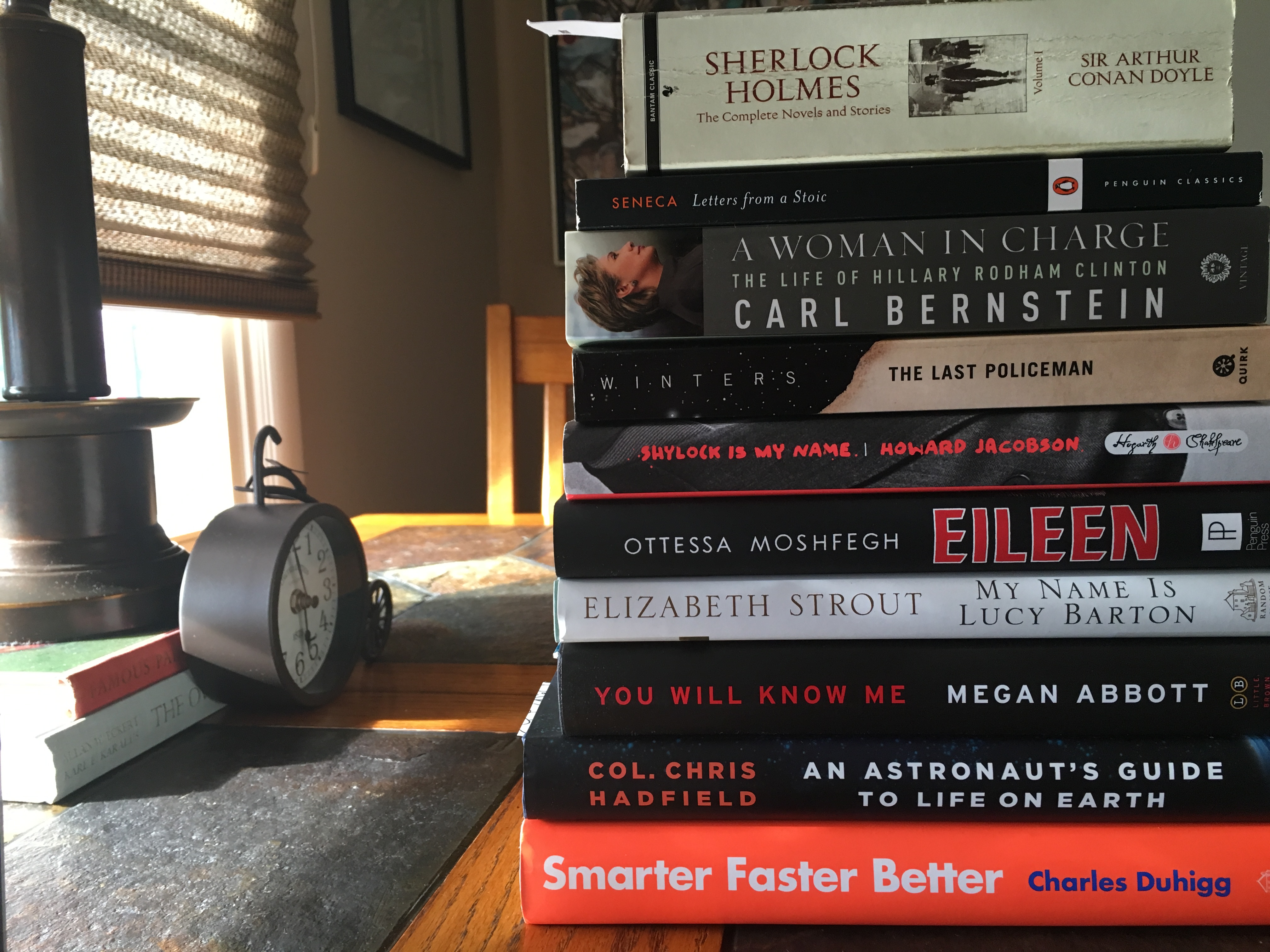
 Well, we’ve arrived at the month’s midpoint. My reading plans (described in this post) included:
■ A Study in Scarlet (Sir Arthur Conan Doyle; 1887. Fiction.)
■ Letters from a Stoic (Seneca; 1494.)
■ A Woman in Charge: The Life of Hillary Clinton (Carl Bernstein; 2007. Non-fiction.)
■ The Last Policeman (Ben Winters; 2012. Fiction.)
■ Shylock Is My Name (Howard Jacobson; 2016. Fiction.)
■ Eileen (Ottessa Moshfegh; 2015. Fiction.)
■ My Name Is Lucy Barton (Elizabeth Strout; 2016. Fiction.)
■ You Will Know Me (Megan Abbott; 2016. Fiction.)
■ An Astronaut’s Guide to Life on Earth (Col. Chris Hadfield; 2013. Non-fiction.)
■ Smarter Faster Better (Charles Duhigg; 2016. Non-fiction.)
From the above list, I have already completed:
■ You Will Know Me (Megan Abbott; 2016. Fiction.)
■ My Name Is Lucy Barton (Elizabeth Strout; 2016. Fiction.)
■ A Study in Scarlet (Sir Arthur Conan Doyle; 1887. Fiction.)
Although I have not been following the Games, I couldn’t help but wonder, after reading Abbott’s novel, if I now understand the grim-faced masks women gymnasts don. As for questions about whether Strout’s novel deserves its place on the Man Booker Prize long list, I’d say yes. From My Name Is Lucy Barton:
p. 14
This must be the way most of us maneuver through the world, half knowing, half not, visited by memories that can’t possibly be true. But when I see others walking with confidence down the sidewalk, as though they are free completely from terror, I realize I don’t know how others are. So much of life seems speculation.
p. 170
When Chrissie left for college, then Becka the next year, I thought — and it’s not an expression, I’m saying the truth — I did think I would die. Nothing had prepared me for such a thing. And I have found this to be true: Certain women feel like this, that their hearts have been ripped from their chests, and other women find it very freeing to have their children gone. The doctor who makes me not look like my mother, she asked me what I did when my daughters went to college, and I said, “My marriage ended.” I added quickly, “But yours won’t.” She said, “It might. It might.”
I finished A Study in Scarlet well in advance of the online book club / MOOC outline because much of the rest of the month is already spoken for.
From A Study in Scarlet, Part I, Chapter V:
“It was magnificent,” he said, as he took his seat. “Do you remember what Darwin says about music? He claims that the power of producing and appreciating it existed among the human race long before the power of speech was arrived at. Perhaps that is why we are so subtly influenced by it. There are vague memories in our souls of those misty centuries when the world was in its childhood.”
From Part I, Chapter VII:
“All this seems strange to you,” continued Holmes, “because you failed at the beginning of the inquiry to grasp the importance of the single real clue which was presented to you. I had the good fortune to seize upon that, and everything which has occurred since then has served to confirm my original supposition, and, indeed, was the logical sequence of it. Hence things which have perplexed you and made the case more obscure, have served to enlighten me and to strengthen my conclusions. It is a mistake to confound strangeness with mystery. The most commonplace crime is often the most mysterious because it presents no new or special features from which deductions may be drawn. This murder would have been infinitely more difficult to unravel had the body of the victim been simply found lying in the roadway without any of those outré and sensational accompaniments which have rendered it remarkable. These strange details, far from making the case more difficult, have really had the effect of making it less so.”
From Part II, Chapter VII:
“I hardly expected that you would. Let me see if I can make it clearer. Most people, if you describe a train of events to them, will tell you what the result would be. They can put those events together in their minds, and argue from them that something will come to pass. There are few people, however, who, if you told them a result, would be able to evolve from their own inner consciousness what the steps were which led up to that result. This power is what I mean when I talk of reasoning backwards, or analytically.”
I think I will finish Eileen later today, after which I plan to carry on with Shylock Is My Name. Related aside: We saw the Shakespeare’s Globe production of Merchant at the Chicago Shakespeare Theater over the weekend. Haunting. Reviews here and here. And because I so thoroughly disagreed with Steven Franks, I appreciated this bit from Chris Jones’ review:
And yet, just last week, my own newspaper published an editorial, penned by a Washington attorney, arguing, in essence, that “The Merchant of Venice” should never be performed again, on the grounds that it is incurably anti-Semitic.
That’s ridiculous, of course, not least because it is only in performance that the play proves its worth. In the hands of a competent director like Jonathan Munby, “The Merchant of Venice” can and does play as a cautionary tale of the perils of anti-Semitism. His work here in concert with the designer Mike Britton is the best I’ve seen from this oft-in-Chicago director. Only in performance can this be a work about how hate can poison an otherwise prosperous and privileged community, extracting a price on victims and perpetrators alike, destroying all that is good, really. This particular production, which features an especially devastating coda, is especially rich in the painting of that picture.
The other books I have finished this month are
■ You’re Never Weird on the Internet (Almost) (Felicia Day; 2015. Non-fiction.)
■ Injection, Volume 2 (Warren Ellis; 2016. Graphic fiction.)

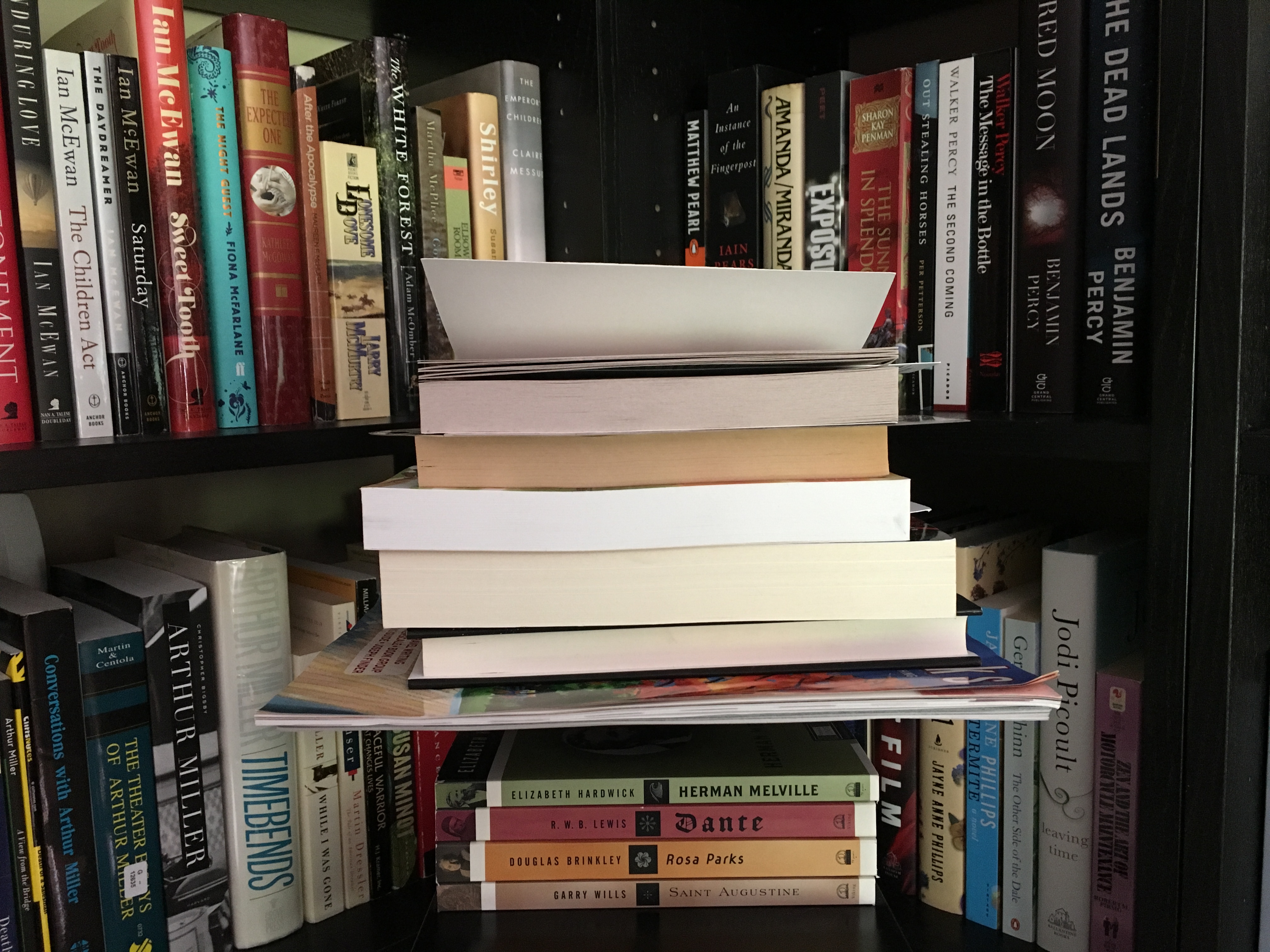 Despite my best intentions, I have only finished four of the ten books I assembled for this post):

 Earlier this week, my daughters helped me with yet another large book reorganization project. For the last 5.5 years, the shelves in the master bedroom (three pine bookcases my husband finished for me — complete with our heart-enclosed initials on the back — in 1983, 1985, and 1986) housed my Joyce Carol Oates and Kurt Vonnegut collections, as well as the remnants of my Arthurian literature obsession and my stash of mass paperbacks. The remaining shelves held new acquisitions, which, after being read, would be sold, donated, or blended into the main library.