

In the spring and summer months, we hang the hummingbird feeder from this hook outside the living room window.
In the spring and summer months, we hang the hummingbird feeder from this hook outside the living room window.

Last weekend, we traveled to Michigan to visit our daughters. We also added one more bookcase to the annex, resulting in what my older daughter has dubbed, a “book-sort-cation” — that is, shifting, dusting, and reorganizing the library to make the best use of the space. So, yes, I did fall a wee bit behind on my reading schedule, but I am now completely caught up. (The courses and groups are listed in the sidebar.)
The recommended text for “Reading the Odyssey” (which begins this week) is the Emily Wilson translation. Others have already praised it (here, here, here), but allow me to add my voice to the chorus: What a lucid and riveting rendition.

A new semester. New music. A few new members.

Because I am also studying Moby-Dick this semester, I appreciated Harold Bloom’s assertion (see introduction to the Edith Grossman translation) that “Melville blended Don Quixote and Hamlet in Captain Ahab (with a touch of Milton’s Satan added for seasoning).” Returning to a book again and again (and again), as I have Moby-Dick, creates a familiar, well-creased mental map. With this, a reader can travel along the accustomed channels or more easily attempt new routes (meanings, metaphors, implications, associations, links to other works, etc.). On my current voyage through Moby-Dick, for example, I have been navigating ideas about how Melville (perhaps as Ishmael, perhaps as the story’s creator) shapes the narrative and what, precisely, we readers are meant to understand as truth in that narrative. Oh, how I wish I had something even approaching that level of familiarity with Don Quixote because Cervantes is also clearly experimenting (perhaps we can even say, playing?) with narrative structure and truth, but I have only the barest outline of a mental map by which to chart my course through this vast novel.
In last week’s tutorial meeting, we discussed Cervantes’ (playful? deceptive? ironic?) intent in the prologue and dedication and touched on the idea of the novel as a “found” history. In Chapters XI through XXI of Part I, readers encounter a number of other approaches to storytelling, including Quixote’s “long harangue” to the goatherds; Antonio’s ballad; Pedro’s account of Grisóstomo and Marcela; the verses of the deceased shepherd; Sancho Panza’s deceptive explanation of his and Don Quixote’s injuries; a reference to the history of the deeds of Don Quixote penned by “the wise man whose task it will be to write” it; Sancho’s “best of all stories” (which, “[a]s finished as his mother,” ends abruptly); the confessions of the prisoners; and the pawned autobiography of Ginés (a narrative of “truths so appealing and entertaining that no lies can equal them”). This variety surely represents more than simple diversion; what is its meaning and purpose?
I wonder, too, if, as with Melville’s sprawling novel (which also employs a variety of narrative forms, from sermon to soliloquy to taxonomy to stage play to sailor’s yarn and more), the varied structure is related to an underlying assertion about the role of truth in storytelling; or do I have that inverted? Is it, rather, an indication that storytelling undergirds truth? In the Grossman translation, I am struck by the repetition of the words “truth” (at least twenty-one in this week’s reading) and “true” (at least nineteen). In fact, Bloom’s introduction opens with the query, “What is the true object of Don Quixote’s quest?” I might parry, What is Don Quixote’s truth? Alternately, What do “true” and “truth” mean to the Knight of the Sorrowful Face? (I have, as I reread Moby-Dick, similarly asked, What is Ahab’s truth? How does it differ from Ishmael’s, the crew’s, and the author’s?) When I concluded this week’s Don Quixote chapters, I affixed two questions like pins to my as-yet faint mental map: Why do the novel’s assorted storytellers insist on the veracity of each narrative? More philosophically, why, when we storytelling animals narrate, do we claim to have proffered the truth?
Four passages particularly speak to the ideas above:
“Since everything I’ve told you is the absolute truth, I take it for granted that what our lad said about what people were saying about the reason for Grisóstomo’s death is also true.” (p. 85)
“I didn’t know her,” responded Sancho. “But the man who told me this story said it was so true and correct that I certainly could, when I told it to somebody else, affirm and swear I had seen it all….” (p. 145)
“… [W]asn’t it laughable how frightened we were, and wouldn’t it make a good story? At least, how frightened I was, for I already know that your grace doesn’t know what fright is or understand the meaning of fear or terror.”
“I do not deny,” responded Don Quixote, “that what happened to us is deserving of laughter, but it does not deserve to be told, for not all persons are wise enough to put things in their proper place.” (p. 151)
“It’s so good,” responded Ginés, “that it’s too bad for Lazarillo de Tormes and all the other books of that genre that have been or will be written. What I can tell your grace is that it deals with truths, and they are truths so appealing and entertaining that no lies can equal them.” (p. 169)

How I have been spending my time: Walking. Music practice. Latin tutorial homework. Supplementary reading for the courses on Moby-Dick and Don Quixote.

You’re never too old.
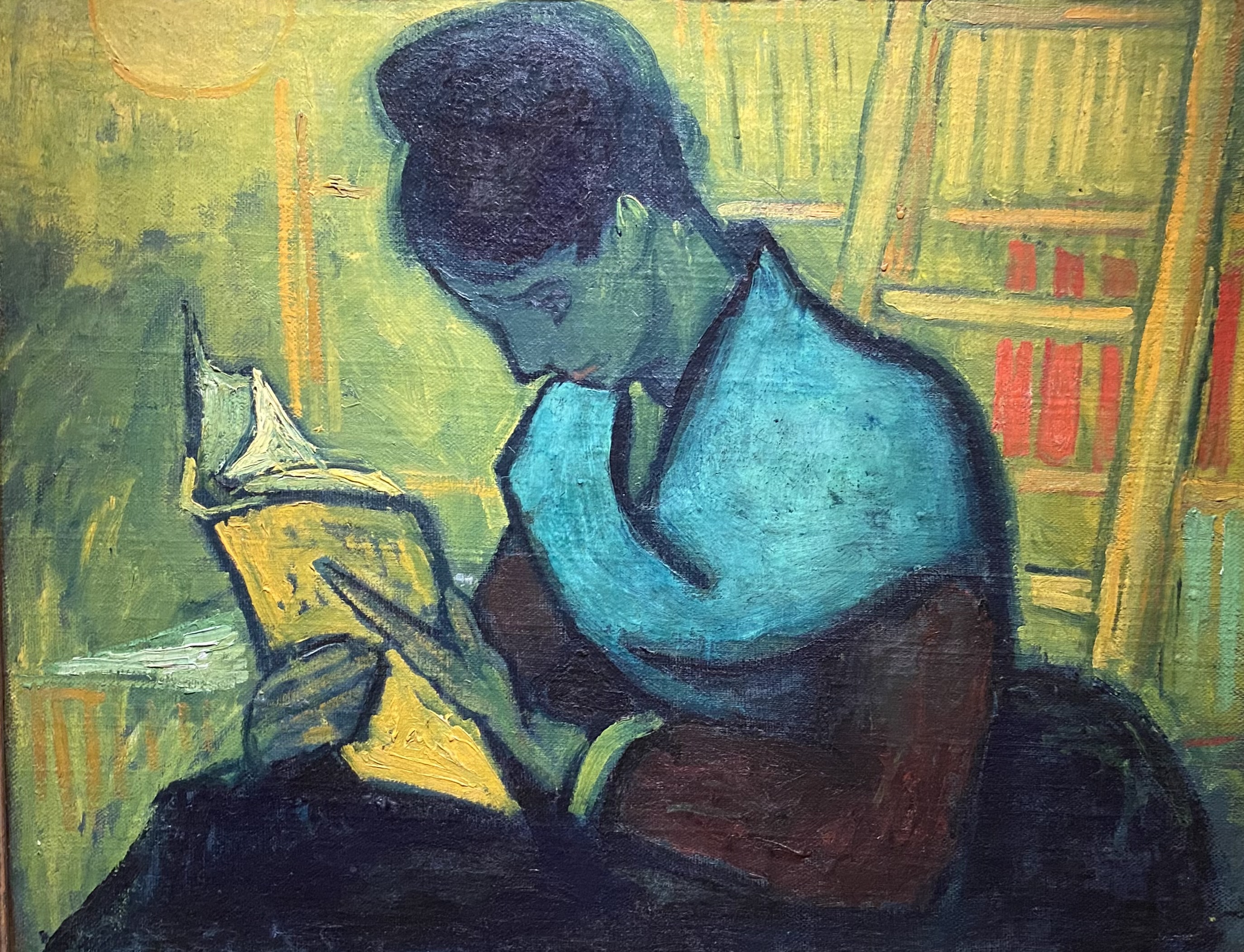
My husband’s image of detail from Vincent Van Gogh’s “The Novel Reader” (1888).
Over the winter break, my husband and daughters visited the wonderful Detroit Institute of Arts for the “Van Gogh in America” exhibition. Naturally, this morning’s news attracted our attention: “Van Gogh painting on display at Detroit Institute of Art is stolen, lawsuit claims” (The Guardian, January 13).

Weather and our schedules require that, this week and next, we take our long walk in the mid-morning. Sun on our faces — wan, incomplete, fast-fading but sun — was the one of the gifts of our last three outings.
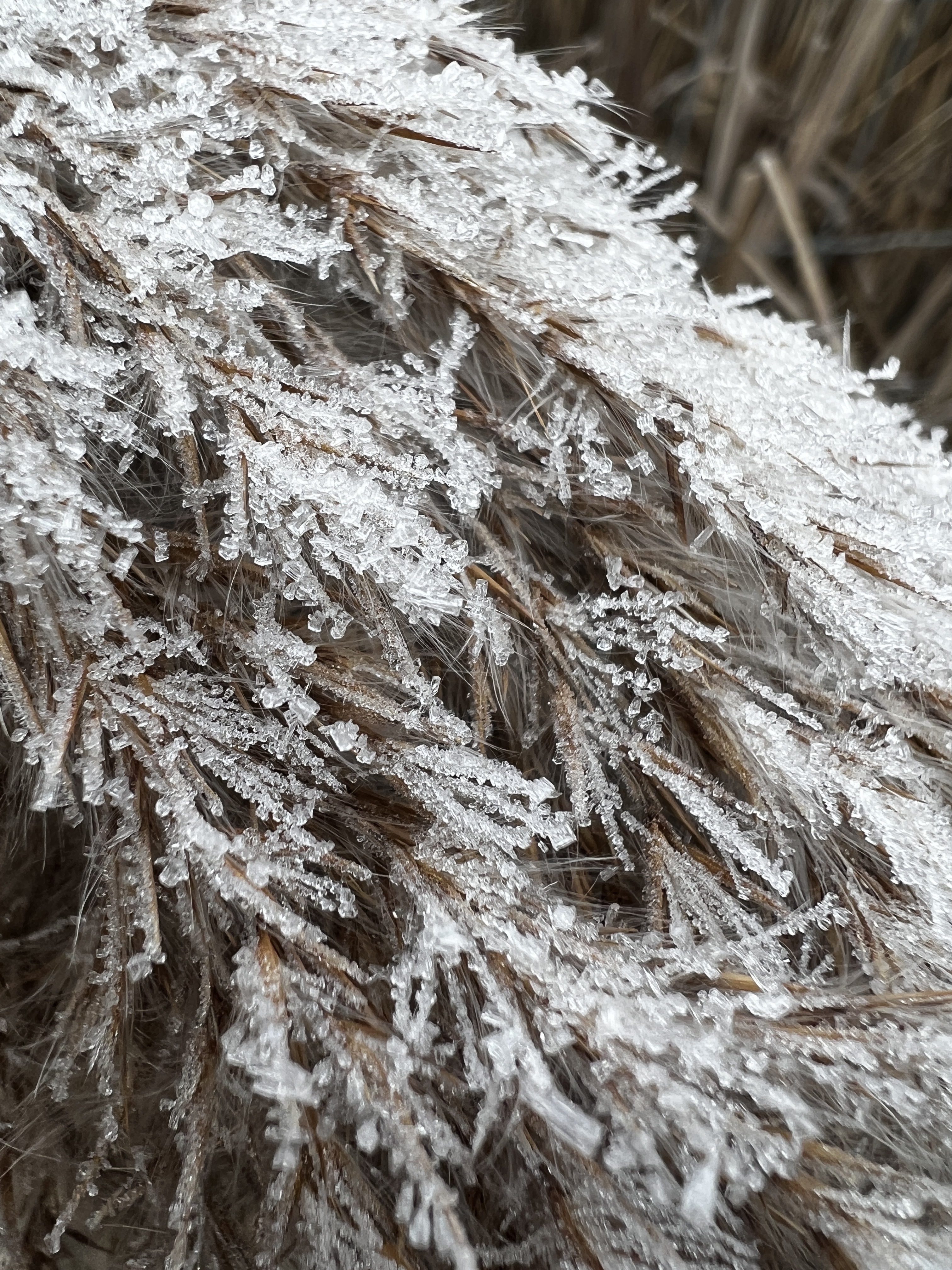
It’s beautifully, wonderfully, perfectly sunny today, but this photo from our last walk of 2022, taken under the dome of heavy, gray sky that is winter in Illinois, captured my attention. I hadn’t realized when I took it that you can make out the ice crystals.

A long walk. Music. Latin. Reading.
 Nerdishly