Homeric

The above is my image of the fragment of Homer’s Iliad (Book 5, lines 824-841), papyrus manuscript, c. 150 – 199 CE, currently on display at the University of Chicago. From “But Is It a Book?:

This papyrus fragment bears 17 lines from Book 5 of Homer’s Iliad. Although epic poems from antiquity are typically divided up into books, the word would not have been understood in the way it is used today. The term comes from the papyrus “bookroll,” which was formed by affixing approximately 20 standard sheets of papyrus together that could be rolled up into a compact unit and hold roughly 700 lines of poetry – close to the typical book divisions of ancient epics.

Four weeks and thirty-five chapters in

In last week’s reading (Chapter XXVI), the barber and the priest “were astonished again as they considered how powerful the madness of Don Quixote was, for it had pulled along after it the good sense of this poor man” – that is, Sancho Panza. In this week’s reading (Chapter XXX), however, it is from Sancho Panza and not from those who “mocked and deceived” Don Quixote that the “quick-witted and very spirited” Dorotea takes her cues. Faced with an incensed knight, she flatters and placates him and reminds him of the boon he has promised her. She then narrates a clever tale featuring an imperiled kingdom, ghastly giants, and an orphaned princess. In short, she enters Don Quixote’s world and does so seemingly without patronizing him. Later, she privately acknowledges to the priest that she, too, “had often spent time reading” the books of chivalry that have reframed Don Quixote’s reality (p. 257), yet she clearly has not succumbed to their spell since she can so readily recognize that the innkeeper (Chapter XXXII) “doesn’t have far to go to be a second Don Quixote.” (p. 270) My initial – and overly simple – observation concerned the ways in which one may engage with, perhaps even indulge others: Sancho Panza and Dorotea do so in a positive manner; the priest and the barber, less so. A more significant idea that occurred to me this week is that even if they dismiss Don Quixote as mad, members of the ever-expanding cast of characters inevitably engage with him where and how he is. 

As I have shared, I am fascinated by the uses and definitions of “true” and “truth” in this work. While I am not setting that line of inquiry aside, I must, in the wake of Chapters XXXIII, XXXIV, and XXXV, wonder if Cervantes is pointing readers to compelling questions about life and literature. After all, there must be a reason our titular character’s adventures occur between and among so many other stories – including a short book read aloud by, of all characters, the priest. (Yes, while Don Quixote sleeps, the priest reads aloud The Man Who Was Recklessly Curious, and when he finishes, he asserts that while the novel “seems fine,” he “cannot persuade himself that it is true….” (p. 312) He cannot “persuade himself that it is true”? It is a novel! What does he mean? Ah, me and notions of truth; moth and flame.)

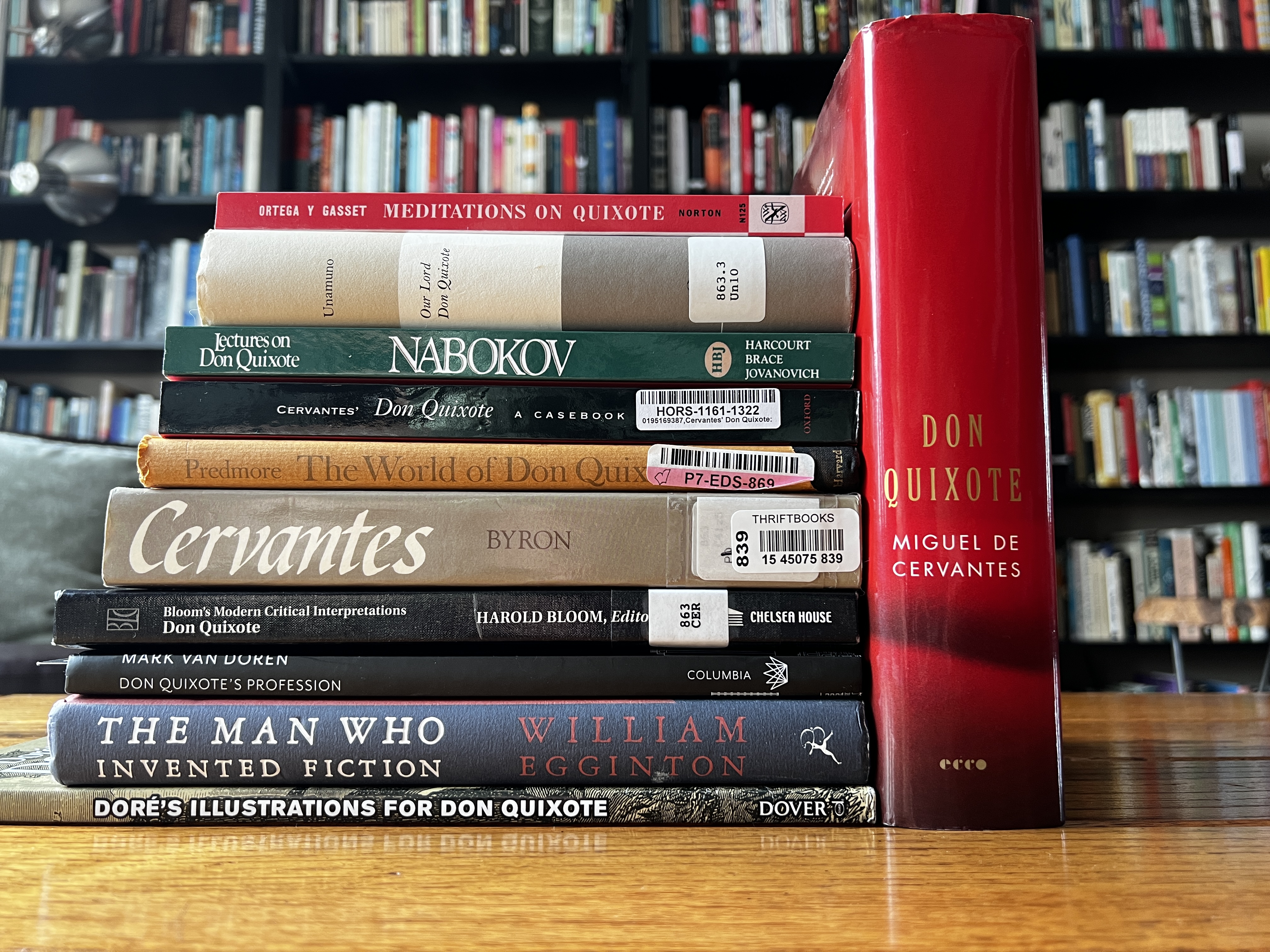
Last week, I posited that the manner in which Cardenio’s story sidelines Don Quixote’s may be a juxtaposition of two types of “madness” – the (apparently) unceasing and the (likely) temporary. (I suspect that once his narrative is resolved, Cardenio will have renounced his wandering and fits and be restored to his “true” life.) When the adventures of the Knight of the Sorrowful Face are again upstaged, this time by the novella, I was compelled to review the previous iterations of story that have occurred. The Grossman translation includes a footnote indicating that Cervantes himself was likely criticized for the “interpolated novels,” of which The Man Who Was Recklessly Curious was the first, but Don Quixote’s story has already intersected with several other narratives: histories, ballads, verses, confessions, autobiography, diary, letters; now a novella. In The World of Don Quixote (1967), Richard L. Predmore notes that critics once reviewed this material as “merely literary baggage.” Even after critics agreed that the additional literature “does fulfill an essential function” in the novel, they could not agree what, but later in the same section, Predmore writes, “Cervantes’ masterpiece suggests that any kind of reading is revolutionary.” Isn’t that a remarkable reminder? Any kind of reading is revolutionary. From that, it might follow that any kind of storytelling can also be revolutionary; therefore, the stories in which the central tale of the mad knight is nested will likely prove as integral to Cervantes’ larger narrative as Don Quixote’s battles with windmills and wine sacks.

Two additional notes:

(1) In Chapter XXXI, Don Quixote encounters Andrés, the servant he believes he rescued in Chapter IV. The unfortunate boy joins the growing chorus of characters who maintain that the knight’s intervention caused more harm than good. Ordinarily, I would be inclined to read this as an indictment, but this week, the reappearance of Andrés provoked laughter.

(2) From page 257:

“Well, there’s something else in this,” said the priest. “Aside from the foolish things this good gentleman says with reference to his madness, if you speak to him of other matters, he talks rationally and shows a clear, calm understanding in everything; in other words, except if the subject is chivalry, no one would think he does not have a very good mind.”

Do we agree with the priest’s assessment? If so, are there places in the text in which Don Quixote has discussed “other matters,” or are we meant to take the priest’s word for it? Is it madness if he is rational? 

“Not as they were, but as they should have been”

In what is perhaps best described as an embarrassment of riches, I am, in addition to a Catherine Project tutorial on Don Quixote and both University of Chicago Graham School and Night School Bar courses on Moby-Dick, enrolled in a short course on The Odyssey with the Brooklyn Institute for Social Research. It may not surprise you, then, to learn that I have begun to discern not only the debt Melville owes Cervantes but the debt both authors owe the oral tradition that yielded the Homeric epics. In the Don Quixote reading over the last three weeks, I encountered many narrative forms (e.g., “found” history, ballad, verses, confessions, autobiography, diary, letter), as well as a diverse cast of narrators. Although their mastery of the craft varies widely, these storytellers generally receive from their audiences the time and space needed to share their tales in full (or, in the case of the Knight of the Sorrowful Face, to expound on the virtues and vicissitudes of knight errantry). Might these plot-advancing soliloquys be the kin of the poets’ songs to the guests of kings, of Nestor’s rueful recollections of Odysseus and Agamemnon, and of Odysseus’ calculated retelling of the (mis)adventures that befell him following the sack of Troy? Not long after making this tentative connection, I encountered the following passage, in which Don Quixote is, once again, schooling Sancho Panza on the chivalric code:

I say, too, that when a painter wishes to win fame in his art, he attempts to copy the original works of the most talented painters he knows; this same rule applies to all the important occupations and professions that serve to embellish nations, and it must be, and is, followed when the man who wishes to be known as prudent and long-suffering imitates Ulysses [Odysseus], in whose person and hardships Homer painted a living portrait of prudence and forbearance; Virgil, too, in the person of Aeneas, portrayed for us the valor of a devoted son and the sagacity of a valiant and experienced captain; they were depicted and described not as they were, but as they should have been, to serve as examples of virtue to men who came after them. (Chapter XXV, p. 193)

Prudence and forbearance? Perhaps Don Quixote and I have not read the same translations of The Odyssey.Where the crafty, cunning Odysseus repeatedly shape-shifts through his layered lies stories, Don Quixote commits unswervingly to the code of conduct espoused by chivalric romances: “‘I thank you for your good intentions, friend Sancho,’” responded Don Quixote, ‘but I want you to realize that all the things I am doing are not jokes but very real; otherwise, I would be contravening the rules of chivalry that command us never to lie….’” Although the knight better exemplifies virtue, suffering, and forbearance than does adroitly deceptive Odysseus, the mad knight and the many-minded Greek do seem to share a need (compulsion?) to “rewrite” the world to conform to their own stories. That said, while Odysseus ostensibly achieves his goal (with Athena’s considerable intervention), Don Quixote seems destined to endure beating after beating. 

I made three other notes about this week’s reading: 

(1) The (apparently) temporary madness of the tattered Knight of the Sierra and the unrelenting madness of Don Quixote. I moved no further along that line of inquiry than a sentence fragment and the idea that if I fronted it with the word “discuss” (i.e., “Discuss the (apparently) temporary madness….”), it would make an infuriating essay question.

(2) Don Quixote’s antics in Chapter XXVI reminded me both of Edgar disguised as “poor Tom” and Lear on the heath. These two old men – Lear and Quixote – seem like psychological brothers. I revisited Bloom’s introduction to the Grossman translation, and he seems to list toward Hamlet.

(3) “And to conclude, I imagine that everything I say is true, no more and no less….” (p. 201) While it may be a fool’s quest, I remain fascinated by the uses and definitions of “true” and “truth” in this work. In the comments last week, Jeanne suggested that Cervantes is “foregrounding something about the perspective of the storytellers in relation to what we commonly think of as truth.” Similarly, Mcanultymaccom observed, “Since its naming/defining is so allusive, perhaps we need better terms: framing devices, constructions, peculiar assertions, etc. All of which foreground the actor/framer vs any claim to ‘truth’ with all its classical undertones.”

The annex

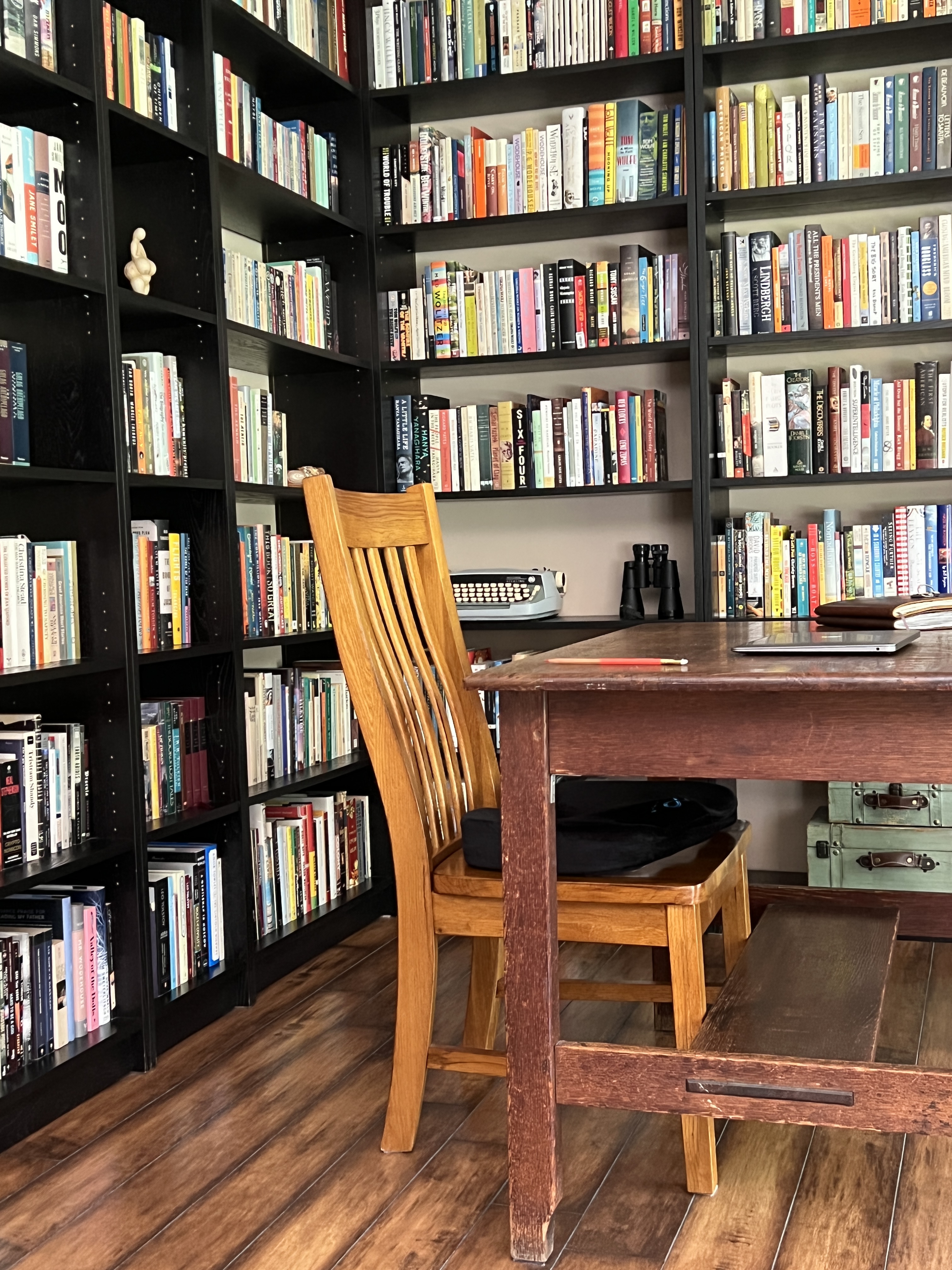
Last weekend, we traveled to Michigan to visit our daughters. We also added one more bookcase to the annex, resulting in what my older daughter has dubbed, a “book-sort-cation” — that is, shifting, dusting, and reorganizing the library to make the best use of the space. So, yes, I did fall a wee bit behind on my reading schedule, but I am now completely caught up. (The courses and groups are listed in the sidebar.)

The recommended text for “Reading the Odyssey” (which begins this week) is the Emily Wilson translation. Others have already praised it (here, here, here), but allow me to add my voice to the chorus: What a lucid and riveting rendition.

“Truths so appealing and entertaining…”

Because I am also studying Moby-Dick this semester, I appreciated Harold Bloom’s assertion (see introduction to the Edith Grossman translation) that “Melville blended Don Quixote and Hamlet in Captain Ahab (with a touch of Milton’s Satan added for seasoning).” Returning to a book again and again (and again), as I have Moby-Dick, creates a familiar, well-creased mental map. With this, a reader can travel along the accustomed channels or more easily attempt new routes (meanings, metaphors, implications, associations, links to other works, etc.). On my current voyage through Moby-Dick, for example, I have been navigating ideas about how Melville (perhaps as Ishmael, perhaps as the story’s creator) shapes the narrative and what, precisely, we readers are meant to understand as truth in that narrative. Oh, how I wish I had something even approaching that level of familiarity with Don Quixote because Cervantes is also clearly experimenting (perhaps we can even say, playing?) with narrative structure and truth, but I have only the barest outline of a mental map by which to chart my course through this vast novel.

In last week’s tutorial meeting, we discussed Cervantes’ (playful? deceptive? ironic?) intent in the prologue and dedication and touched on the idea of the novel as a “found” history. In Chapters XI through XXI of Part I, readers encounter a number of other approaches to storytelling, including Quixote’s “long harangue” to the goatherds; Antonio’s ballad; Pedro’s account of Grisóstomo and Marcela; the verses of the deceased shepherd; Sancho Panza’s deceptive explanation of his and Don Quixote’s injuries; a reference to the history of the deeds of Don Quixote penned by “the wise man whose task it will be to write” it; Sancho’s “best of all stories” (which, “[a]s finished as his mother,” ends abruptly); the confessions of the prisoners; and the pawned autobiography of Ginés (a narrative of “truths so appealing and entertaining that no lies can equal them”). This variety surely represents more than simple diversion; what is its meaning and purpose?

I wonder, too, if, as with Melville’s sprawling novel (which also employs a variety of narrative forms, from sermon to soliloquy to taxonomy to stage play to sailor’s yarn and more), the varied structure is related to an underlying assertion about the role of truth in storytelling; or do I have that inverted? Is it, rather, an indication that storytelling undergirds truth? In the Grossman translation, I am struck by the repetition of the words “truth” (at least twenty-one in this week’s reading) and “true” (at least nineteen). In fact, Bloom’s introduction opens with the query, “What is the true object of Don Quixote’s quest?” I might parry, What is Don Quixote’s truth? Alternately, What do “true” and “truth” mean to the Knight of the Sorrowful Face? (I have, as I reread Moby-Dick, similarly asked, What is Ahab’s truth? How does it differ from Ishmael’s, the crew’s, and the author’s?) When I concluded this week’s Don Quixote chapters, I affixed two questions like pins to my as-yet faint mental map: Why do the novel’s assorted storytellers insist on the veracity of each narrative? More philosophically, why, when we storytelling animals narrate, do we claim to have proffered the truth?

Four passages particularly speak to the ideas above:

“Since everything I’ve told you is the absolute truth, I take it for granted that what our lad said about what people were saying about the reason for Grisóstomo’s death is also true.” (p. 85)

“I didn’t know her,” responded Sancho. “But the man who told me this story said it was so true and correct that I certainly could, when I told it to somebody else, affirm and swear I had seen it all….” (p. 145)

“… [W]asn’t it laughable how frightened we were, and wouldn’t it make a good story? At least, how frightened I was, for I already know that your grace doesn’t know what fright is or understand the meaning of fear or terror.”

“I do not deny,” responded Don Quixote, “that what happened to us is deserving of laughter, but it does not deserve to be told, for not all persons are wise enough to put things in their proper place.” (p. 151)

“It’s so good,” responded Ginés, “that it’s too bad for Lazarillo de Tormes and all the other books of that genre that have been or will be written. What I can tell your grace is that it deals with truths, and they are truths so appealing and entertaining that no lies can equal them.” (p. 169)

The year in books

AE5F0F0D-FCBC-4AC5-8FC6-249C04896317The year opened with the usual goal: read 100 books from my shelves (i.e., books in my collection before the end of 2021), including at least 24 non-fiction titles and at least one book from each of the following categories: Shakespeare (about or retold), poetry, NYRB, Kurt Vonnegut (by or about), Joyce Carol Oates, philosophy, art, and children’s / YA. As it turns out, I read 139 books in 2022, of which 76 were from the shelves. Of those read from the shelves, nineteen were non-fiction titles; and while I met the poetry, NYRB, philosophy, and art challenges, I missed Shakespeare, Vonnegut, Oates, and children’s / YA.

Still. It was a pretty spectacular year of reading, one that included (finally) the bible. Here are some of the other projects, courses, and groups that shaped my reading year.

With the Cardiff BookTalk, I read:
A Clockwork Orange (Anthony Burgess; 1962. Fiction.)
The Waste Land (Norton Critical Edition) (T.S. Eliot. 1922. Poetry.)

The 100 Days of Dante relaunched this year, but I participated in the first cycle, which began in 2021 and continued into 2022. In addition to Purgatorio and Paradiso, I read two related books (marked with asterisks):
Purgatorio (Dante Alighieri; 1320. (Trans. Robin Kirkpatrick; 2008.) Poetry.)
Paradiso (Dante Alighieri; 1320. (Trans. Robin Kirkpatrick; 2008.) Poetry.)
Dante’s Divine Comedy (Seymour Chwast; 2010. Graphic fiction.)
Dante (R.W.B. Lewis; 2001. Non-Fiction.) RFS

For two Guardian Live events:
Twelve Caesars: Images of Power from the Ancient World to the Modern (Mary Beard; 2021. Non-fiction.)
The Essex Serpent (Sarah Perry; 2016. Fiction.)

With A Public Space / APS Together:
Childhood (Tove Ditlevsen; 1967/2021. Fiction.)
Youth (Tove Ditlevsen; 1967/2021. Fiction.)
Dependence (Tove Ditlevsen; 1971/2021. Fiction.)
Moby-Dick; or, The Whale (Herman Melville; 1851. Fiction.)
Cane (Jean Toomer. 1923. Fiction.)
W-3: A Memoir (Bette Howland; 1974. Non-fiction.)
Villette (Charlotte Brontë; 1853. Fiction.)

For three Night School Bar courses:
Debt: The First 5,000 Years (David Graeber; 2011. Non-fiction.)
Caliban and the Witch: Women, the Body, and Primitive Accumulation (Silvia Federici; 2004. Non-fiction.)
Capital Realism (Mark Fisher; 2009. Non-fiction.)

For a Newberry Library course:
The Emigrants (W.G. Sebald; 1992/1996. Fiction.)
The Rings of Saturn (W.G. Sebald; 1995/1998. Fiction.)
Austerlitz (W.G. Sebald; 2001. Fiction.)
Speak, Silence: In Search of W.G. Sebald (Carole Angier; 2022. Non-fiction.)

With Catherine Project reading groups (supplementary texts are marked with asterisks):
Anna Karenina (Leo Tolstoy; 1878. (Trans. Richard Pevear and Larissa Volokhonsky.) Fiction.)
Apology (Plato; 399 BC. (Trans. G.M.A. Grube; 2002.) Non-fiction.)
Moby-Dick; or, The Whale (Herman Melville; 1851. Fiction.)
The Sun Also Rises (Ernest Hemingway. 1926. Fiction.)
The Old Man and the Sea (Ernest Hemingway; 1952. Fiction.)
A Farewell to Arms (Ernest Hemingway. 1929. Fiction.)
On the Origin of Species (Charles Darwin. 1859. Non-fiction.)
* Charles Darwin’s On the Origin of Species (Sabina Radeva; 2019. Graphic non-fiction.)
* The Tree of Life (Peter Sís; 2003. Graphic non-fiction.)
* Darwin: Portrait of a Genius (Paul Johnson; 2012. Non-fiction.)
* Charles Darwin’s On the Origin of Species: A Graphic Adaptation (Michael Keller. 2009. Graphic non-fiction.)
A Good Man Is Hard to Find (Flannery O’Connor; 1953. Fiction.)
Everything That Rises Must Converge (Flannery O’Connor; 1965. Fiction.)

Several readers in the Hemingway group decided to continue reading together:
A Moveable Feast (Ernest Hemingway; 1964. Non-fiction.)
For Whom the Bell Tolls (Ernest Hemingway. 1940. Fiction.)
East of Eden (John Steinbeck. 1952. Fiction.)
Fathers and Sons (Ivan Turgenev (Trans. Constance Garnett); 1862. Fiction.)

And three of us in that group decided to meet, too:
The Pearl (John Steinbeck. 1947. Fiction.)
Lolita (Vladimir Nabokov; 1955. Fiction.)

With the UCSC Deep Read:
Transcendent Kingdom (Yaa Gyasi; 2020. Fiction.)

With The Readers Karamazov:
The Name of the Rose (Umberto Eco; 1980. Fiction.)
* The Key to The Name of the Rose (Adele J. Haft, et al.; 1987/1999. Non-Fiction.)
A Canticle for Leibowitz (Walter M. Miller; 1959. Fiction.)
The Sign of Four (Sir Arthur Conan Doyle; 1890. Fiction.)
A Confederacy of Dunces (John Kennedy Toole. 1981. Fiction.)

For a course with the Premise Institute:
The Metamorphosis (Franz Kafka; 1915. (Trans. Ian Johnston.) Fiction.)
The Metamorphosis (Franz Kafka; 1915. (Trans. Susan Bernofsky.) Fiction.)
The Diving Bell and the Butterfly (Jean-Dominique Bauby; 1997. Non-fiction.)
The Bell Jar (Sylvia Plath. 1963. Fiction.)
Nausea (Jean Paul Sarte. 1938. Fiction.)
Lost Connections: Why You’re Depressed and How to Find Hope (Johann Hari; 2018. Non-fiction.)

In advance of a Theater of War event:
The Suppliants (Aeschylus; 460 BC. Drama.)

In November, I deleted my Twitter account, but I certainly miss the reading groups with whom I read:
Europe Central (William T. Vollmann. 2005. Fiction.)
A Mapmaker’s Dream (James Cowan. 1996. Fiction.)
A Lost Lady (Willa Cather. 1923. Fiction.)
Infinite Jest (David Foster Wallace. 1996. Fiction.)
Zeno’s Conscience (Italo Svevo; 1923. Fiction.)

With the T Book Club:
Desperate Characters (Paula Fox; 1970. Fiction.)
Specimen Days (Michael Cunningham; 2005. Fiction.)

With the SciFri Book Club:
Upgrade (Blake Crouch. 2022. Fiction.)

Looking ahead, this winter, I’m taking classes with the University of Chicago Graham School, the Brooklyn Institute for Social Research, and Night School Bar. The Premise Course in which I’m enrolled will meet once in January and conclude in February. I’m hoping to participate in a Catherine Project tutorial beginning later this month, and the band of merry readers who remained following Hemingway (and Steinbeck and Turgenev) is tackling Crime and Punishment over the next few months. If I manage to keep up with these exciting pursuits, I’d like to participate in the February SciFri Book Club. More another time.